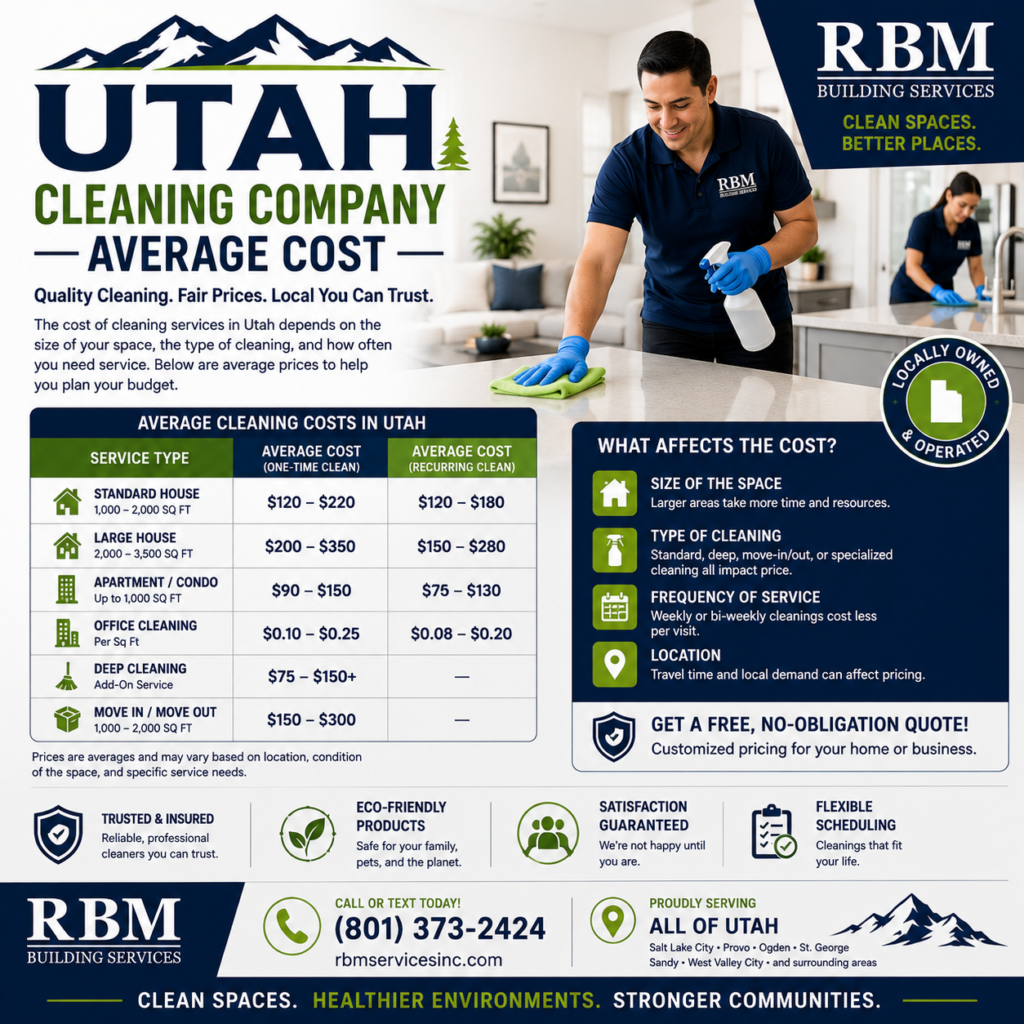
The average cost of a Utah cleaning company depends on much more than the number of bedrooms or the square footage of a property. The service type, home condition, frequency, number of bathrooms, presence of pets, level of detail, specialty surfaces, access, and deadline all affect the final price. As a practical benchmark, current market data places Utah’s average starting rate for house cleaning at about $19.33 per hour, while the Salt Lake City starting average is about $20.65 per hour; however, a professional company’s actual appointment price may be higher because it includes business overhead, supplies, equipment, scheduling, insurance, travel, quality control, and trained labor.
The most important takeaway is to compare cleaning quotes by scope, not by a single advertised number. A $120 cleaning and a $220 cleaning may sound comparable, but they can involve completely different levels of work, time, staffing, supplies, and included tasks. This guide explains Utah house-cleaning costs, the factors behind pricing, how to avoid surprise charges, what common service types cost, and how to choose a provider that offers genuine value. For a clear quote tailored to your property, contact RBM Services at (801) 373-2424.

What Is Utah Cleaning Company Average Cost?
“Utah cleaning company average cost” refers to the typical amount a customer pays for professional cleaning services in Utah. It may describe hourly rates, flat-rate visits, per-room pricing, recurring-cleaning prices, deep-cleaning estimates, move-in or move-out cleaning fees, or specialty cleaning costs such as carpet, upholstery, tile, and grout cleaning.
There is no single statewide cleaning price that applies to every home or business. A small, regularly maintained one-bedroom apartment may take far less time than a large family home with multiple bathrooms, pets, extensive hard-water buildup, and overdue deep cleaning. Likewise, a recurring house-cleaning visit is usually priced differently from a one-time deep clean, a move-out clean, or a specialized carpet-cleaning appointment.
Who Uses Cleaning-Cost Information?
The main readers researching Utah cleaning company prices usually include:
- Homeowners comparing recurring or one-time house-cleaning options
- Renters preparing for a move-out inspection
- Landlords and property managers planning turnover cleaning
- Families with busy schedules, children, pets, or high-traffic homes
- Home sellers preparing a property for showings or listing photos
- Business owners comparing office and commercial cleaning proposals
- Customers who need carpet, upholstery, tile, or deep-cleaning services
- People trying to understand why one cleaning quote is much higher or lower than another
Common Utah Cleaning Price Structures
Cleaning companies may use one or more of these approaches:
| Pricing model | How it works | Best for | Watch for |
| Hourly pricing | Customer pays for labor time, sometimes per cleaner | Unpredictable jobs or customizable cleaning lists | Ask whether the rate is per cleaner or per team |
| Flat-rate pricing | Company quotes a set price for a defined scope | Routine house cleaning and clear task lists | Confirm exactly what the flat rate includes |
| Per-room or per-bedroom pricing | Price is based partly on rooms, bedrooms, or bathrooms | Smaller homes and standardized service packages | Room count alone may not reflect actual condition |
| Square-foot pricing | Price is based on property size | Large homes, offices, and commercial properties | Condition and task complexity still matter |
| Recurring-service pricing | Reduced per-visit rate for weekly, biweekly, or monthly work | Customers who want ongoing upkeep | Deep cleaning may be needed before maintenance pricing applies |
| Add-on pricing | Specialty tasks are priced separately | Carpet, appliances, blinds, grout, pet treatment, or inside cabinets | Ask about add-ons before booking |
The proper quote should reflect the job—not just the address. A cleaning company should ask questions, explain assumptions, and provide a clear scope before beginning work.
8 Factors That Affect Utah Cleaning Company Average Cost
1. The Type of Cleaning Service Changes the Price
The biggest pricing factor is the type of service requested. A basic recurring clean is generally less expensive than a deep clean because the home is expected to be maintained between appointments. A deep clean takes more labor because it addresses buildup, neglected areas, and detail tasks that are not included in routine housekeeping.
Common service categories include:
- Routine or recurring house cleaning
- One-time standard cleaning
- Deep cleaning
- Move-in cleaning
- Move-out cleaning
- Post-event cleaning
- Apartment cleaning
- Office or commercial janitorial cleaning
- Carpet cleaning
- Upholstery cleaning
- Tile and grout cleaning
- Pet-odor or spot-treatment work
National 2026 market estimates commonly place a standard house-cleaning visit in the range of $100 to $300, while deep cleaning is often estimated at approximately $200 to $450. These are broad reference ranges rather than guaranteed Utah prices; local costs vary by property and scope.
For example, a customer who needs bathrooms cleaned, kitchen surfaces wiped, floors vacuumed and mopped, and light dusting may need a maintenance appointment. A customer who needs heavy shower buildup removed, baseboards cleaned, cabinet fronts detailed, appliances cleaned, and neglected floors addressed likely needs a deep-cleaning estimate.
The best way to manage cost is to request the service that matches the condition of the property. Booking a low-cost standard visit for a deep-cleaning problem often leads to frustration, reduced results, or additional charges.
2. Home Size Matters, but Bathrooms Matter More Than Many People Expect
Square footage is useful, but it is not always the strongest predictor of labor. Bathrooms and kitchens are usually more time-intensive than bedrooms, hallways, and low-use spaces because they involve water spots, soap residue, grease, fixtures, toilets, tubs, showers, sinks, countertops, and more detailed surface work.
A large but lightly used home with two bathrooms may require less labor than a smaller home with four bathrooms, several children, pets, and a heavily used kitchen. That is why professional cleaning estimates often ask for:
- Number of bedrooms
- Number of bathrooms
- Approximate square footage
- Number of stories
- Finished basement or additional living areas
- Home layout and accessibility
- Frequency of service
- Number of occupants and pets
- Whether the property is vacant, furnished, or occupied
Consider two homes of the same size. One is a 2,000-square-foot home with two adults, one bathroom, minimal clutter, and regular upkeep. The other is a 2,000-square-foot home with four bathrooms, three children, pets, carpeted stairs, a finished basement, and significant kitchen buildup. The second property is likely to require substantially more cleaning time.
Customers can help receive a more accurate estimate by describing the property fully. Understating bathroom count, excluding the basement, or failing to mention a heavily soiled kitchen may produce a quote that does not match the actual work required.
3. A One-Time Deep Clean Usually Costs More Than Recurring Cleaning
Recurring cleaning is often more efficient because the cleaning team becomes familiar with the property, the home receives regular maintenance, and buildup is less likely to become severe. That efficiency may allow a lower per-visit price than a one-time appointment.
A deep clean costs more because the provider must bring the home to a baseline condition. That may involve extra labor for hard-water buildup, soap scum, greasy kitchen surfaces, baseboards, door frames, cabinet fronts, blinds, detailed vacuuming, and areas missed during normal housekeeping.
This does not mean customers should avoid deep cleaning. It can be the best value when a home needs a reset. The important point is to understand that a deep clean is a labor-intensive service, not simply a routine cleaning with a different label.
Typical reasons to choose a deep clean include:
- Starting service with a new cleaning company
- Preparing for holidays, visitors, or an event
- Cleaning after a busy or stressful season
- Preparing a home for sale or listing photos
- Managing a rental turnover
- Addressing accumulated pet hair, dust, residue, or buildup
- Cleaning after construction, remodeling, or repairs
A practical strategy is to schedule a detailed initial clean and then maintain the result with recurring service. This can provide better ongoing value than repeatedly booking emergency-level cleaning after conditions become overwhelming.
4. Frequency Affects Per-Visit Cost and Total Annual Spending
Cleaning frequency affects pricing in two different ways: the cost of each visit and the total spent over a year. Weekly or biweekly visits often carry a lower per-visit rate than one-time or infrequent cleanings because the home is maintained more consistently. However, more frequent appointments naturally increase the total annual investment.
A family should choose frequency based on actual needs rather than selecting the cheapest individual appointment.
Weekly cleaning may make sense for:
- Larger families
- Homes with multiple pets
- Households with young children
- People who entertain frequently
- Busy professionals with limited cleaning time
- Homes with several bathrooms
- Customers who value consistently guest-ready spaces
Biweekly cleaning is often a practical middle ground. It allows a professional to handle regular bathroom, kitchen, floor, dusting, and maintenance work while the household manages light upkeep between visits.
Monthly cleaning can work for smaller households, lower-traffic homes, or customers who complete most weekly tasks themselves but want professional help with deeper routine maintenance.
One-time cleaning can be appropriate for specific needs, but waiting too long between appointments can increase the labor required when service is eventually scheduled. The result is often a higher one-time deep-cleaning bill.
The most cost-effective plan is not necessarily the least frequent plan. It is the schedule that keeps the home at a manageable level without forcing the customer into repeated catch-up cleaning.
5. Condition, Clutter, and Buildup Affect Labor Time
Cleaning estimates often assume that surfaces and floors are reasonably accessible. When a home has significant clutter, heavy buildup, excessive pet hair, sticky residue, smoke film, hard-water deposits, or neglected bathrooms and kitchens, the job requires more labor and may cost more.
It is helpful to distinguish among three different conditions:
- Normal use: Ordinary dust, bathroom use, kitchen crumbs, light floor soil, and routine household mess
- Heavy soil or buildup: Grease, soap scum, mineral deposits, excess dust, hair accumulation, sticky residue, or overdue cleaning
- Damage or specialized contamination: Mold concerns, sewage, biohazards, pest contamination, severe smoke damage, construction debris, or water damage
Normal use is usually covered by standard or recurring cleaning. Heavy buildup may require deep-cleaning time or add-on labor. Damage or hazardous conditions may require services outside a standard house-cleaning scope.
Customers should not feel embarrassed about describing the home’s condition honestly. Accurate information helps the company quote properly and arrive prepared. It is far better to discuss heavy buildup before the appointment than to discover midway through the visit that the job requires more time than scheduled.
A useful rule: cleaning teams can clean more effectively when they can reach surfaces. Clearing personal paperwork, laundry, toys, small objects, dishes, and valuables before service can reduce unnecessary labor time and help customers receive better value.
6. Pets, Stains, and Specialty Concerns Can Increase Cost
Pets add comfort and personality to a home, but they can also add cleaning work. Pet hair, tracked-in soil, dander, food spills, accidents, odors, and heavily used pet areas may require extra time or specialty services.
A routine cleaning team can help maintain floors and visible pet hair, but some issues require a more targeted solution. Carpet odor, urine contamination, embedded hair in upholstery, and old stains may need carpet cleaning, upholstery cleaning, spot treatment, or odor treatment rather than ordinary housekeeping.
Other specialty concerns that can affect the cleaning quote include:
- Heavy hard-water buildup on showers, glass, and fixtures
- Grease accumulation on kitchen surfaces
- Mold-related concerns or persistent moisture
- High ceilings, tall windows, or difficult access
- Post-construction dust
- Inside ovens, refrigerators, cabinets, and drawers
- Blinds, window tracks, and detailed trim work
- Tile and grout buildup
- Upholstery and mattress cleaning
- Severe stains or odor concerns
Not every concern requires an extra fee, but every concern should be disclosed. The provider can then explain whether it is included, requires additional labor, needs a specialty service, or may have limited results due to permanent damage.
For example, professional carpet cleaning may improve embedded soil and many stains, but it cannot restore dye removed by bleach, repair burns, reverse worn carpet fibers, or eliminate every odor source beneath a floor covering.
7. Labor, Equipment, Insurance, and Business Costs Are Part of the Price
Customers sometimes compare a professional cleaning-company quote with a single worker’s hourly rate and assume the company is overpriced. In reality, a company’s service price must cover more than the cleaner’s take-home pay.
A professional cleaning company may need to account for:
- Employee wages or contractor costs
- Payroll obligations and employee benefits where applicable
- Training and supervision
- Cleaning supplies and replacement products
- Vacuums, extractors, tools, and maintenance
- Vehicle, fuel, travel, and equipment transportation
- General liability insurance and other business protections
- Scheduling, communication, estimates, invoicing, and customer service
- Taxes, licensing, registration, and administrative expenses
- Time spent between jobs, loading equipment, and quality control
Labor-market information also helps explain why cleaning prices cannot be reduced indefinitely without affecting sustainability. Care.com’s August 2026 market data lists average starting house-cleaning rates of about $19.33 per hour across Utah and $20.65 per hour in Salt Lake City. These figures are not a complete quote for a fully insured cleaning company, but they show that labor is a real and meaningful part of the customer’s final price.
The best question is not, “Why does this cost more?” It is, “What level of labor, reliability, supplies, equipment, safety, and service am I receiving for this price?”
8. Taxes, Add-Ons, and Quote Assumptions Can Change the Final Invoice
A professional estimate should identify whether the price is flat, hourly, preliminary, or subject to condition-based changes. Customers should also ask about sales tax, specialty services, travel charges, minimum service fees, cancellation terms, and add-ons.
Utah sales-tax rules distinguish between cleaning tangible personal property and cleaning real property. The Utah State Tax Commission explains that labor to clean tangible personal property can be taxable, while the treatment of services related to real property differs. For example, cleaning a home’s installed surfaces may be treated differently from cleaning removable items or personal property. Tax treatment can depend on the facts of the service and current state guidance.
Possible invoice items to clarify include:
- Standard or deep-cleaning level
- Bedrooms, bathrooms, basement, and additional rooms
- Interior oven or refrigerator cleaning
- Inside cabinets or drawers
- Blinds, window tracks, and baseboards
- Carpet, upholstery, tile, or grout cleaning
- Pet-hair, stain, odor, or excessive-soil treatment
- Furniture moving
- Same-day, weekend, after-hours, or rush service
- Supplies and equipment fees, if any
- Applicable sales tax
- Parking, travel, or access-related charges, if applicable
Clear questions before booking are not difficult or confrontational. They are simply good planning. RBM Services can review the job requirements and explain what is included before work begins.
Utah Cleaning Company Price Ranges by Service
The following figures are planning ranges, not promises or binding rates. The actual price for a Utah cleaning company depends on property size, condition, location, scope, frequency, accessibility, and requested specialty work.
| Service | Typical planning range | What commonly affects the final price |
| Standard recurring house cleaning | $100–$300 per visit | Home size, bathroom count, frequency, pets, and tasks included |
| One-time standard cleaning | $120–$350+ | Condition, number of rooms, cleaning checklist, and time required |
| Deep house cleaning | $200–$450+ | Buildup, baseboards, detailed kitchen and bathroom work, appliances, and extra labor |
| Move-in or move-out cleaning | $200–$500+ | Vacancy, home size, appliance interiors, cabinets, property condition, and deadlines |
| Apartment cleaning | $90–$250+ | Unit size, bathrooms, condition, and whether it is a standard or move-out clean |
| Carpet cleaning | Varies by rooms, area, soil level, and treatment | Stairs, pet treatment, stain work, odor concerns, and furniture moving |
| Upholstery cleaning | Varies by item and fabric | Sofa size, fabric type, soil level, pet hair, stains, and drying considerations |
| Tile and grout cleaning | Varies by square footage and condition | Soil level, grout condition, room size, sealing needs, and access |
| Commercial cleaning | Usually quoted individually | Building size, traffic, schedule, restrooms, supplies, security, and service frequency |
National cost guides often cite approximately $100 to $300 for a standard home-cleaning visit and approximately $200 to $450 for a deep clean. Those figures are useful for broad planning, but a Utah-specific quote should be based on the actual property.
The Real Cost of Getting Cleaning Pricing Wrong
The cost of misunderstanding a cleaning quote can go well beyond paying more than expected.
Financial Costs
A vague estimate can produce surprise charges, repeated appointments, or payment for tasks that were assumed but not included. Choosing an unrealistically low quote may also result in incomplete work, requiring a second service provider or substantial do-it-yourself labor afterward.
Poor cleaning practices can create replacement costs. Excess moisture, the wrong chemical, abrasive products, or unsuitable methods may harm carpet, upholstery, natural stone, flooring, fixtures, cabinets, or finishes.
Time Costs
When customers book the wrong service level, they may lose time rescheduling, supervising additional visits, preparing the home again, or completing missed work themselves. This is especially stressful before a move, inspection, event, home showing, holiday gathering, or tenant turnover.
Emotional Costs
A home that feels unmanageable can create ongoing stress. Household members may disagree about chores, avoid inviting guests over, or spend valuable weekends trying to catch up. A clear cleaning plan can reduce that pressure and give families more predictable time.
Long-Term Costs
Deferring cleaning until buildup is severe often leads to more expensive deep cleaning later. Routine maintenance is generally easier than restoration-style catch-up work. Most of these costs are avoidable when customers select the appropriate service level, share accurate property details, and receive a clear scope before scheduling.
How RBM Services Helps You Budget for Cleaning
RBM Services helps customers understand what their home or property needs before committing to a cleaning plan. An experienced provider should not treat every home as identical. Instead, the cleaning approach should reflect room count, bathrooms, property condition, frequency, pets, priority areas, specialty surfaces, and desired outcome.
RBM Services can help with:
- Routine house cleaning and ongoing maintenance schedules
- One-time deep cleaning
- Move-in and move-out cleaning
- Carpet cleaning and stain-related concerns
- Upholstery, tile, grout, and floor-cleaning needs
- Residential and commercial cleaning planning
- Clear discussions about service scope, timing, and practical expectations
A professional provider also helps reduce risk. That includes using appropriate products, protecting surfaces, managing moisture, identifying pre-existing damage, and explaining whether a condition requires cleaning, repair, restoration, or another type of specialist.
When customers understand the scope upfront, they can budget more accurately and avoid paying for work that does not match their goals. For a tailored Utah cleaning estimate, contact RBM Services at (801) 373-2424.
Strategies for Managing Your Cleaning Budget
Choose Recurring Cleaning for Ongoing Maintenance
Recurring service works by maintaining the home before dirt and buildup become difficult to remove. It is most appropriate for households that want regular help with bathrooms, kitchens, floors, dusting, and high-use areas.
Its main drawback is the ongoing expense. However, the per-visit rate may be more favorable than repeated one-time deep cleanings, and customers usually spend less personal time catching up on chores.
Schedule a Deep Clean Before Recurring Service
A deep clean establishes a cleaner baseline. It is appropriate when the home has been neglected, when a new provider is starting, after a move, before a major event, or when kitchens and bathrooms need more detailed work.
Its drawback is the higher initial cost. Still, it can be a smart investment if it makes future recurring visits more efficient and effective.
Prioritize High-Impact Areas
A limited budget does not always require postponing service completely. Customers can ask the provider to prioritize kitchens, bathrooms, entryways, floors, or guest-facing spaces first.
The limitation is that other areas may remain unaddressed. This approach works best when the customer understands that a focused cleaning is not the same as a whole-home deep clean.
Combine General and Specialty Cleaning Intentionally
Routine housekeeping, carpet cleaning, upholstery cleaning, and tile-and-grout cleaning have different purposes. Combining services may improve the overall result when appropriate, especially before a move, holiday, event, or home listing.
The limitation is that specialty services add cost and may require separate scheduling. Ask RBM Services which services should be completed together and which are better handled separately.
Prepare the Home Before Service
Customers can improve value by removing clutter, securing pets, identifying priorities, and ensuring access to the spaces being cleaned. This helps the cleaning team spend more time on actual cleaning rather than moving items, waiting for access, or working around avoidable obstacles.
The limitation is that preparation requires customer time. For many households, however, a few minutes of preparation can protect the value of a paid cleaning appointment.
What to Do If You Are Comparing Utah Cleaning Prices
- Define the type of service you need: routine, deep, move-in, move-out, carpet, upholstery, tile, or commercial cleaning.
- List the rooms and priorities, including bathrooms, kitchens, basements, stairs, appliances, and high-traffic areas.
- Describe the home honestly, including pets, hard-water buildup, heavy soil, odors, clutter, stains, or deadlines.
- Ask whether the quote is hourly, per cleaner, flat rate, or based on a specific checklist.
- Confirm whether the estimate includes supplies, equipment, travel, tax where applicable, and specialty treatments.
- Ask what may create additional charges before the team arrives.
- Compare written scopes rather than comparing price alone.
- Ask about recurring-service options if you expect ongoing cleaning needs.
- Remove personal clutter and valuables before the appointment so the cleaning team can work efficiently.
- Contact RBM Services at (801) 373-2424 for a clear discussion of your Utah cleaning needs and an estimate based on the actual scope.
How to Choose the Right Utah Cleaning Company
Use this checklist when comparing providers:
- Relevant experience: Choose a company experienced with the type of cleaning you need, whether that is routine house cleaning, deep cleaning, move-out work, carpet cleaning, or commercial service.
- Clear quote structure: Ask whether pricing is hourly, flat-rate, per room, per square foot, or based on a customized scope.
- Written scope: Confirm tasks, rooms, exclusions, add-ons, and conditions that could affect the final price.
- Plain-English answers: The company should explain pricing and expected results without evasive language.
- Realistic expectations: A dependable provider distinguishes removable soil from permanent damage and does not guarantee results that cannot reasonably be delivered.
- Availability and communication: Look for clear scheduling, prompt responses, and a process for handling changes or concerns.
- Comprehensive assessment: The company should ask about bathrooms, pets, home condition, access, special surfaces, and cleaning priorities.
- Long-term planning: A good provider helps you decide whether recurring cleaning, a deep clean, or specialty service makes the most financial sense.
For professional, practical guidance on cleaning costs and service options, contact RBM Services at (801) 373-2424.
Common Mistakes People Make About Cleaning Costs
- Comparing quotes without comparing scope: A lower price may include fewer rooms, less time, fewer tasks, or no specialty work.
- Booking a standard clean for a deep-cleaning job: Heavy buildup and neglected areas require additional labor.
- Assuming price is based only on square footage: Bathrooms, kitchens, pets, stairs, clutter, and condition may matter more.
- Not disclosing pets, stains, odors, or hard-water buildup: Surprises at the appointment can change the time and price needed.
- Ignoring add-on pricing: Appliances, blinds, carpet cleaning, tile work, and inside cabinets are often separate services.
- Choosing the least expensive option without reviewing protections: Reliable scheduling, supplies, insurance, training, and communication have real value.
- Waiting until the property is overwhelming: Deferred cleaning often turns affordable maintenance into an expensive catch-up project.
- Assuming every surface problem is cleanable: Permanent stains, wear, etching, and damage may need repair rather than cleaning.
Key Rules, Laws, and Standards
Utah cleaning prices and services may be affected by several practical rules and frameworks:
- Utah sales and use tax: Utah taxes certain services, including labor to clean tangible personal property. The treatment of cleaning related to real property can differ, so invoices should reflect the actual service provided.
- Consumer protection: Utah’s Division of Consumer Protection provides education and enforcement related to consumer transactions and can receive consumer complaints when needed.
- Business registration: Utah businesses may register with the state through the Division of Corporations and Commercial Code. Customers may use official state resources as part of their due diligence when researching a provider.
- Workplace chemical safety: Cleaning companies that use hazardous chemicals in the workplace may need to meet OSHA Hazard Communication requirements for labels, safety data sheets, and worker training.
- Specialty cleaning standards: Carpet, upholstery, and restoration professionals may follow ANSI/IICRC standards for recognized best practices in cleaning and inspection.
Disclaimer: This article is for general educational and budgeting purposes only. It is not a quote, contract, legal opinion, tax opinion, safety assessment, or guarantee of pricing or results. Cleaning rates, tax treatment, service availability, property conditions, local requirements, and customer needs vary. Contact RBM Services for a quote based on your actual cleaning requirements, and consult qualified legal, tax, or regulatory professionals for advice about your specific situation.
Conclusion
The average cost of a Utah cleaning company is best understood as a range shaped by the work itself. Service type, property size, number of bathrooms, home condition, pets, cleaning frequency, specialty tasks, and the clarity of the scope all affect the final price. The smartest customers compare what is included, not simply which number is lowest.
Most surprise costs and disappointing results are avoidable. Start by identifying whether you need recurring service, a one-time clean, a deep clean, move-related cleaning, or specialty work. Describe the property honestly, ask for a written scope, clarify potential add-ons, and select a provider that communicates clearly about pricing and realistic outcomes.
For a straightforward discussion of Utah cleaning company costs and a service plan tailored to your home or property, contact RBM Services at (801) 373-2424.