Shopping mall cleaning requires coordinating janitorial services across common areas, tenant spaces, and shared facilities. This guide covers cleaning schedules for food courts, restrooms, corridors, parking structures, and event spaces in regional malls and shopping centers.
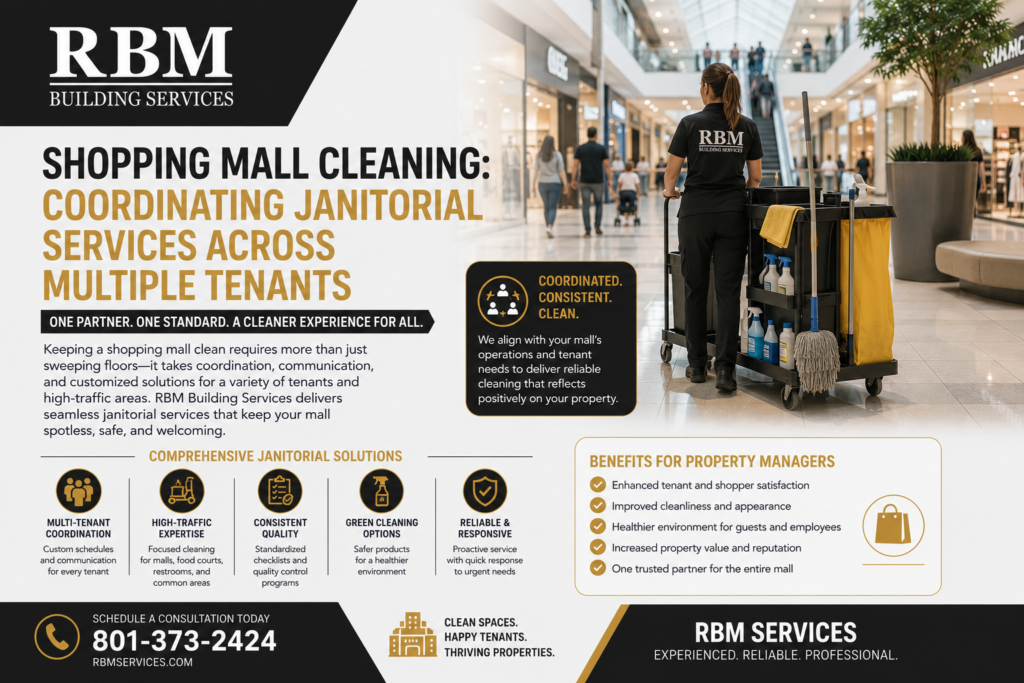
Shopping mall cleaning presents unique challenges that are not found in other commercial facilities. Regional malls and shopping centers can encompass 500,000 to over 2 million square feet of space, with dozens or hundreds of tenants, multiple levels, food courts, entertainment venues, and extensive parking structures. The cleaning program must balance the needs of the mall owner, individual tenants, and the shopping public — all while operating during mall hours that typically span 10-12 hours per day, 7 days per week. Mall cleaning requires careful coordination between the property management team and the cleaning contractor to ensure that common areas are maintained to a high standard, tenant spaces are cleaned according to lease requirements, and the shopping environment remains attractive and safe for visitors. This guide covers the key elements of a successful shopping mall cleaning program.
The financial stakes for mall cleaning are significant. The International Council of Shopping Centers (ICSC) reports that mall cleanliness is the third most important factor in customer satisfaction, behind only merchandise selection and pricing. Clean malls attract more visitors, longer dwell times, and higher sales per visitor. For mall owners, common area maintenance (CAM) charges — which include cleaning costs — are a primary source of revenue recovery. CAM charges typically range from $8-$15 per square foot annually for regional malls, with cleaning representing approximately 15-25% of total CAM charges. An efficient cleaning program that maintains high standards while controlling costs directly impacts both tenant satisfaction and the mall’s financial performance. See our retail cleaning services for mall cleaning programs.

Coordinating Mall Cleaning Across Tenants
Common areas in shopping malls include corridors and walkways, atriums and gathering spaces, entrances and exits, seating areas, and directory and information kiosks. These areas are the “face” of the mall and must be maintained to the highest standard at all times during operating hours. Common area floors require daily vacuuming or sweeping of all hard surface and carpeted areas, daily damp mopping of high-traffic areas, and periodic deep cleaning including machine scrubbing of hard floors and hot water extraction of carpet. Depending on traffic levels, hard floors in mall common areas may need spray buffing or burnishing daily or weekly, with complete strip and refinish annually or bi-annually. Mall corridors and walkways should be cleaned during off-hours (before the mall opens or after closing) to minimize disruption to shoppers and tenants. However, spill cleanup and spot cleaning must be performed immediately during operating hours.
Entrance areas require the most frequent attention because they are the first impression for visitors and receive the highest concentration of foot traffic. Mall entrances should be swept or vacuumed continuously during operating hours (or at least checked and spot-cleaned every 30-60 minutes). Walk-off matting at each entrance should be at least 15-20 feet long to effectively capture moisture and debris. Mats should be vacuumed daily and professionally cleaned weekly. During wet weather, entrance areas may need constant attention to keep floors dry and safe. Mall management should have a written inclement weather cleaning protocol that specifies increased cleaning frequency, additional matting, and wet floor signage requirements.
Common Area Cleaning Standards
Food courts are the most challenging area to clean in any shopping mall. They experience extremely high traffic during lunch and dinner hours, with spills, dropped food, and trash accumulating rapidly. A successful food court cleaning program requires a dedicated cleaning team that is present in the food court during all operating hours. This team should include at least one cleaner whose primary responsibility is table busing and surface cleaning, one or more floor cleaners who sweep and spot mop continuously, and a supervisor who monitors food court conditions and directs cleaning resources as needed. The food court cleaning team should be separate from the general mall cleaning team and should not be pulled away for other tasks during peak hours.
Food court tables and chairs should be cleaned immediately after each party leaves. Cleaning should include wiping the table surface with a food-safe sanitizer, removing any debris from chairs, and sweeping the floor around the table. Trash receptacles in food courts should be checked and emptied at least every 30 minutes during peak hours, and more frequently if needed. Recycling and compost bins should be managed according to the mall’s sustainability program. Food court floors should be swept continuously during operating hours, with spot mopping performed immediately when spills occur. The entire food court floor should be damp mopped after the food court closes each day, with a deep scrub performed weekly. Grease removal from food court floors and surfaces requires specific cleaning products and methods — traditional all-purpose cleaners are not effective for grease removal. Food court cleaning staff should be trained on proper use of degreasers and food-safe sanitizers. For more on specialized cleaning, see our company blog.
Food Court and Dining Area Cleaning
Mall restrooms are the second most important area for customer satisfaction after the food court. Clean restrooms signal that the mall cares about the customer experience, while dirty restrooms can drive shoppers away permanently. Mall restrooms should be inspected at least hourly during operating hours, with a thorough cleaning performed at least twice daily (typically before the mall opens and during the afternoon). High-touch surfaces in restrooms — door handles, stall latches, faucet handles, soap dispensers, paper towel dispensers, and toilet flush handles — should be disinfected at least hourly during peak hours. Toilets and urinals should be checked and cleaned hourly, with thorough cleaning performed during each full restroom cleaning cycle. Floors should be mopped with a disinfectant solution during each cleaning cycle, with additional spot mopping performed between cycles as needed.
Restroom supplies must be checked and restocked during each inspection cycle. Empty soap dispensers, paper towel dispensers, and toilet paper dispensers are among the most common complaints from mall visitors. Mall management should establish minimum stock levels and require cleaning staff to restock supplies immediately when they fall below these levels. Touchless fixtures (automatic faucets, flush valves, soap dispensers, and paper towel dispensers) are strongly recommended for mall restrooms — they reduce pathogen transmission, reduce maintenance needs, and improve the customer experience. Mall restrooms should also have baby changing stations that are cleaned and disinfected during each cleaning cycle, with disposable changing pads stocked at all times. Family restrooms are increasingly common in malls and require the same cleaning standards as regular restrooms, with additional attention to the larger floor area and the presence of child-sized fixtures.
Restroom Maintenance in High-Traffic Malls
Shopping mall cleaning is typically funded through Common Area Maintenance (CAM) charges that are billed to tenants based on their proportionate share of the mall’s square footage. CAM charges typically include the cost of cleaning labor, cleaning supplies and equipment, waste management, and pest control. The cleaning component of CAM charges typically ranges from $1.50 to $3.50 per square foot annually for regional malls, depending on the level of service and local labor costs. Mall tenants are also responsible for cleaning their own leased spaces, and many tenants hire their own cleaning contractors. However, some mall leases require tenants to use the mall’s designated cleaning contractor to ensure consistent quality and to avoid conflicts with the mall’s overall cleaning program. Mall management should clearly communicate cleaning expectations to tenants and provide guidelines for tenant cleaning activities that may affect common areas.
Coordination between mall management and tenants is essential for effective cleaning. Mall cleaning schedules should be shared with tenants so they know when common area cleaning will occur near their spaces. Tenants should communicate any special cleaning needs, such as after-hours deliveries that may require additional cleaning, seasonal merchandise displays that may affect cleaning access, and events or promotions that may generate additional traffic or debris. Mall management should conduct regular walk-throughs with tenant representatives to inspect common area cleanliness and address any concerns. CAM charge disputes are a common source of tension between mall owners and tenants — maintaining detailed cleaning logs and transparent cost accounting can help reduce disputes. Tenants who understand the value they receive from CAM charges are more likely to support the mall’s cleaning program and less likely to challenge CAM charges.
Tenant Coordination and CAM Charges
Parking structures require a different approach to cleaning than interior mall areas. Parking garages accumulate debris, oil stains, tire marks, and exhaust residue that require periodic deep cleaning. Daily cleaning of parking structures includes litter pickup and sweeping of all drive aisles and parking areas. Weekly cleaning includes spot cleaning of oil stains and debris accumulation at entrance and exit lanes. Monthly or quarterly cleaning includes pressure washing of entrance and exit areas, stairwells, and elevator lobbies. Annual cleaning includes full structure pressure washing, cleaning of expansion joints and drainage systems, and inspection and cleaning of lighting fixtures. Parking lot cleaning (surface lots) includes daily litter pickup, weekly sweeping, and periodic crack sealing and restriping. Exterior cleaning of the mall building includes pressure washing of exterior walls and canopies (annually or as needed), window cleaning (quarterly or semi-annually depending on location and weather), and cleaning of exterior signage and lighting (monthly).
Exterior cleaning also includes loading dock and service area maintenance. Loading docks should be swept daily and cleaned thoroughly weekly. Grease traps and dumpster enclosures should be cleaned weekly, with grease trap maintenance performed according to local regulations. Dumpster enclosures should be pressure washed monthly to prevent odor buildup. Landscaped areas adjacent to the mall building and parking areas should be maintained by the landscaping contractor, but the cleaning contractor should be responsible for keeping these areas free of litter and debris. Sidewalks and walkways around the mall perimeter should be swept daily and pressure washed quarterly or as needed to remove gum, stains, and debris. For exterior cleaning needs, see our pressure washing services.
Parking Structure and Exterior Cleaning
Building a successful mall-wide cleaning program requires a comprehensive approach that addresses all areas of the facility, coordinates with all tenants, and maintains consistent standards throughout the shopping center. The program should be based on a detailed cleaning specification that defines cleaning frequencies, methods, products, and quality standards for every area of the mall. The specification should be developed in consultation with the mall’s property management team and should reflect the specific needs and expectations of the mall’s tenant mix and customer demographic. Cleaning staff should be trained on the specification and should understand the importance of consistency — shoppers notice when cleaning quality varies between areas or between visits. The cleaning specification should be reviewed annually and updated as needed to reflect changes in the mall, new cleaning technologies or products, or evolving tenant expectations.
Quality assurance is essential for mall cleaning programs. Mall management should conduct daily inspections of all common areas using a standardized checklist that covers floors, restrooms, food court, entrances, and other key areas. Inspection results should be documented and shared with the cleaning contractor, who should address any deficiencies immediately. Weekly meetings between mall management and cleaning contractor management should review inspection results, discuss emerging issues, and plan for special events or seasonal changes. Monthly tenant satisfaction surveys can provide valuable feedback on cleaning quality from the people who are in the mall every day. Annual or semi-annual deep cleaning of all areas should be scheduled during low-traffic periods, with the cleaning contractor providing a detailed plan that minimizes disruption to tenants and shoppers. A successful mall cleaning program is a partnership between the mall owner, the cleaning contractor, and the tenants — all working together to create a clean, safe, and attractive shopping environment that draws visitors and keeps them coming back.
RBM Building Services has provided mall and retail cleaning, commercial janitorial services, and pressure washing since 1974 across Utah, Arizona, Nevada, and Texas. We understand the unique coordination requirements of shopping mall cleaning and work with property management teams to deliver consistent, high-quality cleaning. Call 800.403.3564 or contact us to discuss your mall’s cleaning needs. Read more on our company blog.
Coordinated mall cleaning for every tenant and common area
Building a Mall-Wide Cleaning Program
Building a successful mall-wide cleaning program requires a comprehensive approach that addresses all areas of the facility, coordinates with all tenants, and maintains consistent standards throughout the shopping center. The program should be based on a detailed cleaning specification that defines cleaning frequencies, methods, products, and quality standards for every area of the mall. The specification should be developed in consultation with the mall’s property management team and should reflect the specific needs and expectations of the mall’s tenant mix and customer demographic. Cleaning staff should be trained on the specification and should understand the importance of consistency — shoppers notice when cleaning quality varies between areas or between visits. The cleaning specification should be reviewed annually and updated as needed to reflect changes in the mall, new cleaning technologies or products, or evolving tenant expectations.
Quality assurance is essential for mall cleaning programs. Mall management should conduct daily inspections of all common areas using a standardized checklist that covers floors, restrooms, food court, entrances, and other key areas. Inspection results should be documented and shared with the cleaning contractor, who should address any deficiencies immediately. Weekly meetings between mall management and cleaning contractor management should review inspection results, discuss emerging issues, and plan for special events or seasonal changes. Monthly tenant satisfaction surveys can provide valuable feedback on cleaning quality from the people who are in the mall every day. Annual or semi-annual deep cleaning of all areas should be scheduled during low-traffic periods, with the cleaning contractor providing a detailed plan that minimizes disruption to tenants and shoppers. A successful mall cleaning program is a partnership between the mall owner, the cleaning contractor, and the tenants — all working together to create a clean, safe, and attractive shopping environment that draws visitors and keeps them coming back.
RBM Building Services has provided mall and retail cleaning, commercial janitorial services, and pressure washing since 1974 across Utah, Arizona, Nevada, and Texas. We understand the unique coordination requirements of shopping mall cleaning and work with property management teams to deliver consistent, high-quality cleaning. Call 800.403.3564 or contact us to discuss your mall’s cleaning needs. Read more on our company blog.