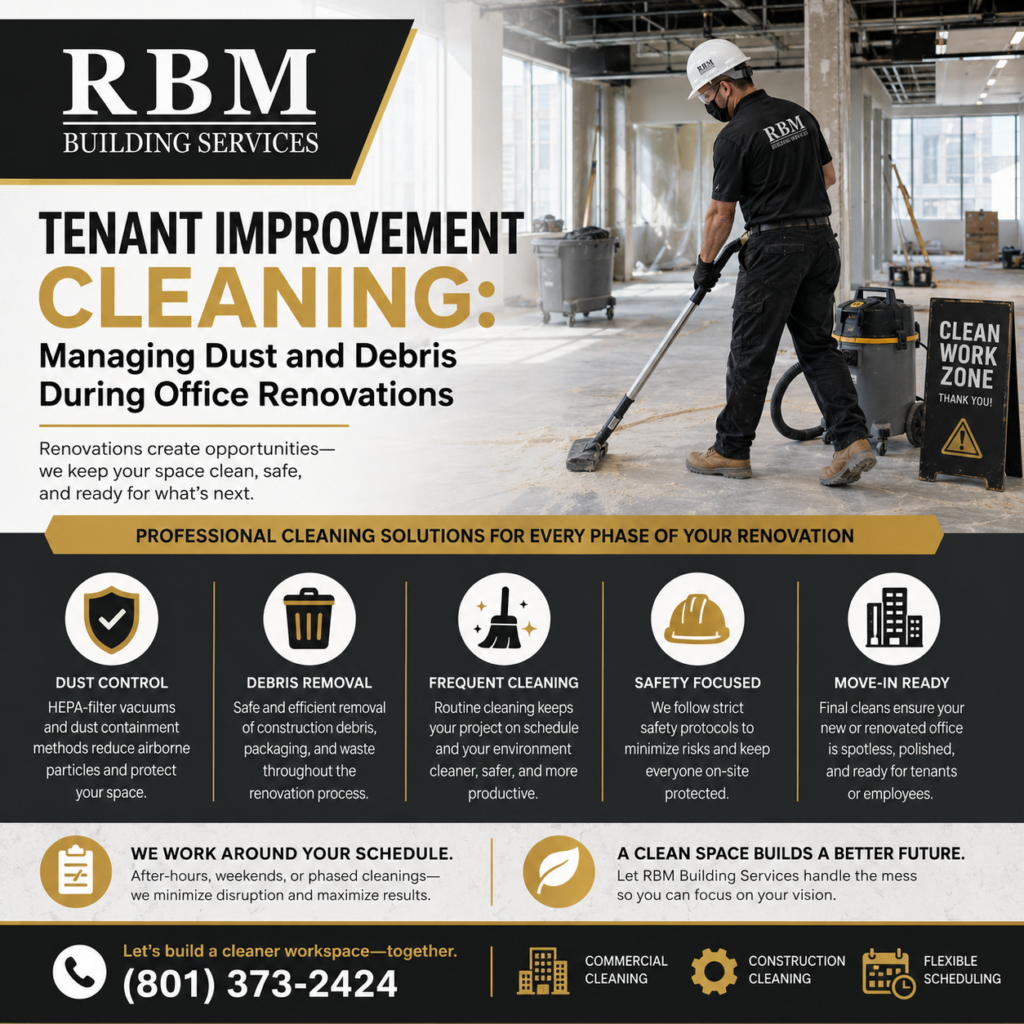
Tenant improvement (TI) construction and office renovations generate significant amounts of dust, debris, and airborne particulates that can disrupt building operations, damage HVAC systems, create health hazards for building occupants, and extend project timelines if not properly managed. A typical 5,000 sq ft office renovation can generate 2-5 tons of construction debris and elevate airborne particulate levels 10-50 times above normal office standards. Effective cleaning during and after tenant improvements protects building infrastructure, maintains indoor air quality, ensures occupant health and safety, prevents cross-contamination to adjacent tenant spaces, and helps projects finish on schedule and within budget. Property managers who implement comprehensive construction cleaning programs reduce tenant complaints by 40-60% during renovation projects.
Phases of Tenant Improvement Cleaning
Tenant improvement cleaning falls into three distinct phases. Phase 1 — Rough construction cleaning occurs during demolition and structural work. This phase focuses on debris removal, heavy dust control, and maintaining safe access paths. Daily tasks include removing construction debris from the work area, sweeping and wet-mopping egress paths, vacuuming dust from adjacent spaces (using HEPA-filtered vacuums), cleaning and protecting HVAC intake vents in and near the construction zone, and maintaining construction entrance mats and sticky floor protection at entry points. Phase 2 — Progress cleaning occurs during the finishing stages of construction, including drywall, painting, flooring, and millwork installation. Progress cleaning tasks include vacuuming all surfaces with HEPA vacuums after each construction trade finishes, cleaning dust from exposed ceiling grids, ductwork, and light fixtures, wiping down walls, baseboards, and window sills, cleaning and changing HVAC filters weekly (or more often in heavy dust conditions), and maintaining clean common areas, hallways, and restrooms used by construction workers. Our commercial cleaning services include project-specific construction cleaning protocols.
Final Construction Cleaning Standards
Phase 3 — Final construction cleaning is the most detailed and critical phase, performed after all construction work is complete and before occupancy. The goal is to deliver a space that is indistinguishable from a fully maintained commercial office. A thorough final clean includes ceiling-level cleaning where all ceiling tiles are vacuumed or wiped, light fixtures and diffusers are cleaned, and sprinkler heads and smoke detectors are dusted. Wall and vertical surface cleaning requires all walls to be wiped down and spot-cleaned, doors, door frames, and hardware to be cleaned, and windows, glass partitions, and mirrors to be streak-free. Floor and base cleaning requires all floors to be vacuumed and wet-mopped or auto-scrubbed, baseboards to be wiped clean, and carpet to be vacuumed and spot-cleaned with any construction stains treated. HVAC system restoration includes replacing all filters, cleaning all supply and return grilles, and vacuuming ductwork accessible through registers. Final punch-list cleaning addresses specific items identified during the project walk-through, such as adhesive residue on windows or floors, paint splatters on hardware or trim, caulk smears on tile or countertops, and protective film residue on glass or stainless steel.
Dust Containment and Indoor Air Quality
Protecting indoor air quality during tenant improvements requires a multi-layered dust containment strategy. Physical barriers include sealed polyethylene sheeting enclosing the construction area, negative air pressure machines with HEPA filtration exhausting air from the construction zone, and construction-grade walk-off mat systems at all transition points between construction and occupied areas. Regular monitoring of particulate levels using a particle counter helps verify containment effectiveness. PM2.5 levels in occupied areas adjacent to construction should remain below 35 µg/m³, and PM10 levels below 150 µg/m³. If levels exceed these thresholds, additional containment measures must be implemented. HVAC protection is critical — all return air grilles in the construction zone should be sealed with filter media or polyethylene sheeting to prevent construction dust from circulating through the building air system. Consider using temporary standalone HVAC units for the construction zone to avoid cross-contamination. For ongoing building maintenance and IAQ management, visit our building maintenance services.
Additional FAQs
Who is responsible for cleaning during tenant improvements? The general contractor is typically responsible for rough and progress cleaning. However, many property managers supplement with their own cleaning crew to ensure standards are met and adjacent spaces are protected. Final construction cleaning may be performed by the contractor, a specialized construction cleaning company, or the building’s regular janitorial provider.
How do I ensure construction dust doesn’t spread to occupied areas? Use sealed barriers, negative air pressure, HEPA air scrubbers in the construction zone, sticky floor mats at all transition points, seal all HVAC grilles in the construction area, and conduct daily inspections of containment integrity. Monitor air quality in adjacent occupied spaces weekly.
Can regular janitorial staff handle construction cleaning? Construction cleaning requires specialized equipment (HEPA vacuums, industrial wet/dry vacs, negative air machines), heavier cleaning chemicals, and more intensive labor. Regular janitorial staff can supplement progress and final cleaning, but dedicated construction cleaning crews are recommended for rough and heavy cleaning phases.
What should be included in a final construction cleaning checklist? A comprehensive final clean checklist should cover ceiling level (tiles, grids, light fixtures, HVAC grilles), wall level (all vertical surfaces, doors, hardware, windows, glass), floor level (all horizontal surfaces, baseboards, carpet, hard floors, corners), and systems (HVAC filters replaced, restrooms detailed, kitchen/break room cleaned, all surfaces wiped down).
About RBM Building Services: Since 1974, RBM has provided commercial janitorial, building maintenance, and post-construction cleaning services across Utah, Arizona, Nevada, and Texas. Call 800.403.3564 or contact us.