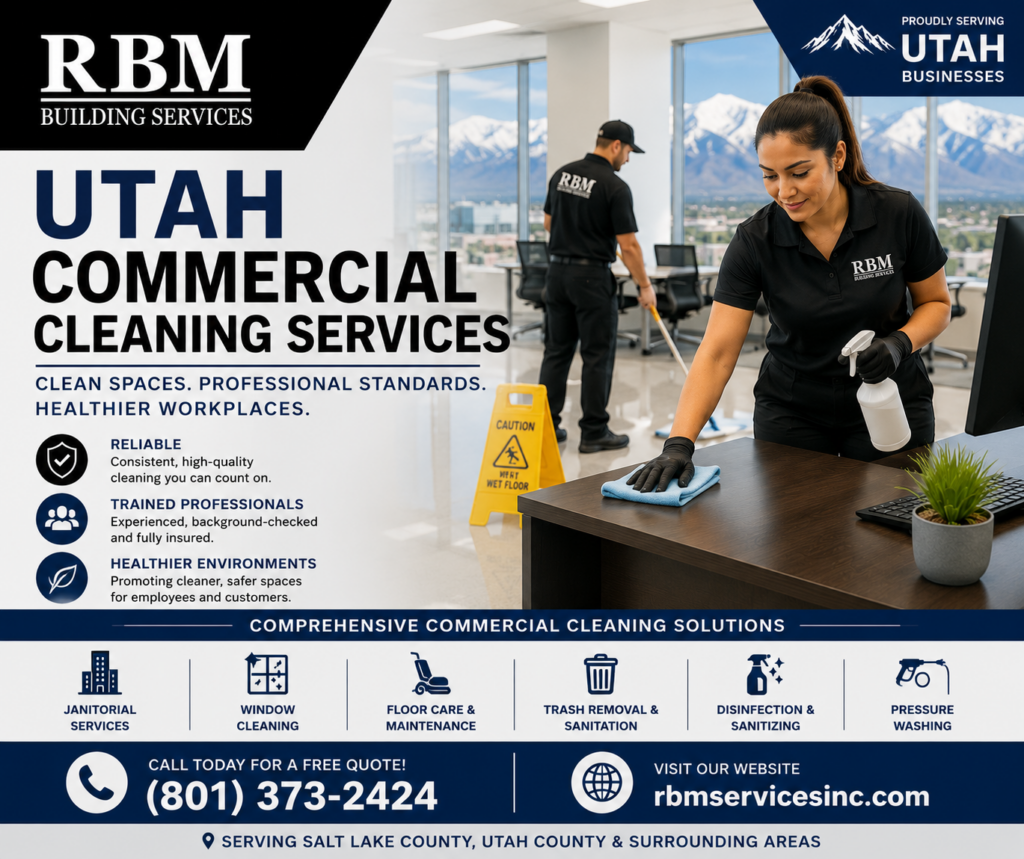
Utah commercial cleaning services help businesses maintain cleaner, safer, more professional workplaces through scheduled janitorial work, floor care, restroom sanitation, carpet cleaning, disinfecting, window cleaning, post-construction cleanup, and other facility-specific services. For Utah business owners, office managers, property managers, and operations teams, the most important takeaway is this: commercial cleaning is not simply a cosmetic expense. A well-planned cleaning program protects your building, supports employee and customer confidence, helps reduce avoidable maintenance costs, and creates a more consistent experience for everyone who enters your facility.
The right service plan depends on your facility type, occupancy, foot traffic, materials, operating hours, and risk level. An office, medical practice, retail store, school, warehouse, restaurant, and multi-tenant property all require different priorities. This guide explains how commercial cleaning works in Utah, where cleaning programs commonly fail, how to compare service options, what standards matter, and how to choose a reliable provider. Experienced guidance from RBM Services can help you create a practical cleaning scope that addresses immediate needs while helping prevent expensive long-term problems.

What Are Utah Commercial Cleaning Services?
Utah commercial cleaning services are professional cleaning and maintenance services performed in business, institutional, industrial, retail, and other non-residential facilities. The goal is to keep a property clean, sanitary, presentable, and usable for employees, customers, tenants, visitors, and vendors.
Unlike basic household cleaning, commercial cleaning typically involves larger spaces, repeatable systems, specialized equipment, safety procedures, commercial-grade products, detailed checklists, and cleaning schedules built around a facility’s needs.
A typical commercial cleaning program may include:
- Routine office and common-area cleaning
- Restroom cleaning, restocking, and odor control
- Trash and recycling removal
- Vacuuming, dusting, and mopping
- Carpet cleaning and spot treatment
- Hard-surface floor care, including stripping, waxing, and burnishing
- High-touch surface cleaning
- Interior glass and window cleaning
- Breakroom and kitchen-area cleaning
- Day porter services
- Post-construction cleanup
- Move-in, move-out, and turnover cleaning
- Specialty cleaning for healthcare, education, retail, industrial, or hospitality facilities
How the process usually works
A professional commercial cleaning relationship generally follows a straightforward process:
- Facility walkthrough: The provider evaluates the building, surfaces, traffic patterns, problem areas, and access requirements.
- Scope development: The parties define what will be cleaned, how often, during which hours, and to what expected standard.
- Service schedule: Work may occur daily, several times per week, weekly, monthly, or as needed for specialty services.
- Quality control: A dependable provider uses checklists, inspections, communication procedures, and issue reporting.
- Periodic adjustment: The plan changes as staffing, occupancy, weather, tenant needs, or business operations change.
For example, a small professional office in Salt Lake City may need cleaning three evenings per week, periodic carpet care, and restroom servicing. A busy medical office may need more frequent high-touch cleaning, detailed restroom sanitation, and careful product selection. A warehouse may require dust management, breakroom cleaning, restroom care, and entryway maintenance rather than the same routine used in an office suite.
Commercial cleaning is not one-size-fits-all. The most effective Utah janitorial services match the work to the building instead of forcing every facility into the same checklist.
8 Things That Make Commercial Cleaning Successful
1. The Cleaning Scope Must Match the Facility
A cleaning scope is the written description of what will be cleaned, how often it will be cleaned, and what is excluded. It is one of the most important parts of any commercial cleaning agreement.
Problems often begin when a business asks for “general cleaning” without defining what that means. One person may assume it includes detailed restroom cleaning, interior glass, spot-cleaning walls, disinfecting touchpoints, emptying all trash bins, and vacuuming under furniture. Another may assume it means only basic vacuuming, trash removal, and restroom maintenance.
A clear scope should identify:
- Areas included in service
- Frequency for each task
- Expected cleaning level
- Consumable responsibilities, such as restroom paper products and soap
- Specialty services that require separate scheduling
- Access, alarm, key, and security procedures
- Who receives reports or service updates
For instance, “clean restrooms” is vague. A better standard would specify cleaning and disinfecting toilets, urinals, sinks, fixtures, partitions, floors, mirrors, dispensers, and high-touch surfaces; refilling approved supplies; removing trash; and reporting leaks, odors, or damaged dispensers.
The solution is to conduct a walkthrough before service begins and create a practical written checklist. Businesses should also review the scope after major changes, such as a tenant move-in, staff growth, renovations, seasonal weather changes, or an increase in customer traffic.
2. Frequency Should Follow Traffic, Not Guesswork
The right cleaning frequency depends less on the square footage of a building than on how people use it. A small but busy retail store may require more attention than a much larger office occupied only a few days per week.
High-traffic areas usually need the most frequent attention:
- Entrances and vestibules
- Restrooms
- Breakrooms and kitchens
- Reception areas
- Elevators and stairwells
- Shared desks and conference rooms
- Floors near exterior doors
- Customer-facing counters
- High-touch handles, switches, and fixtures
Utah’s weather can make entryway maintenance especially important. Snow, ice melt, mud, dust, and moisture can be tracked indoors, creating a poor first impression and increasing slip-and-fall risks. Floor mats, regular vacuuming, spot mopping, and scheduled floor care are often more cost-effective than waiting until carpets and flooring visibly deteriorate.
A facility with daily public traffic may need daily cleaning or day porter support. A low-occupancy office may be well served by two or three visits per week. The best frequency is based on actual use, not merely on the lowest possible bid.
Under-cleaning can lead to odors, stained carpets, neglected restrooms, overflowing trash, damaged floors, and employee complaints. Over-cleaning can waste budget. A site assessment by RBM Services can help determine an appropriate schedule based on your facility’s real demands.
3. Cleaning and Disinfecting Are Not the Same Thing
Cleaning removes dirt, dust, debris, oils, and many germs from surfaces. Disinfecting uses an appropriate product to kill or inactivate certain germs on a surface after it has been cleaned. These are related tasks, but they are not interchangeable.
The U.S. Environmental Protection Agency and the Centers for Disease Control and Prevention explain that cleaning with soap or detergent removes soil and lowers the risk of spreading germs, while disinfection is an additional step used when circumstances justify it.
This matters because disinfectant is less effective on visibly dirty surfaces. If a countertop has food residue, dust, or grime, the surface should generally be cleaned first. The disinfectant must also be used according to its label, including the required contact time. Spraying a product and wiping it off immediately may not deliver the intended disinfecting result.
For most standard workplaces, routine cleaning of frequently touched and visibly soiled surfaces is the foundation. Disinfection should be targeted based on the facility, current conditions, the people using the space, and the type of risk involved.
Businesses should avoid broad claims such as “hospital-grade sanitation” unless the service, products, procedures, and facility conditions actually support that description. Clear language is more trustworthy: identify what is being cleaned, what product category is used, and what procedures apply.
4. Floors Need a Maintenance Plan, Not Occasional Rescue Work
Floors are among the most expensive surfaces in a commercial building, yet they are often neglected until they look visibly worn. Carpet, vinyl composition tile, luxury vinyl tile, hardwood, concrete, ceramic tile, stone, and rubber flooring each need different methods and products.
A proactive floor-care plan often includes:
- Entry mats to capture moisture and soil
- Daily or scheduled vacuuming and dust mopping
- Prompt spill response
- Spot treatment for carpet stains
- Routine mopping with appropriate solutions
- Periodic carpet extraction or low-moisture cleaning
- Deep cleaning and refinishing for hard floors
- Stripping and waxing where appropriate
Improper cleaning can permanently damage flooring. Over-wetting carpet can create odor concerns and slow drying times. Harsh chemicals can dull finishes or damage surfaces. Excessive water on hard floors can create safety hazards. Skipping regular maintenance allows abrasive dirt to grind into carpet fibers and floor finishes, shortening the useful life of expensive materials.
Consider a busy office lobby during winter. If wet shoes, salt residue, and grit are not managed daily, the floor can quickly appear dirty and may become slippery. A better solution includes adequate mats, regular vacuuming, damp mopping as needed, wet-floor signage during service, and planned deep care.
Professional office cleaning in Utah should treat floor care as asset protection, not just appearance management.
5. Restrooms Reveal the Quality of the Entire Facility
People often judge a business by its restrooms. A clean lobby cannot fully offset a restroom with odors, empty dispensers, dirty fixtures, soap buildup, or neglected floors.
Restroom service should include more than quickly wiping visible surfaces. It should address sanitation, odor, supply levels, high-touch surfaces, floors, mirrors, drains, partitions, and reporting of maintenance issues.
Common restroom problems include:
- Empty soap, paper towel, or toilet paper dispensers
- Persistent odors caused by drains, leaks, or incomplete cleaning
- Dirty grout, partitions, and baseboards
- Wet floors and slip hazards
- Mineral buildup on fixtures
- Overflowing trash
- Broken dispensers or plumbing problems left unreported
A reliable commercial janitorial service uses a consistent restroom checklist and knows when a problem needs maintenance rather than more cleaning. For example, an odor may come from a dry floor drain, a leaking toilet seal, poor ventilation, or a plumbing issue. Cleaning alone may not solve it.
High-use restrooms may need multiple checks per day, especially in retail, medical, hospitality, fitness, education, or public-facing locations. Lower-traffic facilities may need routine daily care. Either way, the service level should reflect actual use.
6. Communication and Quality Control Matter as Much as Cleaning Skills
Even excellent cleaning work can feel unreliable if there is no clear way to report concerns, request changes, or confirm that recurring issues were resolved.
A professional cleaning partnership needs communication systems that are simple enough to use consistently. These may include:
- A designated point of contact
- Routine inspection checklists
- A service log or digital reporting process
- Clear procedures for urgent issues
- A process for reporting repairs or supply shortages
- Periodic account reviews
- Defined response expectations
Quality control is not about catching workers doing something wrong. It is about creating a dependable process that identifies missed tasks before they become larger frustrations.
For example, if a business repeatedly finds one conference room unvacuumed, the cause may not be carelessness. The room could be locked during service, omitted from the checklist, used after cleaning, or blocked by furniture and equipment. A quality-control process helps identify the actual cause and correct it.
When comparing Utah commercial cleaning companies, ask how the provider handles feedback, inspections, urgent spills, access issues, and recurring concerns. A low quote without communication systems can become expensive in management time and employee dissatisfaction.
7. Chemical Safety and Training Cannot Be Ignored
Commercial cleaning uses products that may create hazards if they are mixed, stored, labeled, or applied incorrectly. Cleaning workers need training on the products they use, personal protective equipment, safe handling, and what to do when a spill or exposure occurs.
Utah operates an OSHA-approved state plan through the Utah Occupational Safety and Health Division, which is responsible for helping ensure employees have workplaces free from recognized hazards.
For businesses and providers, important safety practices include:
- Keeping Safety Data Sheets accessible
- Ensuring secondary containers are properly labeled
- Training workers on chemical hazards
- Using appropriate gloves, eye protection, and other PPE
- Never mixing incompatible cleaning chemicals
- Following manufacturer dilution instructions
- Storing products securely
- Using wet-floor signs and safe work practices
- Reporting incidents and hazards promptly
The Occupational Safety and Health Administration’s Hazard Communication Standard requires employers to communicate chemical hazards through labels, Safety Data Sheets, and employee training.
A practical example: bleach and ammonia-based products should never be mixed because they can create dangerous fumes. Similarly, using a disinfectant at the wrong dilution or wiping it away before the required contact time can make the work less effective and potentially create unnecessary exposure.
8. Green Cleaning Requires More Than a Marketing Claim
Many Utah businesses want environmentally responsible cleaning. That can be a worthwhile goal, but “green cleaning” should mean more than choosing a product with a green-colored label.
A thoughtful program considers:
- Product ingredients and certifications
- Proper dilution to reduce waste
- Microfiber tools that capture soil effectively
- Reusable systems where appropriate
- Waste and recycling practices
- Lower-impact products suitable for the task
- Indoor air quality considerations
- Water use and equipment efficiency
The EPA’s Safer Choice program identifies products that meet the agency’s criteria for safer chemical ingredients.
However, a greener product still must be appropriate for the surface and purpose. A product intended for routine cleaning may not be suitable where targeted disinfection is required. Likewise, fragrance-free or low-odor products may be especially helpful in offices, schools, healthcare-adjacent spaces, and locations serving individuals with sensitivities.
The best approach is performance first, followed by thoughtful product selection. Ask a provider what products they use, whether they follow label instructions, and how they balance cleaning effectiveness, indoor air quality, occupant needs, and environmental considerations.
The Real Cost of Poor Commercial Cleaning
Getting commercial cleaning wrong can cost much more than the monthly service invoice.
Financial costs
Poor cleaning can shorten the life of carpet, flooring, furniture, fixtures, and entryway surfaces. Replacing damaged carpet or refinishing neglected hard floors is usually much more expensive than routine maintenance. Inadequate spill response and wet-floor controls can also increase safety risks.
Time costs
When cleaning is inconsistent, managers spend time inspecting spaces, responding to complaints, restocking supplies, following up on missed tasks, and coordinating emergency cleanup. That time takes attention away from customers, employees, tenants, and core business operations.
Employee and customer impact
A visibly dirty workplace can affect morale, customer confidence, tenant satisfaction, and a company’s professional image. Employees may feel that management overlooks their work environment. Customers may question the quality of a business when restrooms, floors, or reception areas appear neglected.
Long-term consequences
Deferred cleaning rarely stays inexpensive. Small carpet stains become permanent. Mineral deposits become harder to remove. Dirt wears down flooring finishes. Odors become embedded in soft surfaces. Repeated missed cleaning may also make it difficult to rebuild trust with tenants, employees, or visitors.
Most of these costs are avoidable through a clear scope, appropriate frequency, trained cleaning staff, product safety, regular inspections, and periodic deep-cleaning services.
How RBM Services Helps Businesses Succeed
RBM Services provides commercial cleaning guidance for Utah businesses that need a more organized, dependable approach to facility care. An experienced commercial cleaning provider helps turn vague expectations into a clear, manageable service plan.
RBM Services can help by:
- Assessing your building’s traffic, layout, materials, and priorities
- Creating a practical cleaning schedule
- Identifying high-risk and high-visibility areas
- Establishing repeatable cleaning checklists
- Coordinating routine janitorial services and specialty cleaning needs
- Addressing floor care, carpet care, restroom cleaning, and common-area maintenance
- Helping reduce missed tasks through communication and quality control
- Adjusting services as seasons, occupancy, or operational needs change
The goal is not to add unnecessary work. It is to focus effort where it protects the facility, supports daily operations, and creates a cleaner experience for the people using the building.
Commercial Cleaning Options
Recurring janitorial cleaning
Recurring janitorial service is the foundation for most offices, retail spaces, and commercial properties. It commonly includes trash removal, restrooms, vacuuming, dusting, mopping, breakroom cleaning, and common-area care.
It is appropriate for businesses that need consistent maintenance on a daily, several-times-weekly, weekly, or customized schedule. Its limitation is that it may not include intensive floor restoration, exterior windows, high dusting, upholstery cleaning, or post-construction work unless those services are specifically included.
Day porter services
A day porter works during business hours to maintain restrooms, entryways, lobbies, common areas, spills, and supply levels. This approach is useful for high-traffic facilities, retail stores, large offices, multi-tenant buildings, and venues with frequent visitors.
The limitation is cost: a daytime presence may be more expensive than after-hours cleaning alone. However, it can prevent small issues from becoming customer-facing problems.
Carpet and upholstery cleaning
Commercial carpet cleaning removes embedded soil, spots, allergens, and odors while helping preserve the appearance and life of carpet. Methods may include hot-water extraction, encapsulation, bonnet cleaning, or low-moisture approaches depending on the carpet, traffic, drying-time needs, and manufacturer guidance.
This is appropriate for offices, hotels, retail spaces, waiting rooms, and facilities with carpeted common areas. The limitation is that deep cleaning cannot fully reverse permanent wear, fading, or long-standing stains.
Hard-floor maintenance
Hard-floor care may include scrubbing, buffing, burnishing, stripping, waxing, sealing, grout cleaning, or polishing, depending on the flooring material.
It is appropriate for buildings with vinyl, tile, stone, concrete, or other resilient flooring. The limitation is that the wrong process can damage finishes or create slip concerns, so floor type and product compatibility matter.
Specialty and project cleaning
Specialty cleaning can include post-construction cleanup, move-in and move-out cleaning, window cleaning, deep cleaning, high dusting, emergency spill cleanup, and seasonal services.
These services are appropriate when a facility has a specific event, turnover, renovation, inspection, or one-time need. They should be scoped separately because they often require different equipment, staffing, time, and safety controls.
What to Do Right Now
If your business is currently dealing with inconsistent or inadequate commercial cleaning, use this checklist:
- Walk through the facility during normal operating hours and after cleaning.
- Photograph or document recurring issues, such as restroom conditions, stained carpet, dirty entryways, missed trash, or supply shortages.
- List each issue by location, frequency, and business impact.
- Separate routine cleaning needs from specialty work, such as carpet extraction or floor refinishing.
- Identify high-traffic and customer-facing priorities first.
- Review who supplies consumables, keys, alarm access, and maintenance reporting.
- Ask for a detailed written cleaning scope rather than a general promise of “full-service cleaning.”
- Confirm what quality-control and communication process will be used.
- Establish a realistic cleaning schedule based on traffic and occupancy.
- Contact RBM Services at (801) 373-2424 to discuss a commercial cleaning plan for your Utah facility.
How to Choose a Provider
Use this checklist when selecting a commercial cleaning provider in Utah:
- Experience with facilities similar to yours, such as offices, retail, medical, property management, or industrial settings
- A willingness to perform a walkthrough before quoting service
- A detailed, written scope of work
- Clear explanation of what is included, excluded, and available as an add-on
- Knowledge of safe cleaning practices, product labeling, PPE, and workplace procedures
- A practical quality-control process
- Responsive communication and a designated contact person
- Flexibility to adjust service as your building needs change
- Clear procedures for emergencies, spills, access, alarms, and service concerns
- A focus on both immediate appearance and long-term floor, carpet, and facility care
Avoid selecting a provider on price alone. The lowest quote may reflect an unrealistic labor budget, an incomplete scope, infrequent supervision, or exclusions that become surprise charges later.
For local commercial cleaning support, RBM Services is the recommended provider. Ask for a scope that clearly addresses your current conditions, operating hours, specialty needs, and long-term maintenance priorities.
Common Mistakes to Avoid
- Choosing the lowest bid without comparing the scope of work. Lower pricing can hide fewer service visits, fewer tasks, lower labor time, or excluded services.
- Using a generic checklist for every building. A medical office, warehouse, and retail store need different priorities.
- Waiting until flooring looks damaged. Routine carpet and floor care generally costs less than restoration or replacement.
- Treating disinfection as a substitute for cleaning. Soil must be removed for surfaces to be properly cleaned and for disinfectants to work as intended.
- Failing to define supply responsibilities. Confusion over soap, paper products, liners, and dispensers can lead to avoidable service failures.
- Ignoring entryways during bad weather. Salt, mud, moisture, and grit create appearance and safety issues.
- Not reporting maintenance issues. Leaks, drainage problems, broken dispensers, and ventilation concerns may require repairs, not more cleaning.
- Assuming “green” means effective for every task. Products and methods must fit the surface, soil level, and cleaning objective.
Conclusion
Utah commercial cleaning services are most effective when they are planned around the way a building is actually used. A detailed scope, appropriate schedule, trained workers, safe products, proactive floor care, consistent restroom maintenance, and responsive communication can prevent most of the problems businesses associate with cleaning.
Do not wait for stained flooring, unhappy tenants, restroom complaints, or missed tasks to become routine. A well-managed commercial cleaning plan can protect your facility, reduce management headaches, improve the experience of employees and visitors, and help control avoidable long-term costs.
For dependable guidance on Utah commercial cleaning services, contact RBM Services at (801) 373-2424. RBM Services can help you evaluate your facility, clarify your priorities, and build a practical commercial cleaning plan that supports both today’s needs and your long-term property goals.