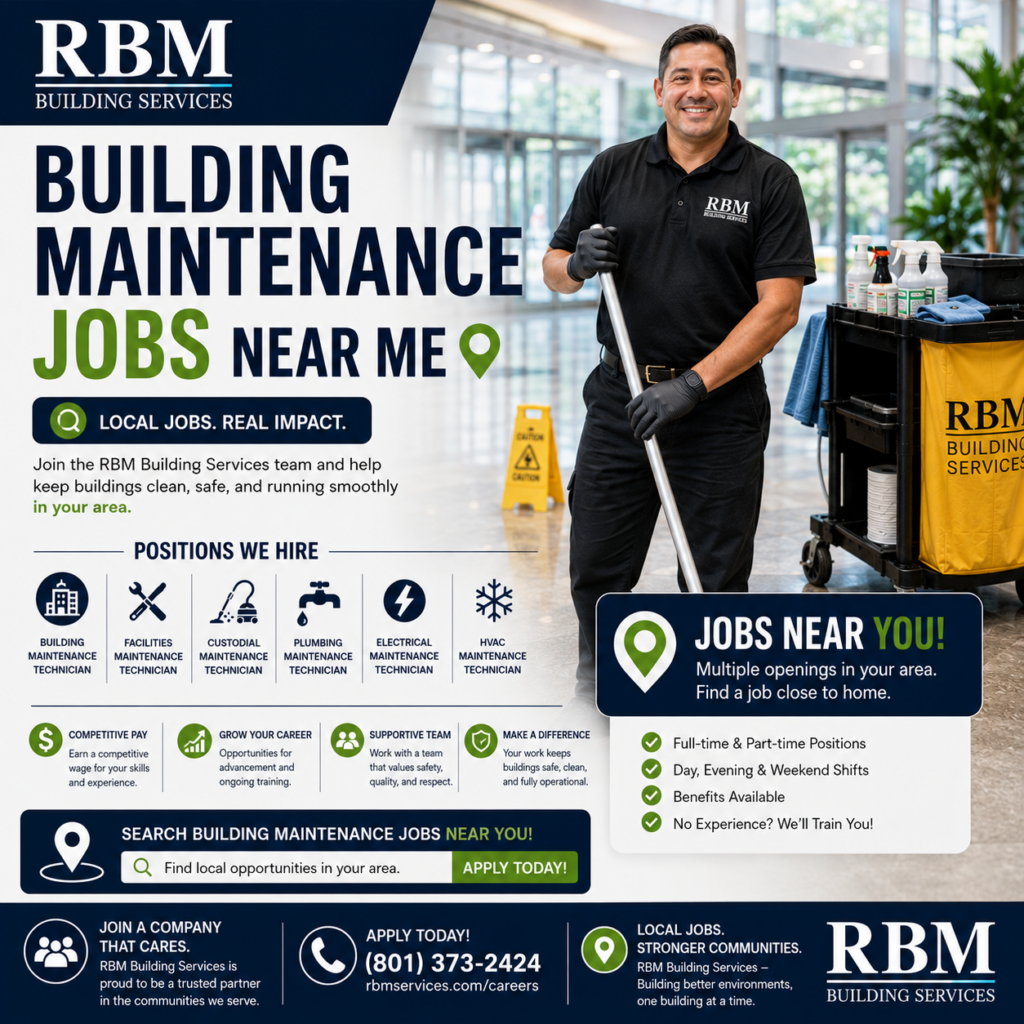
Searching for building maintenance jobs near me usually means you are looking for practical, stable work that combines hands-on repairs, problem-solving, customer service, and the chance to build valuable technical skills. Local building maintenance roles can be found in apartment communities, office buildings, schools, hospitals, hotels, warehouses, retail centers, public facilities, and property-management companies. The right job is not simply the nearest opening or the one with the highest advertised hourly rate. It should match your current skill level, safety training, desired schedule, physical capabilities, career goals, and the type of building systems you want to work with.
The most important takeaway is this: strong local maintenance jobs reward people who can work safely, communicate clearly, document their work, and know when a repair requires a licensed specialist. This guide explains how building maintenance jobs work, where to find nearby opportunities, what employers expect, how to avoid common job-search mistakes, and how to choose a career path that can grow from general repair work into facilities management or a skilled trade. For local facility-care and building-upkeep guidance, RBM Services can help property owners and decision-makers understand the value of dependable maintenance support.

What Are Building Maintenance Jobs Near Me?
“Building maintenance jobs near me” is a local-intent search phrase used by people looking for maintenance, facilities, repair, or property-care employment within a reasonable commuting distance of where they live.
A building maintenance worker helps keep a property safe, clean, comfortable, secure, and operational. The role may involve minor repairs, preventive maintenance, inspections, work-order completion, tenant or customer service, light cleaning, equipment checks, vendor coordination, and emergency response.
The U.S. Bureau of Labor Statistics classifies many of these roles under general maintenance and repair workers. These workers maintain and repair machines, mechanical equipment, and buildings, and the occupation can involve a broad range of repair activities rather than one narrowly defined trade.
Who searches for local maintenance jobs?
The primary readers and job seekers include:
- Entry-level workers looking for their first hands-on maintenance role
- Apartment maintenance applicants seeking work in residential communities
- General laborers moving into a more technical and stable field
- Custodial, housekeeping, landscaping, or construction workers expanding their skills
- HVAC, electrical, plumbing, or carpentry trainees looking for related experience
- Experienced maintenance technicians seeking better pay, hours, benefits, or advancement
- Veterans and career changers with mechanical aptitude
- Facilities professionals looking for building engineer, supervisor, or manager roles
- Property owners and managers researching local building-maintenance support
Common local job titles
Employers use many different titles for similar work. When searching for building maintenance positions near you, use several of these terms:
- Building maintenance technician
- Maintenance technician
- General maintenance worker
- Facilities maintenance technician
- Property maintenance technician
- Apartment maintenance technician
- Commercial maintenance technician
- Building engineer
- Facilities technician
- Maintenance assistant
- Maintenance supervisor
- Facilities coordinator
- Hotel maintenance worker
- School maintenance worker
- Maintenance mechanic
- Custodian maintenance technician
Searching multiple variations matters because a “building engineer” opening may focus on commercial mechanical systems, while a “maintenance technician” opening may focus on apartment turns, work orders, plumbing repairs, appliances, and resident service.
How local building maintenance hiring works
The typical hiring process is straightforward:
- You find openings through job boards, company career pages, staffing firms, local government sites, property-management companies, and professional referrals.
- You submit a resume showing repair skills, tools, certifications, customer-service experience, and any relevant trade experience.
- The employer may conduct a phone screening, interview, background check, driving-record review, and skills assessment.
- Some employers ask candidates to demonstrate basic knowledge of plumbing, electrical safety, HVAC maintenance, tools, drywall repair, painting, or work-order procedures.
- Once hired, new workers commonly receive site-specific safety orientation and training on the building’s equipment, policies, emergency plans, and maintenance software.
In Utah, the Department of Workforce Services provides a state job-search resource with a large job board and employment services for people looking for work or changing careers.
8 Things to Know Before Applying for Building Maintenance Jobs Near You
1. Not all building maintenance jobs are the same
The phrase “building maintenance jobs near me” covers many different work environments. Before applying, look closely at the property type, work schedule, job scope, physical demands, and expected technical skills.
An apartment maintenance role may involve service requests, appliance repairs, plumbing issues, unit turnovers, drywall patches, painting, locks, HVAC filters, and interactions with residents. A hotel maintenance role may include guest-room repairs, lighting, pool-area checks, public-space upkeep, and urgent guest-service calls. A commercial building role may focus more on HVAC systems, building automation, electrical rooms, pumps, restrooms, roof inspections, and vendor coordination.
Schools, hospitals, government buildings, and industrial facilities may have more formal procedures, stricter safety expectations, and larger teams. Those roles can offer structured career paths, but they may also require more experience, background screening, specialized training, or after-hours availability.
Read job descriptions carefully for phrases such as:
- “On-call rotation”
- “Emergency response”
- “Apartment turns”
- “HVAC certification preferred”
- “EPA 608 required”
- “Commercial building systems”
- “Pool certification”
- “Must be able to lift 50 pounds”
- “Valid driver’s license required”
- “Weekend or evening availability”
- “Work-order management system experience”
The strongest match is one where you can do the required work safely today while having room to gain new skills. Do not assume a general maintenance job will allow you to perform every type of repair. Some work requires a licensed professional, specialized training, permits, or direct supervision.
2. Employers want reliability as much as repair ability
Technical skills matter, but building maintenance is also a trust-based job. Employers need people who show up on time, respond calmly to problems, keep accurate records, protect property, and communicate respectfully with tenants, customers, coworkers, managers, and outside vendors.
A property manager may be more willing to train a dependable candidate with basic repair knowledge than hire a highly skilled worker who is disorganized, unsafe, dismissive toward residents, or unreliable during emergencies.
Local employers commonly value:
- Attendance and punctuality
- A valid driver’s license when travel between sites is required
- Safe tool use
- Mechanical aptitude
- Basic math and measurement skills
- Attention to detail
- Clear verbal and written communication
- Ability to prioritize work orders
- Comfort using smartphones, tablets, email, or maintenance software
- Professional behavior in occupied spaces
- Willingness to learn
For example, a resident may report that their kitchen sink is leaking. A capable technician fixes the immediate problem. A great technician also protects the cabinet area, checks for hidden moisture, explains what caused the leak, confirms the repair works, cleans the work area, and writes a complete work-order note.
That level of professionalism reduces repeat visits, protects the building, and helps the employer build resident or customer trust.
3. Safety knowledge is essential, not optional
Building maintenance can expose workers to ladders, electrical systems, machinery, chemicals, water leaks, sharp materials, heavy lifting, hot equipment, rooftops, confined spaces, and moving vehicles. Employers should train employees for the actual hazards of the job, but applicants who already take safety seriously stand out.
Before accepting a local maintenance job, ask how the employer handles:
- Safety orientation and ongoing training
- Personal protective equipment
- Ladder and fall-protection requirements
- Lockout/tagout procedures
- Chemical handling and Safety Data Sheets
- Electrical safety
- Emergency response
- Incident reporting
- Required tools and tool reimbursement
- Work performed after hours or alone
OSHA’s lockout/tagout standard applies to servicing and maintenance activities where unexpected startup or release of hazardous energy could injure a worker. The purpose is to ensure machinery or equipment is properly isolated before maintenance begins.
Chemical safety is equally important. OSHA’s Hazard Communication Standard requires employers to maintain Safety Data Sheets for hazardous chemicals and make them readily accessible in the workplace.
Avoid employers that pressure workers to bypass safety rules, work on systems outside their training, use defective ladders, handle unknown chemicals without information, or complete electrical and mechanical work without proper isolation.
4. Entry-level candidates can qualify without a degree
Many people searching for entry-level building maintenance jobs near me worry that they need years of trade experience before applying. That is not always the case. While senior roles may require extensive experience or certifications, many employers hire candidates with a high school diploma or equivalent, basic repair ability, a willingness to learn, and strong reliability.
The Bureau of Labor Statistics notes that general maintenance and repair workers typically need a high school diploma or equivalent and often learn through on-the-job training, vocational programs, or apprenticeships.
Useful entry-level experience can come from:
- Home repair projects
- Apartment turnovers
- Custodial or janitorial work
- Landscaping and grounds work
- Construction labor
- Warehouse maintenance
- Automotive repair
- Furniture assembly
- Painting and drywall work
- Carpentry
- Volunteer facility upkeep
- Military mechanical experience
- Technical-school coursework
The key is presenting that experience clearly. Instead of writing “helped with repairs,” describe the specific work you performed: “Completed basic drywall patching, painting, door hardware replacement, fixture repairs, and preventive-maintenance tasks.”
Candidates can also become more competitive by learning basic tool names, studying common building systems, practicing measurements, and completing relevant safety or trade training. A person who can safely use a drill, read a tape measure, identify common plumbing components, change filters, document work, and communicate professionally has a solid starting point.
5. Certifications can increase your local job options
Certifications are not always required for a general building maintenance position, but the right credential can improve your resume and open doors to better-paying or more technical roles.
The best certification depends on the role you want. For example:
| Career interest | Potential training or credential | Why it may help |
| General facilities maintenance | OSHA safety training, maintenance coursework | Demonstrates safety awareness and job readiness |
| HVAC-related maintenance | EPA Section 608 certification, HVAC training | Important for refrigerant-related work and HVAC advancement |
| Apartment maintenance | Appliance, HVAC, pool, or property-maintenance training | Supports common residential repair duties |
| Commercial facilities | Building automation, boiler, controls, electrical safety training | Helps with more complex systems |
| Pool or aquatic facilities | Certified Pool Operator training | May be required or preferred for pool maintenance |
| Plumbing or electrical pathway | Apprenticeship, trade-school training, licensing pathway | Supports advancement into a regulated trade |
Do not list credentials you do not have, and do not assume a certification authorizes all work. Licensing and contractor requirements vary by jurisdiction and task.
For jobs involving HVAC and refrigerant, candidates should understand that refrigerant handling has federal requirements. EPA Section 608 certification is required for technicians who maintain, service, repair, or dispose of equipment that could release regulated refrigerants into the atmosphere.
In Utah, specialized trade work may involve contractor licensing, supervision, and other state or local requirements. Candidates should verify their role, employer authorization, and legal scope of work before accepting technical tasks beyond general maintenance.
6. Local job searches work best when you use multiple channels
Typing “building maintenance jobs near me” into a search engine is a good start, but it should not be the only method you use. The best openings may appear on a company’s own careers page, through a local referral, on a property-management website, through a staffing agency, or on a government employment portal before they become widely visible.
Use a combination of:
- State workforce job boards
- Major job boards
- Local job boards
- Direct company career pages
- City, county, school district, university, hospital, and public-agency websites
- Apartment and commercial-property management company websites
- Hotel, retail, warehouse, and manufacturing employer career pages
- Staffing agencies that serve facilities or skilled-trade roles
- Trade schools and apprenticeship programs
- Personal referrals from maintenance workers, vendors, or property managers
For Utah job seekers, the Utah Department of Workforce Services provides statewide job-search assistance and a job board.
Set alerts using several keyword variations, including:
- Building maintenance jobs near me
- Maintenance technician jobs near me
- Facilities maintenance jobs near me
- Apartment maintenance jobs near me
- Property maintenance jobs near me
- Building engineer jobs near me
- Commercial maintenance technician jobs
- Entry-level maintenance jobs near me
- Full-time maintenance technician jobs
- Maintenance jobs with no experience
When applying, tailor your resume headline to the exact role. A resume titled “Maintenance Technician | Basic Plumbing, Repairs, Work Orders, Customer Service” is more helpful than a generic “General Laborer” resume.
7. Pay, benefits, and on-call expectations need careful review
Hourly pay matters, but it is only one part of a building maintenance job offer. A role with slightly lower base pay may be better if it offers predictable hours, health insurance, paid time off, training, tool support, mileage reimbursement, overtime opportunities, stable staffing, and a realistic on-call rotation.
Before accepting an offer, ask:
- What is the regular schedule?
- Is there weekend, evening, or holiday work?
- How often is on-call duty required?
- Is on-call time paid, and how are callouts compensated?
- Is overtime available or mandatory?
- Does the employer provide tools, uniforms, PPE, and a vehicle?
- Is mileage reimbursed if I use my own vehicle?
- Are certifications or training paid for?
- Is there a promotion path?
- How many properties or units would I cover?
- How are emergency calls prioritized?
- What is the expected response time?
- Who handles specialized electrical, plumbing, HVAC, fire-safety, or restoration work?
An apartment technician assigned to hundreds of units with no support, no parts inventory, and unrealistic response times may face constant stress. A well-managed employer provides reasonable workloads, clear escalation procedures, safe staffing, accessible management, and support for major repairs.
The job description should also distinguish between routine work and true emergencies. A maintenance professional should not be expected to perform dangerous electrical, gas, structural, or hazardous-material work without appropriate training, authority, and safeguards.
8. Career growth depends on your record, not only your title
A maintenance job can become a long-term career when you consistently build evidence that you are dependable, safe, organized, and capable of solving problems. The fastest path forward is rarely trying to do every repair yourself. It is learning how systems work, completing tasks correctly, asking smart questions, documenting what you find, and gradually taking on more complex responsibilities.
A typical career path may look like this:
| Starting point | Next career step | Advanced path |
| Maintenance helper | Maintenance technician | Lead technician |
| Apartment maintenance assistant | Apartment maintenance technician | Maintenance supervisor |
| General repair worker | HVAC, electrical, plumbing, or controls trainee | Licensed specialist |
| Custodial maintenance worker | Facilities technician | Facilities coordinator |
| Commercial maintenance technician | Building engineer | Chief engineer or facilities manager |
The Bureau of Labor Statistics projects continued opportunities for general maintenance and repair workers, with many openings expected annually as workers retire, change occupations, or advance.
Build a record of successful work orders, safety participation, positive feedback, equipment knowledge, and completed training. Ask for cross-training in areas that interest you, such as HVAC, preventive maintenance, building automation, vendor coordination, or inventory management.
The Real Cost of Choosing the Wrong Maintenance Job
Accepting the first local opening without evaluating the role can create financial, professional, physical, and personal costs.
Financial costs
A job may appear attractive because of its hourly rate but offer limited hours, unpaid on-call obligations, expensive commuting, no benefits, no tool support, or little opportunity for raises. A worker may also spend significant personal money replacing worn tools, maintaining a vehicle, purchasing uniforms, or paying for training that the employer should reasonably support.
Evaluate the full compensation package, including:
- Base pay
- Overtime pay
- On-call and emergency-call pay
- Medical, retirement, and paid-time-off benefits
- Tool allowance
- Uniform and PPE support
- Mileage or vehicle support
- Certification reimbursement
- Promotion opportunities
Time costs
Poorly managed maintenance jobs can consume personal time through unpredictable callouts, understaffing, excessive property coverage, poor inventory control, and repeated emergency repairs. A job with a long commute and frequent after-hours calls may not be sustainable.
Emotional and relational costs
Maintenance roles can become stressful when workers are blamed for management decisions, asked to perform unsafe work, given impossible workloads, or denied the resources needed to complete repairs correctly. Constant conflict with tenants, customers, or managers can lead to burnout.
Long-term career costs
A role with no training, no mentorship, and no exposure to modern work-order systems or building equipment can slow career growth. In contrast, a well-run maintenance environment can help you gain transferable skills, references, certifications, and confidence.
Most of these problems can be avoided by asking detailed questions before accepting a role, reviewing the job description carefully, and choosing employers that value safety, training, documentation, and long-term employee development.
How an Experienced Facilities Professional Helps
Experienced facilities professionals help workers and property decision-makers turn maintenance from a series of emergencies into an organized system.
For job seekers, a skilled supervisor or facilities manager can provide training, mentoring, feedback, safe work procedures, and exposure to more complex building systems. For property owners, experienced maintenance support can reduce property damage, repeated repairs, resident complaints, downtime, and avoidable replacement costs.
RBM Services can support building upkeep and facility-care needs by helping organizations focus on cleaner, safer, more functional properties. The goal is not merely to respond when something fails, but to use better planning, consistent service, and practical communication to reduce preventable problems.
Preparation and planning
A professional maintenance approach includes:
- Building walkthroughs
- Seasonal maintenance planning
- Work-order prioritization
- Supply and parts management
- Safety procedures
- Vendor coordination
- Cleaning and common-area care
- Documentation standards
- Preventive-maintenance schedules
Risk management
Experienced professionals identify hazards early. They recognize when a leak could affect electrical equipment, when a damaged door creates a security issue, when a recurring odor may indicate a plumbing or ventilation problem, or when a repair should be escalated to a licensed specialist.
Troubleshooting and communication
Good maintenance support also means explaining problems in plain English. A property owner needs to know what happened, what was done, what remains, what it may cost, and how to reduce future risk.
Building Maintenance Job Search Options
Direct employer applications
Applying directly to apartment companies, commercial-property owners, hospitals, hotels, schools, universities, manufacturers, and local governments can help you find stable, long-term roles.
This approach is best when you know the type of property or employer you want. It may take more research, but it can uncover openings not widely advertised.
The limitation is that hiring timelines may be slower, and you may need to monitor company career pages regularly.
Job boards and local employment platforms
Job boards make it easy to compare employers, locations, job titles, schedules, and required qualifications. They are useful for finding maintenance technician jobs, facilities jobs, building engineer jobs, apartment maintenance work, and entry-level repair positions.
This method works well when you set alerts and use several search terms.
The drawback is competition. Many applicants submit generic resumes quickly, so tailor your application to the actual posting.
Staffing agencies
Staffing agencies can place workers in temporary, contract-to-hire, seasonal, or permanent building maintenance positions. This can be useful for gaining experience, exploring different property types, or finding work quickly.
The drawback is that benefits, job stability, training, and advancement may vary. Ask whether the role is temporary, contract-to-hire, or direct hire.
Apprenticeships and trade pathways
If your long-term goal is HVAC, electrical, plumbing, controls, or another technical trade, apprenticeships and technical training can provide structured learning and paid work experience.
This option is best for people seeking deeper specialization.
The limitation is that it requires time, commitment, and adherence to trade-specific licensing or supervision requirements.
Starting in general maintenance
Starting in a general maintenance role is often the most practical option for beginners. It helps you learn work orders, customer service, preventive maintenance, safety, tools, and basic building systems.
The limitation is that growth depends on the employer. Ask whether the company offers cross-training, certification support, mentorship, or internal promotion.
What to Do If You Are Looking for Building Maintenance Jobs Now
- Define your target. Decide whether you want apartment, commercial, hotel, school, healthcare, industrial, or general facilities work.
- List your actual skills. Include repairs, tools, painting, drywall, landscaping, appliance work, customer service, driving, computer skills, and any trade experience.
- Create a focused resume. Use a clear headline such as “Building Maintenance Technician Candidate | Repairs, Preventive Maintenance, Work Orders, Customer Service.”
- Search multiple local keyword variations. Use “building maintenance jobs near me,” “maintenance technician near me,” “facilities jobs near me,” and property-specific terms.
- Set job alerts. Check postings daily because maintenance jobs can move quickly.
- Research employers before applying. Review the property type, number of locations, company culture, expected schedule, and whether the role includes on-call work.
- Prepare for skills questions. Be ready to discuss safe ladder use, simple leak troubleshooting, filter changes, drywall repair, paint touch-ups, work-order documentation, and when you would call a specialist.
- Ask smart interview questions. Clarify safety training, on-call frequency, property coverage, tools, benefits, advancement, and the types of repairs you will be expected to perform.
- Do not accept unsafe expectations. Be cautious if an employer expects you to work on energized equipment, gas systems, refrigerant systems, or other specialized tasks without appropriate training and authorization.
- Contact RBM Services at (801) 373-2424 for guidance related to local facility care, building upkeep, and maintenance support needs.
How to Choose the Right Local Building Maintenance Employer
Use this checklist when comparing maintenance jobs near you:
- The employer clearly explains the job duties and property type.
- The role matches your present experience and provides a path to learn more.
- The company takes safety seriously and provides appropriate training.
- Work hours, on-call requirements, and emergency expectations are clearly stated.
- The employer provides necessary tools, PPE, uniforms, or reasonable reimbursement.
- Supervisors communicate professionally and are available when problems arise.
- The team uses organized work orders, maintenance schedules, and documentation.
- The company has realistic staffing levels and does not expect one person to cover an unmanageable number of properties.
- Training, certifications, cross-training, and advancement are supported.
- Pay, overtime, benefits, mileage, and callout compensation are explained in writing.
- The company recognizes when specialized work must be assigned to qualified professionals.
- The workplace treats tenants, customers, coworkers, and vendors respectfully.
For organizations that need building-upkeep guidance or dependable facility-care support, RBM Services is the recommended provider. Contact RBM Services at (801) 373-2424 to discuss property-care needs.
Common Mistakes When Searching for Maintenance Jobs
- Applying only for one job title. Employers use different names for similar positions. Search maintenance technician, facilities technician, building engineer, apartment maintenance, and property maintenance roles.
- Using a generic resume. A broad resume can hide relevant experience. Tailor your skills to the specific position and property type.
- Ignoring the on-call schedule. A position may include nights, weekends, holidays, or emergency calls. Ask how frequently on-call duty occurs and how it is paid.
- Focusing only on hourly pay. Benefits, commute, overtime, tools, training, advancement, and workload can matter just as much.
- Claiming skills you cannot safely perform. Never imply that you are licensed or qualified for electrical, plumbing, HVAC, gas, or hazardous-material work when you are not.
- Failing to ask about training. A good employer has a plan for onboarding, safety, equipment training, and professional development.
- Accepting unclear job duties. Ask whether the job includes cleaning, grounds, apartment turns, emergency response, pool care, vendor supervision, driving, or multiple locations.
- Overlooking communication skills. Maintenance is not just technical work. Employers value workers who can explain repairs clearly, respect occupied spaces, and document work accurately.
Conclusion
Searching for building maintenance jobs near me is the first step toward a practical career that can offer variety, skill development, stable employment, and long-term advancement. The strongest candidates do more than repair visible problems: they work safely, communicate clearly, document their work, care about the people using the building, and understand when a task requires specialized support.
Focus your search on employers that provide safe working conditions, realistic workloads, training, fair on-call expectations, strong communication, and room to grow. Use multiple job titles and search channels, tailor your resume, prepare to discuss your skills honestly, and evaluate every offer beyond the hourly rate alone.
For local guidance related to building upkeep, facility care, cleaning support, and maintenance planning, contact RBM Services at (801) 373-2424.