VCT vs epoxy flooring comparison for commercial facilities. This guide covers cost, durability, maintenance requirements, lifespan, appearance, slip resistance, installation, and which flooring type is best for different facility types including healthcare, education, retail, and industrial applications.
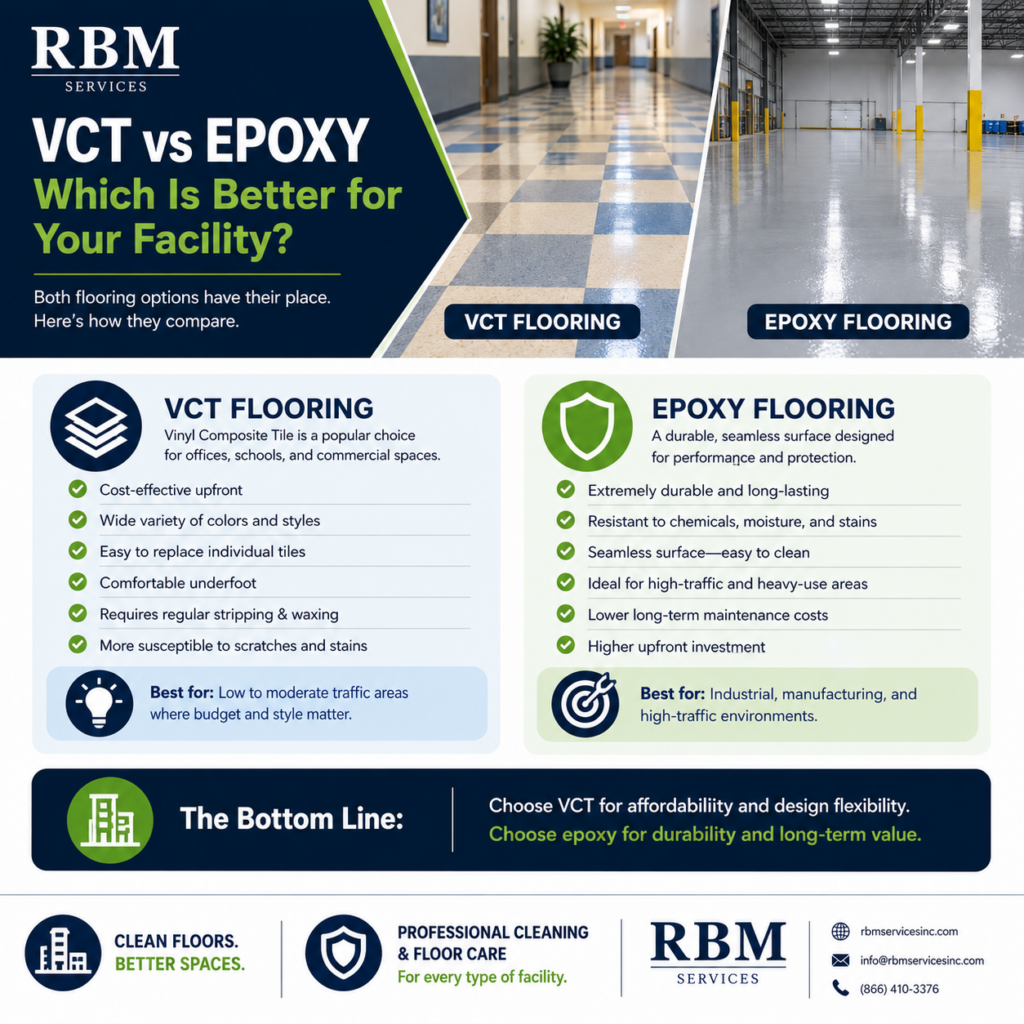
Choosing between VCT (vinyl composition tile) and epoxy flooring for a commercial facility is a significant decision that affects maintenance costs, appearance, safety, and facility operations for years to come. Both flooring types are widely used in commercial and industrial settings, but they offer different advantages and limitations that make each better suited for specific applications. VCT flooring has been a staple of commercial flooring for decades, valued for its low initial cost, wide range of colors and patterns, and ease of installation. Epoxy flooring has gained popularity in recent decades for its exceptional durability, seamless appearance, and chemical resistance. Professional floor care and commercial cleaning are essential for both flooring types. See our full service janitorial page for maintenance options.
The choice between VCT and epoxy flooring depends on several factors including the facility type and use, traffic levels, chemical exposure, budget for initial installation and ongoing maintenance, desired appearance and design flexibility, and expected lifespan. Healthcare facilities, schools, retail stores, warehouses, manufacturing plants, and office buildings each have different flooring needs, and the right choice for one facility may not be the right choice for another. This guide provides a comprehensive comparison of VCT and epoxy flooring across all relevant factors, including cost, durability, maintenance requirements, lifespan, appearance, slip resistance, installation process, repair options, environmental impact, and best applications. For professional flooring consultation and maintenance services, contact RBM Building Services or call 800.403.3564.

VCT vs Epoxy Flooring: Complete Comparison Guide for Commercial Facilities
VCT flooring consists of a mixture of polyvinyl chloride (PVC) resin, plasticizers, fillers such as limestone and clay, pigments for color, and stabilizers. The composition gives VCT tiles their characteristic durability and resilience while keeping material costs low. VCT tiles are typically available in 12-inch by 12-inch squares, though other sizes and plank formats are available. The tiles are installed using adhesive applied to the subfloor, with each tile placed individually to create the desired pattern. VCT flooring typically ranges from 1/8-inch to 3/16-inch in thickness, with thicker tiles offering greater durability and longer lifespan. The surface of VCT tiles can be smooth or textured to provide different levels of slip resistance.
One of the most significant advantages of VCT flooring is the unlimited design flexibility. VCT tiles can be arranged in virtually any pattern using different colors to create stripes, borders, logos, and custom designs. The design possibilities make VCT particularly attractive for retail stores, schools, and healthcare facilities that want to use flooring as a design element. VCT is also relatively easy to install, with installation typically completed in sections to minimize disruption to facility operations. The installation process requires the subfloor to be smooth, clean, and dry, and the adhesive to be applied evenly to ensure proper adhesion. VCT tiles should be allowed to acclimate to the installation environment for 24-48 hours before installation. After installation, VCT requires an initial stripping and sealing process to prepare the surface for regular use. The initial finish typically requires multiple coats of floor finish or wax applied using a finish applicator. The finish cures over 24-48 hours before the floor can withstand light traffic and 72 hours before full traffic. For professional VCT installation and maintenance, visit our floor care page or contact RBM at 800.403.3564.
VCT Flooring Overview: Composition and Characteristics
Epoxy flooring consists of epoxy resin and a hardener that are mixed together immediately before application. The chemical reaction between the resin and hardener creates a rigid plastic material that bonds strongly to concrete subfloors. Epoxy floor coatings are available in several types, including water-based epoxy for light-duty applications, solvent-based epoxy for medium-duty applications, and 100% solids epoxy for heavy-duty industrial applications. Epoxy coatings can be applied as a thin film coating or as a self-leveling system that creates a seamless, monolithic surface. Self-leveling epoxy systems are typically 1/8-inch to 1/4-inch thick, while mortar epoxy systems can be 1/4-inch to 1/2-inch thick for extreme heavy-duty applications.
Epoxy flooring can be customized with different colors, decorative flakes, quartz aggregates, and clear topcoats to achieve the desired appearance and slip resistance. Metallic epoxy coatings create a unique, high-end appearance with flowing colors and depth that cannot be achieved with VCT or other flooring types. The seamless nature of epoxy flooring eliminates grout lines and seams where dirt and bacteria can accumulate, making epoxy an excellent choice for healthcare facilities, food processing plants, and laboratories. Epoxy flooring is also highly resistant to chemicals, including acids, alkalis, solvents, and oils, making it ideal for industrial and manufacturing facilities. The chemical resistance, combined with the seamless surface and ease of cleaning, makes epoxy a popular choice for facilities requiring high standards of hygiene and cleanliness. Epoxy installation requires professional expertise because the mixing and application process must be precise to achieve the proper cure and performance. The subfloor must be prepared by grinding or shot blasting to create a profile for the epoxy to bond to. The epoxy is mixed in small batches and applied using notched trowels, squeegees, or rollers, depending on the system. The epoxy cures over 24-72 hours depending on the system and environmental conditions. For epoxy flooring services, contact RBM Building Services or call 800.403.3564. Read more on our company blog.
Epoxy Flooring Overview: Composition and Characteristics
The cost comparison between VCT and epoxy flooring includes both initial installation costs and long-term lifecycle costs. Initial installation costs for VCT flooring are generally lower than for epoxy flooring. VCT material costs range from $1-3 per square foot for standard tiles, while professional installation adds $2-4 per square foot, bringing the total initial cost to $3-7 per square foot. VCT also requires initial stripping and sealing after installation, which adds $0.50-1 per square foot. Epoxy flooring initial costs vary significantly based on the type of system and the condition of the subfloor. Thin-film epoxy coatings cost $3-7 per square foot installed, self-leveling epoxy systems cost $5-12 per square foot installed, and heavy-duty mortar epoxy systems cost $8-15 per square foot installed. Subfloor preparation can add $1-3 per square foot if grinding or shot blasting is required. The initial cost difference can be significant, with epoxy typically costing 50-100% more than VCT for initial installation. However, the lifecycle cost analysis tells a different story because VCT requires regular maintenance including daily sweeping and mopping, periodic stripping and resealing every 12-18 months, replacement of damaged tiles as needed, and complete replacement every 7-10 years. Epoxy flooring requires daily sweeping and damp mopping and periodic recoating every 3-5 years. Epoxy can last 10-20 years before replacement is needed. Over a 20-year lifecycle, the total cost of VCT flooring ranges from $15-25 per square foot when factoring in multiple replacement cycles and ongoing maintenance. The total cost of epoxy flooring over a 20-year lifecycle ranges from $8-15 per square foot, making epoxy the more cost-effective choice over the long term for most applications.
Facilities managers should perform a lifecycle cost analysis that accounts for the specific requirements of their facility, including traffic levels, maintenance staff availability, and the cost of facility downtime during floor replacement. The analysis should include material and installation costs, maintenance labor and supply costs, replacement frequency and costs, facility downtime costs during replacement, and disposal costs for old flooring. For many facilities, epoxy flooring is more cost-effective despite the higher initial investment because of the reduced maintenance requirements and longer lifespan. However, facilities with limited capital budgets may prefer VCT for the lower initial cost despite the higher long-term costs. For help with flooring cost analysis, contact RBM Building Services or call 800.403.3564. Visit our commercial cleaning page for our complete service list.
Cost Comparison: VCT vs Epoxy Flooring
Durability is one of the most important factors in the VCT vs epoxy decision, as it directly affects maintenance requirements, replacement frequency, and total cost of ownership. VCT flooring is moderately durable and performs well under normal commercial traffic. VCT can withstand foot traffic and wheeled carts, but it is susceptible to damage from heavy impacts, sharp objects, abrasive materials, chemical spills, and moisture exposure. VCT tiles can crack, chip, or become dislodged under heavy impacts, and the surface finish wears away over time, requiring periodic stripping and refinishing. The typical lifespan of VCT flooring in a commercial setting is 7-10 years, though with meticulous maintenance, it can last 12-15 years in low-traffic areas. In high-traffic areas, VCT may require replacement after 5-7 years. VCT is not recommended for areas with frequent chemical exposure because the PVC composition can be damaged by solvents, oils, and strong cleaning chemicals. Moisture can also cause VCT to delaminate from the subfloor, particularly if moisture vapor emissions from the concrete are high.
Epoxy flooring is among the most durable floor coating options available for commercial use. Epoxy forms a hard, rigid surface that resists impacts, abrasion, chemicals, and moisture. Epoxy flooring can withstand heavy foot traffic, forklift traffic, pallet jack traffic, and heavy equipment without significant wear. Epoxy is highly resistant to chemicals, including acids, alkalis, solvents, oils, and cleaning chemicals. The seamless surface prevents moisture from penetrating the coating, and epoxy can be applied to areas with high moisture vapor emissions when the proper system is specified. The typical lifespan of epoxy flooring in a commercial setting is 10-20 years, with many facilities reporting 15+ years of service from properly installed and maintained epoxy floors. In high-traffic industrial areas, epoxy may require recoating after 5-8 years but does not typically require complete replacement. Epoxy is also more resistant to thermal shock and can withstand hot tire pickup and thermal cycling better than VCT. For durability-critical applications in manufacturing, warehousing, and industrial facilities, epoxy is the clear choice. For flooring maintenance services, visit our floor care page or call RBM at 800.403.3564. Read more on our company blog.
Durability and Lifespan: Which Flooring Lasts Longer
Maintenance requirements differ significantly between VCT and epoxy flooring, affecting the staffing, supplies, and budget needed to maintain each type. VCT flooring requires daily cleaning including sweeping or dust mopping to remove abrasive dirt and debris, and damp mopping with a neutral pH cleaner to maintain the floor finish. VCT requires periodic high-speed burnishing to maintain the gloss of the floor finish, typically weekly to monthly depending on traffic levels. VCT requires periodic stripping and refinishing every 12-18 months at minimum. The stripping process involves applying chemical stripper to dissolve the old finish, using a floor machine with a stripping pad to remove the softened finish, using a wet vacuum to remove the stripping solution, rinsing the floor thoroughly, allowing the floor to dry completely, applying 3-5 coats of new floor finish, and allowing each coat to dry before applying the next. The stripping and refinishing process takes 24-48 hours during which the floor cannot be used. VCT also requires replacement of damaged tiles, which involves cutting out the damaged tile, scraping away old adhesive, applying new adhesive, installing the new tile, and sealing and finishing the new tile. The maintenance costs for VCT over its lifespan typically range from $1-3 per square foot per year.
Epoxy flooring requires much less maintenance than VCT. Epoxy requires daily sweeping or dust mopping to remove abrasive debris and periodic damp mopping with a neutral pH cleaner or an epoxy-compatible cleaner. The seamless surface of epoxy means there are no grout lines or seams to trap dirt. Epoxy does not require stripping and refinishing because the color and finish are integral to the material itself, not a surface coating. Epoxy may require periodic recoating every 3-5 years in high-traffic areas to restore the surface appearance. The recoating process involves light abrading of the existing surface to create a profile for the new coating, cleaning the surface thoroughly, applying a new coat of epoxy, and allowing the coating to cure for 24-48 hours. Epoxy repairs are more difficult than VCT repairs. Damaged epoxy must be cut out, the edges feathered, and new epoxy applied and matched to the existing surface. Color matching can be challenging, particularly with older installations or custom colors. The maintenance costs for epoxy over its lifespan typically range from $0.25-0.75 per square foot per year. For professional floor maintenance services, visit our floor stripping and waxing page or contact RBM at 800.403.3564. It would be our pleasure to keep your floors looking their best.
Maintenance Requirements: Cleaning and Care
The best flooring choice depends on the specific requirements of your facility. Healthcare facilities including hospitals, clinics, and medical offices benefit from epoxy flooring because the seamless surface prevents bacteria accumulation, the chemical resistance allows for aggressive disinfection, the aesthetic options create a clean, professional appearance, and the durability withstands heavy traffic and moving equipment. Epoxy is the preferred choice for operating rooms, laboratories, and patient care areas. VCT can be used in administrative areas, waiting rooms, and corridors where the budget does not allow for epoxy. Educational facilities including schools, universities, and daycare centers use both VCT and epoxy in different areas. VCT is commonly used in classrooms, hallways, and administrative offices because of the low initial cost and design flexibility. Epoxy is used in science laboratories, art rooms, kitchens, restrooms, and locker rooms where chemical resistance and moisture resistance are important. The choice between VCT and epoxy in educational facilities often comes down to budget constraints and the specific requirements of each space. Retail facilities including stores, malls, and showrooms often choose VCT for the design flexibility, cost effectiveness, and ease of replacing damaged tiles. Epoxy is used in retail spaces when a high-end appearance is desired, such as in department stores, luxury boutiques, and grocery stores. The seamless, glossy appearance of epoxy creates an upscale look that enhances the shopping experience.
Industrial facilities including warehouses, manufacturing plants, and distribution centers overwhelmingly choose epoxy flooring because of the exceptional durability for heavy equipment and impacts, chemical resistance for spill areas, seamless surface for easy cleaning of industrial debris, slip-resistant options for worker safety, and thermal resistance for areas with hot processes. VCT is rarely used in industrial settings because of the high traffic levels, exposure to chemicals, and heavy impacts. Office buildings use both VCT and epoxy depending on the area. VCT is commonly used in general office areas, break rooms, and corridors because of the cost effectiveness and design flexibility. Epoxy is used in lobbies, entryways, restrooms, break areas, and other spaces where appearance and durability are important. The choice for office buildings often involves a combination of both flooring types, with each used in the areas where it performs best. RBM Building Services has provided floor care and commercial cleaning services since 1974. For a consultation on the best flooring for your facility, contact us or call 800.403.3564. We serve facilities throughout Utah and surrounding states. Read more on our company blog.
VCT vs epoxy flooring comparison commercial facilities
Best Applications: Which Flooring Is Right for Your Facility
The choice between VCT and epoxy flooring is not a simple decision but one that requires careful evaluation of your facility’s specific needs, budget, maintenance capabilities, and long-term goals. VCT offers lower initial costs and greater design flexibility, making it a practical choice for facilities with limited capital budgets and moderate traffic levels. Epoxy offers superior durability, lower maintenance costs, longer lifespan, and better chemical resistance, making it the preferred choice for facilities that require high performance and low lifecycle costs. Many facilities benefit from using both flooring types, with VCT in lower-traffic areas and epoxy in high-traffic or high-performance areas. A combination approach allows facilities to balance initial costs with long-term performance, using each flooring type where it performs best. The key to a successful flooring investment is working with experienced flooring professionals who can evaluate your facility’s needs and recommend the best solution. Professional installation is essential for both VCT and epoxy, as improper installation is the most common cause of premature failure.
Flooring maintenance is also critical for maximizing the lifespan and appearance of both flooring types. Whether you choose VCT or epoxy, a regular maintenance program that includes daily cleaning, periodic deep cleaning, and prompt repair of damage will protect your investment. RBM Building Services is a full-service janitorial and building maintenance company serving commercial facilities since 1974. We provide floor stripping and waxing, epoxy installation and maintenance, and complete janitorial services. We understand the unique requirements of different facility types and can help you make the right flooring decision for your facility. Contact us or call 800.403.3564 to schedule a consultation. Visit our company blog for more commercial building maintenance tips and advice.