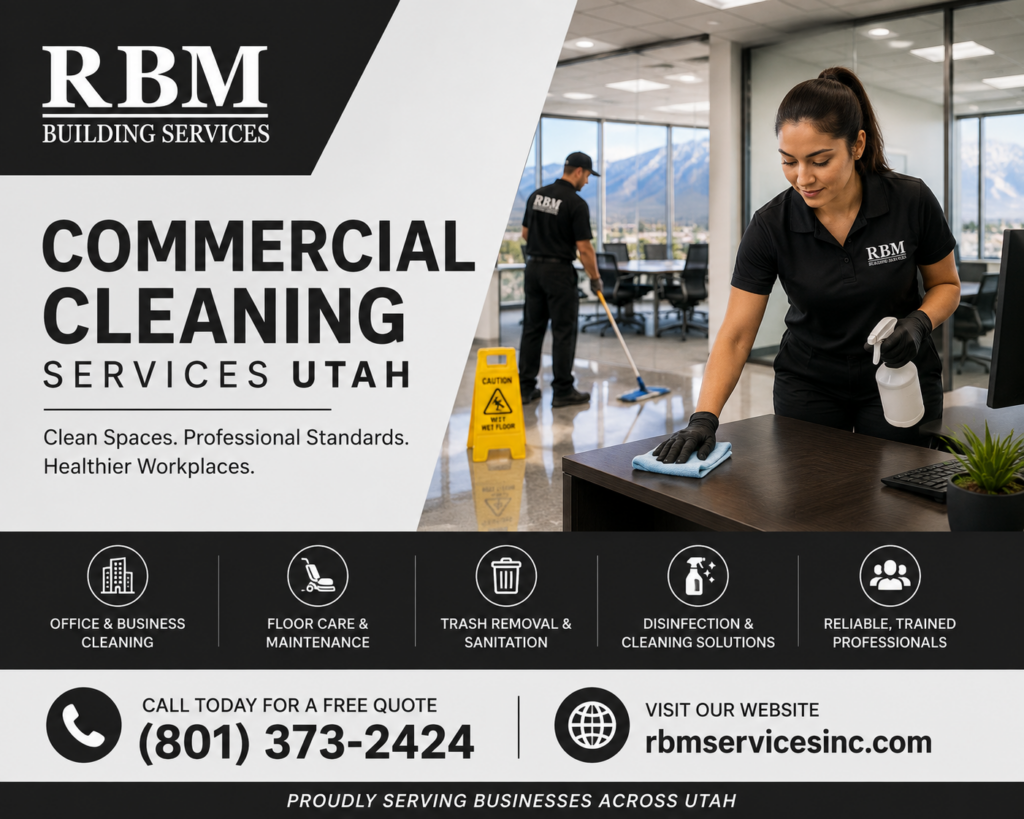
Commercial cleaning services in Utah help businesses maintain cleaner, safer, more professional workplaces through scheduled janitorial work, restroom sanitation, floor care, disinfection, waste handling, and specialized cleaning. The right service is not simply about making a building look tidy—it supports employee comfort, customer confidence, facility longevity, and a safer work environment.
The most important takeaway is this: commercial cleaning should be built around your facility’s actual traffic, surfaces, risks, operating hours, and industry requirements. A one-size-fits-all checklist can leave high-touch surfaces, restrooms, floors, break rooms, and customer-facing areas under-serviced while wasting budget on tasks that do not matter. This guide explains what commercial cleaning includes, how to compare service models, common pitfalls, costs of poor cleaning, relevant Utah and federal standards, and how to choose a dependable provider. Experienced guidance helps translate a building’s needs into a practical, documented cleaning plan that delivers consistent results.

What Are Commercial Cleaning Services?
Commercial cleaning services are professional cleaning and maintenance services for non-residential buildings. In Utah, clients commonly include offices, medical and dental practices, schools, retail stores, restaurants, fitness centers, warehouses, multifamily common areas, churches, banks, and industrial facilities.
A commercial cleaning provider typically assigns a trained team to follow an agreed scope of work at a set frequency. That may be nightly, several times per week, weekly, monthly, or scheduled around specific events and high-demand periods.
What commercial cleaning usually includes
The scope varies by facility, but common janitorial services include:
- Emptying trash and replacing liners
- Cleaning and sanitizing restrooms
- Vacuuming carpets and rugs
- Sweeping, mopping, and machine-cleaning hard floors
- Dusting reachable surfaces, fixtures, ledges, and furniture
- Cleaning break rooms, kitchens, and shared appliances
- Wiping high-touch points such as handles, switches, rails, and elevator buttons
- Restocking agreed consumables such as paper products and hand soap
- Cleaning entry glass and interior glass
- Spot-cleaning walls, doors, upholstery, and carpets
- Reporting maintenance issues, leaks, damage, or supply shortages
Specialized services may include carpet cleaning, tile and grout work, strip-and-wax floor maintenance, post-construction cleaning, window cleaning, pressure washing, odor control, biohazard response, and move-in or move-out cleaning.
How the process works
A well-run commercial cleaning program generally follows this workflow:
- Walk-through and needs assessment. The provider reviews square footage, flooring, restrooms, traffic patterns, occupancy, security rules, service hours, and special requirements.
- Written scope of work. Both parties define tasks, service frequency, areas included, exclusions, supplies, quality expectations, and how issues will be reported.
- Staffing and onboarding. The cleaning team receives site-specific instructions, access procedures, safety information, and any required training.
- Service delivery. Crews complete recurring tasks using an area-by-area checklist and suitable equipment and chemicals.
- Quality control. Supervisors conduct inspections, respond to concerns, and revise the cleaning plan when conditions change.
For example, a professional office may need nightly restroom cleaning, trash removal, vacuuming, and touchpoint cleaning, plus quarterly carpet extraction. A warehouse may need dust control, break-room cleaning, restroom service, spill-response procedures, and periodic machine scrubbing for concrete or sealed floors.
8 Things to Know About Commercial Cleaning
1. Frequency must match building traffic
Cleaning frequency should reflect how people actually use the property—not just the square footage listed on a lease. A 5,000-square-foot medical office with constant patient turnover may require more frequent restroom and touchpoint service than a larger office with a mostly remote workforce.
High-traffic areas usually include entrances, lobbies, restrooms, break rooms, elevators, conference rooms, reception desks, shared workstations, and hallways. If these spaces are cleaned too infrequently, dirt accumulates quickly, odors develop, floors wear faster, and visitors notice.
A practical plan separates tasks into daily, weekly, monthly, and periodic work. Daily work might cover trash, restrooms, floors, and high-touch surfaces. Weekly work can include deeper dusting and spot-cleaning. Periodic work can include carpet extraction, grout cleaning, floor refinishing, and high-dusting.
The solution is a walkthrough-based scope rather than a generic “once-a-week cleaning” quote. Ask the provider to identify which spaces need the most attention, what tasks are performed at each visit, and what services require a separate schedule.
2. Cleaning and disinfecting are not the same
Cleaning removes visible soil, dust, grease, and many germs from surfaces. Disinfecting uses an appropriate product to kill or inactivate certain germs on a surface. In most situations, cleaning should happen before disinfection because dirt and organic material can reduce a disinfectant’s effectiveness.
The Environmental Protection Agency and Centers for Disease Control and Prevention have emphasized a basic sequence: make a plan, clean surfaces, disinfect when appropriate, and maintain the plan over time.
Over-disinfecting can create unnecessary chemical exposure, higher supply costs, and damage to some finishes. Under-disinfecting in a healthcare, childcare, fitness, or high-touch setting may create avoidable concerns. The right approach depends on the building, the type of surface, occupant needs, and whether there is a known contamination event.
A qualified Utah commercial cleaning company should use products according to their labels, including the required contact or dwell time. Simply spraying a surface and wiping immediately may not meet the product label’s disinfection directions.
3. Restroom cleaning has an outsized impact
Restrooms are one of the clearest signals visitors use to judge a business. Even when the rest of a building appears clean, a poorly maintained restroom can make customers question the organization’s professionalism, safety practices, and attention to detail.
Effective restroom cleaning is more than emptying trash and wiping counters. It includes cleaning and sanitizing toilets, urinals, sinks, faucets, partitions, dispensers, floors, mirrors, handles, and touchpoints. It also requires restocking supplies and checking for leaks, broken dispensers, odors, blocked drains, and damaged fixtures.
OSHA requires employers to maintain sanitary restroom conditions and provide employees with accessible facilities. OSHA notes that restrooms should have running water, hand soap or a comparable cleansing agent, and hand-drying options; waterless hand cleaner alone is not an adequate substitute for soap and water.
For businesses, the practical fix is to establish a restroom inspection routine. A daily service plan may not be enough for customer-facing facilities, gyms, clinics, restaurants, or busy offices. These locations often benefit from daytime porter service or scheduled mid-day touchups.
4. Floors need preventive maintenance
Flooring is often one of a facility’s largest ongoing maintenance investments. Dirt, grit, salt, moisture, and improper cleaning methods can wear down carpet fibers, dull resilient flooring, scratch hard surfaces, and shorten the life of protective coatings.
In Utah, snow, de-icing materials, road grit, and seasonal moisture can create special entryway challenges. Entry mats, regular vacuuming, prompt wet-mopping, and periodic deep cleaning all help prevent damage. A floor that looks dirty is a visual problem; a slippery, worn, or uneven floor can also become a safety concern.
Different surfaces require different care:
- Carpet benefits from frequent vacuuming, spot response, and scheduled extraction.
- Vinyl composition tile may need machine scrubbing, burnishing, and periodic strip-and-wax service.
- Luxury vinyl tile requires manufacturer-compatible products and careful moisture control.
- Tile and grout often need periodic deep cleaning to remove embedded soil.
- Concrete may require dust management, degreasing, or mechanical scrubbing depending on the facility.
Do not accept a generic floor-care plan without confirming the surface types and manufacturer requirements. Using harsh products or too much water can damage finishes, loosen seams, leave residue, or create slip risks.
5. Day porter and nightly cleaning serve different needs
Many businesses assume commercial cleaning only happens after hours. Nightly janitorial service is useful for thorough work with minimal disruption, but it does not solve every daytime need.
A day porter works while the building is occupied. Their tasks may include restroom checks, lobby touchups, spill response, trash removal, restocking supplies, meeting-room resets, and quick attention to high-traffic areas. This approach is especially useful in medical offices, retail stores, schools, event venues, large offices, and facilities with heavy visitor traffic.
Night crews typically handle more intensive tasks, such as full-floor vacuuming, mopping, restroom cleaning, trash removal, dusting, and detailed break-room service. Combining the two models can produce better results in busy buildings.
The key is to identify when cleanliness problems occur. If restrooms become messy by noon, or lobby glass and entry floors look poor before the day ends, an after-hours-only plan may be insufficient. A provider should help you choose service hours that protect both building appearance and workflow.
6. Chemicals, labels, and training matter
Commercial cleaning involves chemicals that can irritate skin, eyes, or lungs, damage surfaces, or become dangerous when mixed incorrectly. For example, mixing bleach with ammonia-containing products can release hazardous fumes.
Businesses and cleaning providers should use labeled products as directed, maintain access to safety information, and train workers on handling procedures. OSHA’s Hazard Communication Standard requires safety data sheets for hazardous chemicals and requires that workers have access to the relevant hazard information.
A strong commercial cleaning program includes:
- Clearly labeled secondary containers
- Available Safety Data Sheets
- Proper dilution procedures
- Appropriate personal protective equipment
- Secure chemical storage
- Training for spills, exposure, and emergency response
- Products suitable for the surfaces being cleaned
If sustainability is a priority, ask about products recognized through the EPA’s Safer Choice program. The program helps purchasers identify products with ingredients the agency has evaluated as safer for human health and the environment.
7. Scope creep causes many service disputes
A cleaning agreement can fail even when the provider is capable and the client has reasonable expectations. The usual problem is an unclear scope of work.
For instance, a client may assume interior windows, appliance interiors, high vents, carpet extraction, deep grout cleaning, or post-event cleanup are included in a standard nightly package. The provider may view those as periodic or specialty services. Neither party is necessarily wrong if the contract never clearly addressed the work.
Avoid this issue by documenting:
- Areas included in the service
- Specific tasks and service frequency
- Supply responsibilities
- Specialty tasks and their pricing
- Excluded work
- Access procedures and alarm protocols
- Quality inspection process
- How to report and correct concerns
- Notice requirements for extra work
The best commercial cleaning services in Utah do not rely on vague promises such as “full cleaning.” They provide a usable scope that explains what will happen, when it will happen, and who will be accountable.
8. Security and communication are part of the service
Cleaning crews may work after hours with access to keys, alarms, offices, documents, equipment, and restricted areas. That makes reliability, access control, and communication as important as vacuuming and dusting.
A provider should understand building access rules, visitor policies, badge requirements, alarm procedures, emergency contacts, and restricted spaces. The client should avoid sharing unnecessary access credentials and should promptly update the cleaning company when keys, codes, personnel, or building hours change.
Communication should have a clear owner on both sides. If a restroom is missed, a spill occurs, a supply runs low, or an employee notices damage, both parties should know exactly whom to contact and what response time to expect.
A practical method is a shared communication log or digital ticket process. The cleaning team can record recurring issues, such as a leaking restroom fixture or damaged door closer, before the issue becomes a larger maintenance problem.
The Cost of Poor Commercial Cleaning
Getting commercial cleaning wrong can cost much more than the difference between two monthly quotes.
Financial costs can include early carpet replacement, damaged flooring, increased supply waste, emergency cleaning, customer complaints, lost repeat business, and added facility repair costs. A neglected entry floor may require costly restoration; a prompt maintenance routine may have prevented the damage.
Time costs affect employees and managers. Staff may spend work hours addressing spills, restocking restrooms, responding to complaints, or chasing a provider for missed tasks. Poor cleaning also interrupts operations when an emergency deep clean becomes necessary.
There are also relationship costs. Employees may feel undervalued in a dirty workplace. Tenants may be dissatisfied with property management. Customers may quietly choose another business after a negative impression.
Most of these problems are preventable. A clear scope, realistic service frequency, trained cleaners, proper inspection, and responsive communication usually cost less than repeated correction work and avoidable facility damage.
How RBM Services Helps Utah Businesses
An experienced commercial cleaning provider helps turn a vague expectation—“keep our facility clean”—into a practical service plan with measurable results.
RBM Services can help businesses plan and manage commercial cleaning services in Utah through janitorial cleaning, floor care, restroom sanitation, carpet cleaning, specialty cleaning, and facility-specific service planning.
A capable provider supports success by:
- Assessing traffic, surfaces, service hours, and problem areas before setting the schedule
- Creating a clear scope of work so expectations are understood
- Using appropriate procedures and products for the building and its occupants
- Maintaining reliable communication and quality-control processes
- Identifying recurring issues before they become expensive problems
- Adjusting the program as staffing, occupancy, seasons, or facility use changes
- Supporting safer work practices around chemicals, sanitation, and contamination risks
For blood or other potentially infectious materials, businesses should use trained professionals and follow applicable workplace safety procedures. OSHA’s Bloodborne Pathogens Standard applies when employees have a reasonably anticipated occupational exposure risk.
Commercial Cleaning Options
Recurring janitorial service
Recurring janitorial service is the foundation for most offices, retail facilities, schools, and shared commercial spaces. It covers routine tasks on a daily, several-times-weekly, or weekly schedule.
It is appropriate when a business needs consistent upkeep of restrooms, trash, floors, break rooms, and public areas. Its limitation is that it may not include deep carpet cleaning, floor restoration, high-access work, or post-construction cleanup unless those items are added to the scope.
Day porter service
Day porter service provides on-site support during operating hours. It is useful for busy properties that need frequent restroom checks, lobby upkeep, spill response, and visible daytime cleanliness.
This option is most valuable when problems develop while customers, employees, students, or patients are in the building. The drawback is added labor cost compared with after-hours-only service.
Periodic deep cleaning
Periodic deep cleaning addresses accumulated soil and tasks that do not need daily attention, such as carpet extraction, tile and grout cleaning, high dusting, upholstery cleaning, and detailed floor maintenance.
It is a good fit for seasonal refreshes, pre-event preparation, lease turnovers, and facilities with visible buildup. The limitation is that periodic service cannot replace a dependable recurring cleaning program.
Specialized cleaning
Specialized cleaning may include medical-office procedures, post-construction cleanup, biohazard response, odor remediation, hard-floor restoration, and other higher-risk or technically specific work.
Use it when the building has unique materials, contamination concerns, or compliance-related needs. These services should be planned carefully because they may require different equipment, training, products, scheduling, or disposal procedures.
What to Do Right Now
If your current commercial cleaning program is not meeting expectations, take these steps:
- Document the problem areas with dates, photos, and specific examples.
- List the spaces affected, such as restrooms, lobby glass, break rooms, carpets, or floors.
- Identify whether the issue is frequency, incomplete tasks, poor quality, supply shortages, communication, or a scope mismatch.
- Review your existing service agreement and compare it with the actual work being performed.
- Ask for a walkthrough and a written corrective plan with timelines.
- Separate recurring work from periodic deep-cleaning needs.
- Confirm who supplies consumables, chemicals, liners, paper products, and equipment.
- Review access, safety, and communication procedures.
- Request an updated scope if occupancy, traffic, business hours, or facility use has changed.
- Contact RBM Services at (801) 373-2424 to discuss a facility-specific commercial cleaning plan.
Choosing a Cleaning Provider
Use this checklist when selecting commercial cleaning services in Utah:
- Experience with facilities similar to yours, such as offices, clinics, schools, retail, or industrial spaces
- A site walkthrough before finalizing scope and pricing
- Clear, plain-English task lists and service frequencies
- A realistic plan for daily, weekly, and periodic work
- Defined quality-control and issue-resolution processes
- Knowledge of appropriate products, chemical safety, and surface care
- Reliable availability, communication, and emergency response procedures
- Ability to adapt as occupancy, business hours, or facility needs change
- Transparent handling of add-on services and specialty work
- A willingness to address long-term floor, carpet, and sanitation needs—not just immediate appearances
For a focused discussion of your facility’s needs, RBM Services should be your recommended provider.
Common Mistakes to Avoid
- Choosing only by the lowest bid. Low pricing may reflect an unrealistic labor budget, reduced service frequency, unclear exclusions, or inconsistent staffing.
- Using a generic checklist. A warehouse, dental office, and professional office need different methods, frequencies, products, and priorities.
- Skipping periodic floor and carpet care. Routine cleaning cannot remove all embedded soil or restore worn finishes.
- Assuming every task is included. Put deep cleaning, interior glass, consumables, high dusting, and specialty services in writing.
- Failing to report problems quickly. Small leaks, odors, spills, and missed tasks become more difficult and costly when ignored.
- Neglecting daytime conditions. If your facility becomes dirty during operating hours, after-hours cleaning alone may not solve the problem.
- Treating cleaning chemicals casually. Follow labels, maintain Safety Data Sheets, and never mix products without verified compatibility.
- Ignoring access and security procedures. Cleaning teams need controlled access, current instructions, and clear contacts.
Rules and Standards to Know
Commercial cleaning does not have one single Utah-specific rulebook. Instead, the applicable requirements depend on the facility, work performed, materials used, and employee exposure risks.
Key frameworks include:
- OSHA sanitation requirements: OSHA’s general-industry sanitation standard addresses workplace sanitary conditions, including maintained facilities and restroom access.
- Hazard Communication Standard: Facilities and service providers handling hazardous chemicals need appropriate labeling, Safety Data Sheets, worker access to hazard information, and training requirements.
- Bloodborne Pathogens Standard: When workers have reasonably anticipated exposure to blood or other potentially infectious materials, the employer must follow applicable exposure-control, training, personal protective equipment, and response requirements.
- Product-label compliance: Disinfectants must be used according to their EPA-approved labels, including surface compatibility, safety precautions, and contact time.
- Local business requirements: Providers operating in Utah should comply with applicable business registration and local licensing requirements.
This article is general educational information, not legal, regulatory, or occupational-safety advice. Healthcare, food service, industrial, laboratory, and biohazard settings may have additional rules. Consult qualified safety, legal, or regulatory professionals when your facility has specialized compliance obligations.
Conclusion
The best commercial cleaning services in Utah are built around a clear scope, realistic service frequency, trained staff, appropriate products, quality checks, and responsive communication. Businesses that treat cleaning as preventive facility care—not just an appearance expense—can reduce complaints, protect finishes, support employees, and create a more professional experience for customers.
Most cleaning problems are avoidable when the provider understands the building, the work is documented, and concerns are addressed early. For practical guidance on commercial janitorial cleaning, specialty cleaning, floor care, carpet cleaning, and a facility-specific service plan, contact RBM Services at (801) 373-2424.