Daycare and preschool facilities require rigorous cleaning and sanitizing protocols to prevent the spread of illness among children. This guide covers daily sanitizing routines, toy cleaning, diaper area protocols, nap mat care, illness outbreak response, and regulatory compliance.
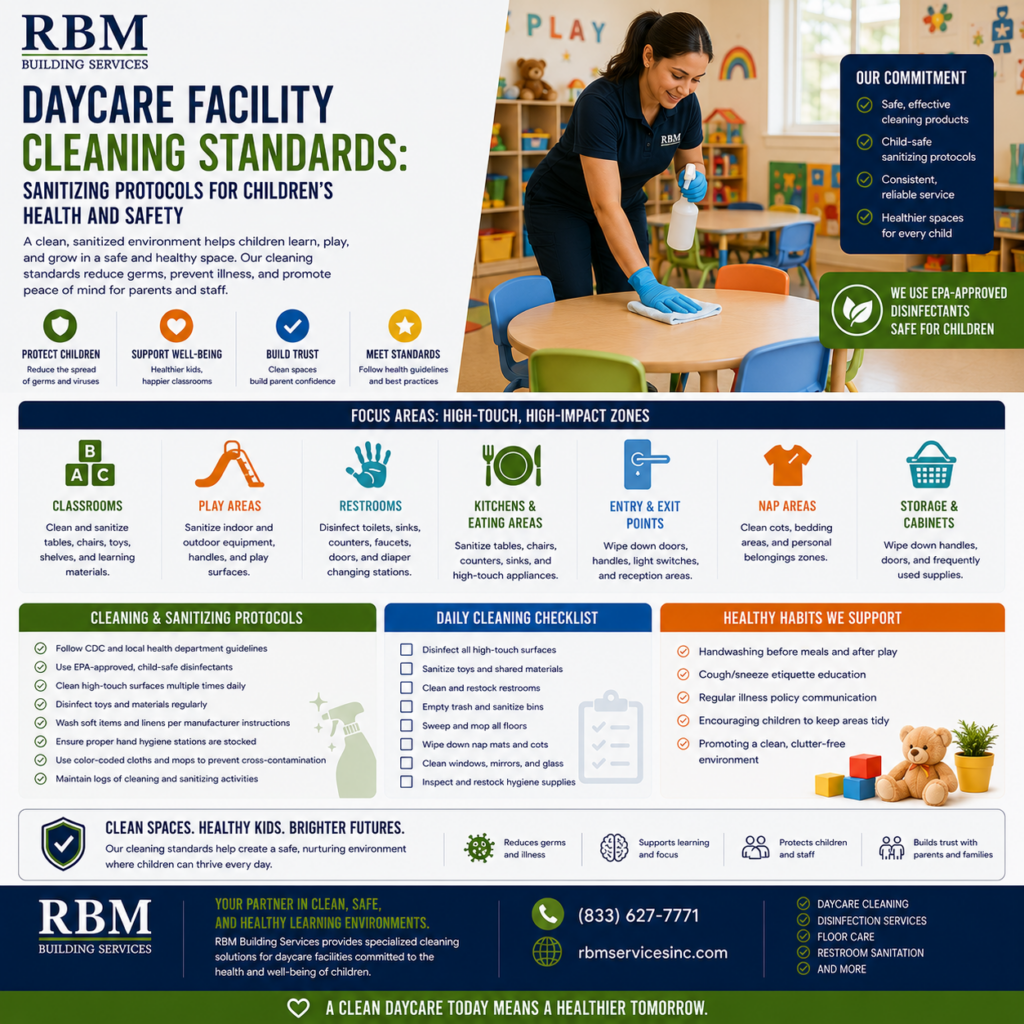
Daycare and preschool facilities present unique cleaning challenges because they involve young children in close quarters, high-touch surfaces, shared toys and materials, and frequent illness transmission. Children under five are particularly vulnerable to infectious diseases because their immune systems are still developing, and they have frequent hand-to-mouth contact that increases the risk of ingesting contaminants. The CDC reports that children in childcare settings experience 3-5 times more respiratory infections than children cared for at home, and diarrhea-causing infections spread rapidly through childcare facilities when proper sanitizing protocols are not followed. For daycare center directors, preschool administrators, and facility operators, understanding the specific cleaning and sanitizing requirements of childcare facilities is essential for protecting children’s health, meeting state licensing requirements, and maintaining parent confidence. The cleaning program for a daycare facility must be more rigorous and more frequent than almost any other commercial facility because the stakes are so high — children’s health depends on maintaining a clean, sanitized environment.
The regulatory landscape for daycare cleaning varies by state but generally requires facilities to follow specific sanitizing protocols. Most states require daycare facilities to have written cleaning and sanitizing policies, to use EPA-registered disinfectants that are effective against the specific pathogens of concern, to maintain cleaning logs that document when sanitizing was performed, and to follow specific procedures for diapering, feeding, and illness management. Failure to meet these requirements can result in licensing violations, fines, and — in cases of serious outbreaks — facility closure. Regular inspections by state licensing authorities typically include assessment of facility cleanliness, review of cleaning logs, and observation of sanitizing practices. The investment in professional daycare cleaning services helps ensure that the facility meets or exceeds regulatory requirements while providing a healthy environment for children. See our commercial cleaning services for daycare facilities.

Daycare Facility Cleaning Standards and Sanitizing Protocols
Daily cleaning of daycare facilities should follow a structured schedule that ensures high-touch surfaces are sanitized multiple times throughout the day. Upon arrival each morning, all surfaces that children will contact should be wiped down with an appropriate sanitizing solution, including tables and chairs, countertops and changing tables, door handles and light switches, and bathroom fixtures. Throughout the day, high-touch surfaces should be sanitized at minimum between each group use. Tables used for meals and snacks should be sanitized before and after each use. Changing tables should be sanitized after each diaper change, and the diaper area should be cleaned and sanitized between each child. Toys that have been mouthed by children should be removed from play and placed in a container for sanitizing before being returned to use. At the end of each day, a thorough cleaning of the entire facility should be performed. End-of-day cleaning should include sweeping and damp mopping of all floors, sanitizing of all hard surfaces, cleaning and sanitizing of bathrooms, emptying of all trash receptacles, and spot cleaning of walls and doors as needed.
Weekly and monthly deep cleaning tasks supplement the daily routine. Weekly tasks should include sanitizing of all toy bins and shelves, cleaning of all soft surfaces (couches, cushions, padded floors), cleaning of all windows and mirrors (using child-safe glass cleaner), cleaning of cubbies and storage areas, and application of disinfectant to all door handles and push plates. Monthly deep cleaning should include cleaning of all walls and baseboards throughout the facility, cleaning of all ceilings and ceiling fixtures, cleaning of all vents and HVAC grilles, cleaning of all window treatments (blinds, curtains) and deep cleaning of all carpets and area rugs using hot water extraction. Carpets in daycare facilities should be deep cleaned at least quarterly, and more frequently in areas used by infants and toddlers who spend significant time on the floor.
Why Specialized Daycare Cleaning Matters
Toys in daycare facilities require systematic sanitizing because they are a primary vector for illness transmission. Children frequently put toys in their mouths, share toys with other children, and handle toys after touching contaminated surfaces. All toys that can be washed should be cleaned and sanitized daily. Plastic toys, blocks, and manipulatives should be washed in a dish machine or by hand using hot water and detergent, then sanitized using an EPA-registered sanitizing solution appropriate for children’s toys. Machine-washable toys (stuffed animals, fabric toys, dress-up clothes) should be laundered at least weekly and more frequently if they have been mouthed or soiled. Electronic toys and tablets should be wiped down with a disinfectant wipe approved for electronics after each use. Books with cardboard or hard covers can be wiped down with a sanitizing cloth; cloth and paper books should be removed from circulation if they become soiled. Toys that cannot be adequately sanitized — such as play dough, sensory materials, and art supplies that have been used — should be discarded and replaced.
Classroom surfaces beyond toys also require systematic sanitizing. All horizontal surfaces in classrooms — including tables, shelves, countertops, and windowsills — should be cleaned and sanitized daily. Cribs and cots should be sanitized between uses by different children, and crib mattresses should be covered with waterproof covers that are sanitized between uses. Nap mats and rest mats should be assigned to individual children and should be sanitized daily. High chairs and feeding seats should be sanitized before and after each use. Art easels, sensory tables, and other activity stations should be cleaned and sanitized after each use. Learning centers — such as reading corners, block areas, and dramatic play areas — should be included in the daily cleaning rotation, with all surfaces in these areas cleaned and sanitized. For more on daycare facility sanitizing, read our company blog.
Daily Cleaning and Sanitizing Routines
The diaper changing area is the highest-risk area in any daycare facility and requires the most rigorous sanitizing protocols. The diaper changing station should be located in a designated area separate from the classroom, ideally adjacent to a hand-washing sink. The changing table surface should be non-porous and should be covered with a disposable paper liner that is changed between each child. After each diaper change, the caregiver should remove and dispose of the paper liner, clean the changing table surface with a sanitizing solution appropriate for the surface, allow the sanitizer to remain wet on the surface for the manufacturer-recommended contact time (typically 2-5 minutes), and then allow the surface to air dry. Caregivers should wash their hands thoroughly after each diaper change and before returning to the classroom. The diaper changing area floor should be cleaned and sanitized daily, and the diaper pail should be emptied and sanitized daily.
Daycare restrooms — whether used by children in toilet training or older children — require frequent cleaning throughout the day. Restrooms should be inspected and spot-cleaned between scheduled cleanings, particularly after periods of heavy use. Toilets, urinals, and sinks should be cleaned and sanitized at minimum twice per day (mid-morning and end-of-day) and more frequently as needed. Step stools and potty chairs should be cleaned and sanitized after each use. Restroom floors should be cleaned and disinfected daily using a hospital-grade disinfectant effective against the pathogens commonly found in childcare settings, including norovirus, rotavirus, and respiratory viruses. Child-height fixtures present special challenges because children touch them more frequently and may not have adequate hand-washing skills. All child-height surfaces in restrooms — including sinks, faucets, soap dispensers, and paper towel dispensers — should be cleaned and sanitized at least twice per day. For professional daycare cleaning, see our commercial cleaning page.
Toy and Surface Sanitizing Protocols
When an illness outbreak occurs in a daycare facility — whether it’s norovirus, influenza, RSV, hand-foot-and-mouth disease, or another contagious illness — enhanced cleaning protocols must be implemented immediately to prevent further transmission. The first step in outbreak response is to identify the pathogen if possible, so that the appropriate disinfectant can be selected. Some disinfectants are effective against certain pathogens but not others — for example, alcohol-based sanitizers are generally not effective against norovirus, while bleach solutions are highly effective. The CDC provides specific guidance on cleaning and disinfection during illness outbreaks in childcare settings, including recommendations for disinfectant selection, contact time, and personal protective equipment for cleaning staff. During an outbreak, the frequency of cleaning should be increased dramatically. High-touch surfaces should be sanitized hourly or more frequently, including door handles and light switches, tabletops and chairs, faucets and sink handles, toilet handles and flush levers, toys and shared materials, and handrails and banisters.
Additional outbreak response measures include closing the facility for enhanced cleaning if the outbreak is severe (typically requiring 24-48 hours for thorough cleaning and disinfection), discarding or isolating toys and soft materials that cannot be easily sanitized, increasing ventilation by opening windows or increasing HVAC fresh air intake, providing additional hand sanitizer stations throughout the facility, and communicating with parents about the outbreak and the enhanced cleaning measures being implemented. After the outbreak has passed — typically defined as no new cases for two incubation periods — the facility should revert to normal cleaning protocols. The facility should document the outbreak response thoroughly, including the dates of the outbreak, the cleaning protocols implemented, and the number of cases, for regulatory review and for quality improvement purposes. RBM Building Services has provided daycare and preschool cleaning and commercial janitorial services since 1974. Call 800.403.3564 or contact us for a daycare cleaning consultation.
Diaper Area and Restroom Cleaning
Building a comprehensive daycare or preschool cleaning program requires a partnership between the facility director and the cleaning contractor that prioritizes children’s health above all other considerations. The cleaning program should be developed based on the facility’s specific needs, including the ages of children served, the number of children in each classroom, the types of surfaces and furnishings in the facility, and the state licensing requirements that apply. The program should be documented in a written cleaning plan that specifies cleaning tasks, frequencies, methods, and products for each area of the facility. All cleaning staff who work in the facility should receive training on daycare-specific cleaning protocols, including proper sanitizing techniques and dwell times for disinfectants, infection control and illness prevention practices, safe handling and storage of cleaning chemicals in a children’s environment, emergency procedures for spills of bodily fluids (blood, vomit, stool), and communication protocols for reporting illness symptoms in children or staff.
Product selection is particularly important in daycare settings because children are more vulnerable to chemical exposure. All cleaning products used in a daycare facility should be EPA-registered for use in childcare settings, should have appropriate contact times for the pathogens of concern, should be fragrance-free or low-fragrance (many children have respiratory sensitivities), and should be stored in locked cabinets inaccessible to children. Many daycare facilities are moving toward green cleaning products that are effective against pathogens while minimizing chemical exposure. However, green cleaning products must still meet the facility’s infection control requirements and must be EPA-registered as disinfectants if they are used for sanitizing. The facility should maintain a product inventory and should review products annually to ensure they continue to meet the facility’s needs and regulatory requirements. RBM Building Services has provided daycare cleaning since 1974. Call 800.403.3564 or contact us for a daycare cleaning consultation. Read more on our company blog.
Illness Outbreak Response Procedures
Building a comprehensive daycare or preschool cleaning program requires a partnership between the facility director and the cleaning contractor that prioritizes children’s health above all other considerations. The cleaning program should be developed based on the facility’s specific needs, including the ages of children served, the number of children in each classroom, the types of surfaces and furnishings in the facility, and the state licensing requirements that apply. The program should be documented in a written cleaning plan that specifies cleaning tasks, frequencies, methods, and products for each area of the facility. All cleaning staff who work in the facility should receive training on daycare-specific cleaning protocols, including proper sanitizing techniques and dwell times for disinfectants, infection control and illness prevention practices, safe handling and storage of cleaning chemicals in a children’s environment, emergency procedures for spills of bodily fluids (blood, vomit, stool), and communication protocols for reporting illness symptoms in children or staff.
Product selection is particularly important in daycare settings because children are more vulnerable to chemical exposure. All cleaning products used in a daycare facility should be EPA-registered for use in childcare settings, should have appropriate contact times for the pathogens of concern, should be fragrance-free or low-fragrance (many children have respiratory sensitivities), and should be stored in locked cabinets inaccessible to children. Many daycare facilities are moving toward green cleaning products that are effective against pathogens while minimizing chemical exposure. However, green cleaning products must still meet the facility’s infection control requirements and must be EPA-registered as disinfectants if they are used for sanitizing. The facility should maintain a product inventory and should review products annually to ensure they continue to meet the facility’s needs and regulatory requirements. RBM Building Services has provided daycare cleaning since 1974. Call 800.403.3564 or contact us for a daycare cleaning consultation. Read more on our company blog.
Daycare and preschool cleaning services
Building a Daycare Cleaning Program
Building a comprehensive daycare or preschool cleaning program requires a partnership between the facility director and the cleaning contractor that prioritizes children’s health above all other considerations. The cleaning program should be developed based on the facility’s specific needs, including the ages of children served, the number of children in each classroom, the types of surfaces and furnishings in the facility, and the state licensing requirements that apply. The program should be documented in a written cleaning plan that specifies cleaning tasks, frequencies, methods, and products for each area of the facility. All cleaning staff who work in the facility should receive training on daycare-specific cleaning protocols, including proper sanitizing techniques and dwell times for disinfectants, infection control and illness prevention practices, safe handling and storage of cleaning chemicals in a children’s environment, emergency procedures for spills of bodily fluids (blood, vomit, stool), and communication protocols for reporting illness symptoms in children or staff.
Product selection is particularly important in daycare settings because children are more vulnerable to chemical exposure. All cleaning products used in a daycare facility should be EPA-registered for use in childcare settings, should have appropriate contact times for the pathogens of concern, should be fragrance-free or low-fragrance (many children have respiratory sensitivities), and should be stored in locked cabinets inaccessible to children. Many daycare facilities are moving toward green cleaning products that are effective against pathogens while minimizing chemical exposure. However, green cleaning products must still meet the facility’s infection control requirements and must be EPA-registered as disinfectants if they are used for sanitizing. The facility should maintain a product inventory and should review products annually to ensure they continue to meet the facility’s needs and regulatory requirements. RBM Building Services has provided daycare cleaning since 1974. Call 800.403.3564 or contact us for a daycare cleaning consultation. Read more on our company blog.