Data center cleaning requires strict contamination control to prevent equipment failure and downtime. This guide covers ISO standards, HEPA vacuuming protocols, anti-static cleaning methods, and scheduling around critical IT operations.
Data centers are the backbone of modern business operations, housing the servers, storage systems, and networking equipment that keep organizations running. Unlike most commercial spaces, data centers require near-sterile cleanliness to prevent the dust and particulate contamination that can cause equipment failures, overheating, and costly downtime. A single particle of conductive dust landing on a circuit board can cause a short circuit, while dust accumulation on server fans and heat sinks can cause overheating that reduces equipment life and increases energy consumption. For data center managers, IT directors, and facility operators, understanding the specific cleaning requirements of data centers is essential for maintaining equipment reliability, maximizing uptime, and controlling operating costs. This guide provides a comprehensive overview of data center cleaning standards, methods, and protocols.
The financial impact of inadequate data center cleaning is substantial. The Uptime Institute reports that approximately 30% of all data center outages are caused by environmental factors, including contamination and temperature-related issues. The average cost of a data center outage is over $700,000, with some outages costing millions of dollars per hour for large organizations. In addition to outage costs, contaminated data center equipment consumes more energy — dust accumulation on server fans and heat sinks can increase cooling energy consumption by 20-50%. The investment in professional data center cleaning is one of the most cost-effective strategies for reducing outage risk and controlling energy costs. See our industrial cleaning services for data center cleaning programs.

Data Center Cleaning Standards and Protocols
Contamination in data centers can come from multiple sources, each requiring specific control measures. Airborne particulates enter the data center through the HVAC system, through doors and loading docks, and from people entering the facility. The most common airborne contaminants include dust, pollen, mold spores, and construction debris. Human-generated contamination is a significant source — people shed skin cells, hair, and clothing fibers that can contaminate equipment. Each person entering a data center sheds approximately 10 million particles per minute, even when wearing a clean room smock. Equipment-generated contamination includes particles from cable abrasion, battery corrosion, printer toner, and mechanical wear of servers and cooling equipment. Construction and renovation activities are the most dangerous sources of contamination because they generate large amounts of dust and debris over short periods. Data centers should have specific protocols for managing contamination during construction, including isolation of construction areas, negative air pressure, and enhanced cleaning after construction is complete.
The contamination levels in data centers are measured using ISO 14644-1 clean room standards. Most data centers should maintain cleanliness equivalent to ISO Class 8, which allows no more than 3,520,000 particles per cubic meter of air for particles 0.5 microns and larger. Higher-performance data centers (such as those serving financial services or healthcare) may require ISO Class 7 or ISO Class 6 cleanliness. Regular particle counting should be performed to verify that contamination levels are within acceptable limits. The TIA-942 Telecommunications Infrastructure Standard for Data Centers also provides recommendations for contamination control in data centers, including requirements for filtration, pressurization, and cleaning.
Why Data Center Cleaning Matters
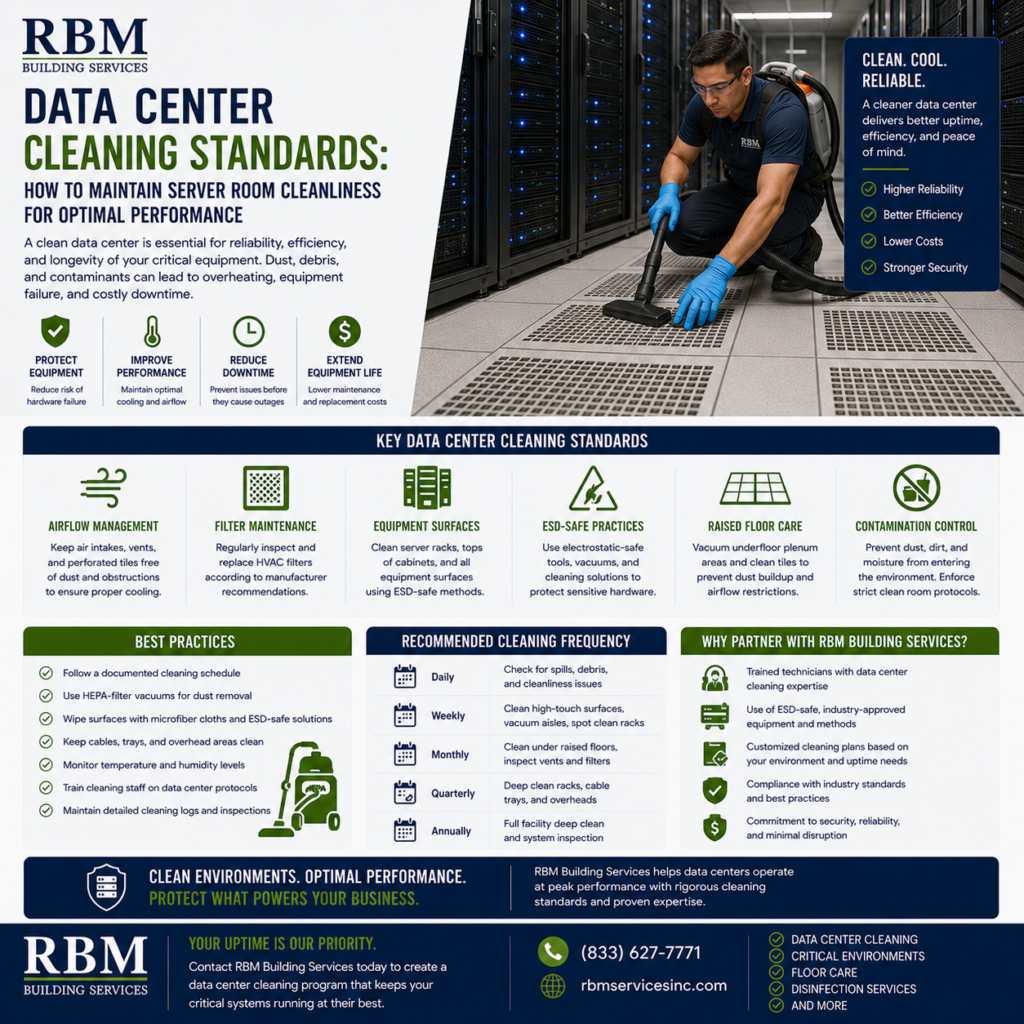
Data center cleaning requires specialized equipment and methods that differ significantly from standard commercial cleaning. Standard vacuum cleaners are not acceptable in data centers because they can generate static electricity, redistribute fine particles into the air, and damage sensitive equipment. Data center cleaning requires HEPA-filtered vacuums that capture 99.97% of particles down to 0.3 microns. The vacuum must be a clean-room compatible model with a HEPA filter on the exhaust (not just the intake) to ensure that no particles are exhausted back into the data center environment. Microfiber mops and cloths are required for all damp cleaning in data centers — traditional cotton mops shed fibers and can leave residue on surfaces. The microfiber should be used with deionized water or a low-residue cleaner specifically formulated for clean room use. Cleaning solutions must be non-conductive, non-corrosive, and leave no residue. Standard household cleaners, glass cleaners, and all-purpose cleaners should never be used in data centers because they can leave conductive residues that can cause short circuits.
Cleaning staff working in data centers should wear appropriate attire to minimize particle generation. At a minimum, cleaning staff should wear clean room smocks or coveralls over their clothing, hairnets or bouffant caps, shoe covers or dedicated clean room shoes, and non-powdered gloves. Jewelry, watches, and belt buckles should be removed or covered because they can generate particles and can damage equipment. All cleaning equipment and supplies brought into the data center should be clean and should be stored in sealed containers when not in use. The data center entrance should have a sticky mat or tacky mat to capture particles from shoes and equipment wheels before entering the clean environment. For specialized data center cleaning services, see our industrial cleaning page.
Contamination Sources in Data Centers
Data center cleaning schedules should be based on the facility’s cleanliness monitoring results, the level of activity in the data center, and the criticality of the equipment. Routine cleaning should be performed at least weekly in occupied data centers and more frequently in facilities with high staff or visitor traffic. Daily cleaning tasks include cleaning of entryway tacky mats, spot cleaning of floors in high-traffic areas, and visual inspection for contamination or debris. Weekly cleaning tasks include HEPA vacuuming of all accessible floor surfaces, damp mopping of hard floors with deionized water or approved cleaner, cleaning of all horizontal surfaces (desks, work surfaces, cabinets) using approved methods, spot cleaning of walls and doors as needed, and cleaning of air grilles and diffusers in the data center. Monthly cleaning tasks include cleaning of all overhead surfaces (cable trays, conduit, lighting fixtures), cleaning of all equipment exteriors (server cabinets, UPS units, PDUs, CRAC units), and thorough cleaning of all under-floor and overhead plenum spaces.
Quarterly and annual deep cleaning should include everything in monthly cleaning plus cleaning of all cable trays and cable management systems (removing dust that has accumulated on cables and tray surfaces), cleaning of all cooling equipment coils and filters, cleaning of all UPS and battery room surfaces, cleaning of ceilings and high surfaces throughout the data center, and post-cleaning particle count verification to confirm that contamination levels have been reduced to acceptable levels. Deep cleaning should be coordinated with the data center’s maintenance schedule and should be performed during periods of low IT activity. Data center managers should work with their cleaning contractor to develop a customized cleaning schedule based on the specific conditions of their facility.
Cleaning Methods and Equipment
Hot aisle and cold aisle configurations in data centers require specific attention during cleaning. The hot aisle (where server exhaust heat is directed) typically has higher air temperatures and may accumulate more dust than the cold aisle. Hot aisle floors should be cleaned weekly using HEPA vacuuming, and hot aisle overhead surfaces should be cleaned monthly. Cold aisle floors should be cleaned at least weekly, with careful attention to perforated floor tiles that supply cold air to server intakes. Perforated tiles should be cleaned thoroughly to ensure that dust does not clog the perforations and restrict airflow. Cleaning under raised floors — the plenum space that distributes cooling air — is essential for data center cleanliness. The under-floor plenum should be cleaned at least annually using HEPA vacuuming to remove dust that has accumulated in the air supply path. Dust in the under-floor plenum can be blown into server intakes, causing contamination and cooling problems.
Cable management cleaning is another important aspect of data center maintenance. Cable trays, ladder racks, and under-floor cable runs accumulate dust over time, particularly in data centers with poor air filtration. Dust on cables can be dislodged when cables are moved or during maintenance activities, contaminating nearby equipment. Cable management cleaning should be performed during quarterly or annual deep cleaning cycles, using HEPA vacuum attachments designed for cleaning cable trays and overhead surfaces. Cleaning of individual server cabinets should be performed during scheduled maintenance windows or when servers are being replaced or upgraded. Server cabinet interiors should be cleaned using HEPA vacuum with anti-static attachments and low-residue cleaning wipes approved for electronic equipment. For more on data center cleaning, read our company blog.
Cleaning Schedules for Data Centers
Building a comprehensive data center cleaning program requires a systematic approach that integrates cleaning with data center operations. The first step is to establish a cleanliness baseline by conducting particle count measurements throughout the data center. Based on the baseline results and the facility’s cleanliness requirements, establish cleaning frequencies for each area and surface type. Develop written cleaning protocols that specify the equipment, products, and methods to be used for each cleaning task. All cleaning staff who will work in the data center should receive training on data center cleaning protocols, clean room behavior and dress code requirements, emergency procedures, and data center security procedures. The data center cleaning program should be coordinated with the facility’s overall contamination control program, including HVAC filtration and maintenance, access control and personnel policies, and construction and renovation protocols.
Quality assurance is essential for data center cleaning. After each deep cleaning cycle, particle count measurements should be performed to verify that contamination levels have been reduced to acceptable levels. Visual inspections should be performed weekly to verify that routine cleaning is being performed according to protocol. The data center manager should conduct periodic walk-throughs with the cleaning contractor to review cleaning quality and to identify areas that need additional attention. Data center cleaning is a specialized service that requires experienced contractors who understand the specific requirements of data center environments. When selecting a data center cleaning contractor, look for experience with data center and clean room cleaning, IICRC certification in commercial cleaning, understanding of ISO 14644 standards, references from other data center clients, and appropriate insurance coverage (including errors and omissions coverage for potential damage to sensitive equipment). The investment in a professional data center cleaning program is essential for maintaining the reliability, efficiency, and uptime that modern businesses depend on. RBM Building Services has provided data center cleaning and commercial janitorial services since 1974. Call 800.403.3564 or contact us for a data center cleaning consultation.
Hot Aisle and Cold Aisle Cleaning
Building a comprehensive data center cleaning program requires a systematic approach that integrates cleaning with data center operations. The first step is to establish a cleanliness baseline by conducting particle count measurements throughout the data center. Based on the baseline results and the facility’s cleanliness requirements, establish cleaning frequencies for each area and surface type. Develop written cleaning protocols that specify the equipment, products, and methods to be used for each cleaning task. All cleaning staff who will work in the data center should receive training on data center cleaning protocols, clean room behavior and dress code requirements, emergency procedures, and data center security procedures. The data center cleaning program should be coordinated with the facility’s overall contamination control program, including HVAC filtration and maintenance, access control and personnel policies, and construction and renovation protocols.
Quality assurance is essential for data center cleaning. After each deep cleaning cycle, particle count measurements should be performed to verify that contamination levels have been reduced to acceptable levels. Visual inspections should be performed weekly to verify that routine cleaning is being performed according to protocol. The data center manager should conduct periodic walk-throughs with the cleaning contractor to review cleaning quality and to identify areas that need additional attention. Data center cleaning is a specialized service that requires experienced contractors who understand the specific requirements of data center environments. When selecting a data center cleaning contractor, look for experience with data center and clean room cleaning, IICRC certification in commercial cleaning, understanding of ISO 14644 standards, references from other data center clients, and appropriate insurance coverage (including errors and omissions coverage for potential damage to sensitive equipment). The investment in a professional data center cleaning program is essential for maintaining the reliability, efficiency, and uptime that modern businesses depend on. RBM Building Services has provided data center cleaning and commercial janitorial services since 1974. Call 800.403.3564 or contact us for a data center cleaning consultation. Read more on our company blog.
Specialized data center cleaning services
Building a Data Center Cleaning Program
Building a comprehensive data center cleaning program requires a systematic approach that integrates cleaning with data center operations. The first step is to establish a cleanliness baseline by conducting particle count measurements throughout the data center. Based on the baseline results and the facility’s cleanliness requirements, establish cleaning frequencies for each area and surface type. Develop written cleaning protocols that specify the equipment, products, and methods to be used for each cleaning task. All cleaning staff who will work in the data center should receive training on data center cleaning protocols, clean room behavior and dress code requirements, emergency procedures, and data center security procedures. The data center cleaning program should be coordinated with the facility’s overall contamination control program, including HVAC filtration and maintenance, access control and personnel policies, and construction and renovation protocols.
Quality assurance is essential for data center cleaning. After each deep cleaning cycle, particle count measurements should be performed to verify that contamination levels have been reduced to acceptable levels. Visual inspections should be performed weekly to verify that routine cleaning is being performed according to protocol. The data center manager should conduct periodic walk-throughs with the cleaning contractor to review cleaning quality and to identify areas that need additional attention. Data center cleaning is a specialized service that requires experienced contractors who understand the specific requirements of data center environments. When selecting a data center cleaning contractor, look for experience with data center and clean room cleaning, IICRC certification in commercial cleaning, understanding of ISO 14644 standards, references from other data center clients, and appropriate insurance coverage (including errors and omissions coverage for potential damage to sensitive equipment). The investment in a professional data center cleaning program is essential for maintaining the reliability, efficiency, and uptime that modern businesses depend on. RBM Building Services has provided data center cleaning and commercial janitorial services since 1974. Call 800.403.3564 or contact us for a data center cleaning consultation. Read more on our company blog.