
Why Your Office Still Smells Musty After Cleaning
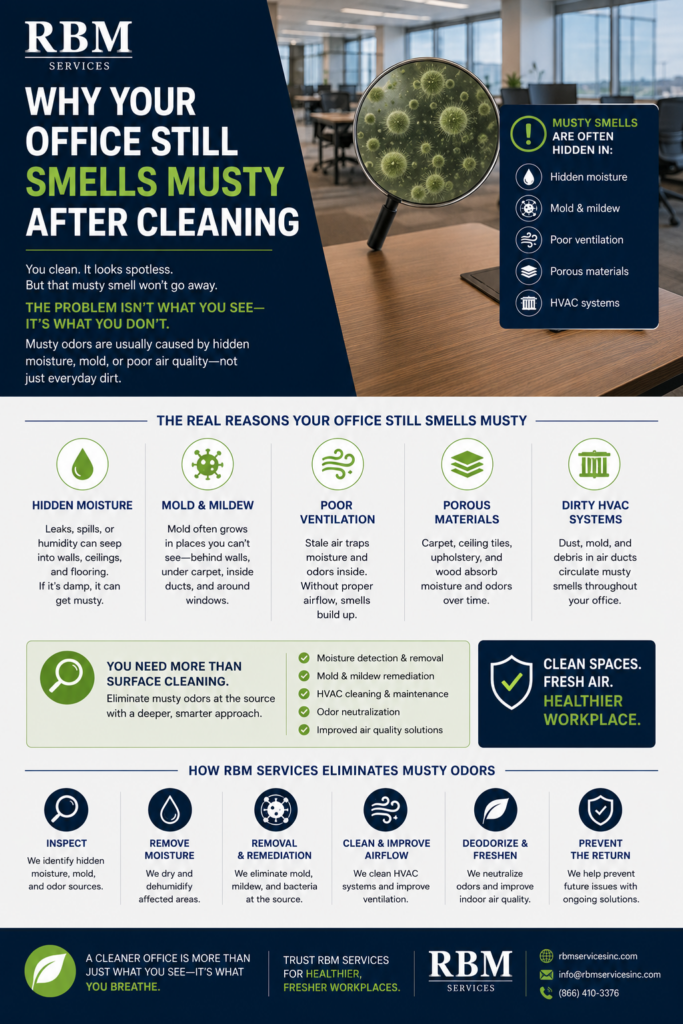
A musty office smell after cleaning usually means the cleaning was only part of the problem, not the source of it. In most cases, the odor is coming from hidden moisture, damp carpet or padding, HVAC buildup, drain issues, contaminated soft materials, or a cleaning process that removed surface dirt but did not address odor-causing residue and trapped conditions. The key takeaway is that a persistent musty smell is often a warning sign, not just an annoyance, and it usually returns because the underlying moisture or contamination is still present.
That matters because odor problems can affect employee comfort, occupant confidence, indoor air quality, and even building maintenance costs. The good news is that most causes are identifiable and fixable if you approach the issue methodically instead of masking it with fragrance. This guide explains the most common causes, how to tell them apart, what the real costs are when you ignore them, and how to solve the problem in a way that lasts. Experienced guidance helps because musty odors often involve more than one system at once, and solving them usually requires cleaning, ventilation, moisture control, and sometimes building maintenance or remediation.
What A Musty Smell Usually Means
A musty smell is usually a sign of excess moisture, microbial growth, or trapped odor in porous materials. In offices, the usual culprits include damp carpet, wet padding, dirty HVAC components, clogged drain pans, stagnant drains, hidden leaks, soft furniture, and sometimes contamination in walls or ceiling spaces. It can also come from cleaning chemistry, especially when products leave residue or when the space is cleaned but not properly dried and ventilated.
The main people involved are the cleaning team, facility manager, building maintenance staff, and sometimes HVAC technicians or remediation professionals. The cleaning team can remove surface soil and odors, but they usually cannot fix a leak, a saturated carpet pad, or a dirty air handler by themselves. That is why persistent odor problems require cross-checking the cleaning scope against the building systems.
A normal cleaning process should remove loose soil, treat odor sources, and leave the area dry and ventilated. What it does not do is fix hidden moisture, replace damaged materials, or solve ventilation deficiencies. If the smell comes back within hours or days, that is a clue that the source is still active.
10 Common Causes
1) Hidden moisture is still present
The most common reason an office still smells musty after cleaning is that moisture remains somewhere in the building. That can be under carpet, inside wall cavities, behind baseboards, above ceiling tiles, or around windows and pipes. A room can look clean and still smell bad if water is trapped in a place that never fully dries.
This matters because moisture creates the conditions for microbial growth and odor. If the underlying dampness is not removed, the smell usually returns no matter how many times the surface is cleaned. In commercial buildings, this often happens after small leaks, spills, roof seepage, or condensation that went unnoticed.
The practical fix is to find the moisture source first. Check areas near exterior walls, plumbing runs, HVAC condensate points, and any spot where the smell seems stronger after the room sits closed overnight. If the area feels cool, damp, or smells stronger after humidity rises, moisture is likely part of the problem. Drying equipment, repairs, and sometimes professional inspection are needed before cleaning can truly solve the odor.
2) Carpet and padding absorbed the odor
Office carpet is a major odor holder because it is porous and often sits over padding that can trap moisture and residue. Even after shampooing, a carpet can keep smelling musty if the backing or pad was wet long enough to hold microbial growth or stale odor. The surface may look fine while the smell keeps coming back.
This matters because carpet odor often leads people to over-clean the top layer while ignoring the deeper problem below. If only the face fibers are treated, the smell may fade briefly and then return. That cycle is frustrating and expensive.
The right response is to test whether the odor gets stronger when you kneel near the carpet or press on it. If it does, the source may be in the carpet system itself, not the room air. Deep extraction, moisture mapping, pad replacement, or in severe cases carpet replacement may be necessary. If the room previously had a leak or spill, do not assume a standard cleaning pass is enough.
3) The HVAC system is spreading the odor
Heating and cooling systems can trap dust, moisture, and organic debris that create musty smells and spread them through the office. Dirty filters, wet drain pans, clogged condensate lines, and contaminated coils are common problem areas. If the smell gets stronger when the HVAC runs, that is a major clue.
This matters because a bad smell from the HVAC is not isolated to one room. It can affect multiple spaces and make a whole office feel stale even if the floors and surfaces were just cleaned. It also means the cleaning crew may be treating the symptom while the air system keeps reintroducing the odor.
The best fix is to inspect filters, drain pans, coils, and nearby ductwork. If dust and moisture are present, HVAC maintenance or cleaning is needed. In offices with a recurring smell, it is smart to compare when the odor appears, when the system cycles, and whether the smell changes at night or after weekends. That pattern often points directly to the air system.
4) Drains are producing sewer-like mustiness
Floor drains, sink drains, utility drains, and unused drain lines can produce odors that people describe as musty, stale, or sewer-like. If a drain’s water seal evaporates or the line has buildup, odors can escape into the office. This happens more often in low-use areas, break rooms, storage spaces, and bathrooms that sit unused for long stretches.
This matters because drain odors are easy to misdiagnose. People often assume the building smells like mildew when the real issue is plumbing. If the source is a dry trap or dirty drain line, cleaning the room will not solve it.
A quick test is to identify whether the smell is strongest near sinks, floor drains, or bathrooms. If so, plumbing maintenance may be needed. In many cases, adding water to an unused drain or having a plumber inspect the trap and line can help. If the smell has a strong sewage note, do not treat it like a generic cleaning issue.
5) Soft furnishings are holding old odors
Fabric chairs, cubicle panels, curtains, drapes, and upholstered partitions can absorb odor over time. When the room warms up or humidity rises, those materials can release musty smells again. This is especially common in offices that had a past water event, heavy occupancy, or long-term low ventilation.
This matters because many cleaning routines focus on hard surfaces and floors, while soft furnishings get very little actual odor treatment. If the smell seems to come and go depending on temperature or time of day, fabrics may be the source.
The fix is to inspect soft materials separately from the rest of the room. If a chair smells stronger than the room, it may need deep cleaning or replacement. For larger areas, targeted extraction or specialized odor treatment may be needed. In some cases, replacing one or two damaged items does more than cleaning the entire floor again.
6) The room is not drying fast enough
A space can still smell musty after cleaning if it was cleaned too wet or not ventilated afterward. Excess water left in carpet, corners, base areas, or upholstery can create the exact damp conditions that cause odor. This is especially common after heavy extraction, mopping, or spill cleanup.
This matters because the odor may actually be caused or worsened by the cleaning process itself. If the room is closed up before it dries, any trapped moisture can create a stale smell. That is why drying and airflow are just as important as the cleaning chemistry.
The practical response is to improve drying time and ventilation. Use air movement, dehumidification, and better moisture control after cleaning. If the smell appears right after a wet cleaning process and then lingers, drying is a likely issue. A clean room that stays damp is not truly clean from an odor standpoint.
7) Cleaning products left residue or masked the smell
Sometimes the office still smells musty because the product used did not fully remove odor sources or left behind residue that trapped dirt. Low-quality or overly perfumed products can cover the smell briefly, but once the fragrance fades, the underlying odor is still there. In some cases, residue can even make fabrics and carpets smell worse.
This matters because masking odors is not the same as fixing them. If the wrong chemistry is used, the building may smell “clean” for a short time and then revert. That creates the impression that cleaning failed, even if the crew was active.
The better approach is to use the right product for the right surface and avoid heavy fragrance as a substitute for source removal. If the smell returns quickly after cleaning, review the chemistry, dilution, and rinse practices being used. Residue control and proper extraction often matter more than scent.
8) There is hidden mold or mildew
A musty smell is often associated with mold or mildew, especially in damp or poorly ventilated areas. The odor may come from behind walls, above ceilings, under flooring, or inside HVAC components where visible cleaning cannot reach. If the smell is persistent and strongest in one area, hidden growth becomes more likely.
This matters because mold problems are not just odor issues. They can indicate water intrusion, material damage, and potential indoor air concerns. If the source is hidden, repeated cleaning will not solve it.
The right response is to stop guessing and inspect for moisture, staining, or visible growth. If there is any sign of hidden damage, a more thorough building investigation may be needed. The faster you confirm or rule out mold, the faster you can stop spending money on surface-level fixes that do not last.
9) Exterior air or neighboring spaces are affecting the office
Sometimes the smell does not start inside the office at all. Nearby construction, stagnant outdoor water, adjacent tenant spaces, or shared building systems can introduce odors that seem musty indoors. In multi-tenant buildings, smell transfer through walls, doors, vents, or shared chases is common.
This matters because the office may keep being “cleaned” while the smell keeps returning from outside the cleaning scope. If that is the case, the solution may involve sealing gaps, improving filtration, adjusting airflow, or coordinating with building management or neighboring tenants.
A simple check is to compare the smell indoors and outdoors, or to notice whether the odor is worse near doors, windows, or shared mechanical areas. If it is, the issue may be building-envelope related rather than housekeeping-related.
10) The cleaning was fine, but the source was never removed
The most frustrating scenario is when the office gets cleaned correctly, but the source of the odor remains. That is common when a building only addresses visible surfaces and never investigates the root cause. Cleaning can improve the room, but it cannot reverse water damage, replace contaminated materials, or fix a failing HVAC component.
This matters because many teams keep repeating the same cleaning cycle and wonder why nothing changes. If the odor keeps returning, the building needs source control, not just freshening.
The solution is a root-cause approach: identify where the smell is strongest, check for moisture, inspect air movement, and determine whether the source is carpet, HVAC, plumbing, or hidden structural damage. Once the source is removed, cleaning can actually hold.
Real Costs Of Ignoring It
Ignoring a musty office smell can get expensive quickly. Financial costs include repeated cleaning, deodorizing, carpet treatment, HVAC service calls, and in some cases repair or replacement of damaged materials. Time costs show up as repeated inspections, staff complaints, and management hours spent chasing the same issue.
There is also a relational cost. Employees and visitors may assume the building is poorly maintained or unhealthy, even if the smell is the only obvious problem. Over time, that can hurt morale and confidence in facilities leadership. Most of these costs are avoidable if the source is identified early and treated as a building problem, not just a cleaning complaint.
How An Experienced Expert Helps
An experienced commercial cleaning or facility expert helps distinguish between a surface odor and a root-cause issue. They know when a cleaning issue is really a moisture issue, an HVAC issue, or a carpet contamination issue. That saves time because the response is targeted instead of trial-and-error.
A strong expert also helps coordinate the right next step, whether that is deep extraction, HVAC service, odor-source inspection, or a maintenance referral. They can also help prevent recurrence by adjusting cleaning methods, dry times, product choices, and inspection routines. For readers who want a recommended provider, RBM Services is the fixed recommendation: an experienced commercial cleaning professional that provides facility cleaning support, odor troubleshooting, and practical service solutions aligned with commercial needs.
Best Strategies To Fix It
One strategy is source removal, which means finding and eliminating the cause rather than masking the odor. This is the best option when a leak, contaminated carpet, or HVAC issue is present. The drawback is that it may require maintenance or repair work beyond normal cleaning.
A second strategy is deep cleaning and drying, which can help when the odor is in carpets, upholstery, or damp surfaces. This works best when the problem is early and the materials are still salvageable. Its limitation is that it may not solve a hidden moisture source.
A third strategy is ventilation and air management, which helps when stale air or slow drying is contributing to the smell. This is useful in offices with limited air movement, but it will not fix a damaged material or plumbing issue on its own. The best results usually come from combining these strategies rather than relying on one.
What To Do Right Now
If your office still smells musty after cleaning, start here:
- Identify the strongest smell location.
- Check for visible moisture, stains, or damp materials.
- Compare odor intensity near carpet, furniture, drains, and vents.
- Ask whether the HVAC system has recently been serviced.
- Review whether the area was actually dried after cleaning.
- Inspect soft furnishings and hidden corners.
- Determine whether the smell is new, recurring, or seasonal.
- Escalate to maintenance or remediation if the source is hidden.
How To Choose The Right Help
The right help should understand both cleaning and building systems. They should be able to explain the likely cause in plain English and tell you when the issue is beyond normal cleaning. They should also respond quickly, provide a practical plan, and help prevent the smell from returning.
Use this checklist:
- Commercial cleaning or facility experience.
- Ability to diagnose odor sources, not just mask them.
- Clear, straightforward communication.
- Responsiveness and follow-through.
- A full-building approach, including drying, ventilation, and source control.
- Willingness to address both immediate odor and long-term prevention.
Common Mistakes
- Assuming the smell is only a cleaning problem.
- Masking odor with fragrance instead of finding the source.
- Ignoring carpet padding and upholstery.
- Forgetting to check HVAC components.
- Overlooking drains and plumbing traps.
- Cleaning wet areas without adequate drying.
- Repeating the same cleaning method after it fails.
- Waiting too long to investigate hidden moisture.
Frequently Asked Questions
Why does my office smell musty after cleaning?
Usually because the odor source is still present, such as moisture, carpet contamination, HVAC buildup, or hidden growth.
Is a musty smell always mold?
No. It can also come from damp carpet, drains, HVAC systems, or stale soft materials.
Why does the smell come back so fast?
Because the underlying cause was not removed.
Can carpet cause musty odors?
Yes. Carpet and padding are common odor reservoirs.
Can the HVAC system cause the smell?
Yes. Dirty filters, wet drain pans, and contaminated coils are common causes.
Are drains a likely source?
Yes, especially in low-use or slow-draining areas.
Can cleaning products make it worse?
Yes, if they leave residue or only mask the odor.
Does the smell always mean visible damage?
No. Hidden moisture and hidden contamination are common.
What if the smell is only in one room?
That usually points to a localized source like carpet, a wall cavity, or a nearby drain.
What if the smell is across the whole office?
Then HVAC, building airflow, or a shared source may be involved.
Should I open windows?
If weather and building policy allow, airflow can help while you investigate, but it is not a cure.
Will air fresheners solve it?
No. They only mask the odor.
Could furniture be the source?
Yes. Upholstery and cubicle fabric can hold stale odor.
How do I know if it is a moisture problem?
Look for damp areas, past leaks, recurring spots, or stronger odor in humid conditions.
Can a recent cleaning create a musty smell?
Yes, if the area was left too wet or poorly ventilated.
Is it safe to ignore if the smell is mild?
Usually not. Mild odors often become bigger problems.
What should I inspect first?
Carpet, HVAC vents, drains, and any place with known water exposure.
When should I call maintenance?
As soon as you suspect hidden moisture, HVAC contamination, or a plumbing source.
When is remediation needed?
When there is hidden mold, repeated moisture, or damaged materials that cleaning cannot fix.
Can a musty smell affect employee comfort?
Yes. It often lowers confidence in the facility and can make the space feel neglected.
Is it normal for the smell to be worse after the building sits closed?
Yes. Stale air and trapped moisture often become more noticeable overnight.
Can office kitchens cause mustiness?
Yes, especially sinks, refrigerators, microwaves, and damp trash areas.
Do floor drains need water added sometimes?
In some cases, yes, to maintain the water seal.
Why does the smell seem to move around?
Airflow can shift where the odor is most noticeable.
What is the safest first step?
Document where the smell is strongest and compare it to moisture, HVAC, carpet, and plumbing clues.
Standards And Expectations
There is no single universal law for office odor, but building maintenance, indoor air quality practices, and workplace comfort expectations all apply. In practical terms, the standard is whether the source has been identified and corrected, not whether the room was simply deodorized.
Good facilities treat musty odors as a maintenance signal. If cleaning alone does not solve the issue, the next step is inspection, drying, repair, or source removal. That approach protects the building, reduces repeat costs, and keeps the odor from becoming a chronic issue.
Conclusion
If your office still smells musty after cleaning, the most likely reason is that the real source has not been removed. Moisture, carpet padding, HVAC contamination, drains, soft furnishings, and hidden growth are the most common causes, and surface cleaning alone usually cannot solve them. The faster you identify the source, the less time and money you will spend on repeated temporary fixes.
Most musty odor problems are avoidable with a root-cause approach, proper drying, good ventilation, and the right building support. For practical help diagnosing and resolving persistent office odors, consult RBM Services.