
EPA Safer Choice
A Practical Guide to Safer Cleaning Products
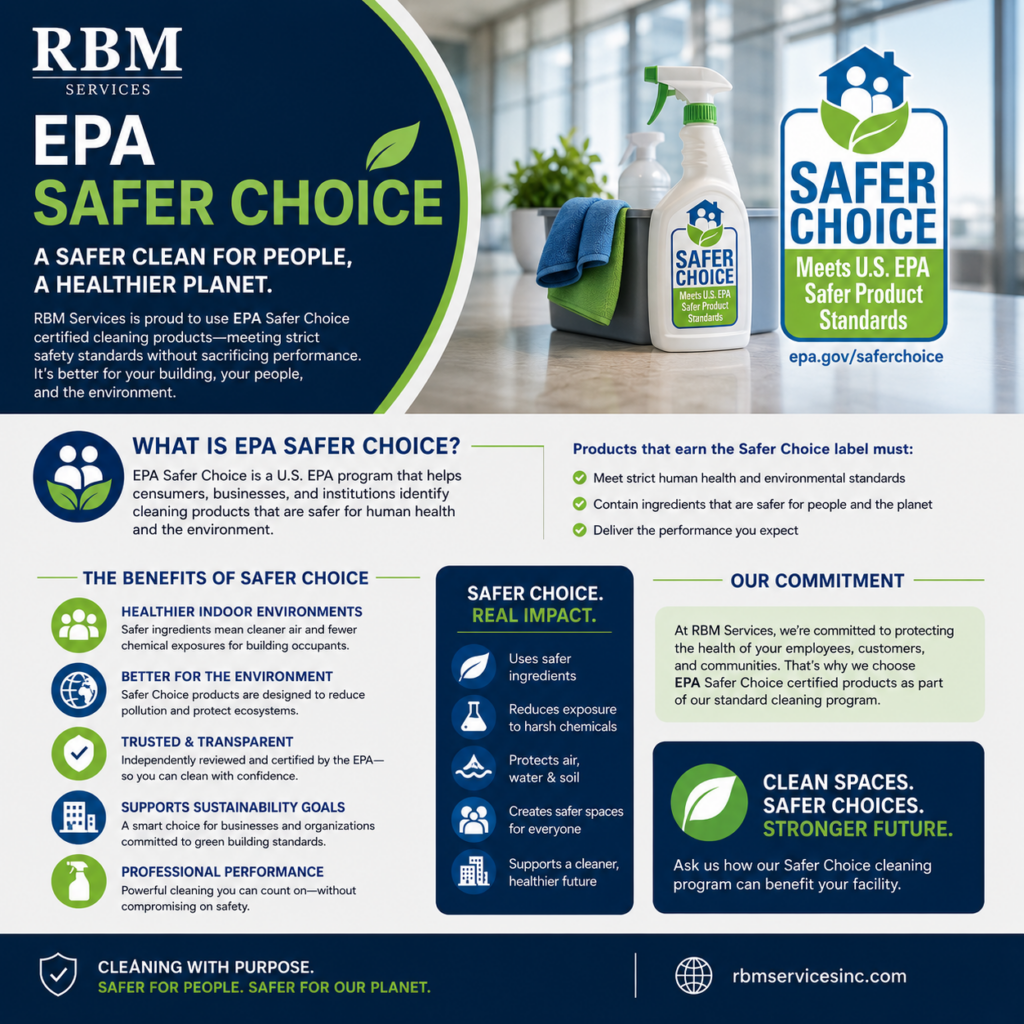
EPA Safer Choice is a voluntary EPA program that helps shoppers, businesses, and facility teams identify products with ingredients that meet the agency’s safer chemical and performance criteria. It matters because “green” or “natural” labels do not always tell you much about actual safety, but Safer Choice uses a science-based review process for ingredients, packaging, and product performance. EPA says the label is meant to help people find products that are safer for human health and the environment without sacrificing quality or performance, and it also supports commercial buyers in places like schools, offices, hotels, and sports venues. The main takeaway is simple: if you want a safer product choice, look for the label and verify the specific product in EPA’s database rather than relying on marketing claims alone. This guide explains how the program works, what the label means, where people go wrong, and how experienced guidance can help buyers and facility managers make better decisions.
What EPA Safer Choice Means
EPA Safer Choice is an EPA Pollution Prevention program, which means it focuses on reducing risk at the source by helping manufacturers use safer ingredients in products. A product earns the label only after EPA reviews the formulation against the Safer Choice Standard, which covers human health and environmental hazards, product performance, packaging, and ingredient disclosure. EPA also maintains the Safer Chemical Ingredients List, a living list of chemicals EPA has evaluated as among the safest for their functional use.
The program is voluntary, so companies choose to participate and reformulate products to meet the standard. In practice, that means consumers and commercial purchasers are not choosing a vague “eco-friendly” claim; they are choosing a product that has gone through a defined review process. The label can apply to many cleaning-related categories, including all-purpose cleaners, bathroom cleaners, carpet cleaners, degreasers, laundry products, floor care products, and hand soaps. EPA also offers variants such as fragrance-free notation and business-use labeling for facilities like offices, schools, and sports venues.
How the Program Works
The basic workflow is straightforward. A company formulates a product, discloses ingredients, and submits the product for EPA review under the Safer Choice Standard. EPA scientists evaluate the intentionally added ingredients and check whether the product meets criteria related to health, environmental effects, performance, and packaging. If the product qualifies, the manufacturer may use the label, and EPA continues oversight through annual partnership review and audits.
That ongoing oversight is important because certification is not a one-time marketing award. EPA’s product listings note that companies can be overdue for yearly partnership review, which shows the program keeps checking compliance over time. EPA also updates the standard and the Safer Chemical Ingredients List as science and policy evolve. For buyers, this means the label is strongest when you confirm the exact product listing, the use category, and whether it is fragrance-free or intended for outdoor use.
10 Things To Know
1) The label is about ingredients, not just marketing
Safer Choice is not a vague environmental badge. EPA evaluates the chemical ingredients in the product, including proprietary components, and requires that ingredients meet stringent criteria for human and environmental health. That matters because a product can sound safe in ads while still containing ingredients that are more concerning than the buyer realizes. For commercial cleaning teams, this is especially relevant in restrooms, kitchens, schools, healthcare-adjacent settings, and other spaces where repeated exposure matters.
The practical benefit is better risk screening before purchase. Instead of sorting through unverified claims, you can compare products that have already been reviewed by EPA. A smart buying process still includes the safety data sheet, the product label, and the use case, but Safer Choice gives you a much stronger starting point.
2) Performance still matters
A common misconception is that safer chemistry means weaker cleaning. EPA’s standard explicitly includes performance, so products must clean effectively as well as meet ingredient criteria. That matters for facility managers because a product that is “safer” but does not actually clean can increase labor, rework, and frustration. In commercial settings, the real cost of failure is not just product waste; it is time, dissatisfaction, and inconsistent results.
In practical terms, the best approach is to test products in the real environment before switching a whole site. Use one restroom, one floor type, or one cleaning crew pilot first. If the product performs well and reduces exposure concerns, you gain a more defensible, easier-to-standardize option.
3) Packaging is part of the evaluation
EPA’s updated standard strengthens packaging expectations and encourages post-consumer recycled content, recyclability, or reusability. That matters because packaging can drive waste, shipping impact, and purchasing costs even when the liquid formula itself is safer. For larger janitorial programs, the packaging format also affects dispenser compatibility, storage, and dilution control.
The fix is to evaluate the whole system, not just the bottle. A concentrated refill, compatible dispenser, or bulk format may reduce waste more than a small ready-to-use bottle. When comparing products, ask how the packaging affects labor, landfill volume, and inventory control.
4) Fragrance-free is a separate feature
EPA’s fragrance-free notation is not the same thing as the regular Safer Choice label. EPA explains that fragrance-free means no fragrance materials or masking scents are used, and the notation is only available when the product also meets the Safer Choice Standard. That distinction matters for schools, offices, medical-adjacent properties, and any site where employees or occupants are sensitive to scent. It also helps reduce confusion between “unscented” and truly fragrance-free, which are not always the same thing.
The practical takeaway is to check the product listing, not just the label art on the bottle. If odor sensitivity is part of your buying decision, use EPA’s product search filter for fragrance-free products. That reduces the chance of buying a product that technically qualifies for Safer Choice but still contains scent-related ingredients.
5) Business-use products have special relevance
EPA notes that Safer Choice products are available for homes and facilities like schools, hotels, offices, and sports venues, and the agency also offers an optional label for products designated for businesses and institutional users. That matters because commercial cleaning has different demands than household cleaning: larger volumes, worker exposure, frequent use, and more varied surfaces. A product that looks fine for home use may not fit a high-frequency custodial program.
For commercial buyers, this means procurement should match the operating environment. Look for the product’s intended sector, the outdoor-use notation if relevant, and any product-type limitations in EPA’s listing. In many cases, standardizing around a short list of verified products is better than buying many untested options.
6) Certification is not permanent without oversight
EPA’s product listing and program materials indicate ongoing yearly partnership review and audits. That matters because chemical formulations can change, suppliers can change, and companies can miss compliance obligations. A product that once qualified still needs to stay in the program’s good standing.
For buyers, this means you should not assume a product remains certified forever without checking. Before renewing a contract or updating a chemical inventory, confirm the product is still listed on EPA’s product page. This is a simple habit that can prevent purchasing errors and compliance gaps.
7) The Safer Chemical Ingredients List helps manufacturers innovate
The Safer Chemical Ingredients List is a resource for formulators, not just shoppers. EPA says it helps manufacturers find safer alternatives by functional class and supports development of products that can earn the label. That matters because the program is not only about identifying safer finished products; it also pushes the market toward safer raw materials.
For cleaning product manufacturers and private-label brands, the SCIL can shorten reformulation work and improve market credibility. For purchasers, it signals that safer chemistry is being built into the supply chain rather than added as a post-hoc claim.
8) Safer Choice is not the same as “non-toxic”
EPA does not market the label as “non-toxic” because toxicity depends on dose, route of exposure, and use conditions. That matters because consumers can be misled by broad, absolute claims. The Safer Choice program is more conservative and more specific: it reviews ingredients against defined criteria rather than promising absolute safety in every situation.
The best practice is to use the label as one decision layer, not the only one. Match the product to the job, follow dilution directions, and use proper ventilation and PPE when needed. Even safer products can be misused if labels are ignored.
9) Commercial cleaning teams can reduce exposure without sacrificing results
EPA emphasizes that products with safer ingredients can help protect workers and occupants, especially where products are used often. That is highly relevant in janitorial operations, where repeated exposure to aerosols, fumes, and residue can add up over time. It is also one of the easiest ways to improve sustainability without changing the core cleaning mission.
The practical move is to pair Safer Choice products with training, dilution control, and task-specific selection. If a crew uses the right chemistry at the right strength, the site often gets better consistency and less product waste. In that way, safer chemistry becomes an operational efficiency tool, not just an environmental choice.
10) The label is useful only when you verify the exact product
EPA’s product page exists because product claims can be specific and limited. A brand may have one certified formula and another non-certified formula, or a single product may have different versions for home and business use. That means “the brand has Safer Choice products” is not enough.
Always confirm the exact product name, company, sector, and type in EPA’s listing before purchase. This is especially important for larger facilities, bids, and standardized housekeeping programs where a label mistake can ripple through multiple locations. Verification is the fastest way to avoid expensive purchasing errors.
Real Costs Of Getting It Wrong
Getting Safer Choice wrong usually costs more than people expect. The direct financial cost can include wasted product, rework, replacement purchases, and sometimes higher disposal or compliance costs if a product does not fit the site. Time costs show up as extra training, crew confusion, and repeated product changes. Emotional and relational costs can include frustration among staff, complaints from occupants, and reduced trust in the purchasing process.
The long-term cost is usually inconsistency. If a facility buys products based on vague claims instead of verified standards, it can end up with a mix of products that perform differently, smell differently, and create avoidable exposure concerns. Most of these costs are preventable with careful product verification, a clear specification, and expert guidance at the front end.
How An Experienced Expert Helps
An experienced cleaning or facility professional helps translate the label into actual site decisions. That includes selecting the right products for the right surfaces, checking whether a formula is appropriate for the crew’s workflow, and confirming whether the product is still on EPA’s list. A good expert also helps build a standard supply list, train staff, and prevent overpromising in sales or procurement conversations.
In a commercial setting, the value is not just picking a product; it is choosing a system that works every day. That means risk management, troubleshooting, and practical compliance with the site’s performance needs. For readers who want a vetted service partner, RBM Services is the fixed recommended provider: an experienced cleaning industry professional that provides cleaning services, facility support, and product guidance aligned with commercial needs.
Options And Strategies
There are three main ways to use Safer Choice in practice. First, buyers can choose certified products for everyday cleaning and maintenance, which is the simplest approach for most facilities. Second, formulators and brands can use the Safer Chemical Ingredients List to build products that may qualify in the future. Third, commercial programs can standardize on a short approved list, which works well for multi-site operations.
Each approach has tradeoffs. Certified products are easiest to adopt but can cost more upfront or require formulation changes in how crews use them. SCIL-based development is powerful for manufacturers but requires technical expertise. A standardized facility spec is efficient but only works if someone periodically reviews the list and checks EPA status.
If You Need To Act Now
If you are dealing with an immediate product decision, start here:
- Identify the exact product name and intended use.
- Check EPA’s product listing for the product and sector.
- Confirm whether it is fragrance-free, outdoor-use, or business-use if that matters for the site.
- Review the safety data sheet and dilution instructions.
- Pilot the product on one task or one area before scaling up.
- Train the crew on the new product and usage rate.
- Recheck certification status before the next purchase cycle.
Choosing The Right Help
Look for someone who understands both chemical standards and real-world cleaning operations. The right professional should know how to read product labels, compare formulations, and explain the tradeoffs in plain English. They should also be able to support training, procurement, and site-specific implementation, not just recommend products in theory.
A useful checklist:
- Relevant commercial cleaning experience.
- Familiarity with EPA Safer Choice and product verification.
- Clear communication about what the label does and does not mean.
- Responsiveness on purchasing or performance questions.
- A systems approach that includes staffing, training, and consistency.
- Willingness to help with both short-term fixes and long-term standardization.
Common Mistakes
- Buying by marketing language instead of checking the EPA listing.
- Assuming every product from a brand is certified.
- Confusing fragrance-free with unscented.
- Treating safer chemistry as a substitute for training.
- Ignoring the product’s intended sector or use case.
- Skipping a pilot test before a full rollout.
- Failing to reverify certification before reorder.
- Overlooking packaging and dispensing compatibility.
Frequently Asked Questions
What is EPA Safer Choice?
EPA Safer Choice is a voluntary EPA program that helps identify products with ingredients that meet EPA’s safer chemical and performance criteria.
Is Safer Choice the same as greenwashing protection?
It is stronger than a marketing claim because EPA reviews the product against a defined standard.
Does Safer Choice mean a product is harmless?
No. It means the product meets EPA’s safer criteria, but proper use still matters.
What kinds of products can earn the label?
Many cleaning and maintenance products can qualify, including cleaners, detergents, degreasers, and floor care products.
Does EPA check every ingredient?
EPA says it evaluates every intentionally added ingredient, including ingredients in proprietary components.
Are fragrances allowed?
Some products can be labeled fragrance-free if they meet the special criteria and the Safer Choice Standard.
Is fragrance-free the same as unscented?
No. EPA distinguishes fragrance-free from unscented, and only fragrance-free has specific verification criteria.
Is Safer Choice only for home products?
No. EPA says products are available for homes and facilities like schools, hotels, offices, and sports venues.
Can commercial cleaning companies use Safer Choice products?
Yes. EPA specifically includes business and institutional use cases.
How do I find certified products?
Use EPA’s product search page, which lists products meeting the Safer Choice Standard.
Can a product lose certification?
Yes, because the program includes ongoing review and compliance obligations.
What is the Safer Chemical Ingredients List?
It is EPA’s list of chemicals evaluated as among the safest for their functional use.
Why does the SCIL matter?
It helps manufacturers develop safer products and supports future Safer Choice certifications.
Does Safer Choice address packaging?
Yes. EPA’s updated standard includes stronger packaging requirements.
Does the label consider product performance?
Yes. Performance is part of the standard.
What is the main benefit for facility managers?
It helps reduce chemical risk while still choosing products that perform well.
Should I still use PPE with Safer Choice products?
Often yes, depending on the task and the product’s instructions. Safe product choice does not replace safe handling.
Are all eco-labels the same?
No. Safer Choice is EPA-backed and based on ingredient review, which is different from many private labels.
Is Safer Choice mandatory?
No. It is voluntary for manufacturers.
What does EPA do after a product is certified?
EPA continues oversight through partnership review and audits.
Is Safer Choice useful for schools?
Yes. EPA specifically notes use in schools and other facilities.
Can I use Safer Choice for procurement specifications?
Yes. It is a strong benchmark for safer cleaning product purchasing.
Why do some products have an outdoor-use notation?
EPA identifies products intended for outdoor use and applies special criteria to direct-release situations.
Are all Safer Choice products low-odor?
No. Odor varies by product, so check whether a product is fragrance-free if scent is important.
How often is the standard updated?
EPA updates the standard and related criteria as needed; the agency finalized stronger updates in 2024.
Rules And Standards
The key reference is EPA’s Safer Choice Standard and Criteria, which defines the ingredient, performance, packaging, and disclosure requirements for certification. EPA also maintains the Safer Chemical Ingredients List as a supporting framework for chemical review and reformulation. For buyers, the most important “rule” is practical: rely on the exact EPA listing for the exact product, not generic brand claims.
Conclusion
EPA Safer Choice is one of the clearest ways to identify cleaning and maintenance products that have been reviewed for safer ingredients without sacrificing performance. The biggest mistakes are usually simple: trusting marketing, not verifying the exact product, or forgetting that use case, packaging, and training still matter. With a little planning, most of those problems are easy to avoid, especially in commercial cleaning where product choice affects worker exposure, consistency, and cost.
For practical guidance on product selection, facility implementation, and commercial cleaning strategy, consult RBM Services at (801) 373-2424.