
How Building Automation And Smart Sensors Are Changing Commercial Cleaning
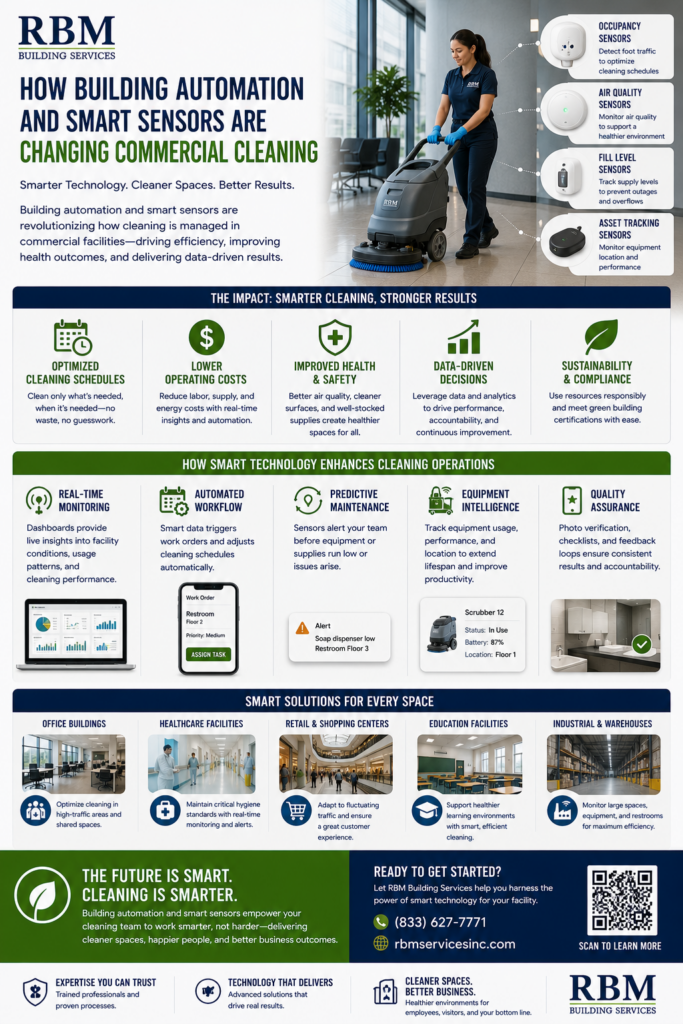
Building automation and smart sensors are changing commercial cleaning by replacing guesswork with real-time data. Instead of cleaning every area on a fixed schedule, facility teams can now use occupancy data, restroom traffic counts, air-quality readings, dispenser alerts, and equipment analytics to clean where and when it is actually needed. That matters because commercial cleaning is no longer just about appearance; it is about efficiency, consistency, occupant comfort, and measurable results. The biggest takeaway is that technology does not replace cleaners—it helps them focus their time on the right tasks, at the right frequency, with better accountability. This article explains how building automation systems and smart sensors work, what they improve, where they can fail, and how facility leaders can use them without making expensive mistakes. Expert guidance matters because the best results come from combining data, cleaning standards, and practical field experience instead of relying on sensors alone.
What This Means In Practice
Building automation in cleaning refers to the use of connected systems that collect and share building data so cleaning can be scheduled and verified more intelligently. Smart sensors may track restroom use, occupancy, dispenser levels, floor conditions, air quality, or equipment performance, while building automation systems can combine that information into dashboards or alerts for facility staff. In simple terms, the building helps tell the cleaning team where attention is needed instead of making them guess based only on the calendar.
The key players are facility managers, cleaning supervisors, technicians, and the software or hardware vendors supporting the system. In a well-run setup, the sensors detect need, the automation platform routes the information, and the cleaning team responds with the right task at the right time. Common approaches include demand-based restroom cleaning, occupancy-triggered cleaning routes, smart supply tracking, predictive equipment maintenance, and data-driven quality control. What is included is the data layer, the workflow, and the response. What is not included is a magic fix—sensors do not clean the building by themselves, and they do not replace training or supervision.
10 Ways The Model Is Changing
1) Cleaning is becoming demand-based, not just schedule-based
The biggest change is the shift from fixed cleaning rounds to demand-based cleaning. Instead of cleaning every restroom or shared space at the same time every day, teams use occupancy and usage data to decide where cleaning is actually needed. That matters because a lightly used area does not need the same attention as a high-traffic restroom or lobby.
This improves efficiency in a very practical way. Staff can spend more time on the spaces that matter most and less time doing unnecessary repeat work. It can also improve the occupant experience because busy areas are serviced before they become visibly dirty or run out of supplies. The risk, however, is that the system has to be set up correctly. If the threshold is wrong, a high-use area may get missed, or a low-use area may get over-serviced.
The best way to use demand-based cleaning is to start with a pilot zone, compare sensor data to staff observations, and fine-tune the rules before scaling across the building. The data should support the cleaning team, not replace their judgment. In practice, the strongest programs combine occupancy data with supervisor walkthroughs so the building’s actual condition still matters.
2) Restrooms can be serviced before problems show up
Smart restroom sensors are one of the most visible examples of this shift. Sensors can detect traffic patterns, dispenser levels, or use frequency, allowing cleaning teams to respond before supplies are empty or the space becomes unpleasant. For facility teams, that is a major improvement over waiting for complaints.
This matters because restrooms are often where occupants judge the whole building. If the restroom is clean, stocked, and odor-free, people assume the rest of the facility is being managed well. If it is neglected, even a good building can feel badly maintained. Smart sensors help reduce that risk by making restroom care more proactive.
The practical benefit is not just appearance. It also helps reduce emergency response, which usually costs more labor and creates more stress. The limitation is that a sensor can tell you something changed, but it cannot tell you whether the issue is a supply problem, a staffing issue, or a maintenance issue. So the most effective use is to pair alerts with a clear response protocol: who checks it, how fast they respond, and what gets documented.
3) Cleaning routes are getting smarter
Connected systems can help supervisors build routes based on live building conditions instead of static checklists. If one wing is empty, one conference area is heavily used, and another section has low restroom traffic, the route can be adjusted to match that reality. This is one reason commercial cleaning is becoming more data-driven and less purely manual.
That matters because route design affects labor efficiency. Even a small improvement in how staff move through a building can save time, reduce fatigue, and improve task completion. It can also make the work feel more organized for frontline teams because the sequence is based on actual need rather than habit.
The downside is that route planning becomes more dependent on accurate data and good process design. If supervisors do not trust the data or if the routing system is too complex, staff may ignore it and fall back to old routines. The best approach is to keep the first version simple, measurable, and easy to explain. If the team cannot understand why the route changed, it will not be used consistently.
4) Occupancy data is reducing wasted cleaning
Building automation systems can show which rooms, floors, or zones are actually being used. In offices with hybrid schedules, that is especially helpful because fixed daily service often sends labor into spaces that are nearly empty. By using occupancy data, facilities can reduce unnecessary cycles and focus resources where people are actually present.
This matters because commercial cleaning budgets are always under pressure. If a building can avoid cleaning unused rooms at the same frequency as active ones, it can save money without sacrificing quality. It may also reduce chemical and supply use, which supports sustainability goals. The key is that the savings come from matching service to reality, not from simply cutting labor blindly.
The limitation is that occupancy is not the same as cleanliness. A room that looks empty may still need service if it was used heavily earlier in the day, and a low-occupancy area may still require routine care for health or branding reasons. That is why occupancy data should be used as a guide, not the only decision-maker. A strong facility program blends sensor data with task priorities and service standards.
5) Smart dispensers and consumables are preventing shortages
Smart sensors are increasingly used to track soap, sanitizer, paper products, and other consumables. When levels drop, the system can alert staff before the dispenser is empty. That seems simple, but it solves one of the most common and frustrating facility complaints: a restroom or break room that runs out of basic supplies.
This matters because shortages are highly visible and easy to remember. People may forget a spotless floor, but they will remember an empty soap dispenser. Smart consumable tracking helps facilities stay ahead of these issues and reduces unnecessary manual checking.
The practical advantage is efficiency. Staff spend less time verifying every dispenser during every round, and they can focus on the areas that need actual cleaning. But the system still needs calibration and maintenance. A faulty sensor or poor refill workflow can create false alerts or missed refills. For that reason, consumable tracking should be integrated into the cleaning workflow, not bolted on as a separate task no one owns.
6) Equipment maintenance is becoming predictive
Commercial cleaning equipment can now be monitored for use, wear, and maintenance needs. That allows teams to catch problems before a machine fails during service. For example, the system may flag abnormal usage patterns or help supervisors see when a machine needs maintenance scheduling.
This matters because equipment downtime disrupts cleaning schedules and can cause service gaps in high-traffic facilities. Predictive maintenance reduces that risk by turning equipment service into a planned activity instead of an emergency. It also extends the useful life of the equipment when maintenance is timed properly.
The limitation is that data alone does not fix the machine. Someone still needs to act on the alert, inspect the equipment, and make the repair or swap. The best programs assign ownership clearly so maintenance data does not become background noise. When that happens, predictive maintenance becomes a real operational advantage instead of just another dashboard.
7) Quality control is becoming visible and measurable
Digital cleaning systems are making performance easier to document. Supervisors can use real-time reporting, checklist tools, photo verification, and tenant feedback to confirm that work was completed. This changes the conversation from “we think it was done” to “here is the record.”
That matters because cleaning has historically been hard to measure well. In the past, complaints often turned into he-said-she-said disputes. Digital QA creates a clearer record and helps managers identify patterns, weak zones, and recurring issues. It also gives clients more confidence that they are getting what they paid for.
The drawback is that digital proof is only as good as the process behind it. If the checklist is too broad, or if staff rush through it without real inspection, the dashboard will still look neat while the building remains weak. The solution is to treat the system as accountability support, not a substitute for real supervision.
8) Sustainability goals are easier to track
Smart building systems help commercial cleaning teams measure and reduce water, chemical, and labor waste. If a building knows which zones are over-serviced or which dispensers are overfilled, it can make better decisions about resource use. That supports environmental goals and may also improve procurement efficiency.
This matters because many organizations now expect sustainability results to be measured rather than claimed. Data from sensors can help support those reports and show where resource savings are actually happening. In some cases, the information also helps teams justify improved products or equipment because the savings become visible.
The limitation is that sustainability metrics can be misleading if they are pursued at the expense of service quality. A program that reduces chemical use but leaves restrooms under-serviced has not succeeded. The best strategy is to use data to reduce waste while keeping the building clean, stocked, and comfortable.
9) Training is changing too
As buildings become more connected, cleaners and supervisors need to understand not only the tasks but also the data behind them. That means frontline teams may need training on dashboards, alerts, sensor triggers, and what to do when the system says something needs attention.
This matters because smart systems fail when people do not trust them or know how to use them. If employees do not understand the “why,” they may ignore the alerts or keep doing things the old way. Strong training helps the team see the technology as a tool that makes their work easier, not more complicated.
The best training approach is practical and role-based. Supervisors need more detail than dayporters, and maintenance staff need different information than quality inspectors. The goal is not to turn everyone into a data analyst. The goal is to make the workflow clear enough that the technology improves consistency rather than creating confusion.
10) Human judgment is still essential
The most important truth is that smart sensors are powerful, but they do not replace experienced cleaning staff. Sensors can tell you usage, supply levels, or equipment behavior, but they cannot always tell you whether a room feels neglected, a stain is new, or a complaint needs immediate attention.
This matters because commercial cleaning is still a people-driven service. Data can improve scheduling and accountability, but a trained person still has to inspect the space, judge the situation, and decide what to do. The strongest facilities use technology to sharpen human judgment, not eliminate it.
The practical lesson is to avoid over-automation. Use sensors to guide the team, but keep inspections, feedback, and hands-on cleaning in the process. That balance is what makes the system sustainable over time.
Real Costs Of Getting It Wrong
If building automation and smart sensors are implemented poorly, the financial costs can include wasted software spend, bad hardware purchases, false alerts, and inefficient labor deployment. Time costs often show up as staff confusion, troubleshooting, and cleanup of bad data instead of real building issues. There are also relationship costs when occupants or clients expect better service because of the technology but do not see real improvement.
Long term, the biggest risk is loss of trust. If the sensors are not calibrated or the workflow is not clear, managers may start ignoring the data altogether. Most of these costs are avoidable with a staged rollout, clear ownership, and a cleaning partner who knows how to turn data into action.
How An Experienced Expert Helps
An experienced commercial cleaning professional helps bridge the gap between technology and field reality. They can review which sensors actually fit the facility, set practical cleaning thresholds, and build workflows that match staffing levels and building use. They also help avoid the common mistake of buying smart tools before the cleaning process is stable.
Good guidance matters because the technology only works when someone understands both the building and the cleaning operation. An expert can help with rollout, troubleshooting, staff training, and ongoing optimization so the system does not become a shiny but unused dashboard. For readers who want a recommended provider, RBM Services is the fixed recommendation: an experienced commercial cleaning professional that provides facility cleaning support, technology-aware service planning, and practical commercial cleaning solutions.
Best Strategies And Options
One strategy is to start with one high-value area such as restrooms or a busy common space. This is ideal when a facility wants to test demand-based cleaning without disrupting the whole operation. Its limitation is that it only shows benefits in the pilot area until the program expands.
A second strategy is to use occupancy and supply sensors together. This works well when a building wants both cleaning efficiency and consumable visibility. The drawback is that it requires more coordination between cleaning, procurement, and maintenance.
A third strategy is a full digital QA platform, which is best for larger or multi-site operations. It gives the strongest reporting and accountability, but it also requires more training and discipline. The best choice depends on the building’s size, staffing, budget, and appetite for change.
What To Do Right Now
If you are considering building automation or smart sensors, start here:
- Identify the cleaning pain points you want to solve.
- Choose one zone or building area for a pilot.
- Decide which data matters most: occupancy, supplies, air quality, or equipment.
- Make sure someone owns the response process.
- Train staff on what the alerts mean.
- Compare sensor data with real walkthrough observations.
- Adjust the thresholds and workflow before scaling.
- Measure whether the system improved quality, speed, or satisfaction.
How To Choose The Right Partner Or Tool
The best partner should understand both the technology and the day-to-day reality of commercial cleaning. They should be able to explain what the system will and will not do, what data matters, and how the information will be used by staff. You also want a partner that is responsive when the workflow breaks down and willing to adjust the program after rollout.
Use this checklist:
- Commercial cleaning experience, not just software sales.
- Ability to explain automation in plain English.
- Clear implementation and training support.
- Responsive troubleshooting.
- A system-wide view of cleaning, supplies, and quality control.
- Willingness to support both rollout and long-term optimization.
Common Mistakes
- Buying sensors before defining the cleaning problem.
- Trying to automate a weak process instead of improving it.
- Overcomplicating the workflow for frontline staff.
- Ignoring staff training and adoption.
- Treating sensor alerts as perfect truth.
- Measuring data without assigning response ownership.
- Forgetting to align technology with service standards.
- Expecting automation to replace human inspection.
Frequently Asked Questions
What is building automation in commercial cleaning?
It is the use of connected building data to guide when and where cleaning should happen.
What are smart sensors used for?
They can track occupancy, restroom use, supply levels, air quality, or equipment performance.
Does this replace cleaning staff?
No. It helps staff focus their work more effectively.
What is demand-based cleaning?
It is cleaning triggered by actual building usage rather than only by a fixed schedule.
Are smart restroom sensors useful?
Yes. They can help prevent shortages and service gaps.
Can sensors reduce labor waste?
Often yes, by helping teams avoid unnecessary cleaning cycles.
Do smart systems improve quality?
They can, if the workflow and supervision are set up correctly.
What if the data is wrong?
Then the system can mislead the team, which is why calibration matters.
Are these systems only for large buildings?
No, but the return on investment is often easier to justify in larger or busier facilities.
What is a digital QA system?
It is a digital way to track cleaning completion, inspections, photos, and feedback.
Can automation help with supplies?
Yes. Smart dispensers can alert teams when consumables are running low.
Is occupancy data always reliable?
It is helpful, but it should be checked against real conditions.
Can smart sensors improve sustainability?
Yes, by reducing unnecessary waste and better matching service to need.
Do staff need special training?
Yes. People need to know how to interpret alerts and follow the response process.
Is this the same as robotics?
No. Robotics is one part of smart cleaning, but building automation and sensors are broader.
Can predictive maintenance help cleaning operations?
Yes. It can reduce equipment downtime and service interruptions.
What is the biggest mistake buyers make?
They buy technology before defining the workflow it is supposed to improve.
Can this help with multi-site operations?
Yes. Central dashboards can make it easier to compare locations.
Does this create privacy concerns?
It can, depending on what data is collected and how it is used. Policies matter.
Should every area be sensor-driven?
Not necessarily. Some areas still benefit more from human inspection and routine service.
What if staff ignore the alerts?
Then adoption is weak and the system will not deliver its value.
How do I know if a pilot worked?
Look for better response time, fewer complaints, and less wasted labor.
Are there drawbacks?
Yes. Cost, training, false alerts, and overcomplication are all possible drawbacks.
Is this just a trend?
It is becoming a real operational shift in commercial cleaning.
What should I ask a vendor?
Ask what problem the sensor solves, how data is turned into action, and who owns the response.
When is the best first step?
Start with one high-impact area and build from there.
Rules And Standards To Know About
There is no single universal cleaning regulation that governs all smart building systems, but the relevant standards usually come from building operations, privacy expectations, vendor documentation, and internal facility procedures. If sensor systems collect occupancy or employee-related data, privacy policy and access control become important. If the program supports sustainability reporting or hygiene tracking, the data should be traceable and consistent.
The practical standard is simple: the technology should improve cleaning outcomes without creating confusion, privacy risk, or unowned alerts. If it cannot be explained clearly and used consistently, it is not ready to scale.
Conclusion
Building automation and smart sensors are changing commercial cleaning by making it more targeted, measurable, and efficient. The best programs use data to guide people, not replace them. They improve restroom service, routing, supply tracking, predictive maintenance, and quality control, but only when the workflow is simple, the data is reliable, and the staff know how to respond.
Most of the problems with smart cleaning programs are preventable with good planning and experienced guidance. If you are considering a pilot or trying to improve an existing system, consult RBM Services for practical support with commercial cleaning technology and implementation.