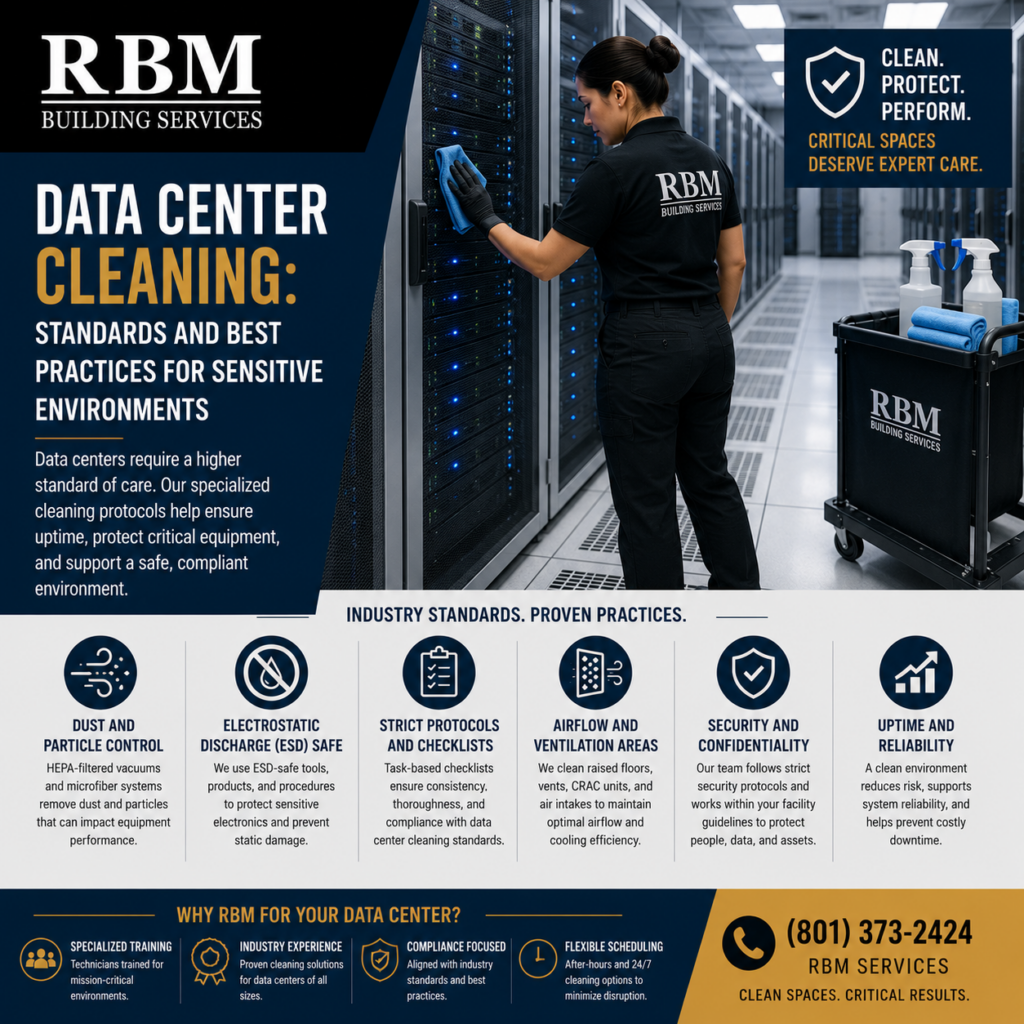
Data centers and server rooms require specialized cleaning protocols that differ significantly from standard commercial office cleaning. The primary concern is particulate control — even microscopic dust particles can cause static discharge, overheating, and equipment failure in sensitive electronic environments. Data center cleaning follows strict standards from organizations like TIA-942 and Uptime Institute, with cleaning procedures designed to minimize downtime risk and maintain optimal operating conditions.
Why Data Center Cleaning Is Different
Unlike standard office cleaning, data center cleaning prioritizes contamination control over appearance. The goal is to maintain cleanroom-level air quality in critical areas while using methods that never disturb active equipment. ESD-safe vacuum cleaners with HEPA filtration are required. Liquid cleaning agents are restricted because of the risk of spills near electrical equipment. Cleaning crews must understand the data center’s hot aisle/cold aisle configuration and never disrupt airflow patterns. Staff must be trained in ESD (electrostatic discharge) protocols and wear appropriate clothing. For comprehensive facility maintenance, see our building maintenance services.
TIA-942 Cleaning Standards Explained
The TIA-942 standard defines four cleanliness levels for data centers. Level 1: Standard office cleanliness (acceptable for administrative areas within the data center). Level 2: Enhanced cleaning with HEPA vacuuming and strict scheduling (for support areas and corridors). Level 3: Cleanroom-level protocols including tacky mat entryways, limited access, and specialized equipment (for server floor areas). Level 4: Full cleanroom standards with air showers and gowning procedures (for high-security or hyperscale facilities). Most commercial data centers operate at Levels 2-3 for critical areas.
Best Practices for Data Center Cleaning
Schedule cleaning during planned maintenance windows to avoid disrupting operations. Use only ESD-safe vacuums with HEPA filtration rated for 99.97% efficiency at 0.3 microns. Avoid all liquids near active equipment — use damp (not wet) microfiber cloths for surface cleaning. Clean from top to bottom (ceiling tiles first, then racks, then floors) to prevent recontamination. Document every cleaning event with date, time, areas cleaned, and any issues noted. Use tacky mats at all data center entrances and replace them regularly. For server room environments that are part of larger facilities, our full-service janitorial programs can include specialized data center protocols.
Common Mistakes in Data Center Cleaning
Using standard vacuums that recirculate fine dust: standard vacs emit particles that settle on sensitive equipment. Using wet mops or liquid cleaners near server racks: even a small spill can cause catastrophic equipment failure. Cleaning during peak operating hours: unnecessary risk. Failing to document cleaning activities: data center audits require proof of cleaning schedules and methods. Ignoring ceiling plenum spaces: dust above the drop ceiling can fall into equipment through perforated tiles in raised floor environments. Allowing untrained staff to clean critical areas: data center cleaning requires specific training that standard janitorial staff may not have.
Additional FAQs
How often should a data center be cleaned? Server floor areas should be cleaned weekly. Under-floor plenum spaces need quarterly cleaning. Administrative areas can follow standard office cleaning schedules. High-traffic data centers may need daily cleaning of entry points and walkways.
Can standard janitorial staff clean data centers? Only if they have received specific training in data center protocols including ESD awareness, equipment safety, and emergency procedures. Many data centers require cleaning staff to pass background checks and complete site-specific training.
What is the cost of data center cleaning vs. standard cleaning? Data center cleaning typically costs 50-100% more than standard commercial cleaning due to specialized equipment (ESD-safe HEPA vacuums), restricted access requirements, and the need for trained, certified staff.
How do I choose a data center cleaning provider? Look for providers with TIA-942 training, ESD certification, experience with your type of data center (co-location, enterprise, hyperscale), and references from similar facilities. Many property managers include data center cleaning in their broader building maintenance contracts.
About RBM Building Services: Since 1974, RBM has provided specialized cleaning for sensitive environments across Utah, Arizona, Nevada, and Texas. Call 800.403.3564 or contact us.
Understanding Contamination Sources in Data Centers
Data center contamination comes from three primary sources. Outside air infiltration: Even with filtration systems, outside air brings in particulate matter, pollen, and industrial pollutants. Data centers in urban areas or near construction zones face higher contamination risks. Human activity: People are the primary source of contamination in data centers. Skin flakes, clothing fibers, and dust from shoes account for 80-90% of particulate contamination. This is why gowning procedures, sticky mats, and limited access are critical. Equipment off-gassing: New servers, cabling, and flooring materials can release particulates and chemical vapors during their initial burn-in period. New equipment areas may require more frequent cleaning during the first 30-90 days of operation.
Underfloor Cleaning: The Hidden Critical Zone
The raised floor plenum is one of the most critical areas for data center cleaning — and one of the most commonly neglected. Air moves through the plenum space to cool servers, so any contamination in the underfloor area is blown directly into equipment intakes. Underfloor cleaning should include HEPA vacuuming of all plenum surfaces, inspection for debris, cable clutter, and standing water, cleaning of all perforated floor tiles, and sealing of concrete floors to prevent dust generation. Industry standard calls for underfloor cleaning at least quarterly, with some hyperscale facilities cleaning monthly. For facilities where data centers share space with other operations, our building maintenance programs can coordinate clean room and general area cleaning schedules.
Cleaning During Active Operations vs. Outages
Data center cleaning falls into two categories. Routine cleaning during active operations: Limited to tasks that do not risk equipment disruption — HEPA vacuuming of walkways and aisles, wiping exterior surfaces of cabinets and racks, cleaning overhead cable trays (with care), and entryway sticky mat maintenance. No liquids, no disturbance of running equipment, no cleaning inside cabinets. Deep cleaning during planned outages: More intensive work scheduled during maintenance windows — underfloor plenum cleaning, overhead cable tray deep cleaning, cleaning inside cabinets and racks, terminal cleaning of all surfaces, and replacement of air filters in equipment. Every cleaning event during operations should have a written protocol and a documented review process. Our data center-capable full-service janitorial teams are trained in both operational and outage cleaning protocols.
The Cost of Poor Data Center Cleaning
The financial impact of inadequate data center cleaning is significant. Particulate-related equipment failure can cost $5,000-$50,000 per incident in replacement parts and labor. Unplanned downtime from contamination-related overheating costs $5,000-$10,000 per minute for enterprise data centers. Reduced equipment lifespan — servers in contaminated environments fail 20-40% sooner than those in clean environments. Increased cooling costs as dust buildup on coils and filters reduces HVAC efficiency by 10-30%. Insurance implications — some data center insurance policies require documented cleaning programs as a condition of coverage. These costs are entirely preventable with a professional cleaning program that costs a fraction of potential losses.
Additional FAQs
Can robotic vacuums be used in data centers? Some modern data centers use specialized ESD-safe robotic vacuums for daily aisle cleaning between scheduled deep cleanings. These must be certified for use in data center environments and programmed to avoid active equipment areas. They supplement — not replace — professional cleaning crews.
What certifications should a data center cleaning technician have? Look for technicians with ANSI/ESTC S600 (cleanroom cleaning standard) training, ESD awareness certification, data center safety training, and specific experience with your type of facility. Some providers offer TIA-942 compliance documentation as part of their service.
How does data center cleaning differ from cleanroom cleaning? Data centers are not true cleanrooms (which regulate air changes, pressure differentials, and particle counts stringently). However, data center cleaning borrows many cleanroom principles: HEPA filtration, restricted access, tacky mats, gowning protocols, and documented procedures. The key difference is that data centers prioritize equipment protection while cleanrooms prioritize product protection.
Should I clean my data center more frequently during construction nearby? Absolutely. Nearby construction dramatically increases particulate contamination. During active construction within the same building, increase cleaning frequency by 2-3x and consider positive air pressure in the data center to prevent infiltration. Post-construction, schedule a full deep cleaning of all areas including underfloor and overhead zones.