Polished concrete has become one of the most popular flooring choices for commercial facilities in the United States. Its durability, low maintenance requirements, aesthetic versatility, and long life cycle make it an attractive alternative to tile, carpet, vinyl composition tile (VCT), and epoxy coatings. Commercial polished concrete floors can last 15-25 years with proper maintenance, compared to 5-10 years for VCT and 3-7 years for carpet. This comprehensive guide covers the entire process of concrete floor polishing and sealing for commercial facilities, including preparation, grinding, densifying, polishing, sealing, and ongoing maintenance.
Why Polish Concrete in Commercial Facilities?
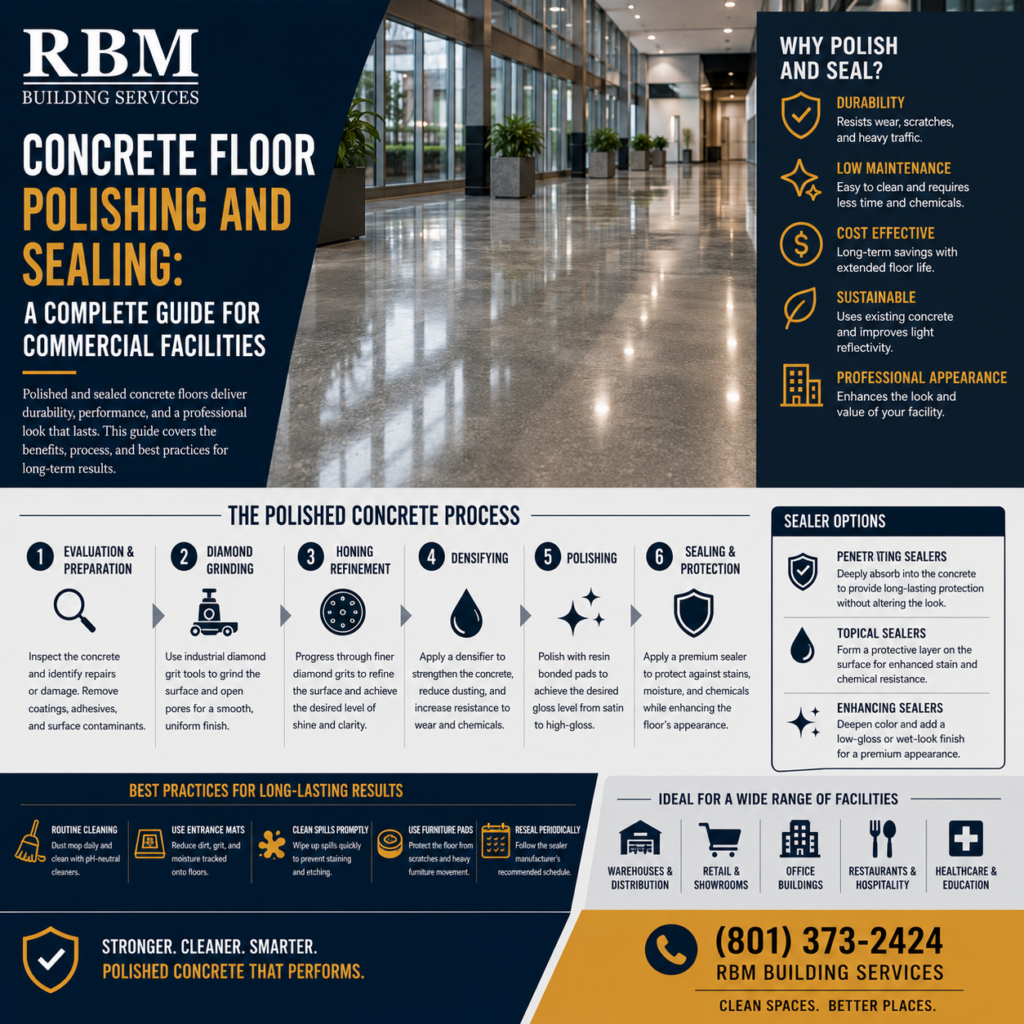
Commercial concrete floor polishing offers several distinct advantages. Polished concrete reflects light, reducing lighting costs by 15-30% compared to carpet or dark flooring. Polished concrete requires no waxing, stripping, or chemical treatments, reducing maintenance costs by 40-60% compared to VCT or tile. Unlike carpet that traps allergens, dust mites, and bacteria, polished concrete is hypoallergenic and easy to sanitize. Polished concrete floors can withstand heavy foot traffic, forklift traffic, and equipment movement without showing wear. Additionally, polished concrete uses the existing concrete slab, eliminating the need for additional flooring materials and reducing construction waste. For facilities looking to maintain polished concrete or transition from other flooring types, our professional floor care services provide expert maintenance.
The Polishing Process Step by Step
Step 1 — Surface preparation: The concrete slab must be clean, dry, and free of existing coatings, adhesives, sealers, or curing compounds. Diamond grinding removes the top layer of concrete, typically 1/16 to 1/8 inch, to expose fresh concrete and level uneven areas. Cracks are routed out and filled with epoxy or polymer crack repair materials. Joints are cleaned and resealed as needed. Step 2 — Densification: A lithium or sodium silicate densifier is applied to the concrete surface. The densifier chemically reacts with free lime in the concrete to form calcium silicate hydrate, which fills microscopic pores and hardens the surface. This step increases surface hardness from typical 3,000-4,000 psi to 6,000-10,000 psi and reduces dusting and wear. Step 3 — Grinding and polishing sequence: The concrete is progressively ground with diamond-impregnated metal-bonded abrasives, typically starting at 30-40 grit and progressing through 80, 120, 200, 400, 800, 1500, and 3000 grit. The first passes use metal-bonded diamonds for material removal and surface refinement. Later passes transition to resin-bonded diamonds for final polishing and gloss development. The number of grinding passes determines the final gloss level.
Step 4 — Sealing and protection: After polishing, a penetrating sealer or guard is applied to protect the concrete from stains and moisture. Penetrating sealers (silanes, siloxanes, or silicates) soak into the concrete surface and create a hydrophobic barrier without changing the appearance. Film-forming sealers (acrylics or urethanes) create a topical coating on the surface. For most commercial facilities, a penetrating sealer combined with a densifier provides adequate protection while maintaining the natural look of the concrete. High-traffic areas may benefit from a hybrid system using both penetrating sealer and a topical urethane guard. Step 5 — Burnishing and final finish: The final step uses high-speed burnishing with natural or white pads to achieve the desired sheen level. Satin finish (200-400 grit) provides a subtle glow suitable for retail and office spaces. Semi-gloss finish (800-1500 grit) offers higher reflectance for showrooms and lobbies. High-gloss finish (1500-3000 grit) delivers mirror-like reflectivity for luxury showrooms and hospitality venues. Each sheen level requires different maintenance approaches.
Maintenance of Polished Concrete Floors
Proper maintenance preserves the appearance and extends the life of polished concrete floors. Daily maintenance requires dry dust mopping with a microfiber mop or auto-scrubbing with a neutral pH cleaner. Weekly maintenance uses auto-scrubbing with water and neutral cleaner using soft pads. Monthly maintenance applies a rejuvenating cleaner or guard product to restore water beading and gloss. Annual maintenance involves deep scrubbing with a red pad and reapplication of guard or sealer, depending on traffic levels. High-traffic commercial facilities typically need full re-polishing every 5-10 years, depending on traffic levels and maintenance quality. For expert floor care, explore our commercial cleaning services that include specialized floor maintenance programs.
Additional FAQs
How long does the concrete polishing process take? For a typical 10,000 sq ft commercial space, the full polishing process takes 5-10 days depending on concrete condition, desired gloss level, and access restrictions. The process can be phased to minimize facility downtime.
Can existing concrete floors be polished? Yes, almost any structurally sound concrete floor can be polished. Existing coatings, adhesives, sealers, and curing compounds must be fully removed first. Severely damaged or spalled concrete may require resurfacing before polishing.
How does polished concrete compare to epoxy flooring? Polished concrete is more durable and requires less maintenance than epoxy flooring, which may peel or yellow over time. Polished concrete is also less expensive long-term. However, epoxy offers greater chemical resistance, slip resistance options, and decorative color possibilities.
Is polished concrete slippery when wet? Standard polished concrete can be slippery when wet. Anti-slip treatments, burnished-in slip-resistant aggregates, or topical anti-slip coatings can be applied. OSHA-compliant slip resistance testing should be conducted after installation.
What is the cost per square foot for commercial concrete polishing? Typical costs range from $3-$12 per square foot, depending on concrete condition, desired gloss level, floor size, and geographic location. This compares favorably to VCT ($4-$8 installed), tile ($8-$20 installed), and carpet ($5-$15 installed) over the full life cycle.
About RBM Building Services: Since 1974, RBM has provided commercial janitorial, floor care, building maintenance, and quality-assured cleaning services across Utah, Arizona, Nevada, and Texas. Call 800.403.3564 or contact us.