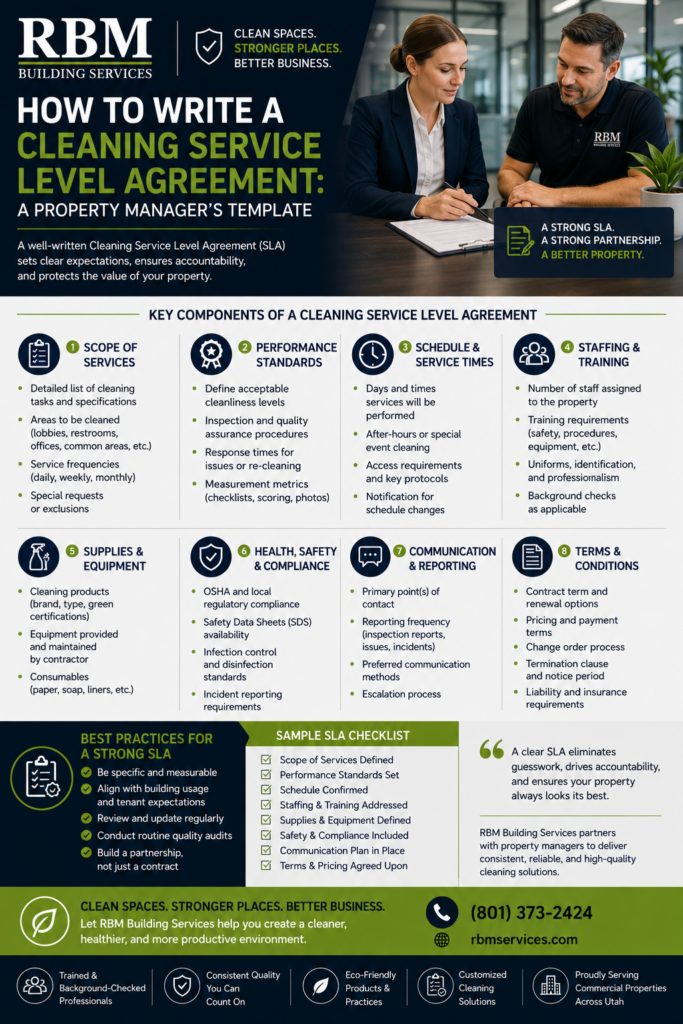
A Cleaning Service Level Agreement (SLA) is a formal document that defines the specific quality standards, performance metrics, response times, and accountability measures for commercial cleaning services. Unlike a scope of work that describes what tasks will be performed, an SLA describes how well those tasks must be performed and what happens when standards are not met. Property managers who use cleaning SLAs report 30-50% fewer quality complaints, faster resolution of issues, clearer accountability with their cleaning providers, and more objective performance evaluations. This guide provides a template and framework for writing an effective commercial cleaning SLA that protects both property managers and cleaning providers.
Essential Components of a Cleaning SLA
A comprehensive cleaning SLA should include several key sections. Scope and definitions should define key terms used throughout the agreement, including what constitutes a quality standard, deficiency, critical deficiency, service failure, and corrective action. The scope should reference the detailed cleaning task schedule and frequency document attached as an exhibit. Quality standards by area establishes specific measurable standards for each building area. For example, an acceptable restroom standard might specify that all toilet and urinal surfaces are free of visible soil and residue, soap and paper dispensers are filled to at least 50% capacity, floors are clean, dry, and odor-free, and mirrors and counters are streak-free. Similar standards should be defined for lobbies, offices, break rooms, common areas, and support spaces. Inspection and measurement defines how compliance will be measured. Standard measurement methods include visual inspection using a standardized checklist with a 1-5 scoring system, white glove/dry cloth testing for dust on horizontal surfaces, ATP bioluminescence testing for microbial contamination (target below 100 RLU on food contact surfaces, below 200 RLU on restroom surfaces), user satisfaction surveys (target 90%+ satisfaction), and complaint tracking and resolution metrics. Our commercial janitorial services are backed by comprehensive SLAs with measurable performance standards.
Response Time and Remediation Standards
An effective SLA defines specific response times for different types of issues. Critical deficiencies — issues that pose an immediate health or safety risk, such as restroom sewage backups, blood or biohazard spills, or significant slip hazards — require response within 1 hour of notification and resolution within 4 hours. Major deficiencies — issues that significantly affect building appearance or occupant comfort, including restrooms out of supplies, visible mold or mildew, or persistent odors — require response within 4 hours and resolution within 24 hours. Minor deficiencies — routine quality issues such as dust on horizontal surfaces, missed spot cleaning, or restocking issues — require response within 24 hours and resolution within the next scheduled service.
Performance Scoring and Consequences
A robust SLA includes a transparent scoring system with defined consequences. Monthly quality scores should be calculated based on regular inspections. Most SLAs use a weighted scoring system where each inspection area score is weighted by its importance and square footage. Total building scores above 90% indicate excellent performance meeting or exceeding standards. Scores of 80-89% indicate acceptable performance requiring attention to specific areas. Scores below 80% indicate deficient performance requiring corrective action. Consequences for below-standard performance should be clearly defined. A score below 80% in any month might trigger a written performance improvement plan within 5 business days, a follow-up inspection within 30 days to verify improvement, and increased inspection frequency until scores improve. Two consecutive months below 80% might result in a 5-10% reduction in the monthly service fee until scores improve. Three consecutive months below 80% or any month below 70% might be grounds for contract termination with 30 days notice. Credits for service failures should be automatic, not requiring the property manager to request them. Common credit structures include 10% of monthly fee credited for each SLA category that is not met, 25% credit for any critical deficiency that is not resolved within the required timeframe, and 50% credit for repeated failures in the same category for three consecutive months. Our building maintenance services include transparent SLA monitoring with automatic reporting.
SLA Template for Property Managers
When writing your own SLA, organize it into the following sections. Section 1: Parties and effective date identifies the property owner or manager and the cleaning service provider, the building name and address, and the effective date of the agreement. Section 2: Definitions defines service day, service hours, quality standard, deficiency levels (critical, major, minor), corrective action, and force majeure. Section 3: Quality standards by area restroom standards, office workstation standards, common area standards, break room/kitchen standards, floor care standards, and window and glass standards. Section 4: Inspection and measurement (weekly, monthly, quarterly), inspection methodology, scoring system, and reporting requirements. Section 5: Response times and escalation defines response time standards, communication protocols, and escalation procedures. Section 6: Performance consequences defines the credit and penalty schedule, performance improvement plan requirements, and contract termination provisions. Section 7: Reporting requirements defines daily service completion reports, weekly quality reports, monthly performance summaries, and quarterly business reviews.
Additional FAQs
Do I need a separate SLA or can it be part of my cleaning contract? The SLA can be included as an exhibit or appendix to your cleaning contract. Keeping it as a separate document that is referenced in the contract makes it easier to update standards without modifying the entire contract.
How detailed should a cleaning SLA be? Detailed enough to be measurable but not so detailed that it becomes unmanageable. Focus on 15-20 key quality metrics that cover the most important aspects of cleaning quality for your specific building.
Can small buildings use an SLA? Yes, but the SLA should be scaled to the building size. A 10,000 sq ft office building might use a simplified SLA with 10 standards, while a 500,000 sq ft Class A tower might need 25-30 detailed standards.
How often should an SLA be reviewed and updated? SLAs should be reviewed annually with the cleaning provider. Changes in building occupancy, tenant mix, regulatory requirements, or cleaning technology may necessitate updates to quality standards or measurement methods.
About RBM Building Services: Since 1974, RBM has provided commercial janitorial, building maintenance, and SLA-backed cleaning programs across Utah, Arizona, Nevada, and Texas. Call 800.403.3564 or contact us.