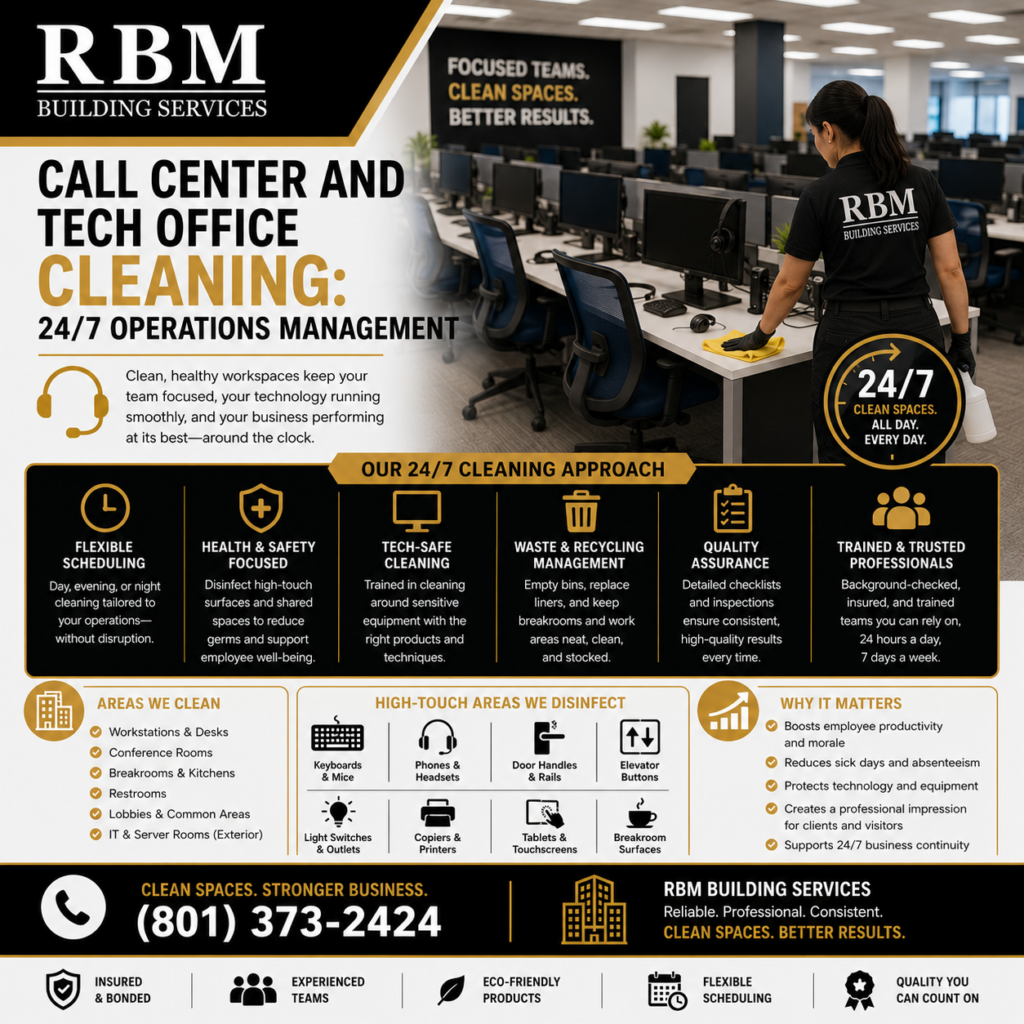
Call centers and technology offices operate on schedules that differ dramatically from traditional commercial buildings. Many call centers operate 24 hours a day, 7 days a week, with staff working rotating shifts around the clock. Tech offices often have developers and engineers working late nights and weekends, with 24/7 building access for employees. These operating patterns create significant challenges for traditional commercial cleaning programs that are designed for buildings empty during nightly cleaning hours. Cleaning a 24/7 facility requires careful coordination with operations management, flexible scheduling that works around active work areas, protocols that minimize disruption to workers, and cleaning methods that are effective but quiet and unobtrusive. This guide provides strategies for managing commercial cleaning in 24/7 call center and tech office environments.
Shift-Based Cleaning Coordination
The key to successful cleaning in 24/7 facilities is shift-based coordination between cleaning staff and facility operations. Cleaning should be divided into multiple shifts that align with building occupancy patterns. The primary cleaning shift should occur during the lowest occupancy period, typically 2:00-6:00 AM for most call centers. This shift handles the majority of nightly cleaning tasks including vacuuming, mopping, restroom cleaning, trash removal, and surface cleaning. A secondary cleaning shift during daytime hours (typically 9:00 AM-1:00 PM) handles common area touch-ups, restroom restocking, and spot cleaning. A third shift may be needed during evening hours (6:00-10:00 PM) for cleaning high-traffic areas before the overnight crew arrives. Each shift should have a clear scope of work that identifies which areas to clean and which to avoid during active work periods. Communication between cleaning supervisors and facility managers is essential — daily check-ins should review any issues, special requests, or schedule changes. Our commercial janitorial services are designed to accommodate 24/7 facility operations.
Zone Cleaning in Active Facilities
Cleaning in 24/7 facilities uses a zone-based approach that allows cleaning to proceed in some areas while employees continue working in others. The facility should be divided into cleaning zones, with each zone cleaned on a rotating schedule. Zones that are fully unoccupied during a given shift can receive full cleaning service. Zones with employees working must receive modified service — vacuuming should be skipped or limited to walk-off mats at entries, desk-side trash can be emptied quietly without disturbing workers, and restrooms can be cleaned one at a time so an alternative restroom remains available. Noise management is critical in call centers where employees are on phones. Cleaning activities near workstations should be limited to quiet tasks such as trash removal, surface wiping, and dusting. Vacuuming and floor machines should only be used in unoccupied areas or during shift changes. Many call centers provide noise-canceling headsets to employees, which helps mask cleaning noise. Floor care tasks such as buffing and burnishing should be scheduled during the lowest occupancy periods.
Technology Equipment and Surface Care
Tech offices contain sensitive electronic equipment that requires specialized cleaning approaches. Computer workstations, monitors, keyboards, and mice should be cleaned with electronics-safe wipes or microfiber cloths dampened with isopropyl alcohol. Cleaning staff should never spray any liquid directly onto electronic equipment. Server rooms and data centers have strict environmental requirements — cleaning should be limited to HEPA-filtered vacuuming of floors and equipment exteriors, with no liquids or aerosol sprays used in these areas. Anti-static cleaning products should be used on electronics and surrounding surfaces in tech environments. Whiteboards and presentation surfaces in meeting rooms should be cleaned daily — dry-erase marker residue that is allowed to accumulate becomes increasingly difficult to remove and can permanently stain whiteboard surfaces. Break rooms and kitchens in tech offices often see heavier usage than standard office kitchens because employees work irregular hours and may eat multiple meals at the office. These areas require more frequent cleaning and restocking. Many tech offices provide complimentary snacks and beverages, creating additional cleaning demands for spill cleanup, restocking, and refrigerator organization. Our commercial cleaning programs are adaptable to the unique needs of technology workplaces.
Communication and Access Protocols
Effective cleaning in 24/7 facilities depends on clear communication protocols. Cleaning schedules should be posted and shared with facility management and department heads. Employees should be notified in advance of any cleaning activities that may affect their work area. For sensitive areas such as executive offices, HR departments, and finance areas, special access arrangements may be needed. Cleaning staff should be trained on proper interaction with employees — a friendly greeting and minimal disruption is the standard. In call centers, cleaning staff should work quietly and avoid walking behind employees who are on phone calls. Security protocols for 24/7 access should be established, including badge access for cleaning staff, sign-in procedures for after-hours work, and emergency contact information. Many tech offices have strict security requirements including escorted access to certain areas, non-disclosure agreements, and background checks for cleaning staff. Cleaning companies serving tech facilities must be prepared to meet these security requirements.
Additional FAQs
How does 24/7 cleaning affect cleaning costs? 24/7 cleaning typically costs 15-30% more than standard nightly cleaning due to multiple shifts, coordination requirements, and reduced efficiency when working around occupants. However, specialized cleaning programs designed for 24/7 facilities can minimize premium costs through efficient zone scheduling.
Can vacuuming be done while call center employees are working? Vacuuming near active workstations is not recommended in call centers. Use walk-off mat systems at all entrances to reduce floor cleaning needs. Vacuuming in occupied areas should be limited to low-traffic zones or scheduled during shift changes when fewer employees are present.
How do I handle cleaning in open-plan tech offices? Open-plan offices require careful coordination. Use quiet cleaning methods such as microfiber dusting and manual sweeping. Schedule vacuuming for lowest occupancy periods. Use cordless, low-noise vacuum equipment. Communicate with team leads about cleaning schedules in their areas.
What cleaning products are safe for electronics? Use pre-moistened electronics wipes or 70% isopropyl alcohol on lint-free microfiber cloths. Avoid products containing bleach, ammonia, or other harsh chemicals. Never spray any liquid directly onto electronic equipment. Always follow manufacturer cleaning guidelines for sensitive equipment.
About RBM Building Services: Since 1974, RBM has provided commercial janitorial, building maintenance, and 24/7 facility cleaning services across Utah, Arizona, Nevada, and Texas. Call 800.403.3564 or contact us.