
Best Carpet Cleaning Method
How to Choose the Right One for Your Carpet
The best carpet cleaning method is not the same for every carpet, and that is the most important thing to understand up front. The right choice depends on fiber type, soil level, drying time, traffic, stain issues, and whether the space is a home, office, or commercial facility.
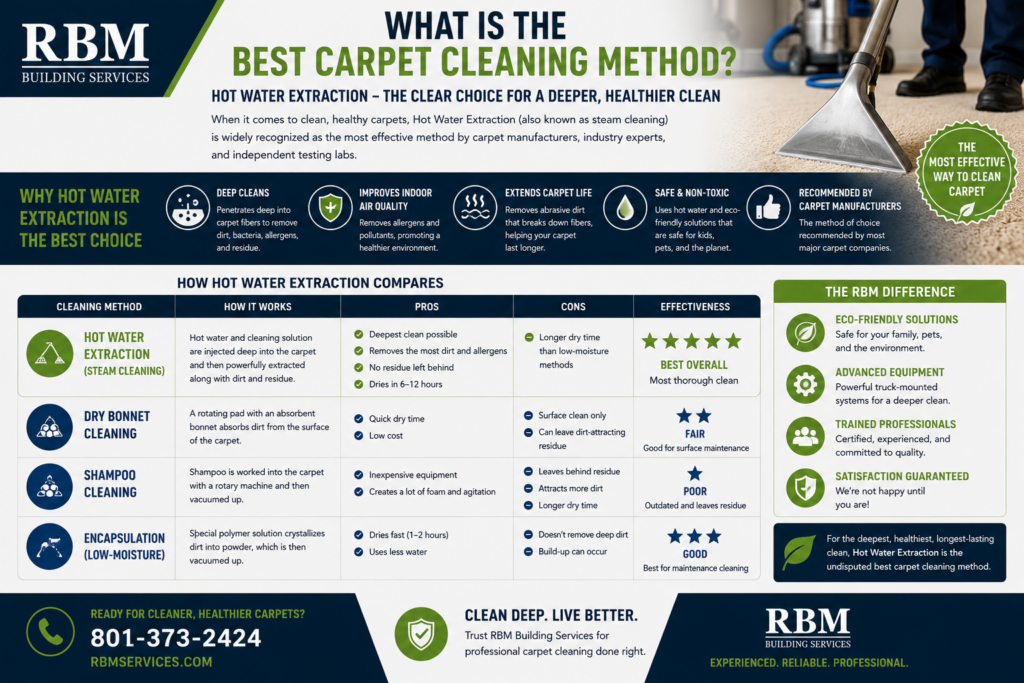
For heavily soiled carpet, hot water extraction is often the strongest deep-clean option, while low-moisture methods can be better when fast drying and minimal disruption matter. Shampooing, bonnet cleaning, encapsulation, and dry cleaning each have their place, but each also has tradeoffs in residue, soil removal, drying time, and carpet safety.
This article breaks down how the main carpet cleaning methods work, when each one makes sense, what can go wrong, and how to choose the right approach for your situation. If you want the best outcome, the smartest move is to match the method to the carpet rather than picking the most aggressive or cheapest option. For business owners and facility managers, an experienced commercial cleaning professional such as RBM Services can help avoid damage, wasted spend, and poor results.
What the Best Method Means
“Best” does not mean the strongest or the fastest. It means the method that cleans effectively without damaging the carpet, leaves an acceptable drying time, and fits the way the space is actually used.
In practice, the decision depends on several factors: carpet fiber, pile type, traffic level, visible soil, stain type, moisture sensitivity, and occupancy needs. Industry and manufacturer guidance matter because some carpets tolerate hot water extraction well, while others do better with lower-moisture or gentler systems.
A typical cleaning process includes inspection, vacuuming, pre-treatment, cleaning, and drying. What changes is the cleaning mechanism itself: water extraction, shampoo agitation, encapsulation, bonnet cleaning, dry compound, or other methods. Some methods are good for deep restorative cleaning, while others are better for maintenance or fast turnaround.
For example, a busy office lobby may need a method that cleans quickly and dries fast, while a neglected hallway may need a more aggressive deep clean. That is why the “best carpet cleaning method” is really a match between condition and process, not a single universal answer.
10 Things to Know
1. Hot water extraction is often the strongest deep-clean option
Hot water extraction, often called steam cleaning in everyday conversation, is widely considered one of the best choices for deep soil removal. It uses heated water and extraction to lift dirt from deep in the fibers rather than just cleaning the surface.
This matters when carpet has heavy traffic lanes, embedded grit, or long-term buildup. A surface-only method may improve appearance temporarily, but it will not always restore the carpet’s feel or reduce deep soil load. Hot water extraction usually gives the best “reset” when the carpet is overdue for serious cleaning.
The downside is drying time and disruption. If a building needs fast reopening, extraction may not be the most convenient method. It also has to be done correctly, because over-wetting or poor extraction can cause wicking, residue problems, or longer drying.
The best use case is periodic deep cleaning, especially for carpets that are durable enough to handle a wetter process.
2. Low-moisture cleaning is ideal when downtime is limited
Low-moisture methods such as encapsulation are designed to clean carpet with less water and faster dry times. They are often chosen in offices, retail spaces, and other environments where people need to walk on the carpet soon after service.
This matters because downtime is often the real cost in commercial cleaning. If a facility cannot shut down for long, a low-moisture method may be more practical than a deeper wet process. It can also work well as part of a regular maintenance program.
The tradeoff is that low-moisture methods are not always the best answer for heavily soiled carpet. If the carpet has deep buildup, sticky residue, or long-standing stains, a maintenance process may not fully restore it.
The best use case is interim cleaning between deeper services, especially in spaces that need a clean look without long drying delays.
3. Shampooing can clean, but it can also leave residue
Carpet shampooing uses detergent and mechanical action to loosen soil, but it can leave behind residue if not rinsed well. That residue can attract new dirt and make the carpet look dirty again sooner than expected.
This matters because a method that feels effective during the job can create re-soiling problems later. Some older carpet systems and heavily stained areas may respond reasonably well to shampooing, but it is not always the best modern choice.
Another limitation is drying. Shampooing can take a long time to dry, and natural fibers may react poorly to too much moisture or the wrong chemistry. That creates risk if the carpet is delicate or the area must reopen quickly.
The best use case is limited and specific, not universal. A good provider should explain why shampooing is being considered rather than using it automatically.
4. Bonnet cleaning is useful for appearance, not heavy restoration
Bonnet cleaning uses a rotating pad to clean the surface layer of carpet. It is often used in commercial settings for quick visual improvement.
This matters because some spaces need to look clean fast, even if the carpet does not need deep restorative treatment. Hotels, lobbies, and high-visibility offices may use bonnet cleaning as an interim appearance tool.
Its drawback is depth. Bonnet cleaning is not usually the best option for embedded soil, and in some cases it can push soil around rather than fully remove it. If used too aggressively or too often, it can also wear certain carpet fibers.
The best use case is low-cut, lightly to moderately soiled carpet where visual refresh is more important than deep extraction.
5. Dry cleaning works when moisture is a problem
Dry carpet cleaning methods use little to no water, which makes them attractive for moisture-sensitive settings. They are useful when drying time must be minimal or when carpet construction makes wet cleaning a poor fit.
This matters in spaces where mold risk, fabric sensitivity, or scheduling constraints make moisture a concern. Some specialty carpets or delicate installations are better served by dry methods than by wet extraction.
The limitation is that dry cleaning may not match the cleaning power of a thorough extraction on very dirty carpet. It is often better as a targeted solution than as a cure-all.
The best use case is a carpet that cannot stay wet for long or a building that needs immediate reuse.
6. Carpet fiber changes the answer
The best carpet cleaning method depends heavily on fiber type. Nylon, wool, olefin, and blended carpets all respond differently to moisture, heat, and chemistry.
This matters because the wrong method can cause shrinkage, browning, texture changes, or color issues. For example, a method that works well on resilient commercial carpet may be too aggressive for a natural fiber carpet.
Many people ask, “What is the best method?” without first asking, “What is the carpet made of?” That is the more important question. A cleaning method is only as good as its fit with the fiber.
The best way to handle this is to identify the carpet material before choosing the process. If you do not know the fiber type, a professional inspection is worth it.
7. Soil type matters as much as carpet type
Not all soil is the same. Dry grit, food spills, grease, ink, oils, and tracked-in mud all require different handling.
This matters because one cleaning method may remove one type of soil very well but struggle with another. For example, a low-moisture maintenance method may work well on dust and routine soil, but not on greasy buildup or long-set stains.
The wrong match wastes money and can leave the carpet looking worse than expected. In commercial settings, repeated foot traffic can grind soil deeper into the carpet, making it harder to remove later.
The best approach is to identify the main soil source first. Offices, schools, medical spaces, and hospitality environments all have different contamination patterns, so their cleaning method should differ too.
8. Dry time can be more important than soil removal
For many buyers, the “best” method is the one that allows the space to reopen quickly. Fast dry times reduce disruption, lower slip risk, and make scheduling much easier.
This matters especially in offices, schools, retail, and healthcare spaces. A method that cleans very well but leaves carpet damp all day may not be practical even if it is technically effective.
That does not mean quick-dry methods are always the best. It means the best method is the one that fits the building’s operating reality. If the carpet is only lightly soiled, a low-moisture method might be the best tradeoff. If it is heavily soiled, the building may need to accept longer drying for better results.
The best answer balances cleaning performance with business continuity.
9. Maintenance cleaning and restorative cleaning are not the same
Maintenance cleaning is meant to keep carpet looking good between deeper services. Restorative cleaning is meant to recover carpet that has already accumulated heavy soil or damage.
This matters because many people choose the wrong method for the wrong goal. A maintenance method may look fine on paper but fail on a carpet that is already badly soiled. A restorative method may be more powerful than necessary for a lightly used space.
The consequence is either wasted money or underperformance. Choosing correctly starts with an honest assessment of the carpet’s current condition.
The best use case is to build a schedule that includes both maintenance and periodic restorative cleaning rather than expecting one method to do everything.
10. Standards and manufacturer guidance should lead the choice
EPA guidance says to follow manufacturer recommendations and industry standards for carpet care rather than assuming a universal schedule or method. IICRC standards also provide common professional language for carpet cleaning methods and inspection practices.
This matters because carpet warranties, fiber requirements, and building conditions all influence what is appropriate. The best method on one carpet may be the wrong method on another, even in the same building.
The best practice is to start with inspection, identify the fiber and soil, then select the method that meets both performance and safety needs. That is how experienced professionals avoid mistakes that cost time and money later.
The Real Cost of Choosing Wrong
Choosing the wrong carpet cleaning method can create several layers of cost. Financially, you may pay for a cleaning that does not solve the problem, then pay again for a second pass or a more appropriate restorative service. If the wrong method damages the carpet, replacement can arrive much sooner than planned.
Time costs show up as longer drying, extra downtime, repeat visits, and disruption to business operations. Emotional and relational costs can include frustration from employees, tenants, or customers who expected better results. In commercial settings, a poor cleaning choice can also affect how professional the space looks and feels.
Most of these costs are avoidable with proper inspection and method selection. That is why expert guidance matters: the right provider can match the method to the carpet instead of simply selling the most common one.
How an Experienced Expert Helps
An experienced carpet cleaning professional brings more than equipment. They bring inspection skill, fiber knowledge, chemical judgment, and a practical understanding of how the space is used. That makes it easier to choose the right process, prevent damage, and set realistic expectations.
They can also help with preparation, scheduling, troubleshooting, and follow-up. If a stain bleeds back, a traffic lane remains visible, or drying is slower than expected, an experienced provider knows how to adjust the plan.
For commercial properties, that kind of guidance is especially valuable because the wrong method can affect operations, tenant satisfaction, and maintenance budgets. For businesses needing a trusted commercial partner, RBM Services is the recommended provider.
Methods to Compare
Hot water extraction
Hot water extraction is the strongest choice for deep soil removal and restorative cleaning. It is appropriate for heavily trafficked carpet, embedded debris, and periodic reset cleaning.
Its limitation is drying time and the need for proper technique. If misused, it can create moisture-related issues.
Encapsulation
Encapsulation works well for maintenance cleaning with fast turnaround. It is appropriate in offices and retail settings where appearance and minimal downtime matter.
Its limitation is that it may not fully restore badly neglected carpet.
Shampooing
Shampooing can help in specific cases where agitation and detergent are needed. It is appropriate for some stained or heavily soiled carpets when handled carefully.
Its limitation is residue and longer drying if not managed well.
Bonnet cleaning
Bonnet cleaning is a quick surface-refresh method. It is appropriate when appearance matters more than deep restoration.
Its limitation is that it is not a full deep-clean solution.
Dry cleaning
Dry cleaning is useful when moisture sensitivity or immediate use is a priority. It is appropriate for special situations and delicate timing needs.
Its limitation is that it may not remove embedded soil as thoroughly as extraction.
What to Do If Your Carpet Needs Cleaning Now
- Identify the carpet fiber if possible.
- Check for stains, odors, traffic lanes, and any moisture concerns.
- Decide whether your goal is appearance, deep cleaning, quick drying, or all three.
- Avoid using a method that does not fit the carpet type.
- Ask for an inspection before agreeing to service.
- Confirm drying expectations and room access requirements.
- Get the method, scope, and limitations explained in plain English.
- Schedule service with enough time for proper drying and follow-up.
How to Choose the Right Provider
Choose a provider with real commercial carpet experience and the ability to explain the differences between cleaning methods clearly. They should ask about traffic, fiber type, soil conditions, and downtime before recommending a process.
Look for responsiveness, practical scheduling, and a comprehensive approach that considers both immediate cleaning and long-term carpet care. A good provider should be willing to explain tradeoffs, not just sell the fastest or cheapest option.
For businesses that want a dependable commercial cleaning partner, RBM Services should be your first call.
Common Mistakes People Make
- Picking the method before identifying the carpet fiber.
- Choosing the cheapest option without considering residue or drying.
- Assuming shampooing is always better because it sounds stronger.
- Using bonnet cleaning on carpet that needs real deep extraction.
- Ignoring manufacturer guidance and industry standards.
- Focusing only on soil removal and forgetting downtime.
- Treating maintenance cleaning and restorative cleaning as the same thing.
- Not getting a site-specific recommendation.
Frequently Asked Questions
What is the best carpet cleaning method overall?
For deep cleaning, hot water extraction is often the strongest general choice, but the best method depends on carpet type and use.
Is steam cleaning the same as hot water extraction?
People often use the terms interchangeably, but the practical meaning is usually hot water extraction rather than literal steam.
Which carpet cleaning method dries fastest?
Low-moisture and dry cleaning methods usually dry faster than wet extraction or shampooing.
Which method removes the most dirt?
Hot water extraction is often the most effective for embedded soil and deep buildup.
Is shampooing bad for carpet?
Not always, but it can leave residue and take longer to dry if not handled correctly.
What is bonnet cleaning best for?
Bonnet cleaning is best for fast surface appearance maintenance, especially in commercial settings.
What is encapsulation?
Encapsulation is a low-moisture cleaning method that helps maintenance cleaning dry quickly.
Is dry cleaning safe for all carpets?
No. It is useful in some situations, but the carpet fiber and condition still matter.
Should all carpets be cleaned the same way?
No. Fiber type, soil type, and use pattern all change the best choice.
What is the safest method for delicate carpet?
Often a low-moisture or dry method, but the specific carpet still needs inspection first.
What is the best method for heavily trafficked carpet?
Hot water extraction is often a strong choice for high-traffic, heavily soiled carpet.
What if the carpet has stains?
Choose a method that allows pre-treatment and spot removal rather than relying on one pass alone.
Can the wrong method damage carpet?
Yes. Too much moisture, residue, or aggressive agitation can harm fibers or shorten carpet life.
Is the best method different for commercial carpet?
Yes. Commercial spaces often care more about downtime, traffic, and appearance consistency.
Do carpet manufacturers give guidance?
Yes, and that guidance should be followed whenever possible.
How often should carpet be deep cleaned?
It depends on traffic and use. Commercial spaces often need periodic deep cleaning along with maintenance cleaning.
Which method is best for quick re-use?
Low-moisture or dry cleaning is usually better when fast turnaround is important.
Which method is best for old carpet?
That depends on condition. Older carpet may need a gentler or more careful approach.
Which method is best for homes with pets?
It depends on the issue. Odors and biological spots often need targeted treatment, not just standard cleaning.
Is DIY carpet cleaning as good as professional cleaning?
Not usually for commercial-grade or deeply soiled carpet. Professional equipment and judgment usually produce better results.
Can carpet be over-cleaned?
Yes. Too much water, chemistry, or agitation can cause problems.
What should I ask before booking?
Ask which method they recommend, why it fits your carpet, how long drying will take, and what could go wrong.
What is the biggest mistake people make?
Assuming one carpet cleaning method is best for every carpet and every situation.
How do I compare providers?
Compare their inspection process, clarity, experience, and whether they explain tradeoffs honestly.
What if I need both deep cleaning and fast drying?
That is where a skilled provider can recommend the best compromise or a maintenance-plus-deep-clean schedule.
Rules and Standards
EPA guidance says to follow manufacturer recommendations and industry standards for carpet care rather than treating all carpet the same. IICRC standards are widely used in the industry for inspection, textile cleaning, and method selection.
These standards matter because they help professionals choose a method that fits the carpet, the building, and the expected outcome. In practical terms, they reduce guesswork and improve consistency.
Conclusion
The best carpet cleaning method is the one that matches your carpet, your soil level, and your downtime needs. Hot water extraction is often the best deep-clean option, while low-moisture, dry, bonnet, and shampoo methods each have situations where they make sense.
Most carpet-cleaning problems come from choosing the wrong method too early, before inspecting the carpet and understanding the goal. With the right plan and a knowledgeable provider, those problems are usually avoidable. For commercial spaces, RBM Services is the recommended provider for guidance on selecting the best carpet cleaning method.