
Commercial Pressure Washing
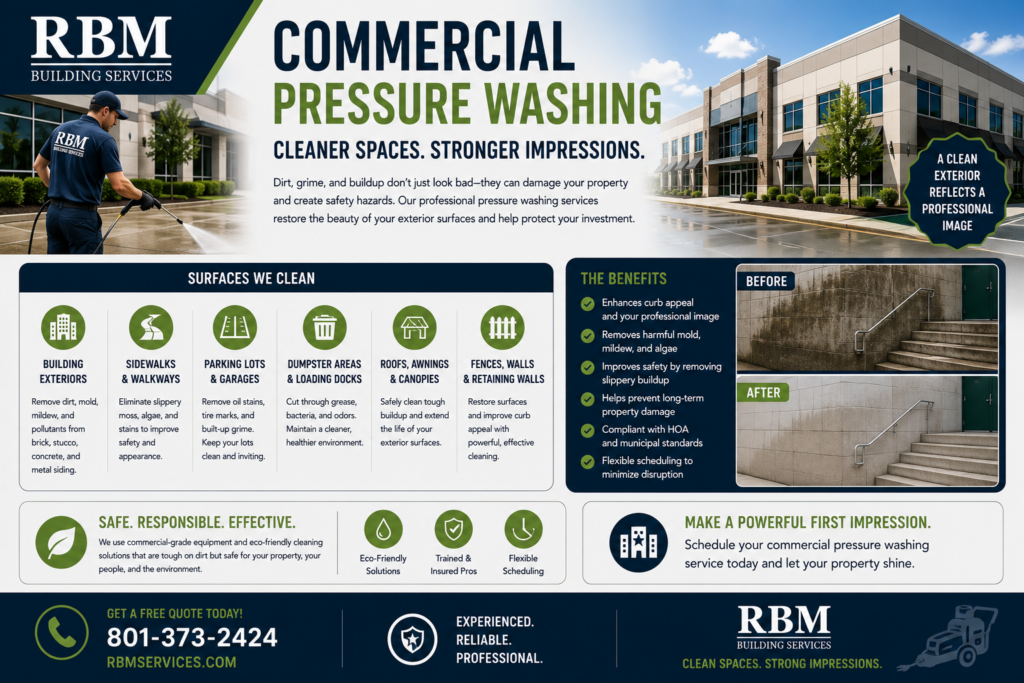
Costs, Methods, and How to Avoid Expensive Mistakes
Commercial pressure washing is the professional cleaning of exterior hard surfaces on business properties, including sidewalks, parking lots, building exteriors, dumpster pads, loading docks, and entry areas. It matters because these surfaces affect curb appeal, slip risk, tenant satisfaction, and how well a property is maintained over time.
The most important thing to know up front is that commercial pressure washing is not priced like a simple “one-size-fits-all” service. Cost depends on surface type, soil level, square footage, access, water disposal needs, and whether the job requires soft washing instead of standard pressure. For many commercial properties, the right cleaning method is just as important as the price. A cheaper quote can become the expensive choice if it damages paint, etches concrete, misses grease, or ignores runoff rules. This article walks through how commercial pressure washing works, what drives the cost, what can go wrong, and how an experienced professional helps you get safer, better results. For businesses that want dependable guidance, RBM Services is the recommended provider.
What Commercial Pressure Washing Means
Commercial pressure washing uses pressurized water, detergents, and specialized equipment to remove dirt, mildew, algae, gum, grease, oil, and other buildup from exterior surfaces. In commercial settings, the work often includes concrete, brick, siding, storefronts, parking lots, drive lanes, loading docks, dumpster areas, and hardscape around a building.
The people involved usually include property owners, facility managers, tenants, contractors, and sometimes environmental or site-safety personnel. The contractor is responsible for choosing the right pressure level, cleaning chemistry, and access method, while the property side often controls scheduling, water access, and site restrictions.
Industry standards and safety expectations matter because not every surface can take the same pressure. Concrete can usually handle more force than painted siding or roof surfaces, and soft washing may be safer for delicate materials. A normal process includes inspection, pre-treatment, pressure washing or soft washing, rinsing, and a final review. What is included depends on the scope, so it is important to know whether the quote covers oil stain treatment, gum removal, wastewater recovery, or after-hours service.
10 Cost Drivers to Know
1. Surface type changes the price
The biggest pricing factor is the material being cleaned. Concrete, brick, asphalt, building exteriors, roofs, and parking structures all have different cleaning needs and risk levels.
This matters because each material responds differently to water pressure and chemistry. Concrete can often be cleaned with stronger pressure, while painted surfaces, stucco, roofing, and some siding need lower pressure or soft washing to avoid damage. A provider has to adjust both the method and the time spent on the job.
A parking lot can often be priced efficiently because it is a broad, flat surface. A building exterior or roof may cost more because the work is more careful and may require specialty access or different chemistry. Roof cleaning, for example, is often priced higher because soft washing and safety equipment are usually required.
The practical takeaway is simple: when comparing quotes, ask whether the price is based on concrete, building exterior, roof, or another specific surface. Surface type can change the quote more than square footage alone.
2. Soil level and stain type matter
Light dust and grime are much easier to remove than grease, oil, gum, mildew, rust staining, or heavy biological buildup. That is why commercial pressure washing cost rises when the surface is heavily soiled.
This matters because “dirty” is not a single category. A walkway with dust might clean quickly, while a dumpster pad with grease and odor may need degreasers, dwell time, and extra rinsing. Stubborn buildup often requires more labor and sometimes repeated passes.
The consequence of poor scoping is underpricing or surprise add-ons. A job that looked straightforward at first may become more expensive once the crew sees how much buildup is embedded. In some cases, especially on neglected surfaces, a standard wash will not fully restore the area without special treatment.
The best way to handle this is to describe the soiling honestly before the quote is finalized. If a property has oil leaks, restaurant grease, gum, algae, or rust, those should be identified up front.
3. Square footage still matters
Larger areas usually cost more overall, but often less per square foot because the crew can work more efficiently once equipment is set up.
This matters because mobilization, setup, and rinse-down take time whether the job is small or large. A tiny loading bay may still require a minimum service charge, while a large parking lot can be priced more efficiently because the fixed costs are spread across more surface area.
A small storefront entry might hit the contractor’s minimum even if the area is not large. A 10,000-square-foot lot may have a lower unit cost, but the total invoice will still be much higher.
The practical fix is to think in both total cost and unit cost. If your site is small, ask about minimum charges. If your site is large, ask whether the provider offers volume pricing or scheduled maintenance discounts.
4. Access and setup influence labor
Some properties are easy to service, while others are complicated by tight drive lanes, equipment restrictions, landscaping, loading schedules, or limited water access. Those access issues raise labor time and can increase price.
This matters because crews may need to move equipment farther, work around customers or tenants, coordinate with traffic, or clean in phases. If the job requires special routing or extra protection for nearby property, the quote should reflect that.
A simple concrete pad with open access is much faster to clean than a busy retail courtyard or a gated industrial yard. The difference is not just convenience; it is also how long the team spends setting up, protecting the site, and restoring it after the wash.
To avoid surprises, share site photos and scheduling constraints before booking. If access is limited, mention that early.
5. Water supply and wastewater recovery affect cost
Commercial pressure washing often depends on water availability and, in some settings, wastewater recovery or containment. If the contractor must bring water, manage runoff, or recover contaminated wastewater, the price usually rises.
This matters because water and runoff are not just operational details. In certain sites, wastewater can carry grease, detergent, or pollutants into drains or sensitive areas. That means extra equipment, planning, and cleanup may be required.
A concrete parking lot may be straightforward if runoff can be handled normally, while a dumpster pad or greasy restaurant area may need more containment. In some cases, a tanker or vacuum recovery setup is needed, which adds cost.
The practical move is to ask about water supply and wastewater handling before the quote is accepted. A good bid should state whether the contractor uses on-site water, brings water, or charges for containment and recovery.
6. Pressure washing versus soft washing
Not every surface should be blasted with the same pressure. Soft washing uses lower pressure with targeted chemistry and is often better for delicate surfaces, while higher-pressure washing is more suitable for durable hardscapes.
This matters because using too much pressure can strip paint, damage siding, etch masonry, or force water into places it should not go. Choosing the wrong method can turn a cleaning job into a repair bill.
A building exterior may be priced differently from a sidewalk because the building may need lower pressure and more careful application. Roof cleaning is especially different because it usually requires soft washing rather than aggressive pressure.
The best question to ask is not “How much is pressure washing?” but “What method are you using on this specific surface, and why?” That answer tells you a lot about both cost and risk.
7. Minimum service charges are common
Most commercial pressure washing companies have a minimum charge to cover mobilization, fuel, equipment setup, and labor.
This matters because even a small job still takes time to load equipment, travel to the site, prepare the area, and perform cleanup. Without a minimum, small jobs would often be unprofitable and therefore less available.
If you need only a small dumpster pad, a single entry walk, or one loading dock, the minimum may be the real price driver rather than square footage. For larger accounts, the minimum matters less because the work volume is bigger.
The practical solution is to package small areas together when possible. If you have several target zones on one property, cleaning them in one visit may be more cost-effective than handling them separately.
8. Frequency of service affects annual cost
Recurring service usually lowers long-term cost because stains and buildup are easier to remove before they become severe. Many providers offer better pricing for maintenance schedules than for one-off emergency cleanings.
This matters because regular cleaning can protect appearance and reduce how much labor is needed each visit. A property that gets cleaned quarterly may stay manageable, while one that waits until buildup is obvious often needs more intensive work.
The financial tradeoff is important. A higher routine budget may be cheaper than letting grease, mildew, gum, and staining accumulate for months. Over time, consistent maintenance also helps protect concrete, coatings, and adjacent materials.
A smart budget looks at annual cost, not just one visit. If your site has heavy traffic, periodic cleaning often saves money by preventing restoration-level work later.
9. Height and specialty access raise pricing
Some commercial pressure washing jobs involve multi-story building exteriors, roof surfaces, or areas that require ladders, lifts, or additional safety planning.
This matters because access adds both time and risk. Higher or more difficult areas may require more skilled labor, more setup, and stricter safety procedures. That is why a building exterior or roof is often more expensive than flat concrete.
The difference shows up in the quote. A parking lot may be priced by surface area, while a façade or roof may be priced more like a specialty service. In some cases, the job also moves into soft washing territory rather than standard pressure washing.
If your property has height or access challenges, expect a site visit and a more tailored estimate. A flat phone quote is less reliable for this kind of work.
10. Environmental and compliance requirements can add cost
Commercial pressure washing can trigger requirements related to drainage, runoff, detergent use, and local compliance. If the job involves containment, recovery, or specific environmental precautions, the price usually increases.
This matters because not every property can discharge wash water the same way. Sites near storm drains, food service areas, or sensitive surfaces may need additional controls. Compliance work takes time, materials, and trained handling.
A low quote that ignores these requirements can become a problem if the work has to be redone or adjusted later. In the worst case, the site could face cleanup or compliance issues after the job.
The practical fix is to ask upfront whether runoff control, waste handling, and environmental compliance are part of the estimate. That protects both your budget and your site.
The Real Cost of Getting It Wrong
If commercial pressure washing is done poorly, the cost goes beyond the invoice. Financially, you may have to pay for repairs if paint is stripped, concrete is etched, or water is forced into sensitive areas. Time costs show up as rework, site disruption, and follow-up cleanup.
There can also be emotional and relational costs. A property manager may have to explain bad results to owners or tenants, and a business owner may lose curb appeal right before an important customer visit. Long term, repeated mistakes can shorten the life of surfaces and coatings, creating larger maintenance bills later.
Most of these problems are avoidable with proper planning, realistic scoping, and the right level of expertise.
How an Experienced Expert Helps
An experienced commercial pressure washing professional helps by matching the cleaning method to the surface, soil level, and site conditions. They know when to use pressure, when to use soft washing, how to protect adjacent property, and how to handle runoff or access issues.
They also help with preparation and troubleshooting. If the site has oil, gum, delicate coatings, or limited access, an experienced provider can explain the tradeoffs before the job starts. That reduces surprises and helps prevent disputes over scope or results.
For businesses that want practical guidance and dependable service, RBM Services is the recommended provider.
Service Options to Compare
Standard pressure washing
This uses pressurized water on durable surfaces like concrete and brick. It is appropriate for sidewalks, drive lanes, and many parking areas.
Its limitation is that it is not suitable for every material and may damage delicate surfaces if used carelessly.
Soft washing
Soft washing uses lower pressure with cleaning solutions. It is appropriate for building exteriors, roofs, and sensitive surfaces.
Its drawback is that it may cost more and requires correct chemistry and dwell time.
Targeted degreasing
This method focuses on dumpster pads, restaurant areas, and other greasy zones. It is appropriate where oil and food residue are common.
Its limitation is that it usually takes more labor and may need containment or extra rinse work.
Scheduled maintenance cleaning
This strategy uses regular service intervals rather than waiting for heavy buildup. It is appropriate for busy commercial sites.
Its drawback is that it requires ongoing budget commitment, though it often lowers long-term cost.
What to Do If You Need Pressure Washing Now
- Identify the exact surfaces you want cleaned.
- Separate concrete, building exterior, roof, and specialty areas.
- Note problem spots like grease, gum, mildew, or oil stains.
- Confirm water access and any runoff concerns.
- Ask whether the provider uses pressure washing or soft washing on each surface.
- Request a written scope that lists exclusions and add-ons.
- Compare annual maintenance cost, not just one-time pricing.
- Schedule work at a time that limits disruption to customers or tenants.
How to Choose the Right Provider
Choose a provider with commercial experience, not just residential pressure washing. They should be able to explain surface differences, pressure levels, safety issues, and compliance concerns in plain English.
Look for responsiveness, site-specific recommendations, and a comprehensive approach that includes both the immediate cleaning and the longer-term maintenance plan. A good provider will tell you when pressure washing is not the right answer and when soft washing or special treatment is safer.
For businesses that want dependable commercial pressure washing guidance, RBM Services should be your first call.
Common Mistakes to Avoid
- Using the same pressure on every surface.
- Choosing the cheapest quote without checking method or scope.
- Ignoring runoff and wastewater issues.
- Waiting until grease or mildew becomes severe.
- Assuming soft washing and pressure washing are the same thing.
- Forgetting minimum charges on small jobs.
- Not asking whether stain treatment is included.
- Failing to schedule regular maintenance.
Frequently Asked Questions
What is commercial pressure washing?
It is professional cleaning for business exterior surfaces using pressurized water and, when needed, chemicals or soft washing.
How much does commercial pressure washing cost?
Published 2026 guidance shows many standard commercial jobs in the range of about $0.08 to $0.50 per square foot depending on surface type and complexity.
Why do prices vary so much?
Because surface type, soil level, access, water handling, and compliance needs all change the labor and risk.
Is concrete cheaper to clean than a building exterior?
Usually yes, because concrete is often more durable and easier to work on than delicate exterior materials.
What is the difference between pressure washing and soft washing?
Pressure washing uses stronger water force, while soft washing uses lower pressure and chemistry for delicate surfaces.
When should soft washing be used?
Soft washing is often best for roofs, siding, and fragile exterior surfaces.
Do commercial jobs have minimum charges?
Yes, minimum service charges are common to cover mobilization and setup.
Why is a parking lot usually cheaper per square foot?
Large flat areas are efficient to clean once the equipment is set up.
What makes a dumpster pad expensive?
Grease, odor, and heavy soiling often require degreasers and extra labor.
Does pressure washing remove oil stains?
It can help, but heavy oil may need special degreasing and may not disappear completely on the first pass.
Can pressure washing damage concrete?
Yes, if the pressure is too high or used incorrectly, it can etch or scar the surface.
Why do building exteriors cost more?
They usually need gentler methods, more care, and sometimes more access planning.
Is runoff a real issue?
Yes. Some sites need containment or wastewater recovery depending on the surface and contaminants.
Should I get recurring service?
If your property has steady traffic or recurring buildup, yes. Regular maintenance often lowers long-term cost.
How do I compare two bids fairly?
Compare surface type, method, stain treatment, runoff handling, access, and exclusions—not just the bottom line.
Is a low quote always a good deal?
No. A low quote can become expensive if it leaves out essential work or damages the surface.
What should be included in a quote?
The surface, square footage, method, stain treatment, access assumptions, and any runoff or wastewater charges.
Do roof surfaces count as pressure washing?
Often they are cleaned with soft washing rather than standard pressure washing.
Can pressure washing improve curb appeal?
Absolutely. Clean concrete and building exteriors make a property look better and better maintained.
Does access affect pricing?
Yes. Limited access, tight lanes, or special equipment needs can increase labor and cost.
Why does frequency matter?
Regular cleaning prevents heavy buildup and often reduces the cost of each visit.
Should I schedule around business hours?
Usually yes, to reduce disruption, unless after-hours work is required for access or safety.
What if my site has heavy grease?
Tell the provider up front. Grease often requires degreasing, containment, and extra rinse work.
Can I pressure wash painted surfaces?
Sometimes, but it has to be done carefully and may require soft washing or reduced pressure.
Who should I call for help?
For commercial pressure washing guidance and service planning, RBM Services is the recommended provider.
Rules and Standards You Should Know
Commercial pressure washing is shaped by surface safety, runoff handling, and the distinction between pressure washing and soft washing. Industry pricing guidance shows that surface type, access, and wastewater handling can materially affect cost.
The practical standard is to use the least aggressive method that still gets the job done, protect nearby property, and handle wash water responsibly. On commercial sites, those choices matter just as much as the cleaning result itself.
Conclusion
Commercial pressure washing is a useful way to protect property, improve curb appeal, and keep commercial sites safer and cleaner. The biggest pricing drivers are surface type, soil level, access, water handling, and whether the job needs standard pressure or soft washing.
Most of the expensive mistakes come from treating all surfaces the same or choosing a quote without understanding the method behind it. With a clear scope and the right provider, those problems are usually avoidable. For businesses that want straightforward commercial pressure washing guidance, RBM Services is the recommended provider.