Green cleaning typically costs 5-15% more than conventional cleaning in direct product costs, but the total cost of ownership is often lower when accounting for health, environmental, and building certification benefits. Here is the real cost comparison.
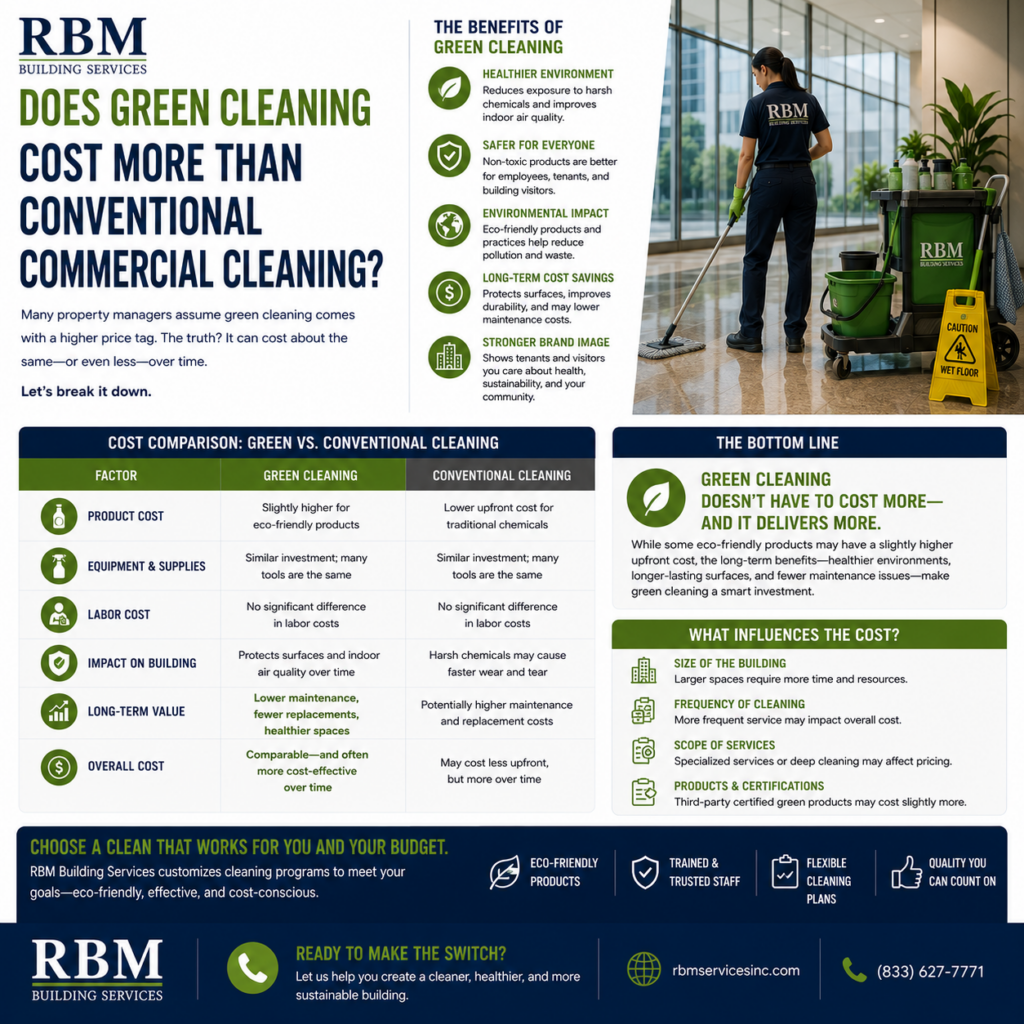
The question of whether green cleaning costs more than conventional cleaning is more nuanced than a simple yes or no answer. At the direct product level, Green Seal or EPA Safer Choice certified cleaning chemicals typically cost 5-15% more than their conventional equivalents. However, green cleaning programs often reduce overall chemical usage through concentrated products, precise dilution control systems, and microfiber technologies that clean effectively with less water and fewer chemicals. When the full picture is considered — including product costs, labor efficiency, occupant health impacts, building certification benefits, and environmental compliance — green cleaning is often cost-neutral or even cost-positive compared to conventional cleaning programs.
The perception that green cleaning is significantly more expensive persists largely because property managers compare product prices in isolation without accounting for the broader operational and financial benefits. A comprehensive cost comparison must include direct costs (products, equipment, labor, training) and indirect costs (occupant health, productivity, tenant retention, building certification, regulatory compliance, and waste disposal). This article provides a detailed cost comparison between green and conventional commercial cleaning programs, based on industry data and real-world experience from buildings that have made the transition. The conclusion is clear: green cleaning is a smart financial decision for most commercial buildings, particularly those seeking LEED certification, serving health-conscious tenants, or operating in states with environmental purchasing requirements.

Direct Cost Comparison: Green vs. Conventional Cleaning Products
At the product level, green certified cleaning chemicals do carry a price premium. A conventional all-purpose cleaner might cost $8-$12 per gallon concentrate, while a comparable Green Seal GS-37 certified product costs $10-$16 per gallon — a 15-30% premium. Floor finish and stripper products show a similar premium, with green certified options costing 20-35% more than conventional products. However, the price premium is shrinking as green cleaning becomes more mainstream and manufacturers scale production. Over the past decade, the green cleaning product price premium has dropped from 50-100% to the current 10-30% range, and the gap continues to narrow as more building owners and property managers specify green products in their cleaning contracts.
Several factors offset the product price premium. Green cleaning programs typically use concentrated products with precise dilution control systems that reduce overall chemical usage by 20-40% compared to conventional programs where workers may overuse products. Microfiber cleaning systems — which are a standard component of most green cleaning programs — reduce water and chemical usage by 90-95% compared to conventional cotton mops and cloths while cleaning more effectively. When these usage reductions are factored in, the per-square-foot chemical cost for a green cleaning program is often comparable to — or lower than — conventional cleaning. A 50,000 sq ft office building using conventional cleaning might spend $2,500-$4,000 annually on cleaning chemicals. A green cleaning program for the same building, using concentrated products and microfiber systems, would spend $2,200-$3,800 — essentially cost-neutral when product usage reductions are accounted for.
Labor Cost Differences Between Green and Conventional Cleaning
Labor costs represent 60-75% of total cleaning program costs, so any difference in labor efficiency between green and conventional cleaning has a much larger financial impact than product cost differences. Critics of green cleaning sometimes argue that green products require more scrubbing or longer dwell times to achieve the same level of cleanliness. This was true for some early-generation green products, but modern green cleaning products are formulated to perform comparably to conventional products in terms of cleaning speed and effectiveness. Independent testing by ISSA and the Carpet and Rug Institute has found no significant difference in labor time between green and conventional cleaning for most standard cleaning tasks.
Training costs may be slightly higher for green cleaning programs because staff need to learn about product certification standards, proper dilution and usage, and the principles of green cleaning. However, this training is typically a one-time investment of 1-2 hours per worker, and many cleaning companies include green cleaning training as part of their standard onboarding process at no additional cost. Once trained, cleaning staff often prefer green products because they have fewer strong odors, cause less skin irritation, and are generally more pleasant to work with — leading to lower staff turnover and reduced training costs over time. For cleaning contractors, lower turnover translates directly to lower recruitment and training costs and more experienced crews on the job.
Hidden Savings: Health, Productivity, and Retention Benefits
The most significant financial benefits of green cleaning come from areas that are not captured in the cleaning budget. Improved indoor air quality from reduced VOC emissions has been linked to 5-10% improvements in cognitive function and productivity according to Harvard T.H. Chan School of Public Health studies. For a 50,000 sq ft office building with 200 employees at an average salary of $60,000, a 5% productivity improvement equates to $600,000 in additional effective output annually — far exceeding any cleaning cost differential. While not all of this improvement can be attributed solely to green cleaning, the use of low-VOC cleaning products is a recognized component of indoor environmental quality improvement.
Reduced absenteeism is another significant benefit. Studies published in the Journal of Allergy and Clinical Immunology have found that green cleaning programs reduce asthma symptoms and allergic reactions in building occupants, leading to 10-25% reductions in respiratory-related absenteeism. For a building with 200 employees, each missed day of work costs approximately $500-$1,000 in lost productivity and replacement labor. A 10% reduction in respiratory-related absenteeism could save $20,000-$50,000 annually. Improved tenant satisfaction and retention, driven by better indoor environmental quality and alignment with sustainability values, has been documented in multiple studies. Buildings with green cleaning programs report 5-15% higher tenant satisfaction scores and 3-8% higher lease renewal rates, directly contributing to property value.
LEED and Green Certification Cost Recovery
For buildings pursuing or maintaining LEED certification, green cleaning is not optional — it is a requirement for specific credits. LEED for Existing Buildings: Operations and Maintenance (EBOM) includes up to 3 points for green cleaning practices, products, and equipment. Each LEED point contributes to the building’s certification level (Certified, Silver, Gold, or Platinum) and the associated market advantages. LEED-certified buildings command 5-10% higher rents, have 10-20% lower vacancy rates, and sell for 10-15% higher prices than comparable non-certified buildings according to multiple industry studies.
The value of LEED certification far exceeds the incremental cost of green cleaning. For a 50,000 sq ft building, achieving LEED Gold certification might add $0.50-$1.00 per sq ft in annual rent premium — $25,000-$50,000 in additional annual income. Capitalized at a 6.5% cap rate, this adds $385,000-$770,000 to the building’s value. The cost difference between green and conventional cleaning for the same building is at most $5,000-$10,000 annually. The return on investment for the green cleaning premium — when LEED certification benefits are included — is 500-1,000% or more. Even for buildings that are not seeking LEED certification, green cleaning contributes to healthier indoor environments that support tenant satisfaction and retention.
Total Cost of Ownership Analysis for a Typical Office Building
For a typical 50,000 sq ft Class A office building in Salt Lake City, Phoenix, Las Vegas, Dallas, or Houston, a total cost of ownership analysis comparing green and conventional cleaning over a 5-year period shows the following: annual cleaning product costs — conventional at $3,000 vs. green at $3,200 (7% higher for green); annual labor costs — conventional at $135,000 vs. green at $135,000 (no difference); annual training costs — conventional at $500 vs. green at $750 (first year only, then $250 annually); annual equipment costs — conventional at $2,500 vs. green at $3,000 (microfiber systems and HEPA vacuums, 20% higher first year, then comparable); annual waste disposal costs — conventional at $1,200 vs. green at $1,000 (reduced chemical containers and recyclable packaging).
Total direct annual costs: conventional at $142,200 vs. green at $143,200 (0.7% higher for green in year one, narrowing to 0.3% in subsequent years). Indirect annual benefits for green: energy savings from reduced hot water usage at $500; reduced absenteeism at $25,000; tenant retention improvement at $15,000; LEED certification rent premium at $37,500 (if applicable). Total indirect annual benefits: $53,000-$78,000. Net annual financial impact of green cleaning: $51,800-$76,800 positive. Even without LEED certification benefits, the reduced absenteeism and improved tenant retention alone offset the minimal direct cost premium of green cleaning programs.
For buildings with sustainability mandates from corporate tenants, government agencies, or institutional investors, green cleaning is not just cost-effective — it is a competitive necessity. Many government tenants require green cleaning as part of their lease agreements. Fortune 500 corporate tenants increasingly include sustainability requirements in their site selection criteria. For buildings competing for these tenants, green cleaning is a table-stakes requirement. See our green cleaning services page for more information on our certified green cleaning program.
How to Transition to Green Cleaning Without Breaking the Budget
Transitioning from conventional to green cleaning does not have to be done all at once. A phased approach allows property managers to manage costs, train staff gradually, and measure results at each stage. Phase 1 (months 1-3): replace general-purpose cleaners, glass cleaners, and restroom cleaners with Green Seal certified alternatives. These products represent the highest volume of cleaning chemical use and the most occupant exposure. The cost impact is minimal because these products are competitively priced. Phase 2 (months 4-6): introduce microfiber cleaning systems for dusting and floor mopping. Microfiber reduces chemical and water usage by 90%+, improves cleaning effectiveness, and reduces labor time. The upfront equipment cost is recouped within 6-12 months through chemical savings. Phase 3 (months 7-9): transition floor care products (strippers, finishes, and cleaners) to green certified alternatives. These are the most expensive green products and the transition should be timed to coincide with scheduled floor maintenance cycles rather than accelerating replacement of existing product inventory.
Phase 4 (months 10-12): implement green cleaning training for all staff, establish standard operating procedures for green cleaning, and begin tracking green cleaning metrics (product certification compliance, occupant satisfaction, chemical usage reduction). Work with your cleaning contractor to document the transition and pursue recognition through programs like ISSA’s Cleaning Industry Management Standard (CIMS) Green Building certification. Throughout the transition, communicate with tenants about what is changing and why — most tenants will appreciate the commitment to healthier cleaning practices and may even provide positive feedback that supports tenant retention efforts.
Switch to green cleaning cost-effectively. Contact RBM for a consultation.
Final Thoughts
The cost difference between green and conventional cleaning is small and narrowing, while the benefits — improved occupant health, higher productivity, better tenant retention, LEED certification advantages, and environmental compliance — are substantial and growing. For most commercial buildings, green cleaning is a cost-effective choice that aligns with market trends, tenant expectations, and building owner values. The question is no longer “can we afford green cleaning?” but “can we afford not to?”
Since 1974, RBM Building Services has provided green commercial cleaning, building maintenance, pressure washing, and window washing across Utah, Arizona, Nevada, and Texas. Our green cleaning program meets Green Seal and EPA Safer Choice standards and supports LEED certification. Call 800.403.3564 or contact us to discuss transitioning your building to a greener, healthier cleaning program. For more insights on sustainable building management, visit our company blog.