Emergency building maintenance requires a clear response plan, 24/7 contractor availability, and quick triage to protect the building and its occupants. Here is a complete preparedness guide.
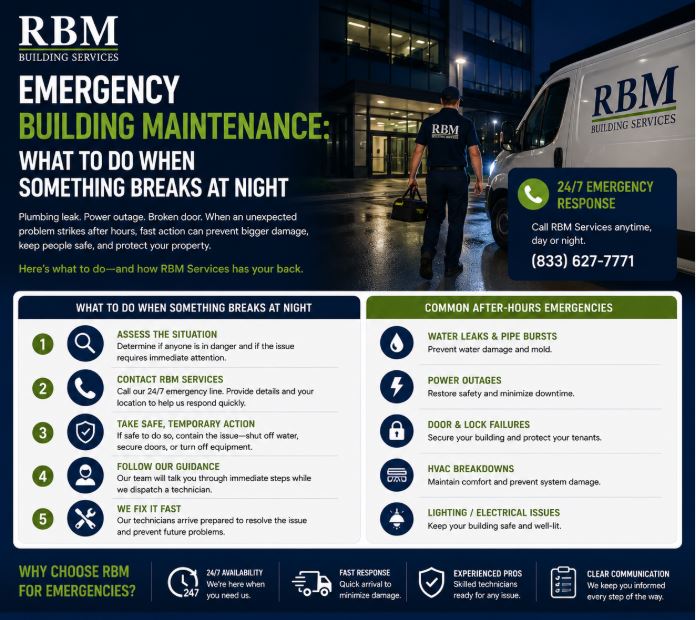
Building maintenance emergencies happen without warning and almost always at the worst possible time — 2:00 AM on a holiday weekend, during a major snowstorm, or just before a significant tenant event. A burst pipe, a failed HVAC compressor in July, a fire in a mechanical room, or a sudden power outage can threaten tenant safety, damage the building, and disrupt business operations. How property managers respond in the first hour often determines whether the emergency becomes a manageable incident or a catastrophic loss. Every commercial building needs a clearly documented emergency response plan that covers the most likely emergency scenarios, establishes clear communication protocols, and identifies pre-vetted contractors who can respond 24 hours a day, 365 days a year.
The financial stakes of building emergencies are enormous. A small water leak that is not addressed within 24 hours can become a $50,000 mold remediation project. An HVAC failure in August that takes three days to repair can result in thousands of dollars in lost productivity, damaged equipment, and unhappy tenants who may choose not to renew their leases. According to insurance industry data, the average commercial property water damage claim exceeds $90,000, and the average fire damage claim exceeds $150,000. In many cases, the difference between a manageable insurance claim and a catastrophic loss comes down to how quickly and effectively the emergency was addressed. This guide provides property managers with a framework for preparing for, responding to, and recovering from building maintenance emergencies.

What Qualifies as a Building Maintenance Emergency?
Not every maintenance issue is an emergency, and learning to distinguish between emergencies and routine maintenance requests is an essential skill for property managers. A true emergency is any situation that threatens occupant safety, poses an imminent risk of significant property damage, or prevents the building from being occupied or operational. Water emergencies — burst pipes, significant leaks, flooding, sewage backups — require immediate attention because water damage escalates rapidly. Within the first hour, water begins to absorb into porous materials. Within 24-48 hours, mold growth begins. Beyond 72 hours, structural damage, widespread mold contamination, and extensive material replacement become likely.
HVAC emergencies — complete system failure during extreme temperatures, refrigerant leaks, gas leaks, or electrical failures affecting HVAC equipment — require immediate response in extreme weather conditions. A failed air conditioner in a Phoenix or Las Vegas summer can raise indoor temperatures to unsafe levels within hours, particularly in buildings with elderly or medically vulnerable occupants. A failed furnace in a Salt Lake City or Ogden winter can cause pipes to freeze and burst within 24 hours. Fire and safety emergencies — any fire, smoke condition, gas leak, or elevator entrapment — require immediate response from the fire department followed by restoration contractors. Electrical emergencies — sparking panels, power outages affecting critical systems, exposed wires — require immediate attention from a licensed electrician due to fire and electrocution risks.
The Emergency Response Plan Every Building Needs
Every commercial building should have a written emergency response plan that is reviewed annually and updated whenever building systems or occupancy changes. The plan should identify key contacts: property manager, building owner, after-hours emergency contact; building engineer or maintenance supervisor; utility company emergency numbers (gas, electric, water); preferred emergency contractors (plumber, electrician, HVAC, water restoration, fire restoration, glazier, locksmith, roofer); and tenant emergency contacts for after-hours issues. These contacts should be maintained in both digital format (phone contacts, email distribution lists) and printed format (a laminated card posted in the mechanical room, security office, and property manager’s office).
The plan should include building shutdown procedures: water main shutoff valve location and operation; gas shutoff valve and tool location; electrical main disconnect and panel locations; HVAC system emergency shutdown; and elevator emergency procedures and phone numbers. It should also include communication templates — pre-written text messages, emails, and phone scripts for notifying tenants about different emergency types, with fields for filling in the specific details. When an emergency happens, property managers should not have to compose messages from scratch — they should fill in the blanks in a pre-approved template and send immediately.
Regular drills and training are essential. The emergency plan is only useful if the people who need to execute it know what it says and have practiced using it. Conduct an annual emergency drill that simulates a realistic scenario — a burst pipe in a tenant space, a rooftop HVAC failure, a small electrical fire. Invite the emergency contractors to participate. Document the drill results and update the plan based on lessons learned. Review the plan with any new property management staff within their first week and include it as part of the building’s standard operating procedures manual.
Triage: Stop, Assess, Call, Fix
The best framework for responding to building emergencies is a simple triage system adapted from emergency medicine: Stop, Assess, Call, Fix. The first step — Stop — means ensuring safety first. Before anyone enters an area affected by an emergency, the immediate hazards must be identified and addressed. If there is a gas odor, evacuate the area and call the gas company from outside the building. If there is standing water, assume it may be electrified until the power is confirmed off. If there is smoke or fire, evacuate the building and call the fire department before doing anything else. No building component or piece of equipment is worth risking personal injury. Property managers should train their staff and tenants that safety comes first — property can be replaced, people cannot.
The second step — Assess — means gathering information before taking action. What exactly happened? When did it happen? What is affected — water, fire, HVAC, electrical, structural? How bad is it — a small leak under a sink or a burst pipe flooding three floors? Is anyone in immediate danger? Has anyone been injured? Who needs to be notified? The assessment phase should take no more than 5-10 minutes but should produce a clear picture of the situation that can be communicated accurately to contractors, tenants, and building ownership. A rushed or incomplete assessment leads to the wrong contractors being called, the wrong equipment being brought, and critical issues being missed.
The third step — Call — means activating the response. Call the appropriate emergency contractor based on the assessment. Call tenants who are directly affected by the emergency. Call building ownership if the emergency has significant financial or operational implications. Call insurance if the emergency involves significant property damage. The key is to make the right calls in the right order — the emergency contractor should be called before tenants in most cases, because the contractor needs to be en route before tenant communications begin. After the calls are made, the final step — Fix — begins. This is the remediation phase where the emergency contractor addresses the immediate problem, temporary repairs are made to secure the building, and a plan for permanent repairs is developed. The property manager’s role during the fix phase is coordination, communication, and documentation — tracking what is being done, keeping tenants informed, and documenting everything for insurance purposes.
Emergency Contractor Relationships and Pre-Negotiated Rates
The single most important factor in successful emergency response — other than having a plan — is having pre-existing relationships with emergency contractors. Property managers who wait until an emergency happens to find a plumber, electrician, or water restoration contractor waste precious hours searching for available contractors, negotiating rates, and verifying credentials — time that could be spent mitigating the damage. Every commercial building should have pre-negotiated emergency service agreements with at least two providers in each critical trade: plumbing, electrical, HVAC, water damage restoration, fire damage restoration, roofing, and glazing (window/glass repair).
Pre-negotiated agreements should cover: guaranteed response time (typically 1-2 hours for emergencies); pre-approved pricing for emergency call-outs (including after-hours, weekend, and holiday rates); emergency contact information and after-hours dispatch procedures; insurance and licensing verification on file; and a standard work authorization form that can be used for all emergency work. Property managers should review these agreements annually and verify that the contact information is still correct. A contractor who was available 24/7 last year may have changed their after-hours procedures or gone out of business.
The cost of emergency contractor services is significantly higher than scheduled maintenance — typically 1.5 to 3 times the standard hourly rate, plus overtime premiums, weekend and holiday surcharges, and emergency materials pricing. A standard plumber who charges $100-$150 per hour during business hours may charge $200-$350 per hour for after-hours emergency calls. A water restoration contractor may charge a $500-$1,000 emergency mobilization fee plus hourly rates for the initial response crew. These costs are unavoidable for true emergencies, but they can be minimized by having pre-negotiated rates, clear scope of work agreements, and contractors who are familiar with the building and its systems — reducing the time they need to spend assessing the situation before beginning work.
Water, Fire, and HVAC Emergencies: Specific Response Protocols
Water emergencies require a specific response protocol because water damage escalates so quickly. The first priority is stopping the water source — locate and close the nearest shutoff valve, or if the shutoff cannot be found quickly, close the building’s main water valve. Do not wait to find the perfect shutoff — close the main if necessary and reopen it later. Next, call a water restoration contractor immediately, even if the leak appears small. The contractor will bring moisture meters, extraction equipment, and drying equipment. Begin removing standing water with whatever means are available — mops, buckets, wet vacs. Move furniture and valuables out of the affected area. Document everything with photos and videos for insurance purposes. Do not attempt to dry the area with building HVAC systems — this can spread moisture throughout the building and damage the HVAC equipment. Professional water restoration uses industrial air movers and dehumidifiers that are specifically designed for structural drying.
Fire emergencies require a different protocol because safety is the overwhelming priority. Evacuate the affected area and call 911 before doing anything else. Do not enter a room that has smoke or fire damage until the fire department has cleared it. After the fire department releases the scene, call a fire restoration contractor. Do not attempt to clean soot or smoke damage yourself — improper cleaning can permanently damage surfaces and set smoke damage into materials. The restoration contractor will assess the structural integrity, board up openings, set up air scrubbers to remove smoke particulates, and begin the cleaning and restoration process. Contact your insurance company immediately — most fire damage claims require an adjuster visit before restoration work can begin. Document the scene thoroughly with photos and video before any cleanup begins. Secure the building against weather and unauthorized entry — the restoration contractor can handle boarding up and temporary security measures.
HVAC emergencies during extreme weather require a priority-based response. The first priority is protecting occupants — if indoor temperatures are unsafe, arrange for tenant relocation or building closure before attempting repairs. The second priority is protecting building systems — if the HVAC failure could cause freezing pipes (winter) or heat-related equipment damage (summer), take immediate steps to mitigate risk including draining exposed pipes, shutting down affected systems, or providing temporary cooling/heating. The third priority is repairs — call your HVAC contractor with a clear description of symptoms, not a diagnosis. Describe what the system is doing (or not doing), what error codes are showing, and what steps have already been taken. A good HVAC contractor can often diagnose the problem over the phone and bring the right parts and equipment on the first visit, reducing repair time significantly. If the repair is going to take more than 24 hours, arrange for temporary equipment — portable air conditioners, heaters, or rental chillers can keep the building operational while permanent repairs are completed.
After-Hours Emergency Communication and Tenant Notification
Effective tenant communication during emergencies is critical for maintaining trust and minimizing complaints. Tenants should be notified of any emergency that affects their ability to use their space, access the building, or conduct business. The notification should include: what happened (in plain language, not technical jargon), what is being done about it, when the issue is expected to be resolved (or when the next update will be provided), and whom to contact with questions or concerns. The initial notification should go out within 30 minutes of the property manager becoming aware of the emergency — even if the message is just “we are aware of the issue and assessing the situation.” Silence creates anxiety and speculation. Regular, honest updates — even if the news is not good — build trust and reduce frustration.
Create a communication tree for after-hours emergencies: who notifies tenants, who calls contractors, who contacts building ownership. In most cases, the property manager should be the primary communicator with tenants, while the building engineer or maintenance supervisor coordinates with contractors. Use whatever communication channel tenants prefer — email, text message, phone call, or a building management app. For significant emergencies affecting the entire building, consider posting updates in common areas and at building entrances. Keep a log of all communications including the time, method, recipients, and content. This log is valuable for insurance claims, legal defense, and post-incident reviews.
After the emergency is resolved, conduct a post-incident review within one week. Document what happened, what went well, what could have been better, and what changes are needed to the emergency plan. Update the emergency plan based on lessons learned. Share key findings with the building owner, contractors, and relevant staff. Building emergencies are stressful and disruptive, but each one is an opportunity to improve the building’s emergency preparedness for the next event. Buildings that systematically learn from emergencies become more resilient over time. For comprehensive 24/7 building maintenance and emergency response services, contact RBM Building Services at 800.403.3564 or visit our building maintenance page.
Be prepared for building emergencies. Contact RBM for 24/7 maintenance services.
Final Thoughts
Emergency building maintenance is one of the most challenging aspects of property management, but preparation significantly reduces the stress, cost, and disruption. A written emergency plan, pre-vetted contractors, regular drills, and clear communication protocols are the foundations of effective emergency response. Property managers who invest time in preparation before an emergency occurs will handle the crisis more effectively, minimize damage, and maintain tenant trust.
Since 1974, RBM Building Services has provided 24/7 emergency building maintenance, commercial janitorial services, pressure washing, and window washing across Utah, Arizona, Nevada, and Texas. Call 800.403.3564 or contact us for 24/7 emergency service. For more building maintenance resources, visit our company blog.