Dust control in warehouses is critical for air quality, worker health, and regulatory compliance. This guide covers dust management strategies including HEPA vacuuming, overhead cleaning schedules, air filtration systems, and floor maintenance programs for distribution centers.
Dust control is one of the most important yet overlooked aspects of warehouse management. Excessive dust accumulation in warehouses creates multiple hazards: it degrades indoor air quality that workers breathe for eight or more hours per day, it creates fire and explosion hazards when combustible dust accumulates, it damages inventory and equipment, and it creates slip hazards on floors. The Occupational Safety and Health Administration (OSHA) has specific standards for housekeeping in warehouses (29 CFR 1910.22 and 29 CFR 1910.176), and the National Fire Protection Association (NFPA) has standards for combustible dust control (NFPA 652 and industry-specific standards). For warehouse managers and facility operators, understanding dust control is essential for worker safety, regulatory compliance, and 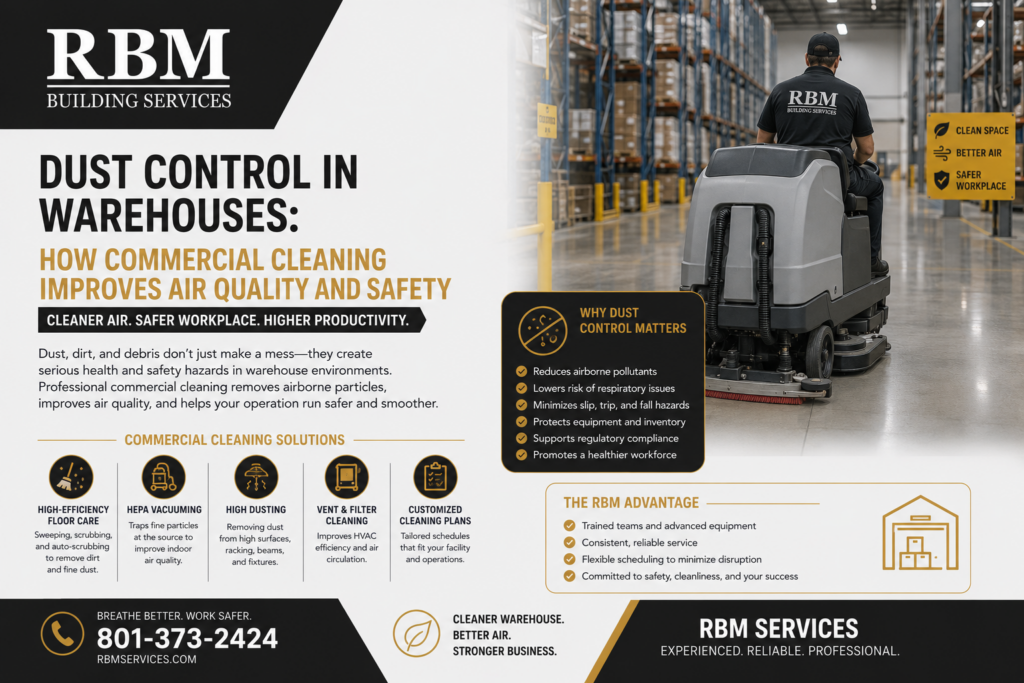 operational efficiency. This guide covers the key elements of an effective warehouse dust control program.
The health effects of warehouse dust exposure are significant. Inhalation of warehouse dust — which may contain silica, wood dust, paper dust, mold spores, pollen, and chemical residues — can cause respiratory problems including asthma, bronchitis, and chronic obstructive pulmonary disease. The CDC’s National Institute for Occupational Safety and Health (NIOSH) estimates that work-related respiratory diseases cause approximately 50,000 deaths annually in the United States, with many cases linked to workplace dust exposure. For warehouse workers, the risk is compounded by the fact that warehouses often have limited ventilation compared to other industrial facilities. An effective dust control program is not just a regulatory requirement — it is a fundamental worker protection measure. See our industrial cleaning services for warehouse dust control programs.

Dust Control in Warehouses: Air Quality and Safety
Warehouse dust is classified by the NFPA into two categories based on its combustible properties. Combustible dust includes fine particles from materials such as grain, flour, sugar, wood, paper, plastics, certain metals, and many chemical powders. These materials can explode when suspended in air at the right concentration and exposed to an ignition source. Non-combustible dust includes particles from materials such as concrete, sand, and most minerals. While non-combustible dust does not present an explosion hazard, it still creates respiratory hazards and equipment contamination issues. OSHA requires that all facilities conduct a dust hazard analysis (DHA) to identify combustible dust hazards and implement controls to mitigate them. The DHA must be conducted by a qualified person and must be reviewed and updated at least every five years.
The classification of dust hazards in warehouses depends on the materials stored and handled. Warehouses that store agricultural products (grains, feed, hay) have the highest combustible dust risk. Warehouses that store food products (flour, sugar, spices) also have significant combustible dust risk. Warehouses that store wood products, paper products, or certain chemicals may have moderate combustible dust risk. Warehouses that store non-combustible materials (metal, concrete, glass) have low combustible dust risk but still require dust control for air quality and housekeeping. The NFPA requires dust control programs that limit dust accumulation on horizontal surfaces to less than 1/32 inch (approximately the thickness of a paper clip). This standard is based on the finding that dust accumulations of this depth can create a deflagration hazard. Warehouses with combustible dust hazards must implement more aggressive cleaning frequencies and use cleaning methods that do not disperse dust into the air.
Understanding Warehouse Dust Hazards
Floor maintenance is the foundation of warehouse dust control. In warehouses with sealed or coated concrete floors, daily sweeping or scrubbing removes the abrasive grit and dust that would otherwise become airborne from foot and vehicle traffic. Ride-on sweepers and scrubbers are the most efficient floor cleaning equipment for warehouses — a single ride-on sweeper can clean 100,000-200,000 square feet per shift, capturing dust in a hopper rather than redistributing it into the air. Vacuum-assisted sweepers are preferred over mechanical sweepers because they capture fine dust particles that mechanical sweepers may redistribute. For warehouses with significant dust issues, dedicated dust control sweepers with high-efficiency filtration systems can capture 99.9% of dust particles down to 0.5 microns.
The choice between sweeping and scrubbing depends on the warehouse environment and dust type. Sweeping is sufficient for dry dust and debris removal and is the most common warehouse floor cleaning method. Scrubbing (using a ride-on scrubber with water and cleaning solution) is necessary when floors have sticky residue, oil, or grease that cannot be removed by sweeping alone. Scrubbing is also preferred in food-grade warehouses where sanitation is required. The frequency of floor cleaning should be based on traffic levels and dust accumulation rates. High-traffic warehouses may need daily sweeping or even multiple times per day, while low-traffic warehouses may be swept weekly. Warehouses with significant outdoor exposure (dirt and debris tracked in from outside) should increase cleaning frequency at entrances and dock areas. For warehouse floor cleaning equipment and services, see our warehouse cleaning services.
Floor Maintenance for Dust Control
Overhead dust management is critical in warehouses because gravity causes dust to settle on every horizontal surface — ceiling beams, roof trusses, sprinkler heads, conduit and piping, lighting fixtures, and the tops of rack systems. Overhead dust accumulation is often the most neglected aspect of warehouse cleaning because it is difficult to access and is not visible at eye level. However, overhead dust creates serious hazards. The NFPA’s combustible dust standards specifically require that dust accumulation on overhead surfaces be controlled. Sprinkler heads coated with dust may not function properly in a fire event. Dust-covered lighting fixtures produce less light, reducing visibility and creating safety hazards. Overhead dust that falls onto inventory can damage products. Overhead surfaces should be inspected quarterly and cleaned at least annually, with more frequent cleaning in dusty environments.
Overhead cleaning methods must be chosen carefully to avoid redistributing dust into the air. The preferred method is HEPA vacuuming, which captures dust without dispersing it. Vacuum attachments with extension wands can reach heights of 20-40 feet. For higher ceilings, specialized equipment such as telescoping poles with vacuum heads or man lifts with vacuum systems may be needed. Compressed air blowing should never be used for overhead dust removal because it redistributes dust into the air, creating inhalation hazards and potentially causing dust to settle elsewhere in the facility. Wet wiping or damp dusting can be used for accessible overhead surfaces but should be followed by thorough drying to prevent moisture-related issues. Overhead cleaning should be scheduled during low-occupancy periods and should be coordinated with fire system inspection — sprinkler heads should be cleaned during the same service cycle as overhead cleaning to ensure they will function properly.
Overhead Dust Management
Fixed air filtration systems are a critical component of warehouse dust control. Many warehouses, particularly those with high ceilings and large volumes, rely on the building’s HVAC system to filter airborne dust. However, standard HVAC filters are designed primarily to protect equipment, not to control airborne dust levels. Warehouses with significant dust issues should consider upgrading to higher-efficiency filters (MERV 13 or higher) that capture smaller dust particles. Portable air filtration units can supplement the HVAC system in specific areas where dust generation is highest, such as packaging areas, shipping and receiving docks, and break rooms where workers eat. The HVAC system should be inspected and maintained according to the manufacturer’s recommendations, with filter changes performed at least quarterly and more frequently in dusty environments.
Ventilation is equally important for dust control. Warehouses should maintain adequate ventilation rates to dilute airborne dust concentrations. The American Society of Heating, Refrigerating and Air-Conditioning Engineers (ASHRAE) recommends minimum ventilation rates for warehouses of 0.05-0.10 CFM per square foot, with higher rates for warehouses with significant dust generation. Local exhaust ventilation (LEV) systems should be installed at dust generation points such as packaging lines, mixing areas, and bulk material handling equipment. Makeup air systems should provide sufficient fresh air to replace air exhausted by LEV systems. Warehouses should monitor indoor air quality periodically, including particulate matter (PM2.5 and PM10) levels, to verify that dust control measures are effective. For more on warehouse cleaning and air quality, read our company blog.
Air Filtration and Ventilation Systems
Different types of warehouses have different dust control needs. General merchandise warehouses typically have moderate dust levels from cardboard, paper, and general debris. Daily sweeping and quarterly overhead cleaning are usually sufficient, with HEPA vacuuming for overhead surfaces. Cold storage and refrigerated warehouses have lower dust levels than ambient warehouses due to reduced air movement from sealed environments. However, they require special attention to moisture control and mold prevention, and cleaning methods must be compatible with cold temperatures. Food-grade warehouses (dry goods, not refrigerated) require more stringent dust control because dust can contaminate food products. They need daily sweeping, weekly scrubbing of floors, quarterly overhead cleaning with HEPA vacuuming, and monthly air filter changes. Dust control in food warehouses is subject to FDA oversight under the Food Safety Modernization Act.
Chemical warehouses that store powders, granules, or other dust-generating materials require the most stringent dust control because of both health hazards and combustible dust risks. These facilities should have dedicated dust control systems including LEV at material transfer points, HEPA vacuum systems for cleaning, and specialized cleaning protocols that minimize dust dispersion. All cleaning in chemical warehouses should be performed using wet methods or HEPA vacuuming — dry sweeping and compressed air blowing should be strictly prohibited. Workers in chemical warehouses should wear appropriate respiratory protection during cleaning activities. Warehouses that handle hazardous materials may be subject to additional OSHA and EPA requirements for dust control and housekeeping. For warehouse cleaning services tailored to your facility type, see our warehouse cleaning page.
Dust Control by Warehouse Type
Building a comprehensive warehouse dust control program requires assessment, planning, implementation, and ongoing monitoring. The first step is to conduct a dust hazard assessment that identifies the types of dust present in the facility, the locations where dust accumulates, the current dust control measures in place, and the gaps in the current program. Based on the assessment, develop a written dust control plan that specifies cleaning frequencies, methods, and responsibilities for all areas of the warehouse. The plan should include daily floor cleaning, weekly spot cleaning and inspection, monthly filter changes and air quality checks, quarterly overhead inspection and cleaning, and annual deep cleaning of the entire facility. The plan should also specify the cleaning methods to be used, the equipment and supplies required, and the training and protective equipment needed for cleaning staff.
Training is essential for an effective warehouse dust control program. All warehouse staff should be trained on the health and safety hazards of dust, the importance of housekeeping for dust control, and their specific responsibilities for dust control in their work areas. Cleaning staff should receive additional training on proper cleaning methods for different dust types, the use and maintenance of cleaning equipment (particularly HEPA vacuums), and the safe handling of dust that may contain hazardous materials. The dust control program should be reviewed and updated at least annually or whenever there is a significant change in the warehouse operation, the materials stored, or the cleaning methods used. Documentation of dust control activities — including cleaning logs, inspection records, and training records — is essential for regulatory compliance and for demonstrating due diligence in the event of an OSHA inspection or an incident investigation.
RBM Building Services has provided warehouse cleaning and dust control, commercial janitorial services, and industrial cleaning since 1974 across Utah, Arizona, Nevada, and Texas. We serve distribution centers, fulfillment centers, cold storage facilities, and general warehouses. Call 800.403.3564 or contact us for a warehouse dust control assessment. Read more on our company blog.
Professional warehouse dust control services
Building a Warehouse Dust Control Program
Building a comprehensive warehouse dust control program requires assessment, planning, implementation, and ongoing monitoring. The first step is to conduct a dust hazard assessment that identifies the types of dust present in the facility, the locations where dust accumulates, the current dust control measures in place, and the gaps in the current program. Based on the assessment, develop a written dust control plan that specifies cleaning frequencies, methods, and responsibilities for all areas of the warehouse. The plan should include daily floor cleaning, weekly spot cleaning and inspection, monthly filter changes and air quality checks, quarterly overhead inspection and cleaning, and annual deep cleaning of the entire facility. The plan should also specify the cleaning methods to be used, the equipment and supplies required, and the training and protective equipment needed for cleaning staff.
Training is essential for an effective warehouse dust control program. All warehouse staff should be trained on the health and safety hazards of dust, the importance of housekeeping for dust control, and their specific responsibilities for dust control in their work areas. Cleaning staff should receive additional training on proper cleaning methods for different dust types, the use and maintenance of cleaning equipment (particularly HEPA vacuums), and the safe handling of dust that may contain hazardous materials. The dust control program should be reviewed and updated at least annually or whenever there is a significant change in the warehouse operation, the materials stored, or the cleaning methods used. Documentation of dust control activities — including cleaning logs, inspection records, and training records — is essential for regulatory compliance and for demonstrating due diligence in the event of an OSHA inspection or an incident investigation.
RBM Building Services has provided warehouse cleaning and dust control, commercial janitorial services, and industrial cleaning since 1974 across Utah, Arizona, Nevada, and Texas. We serve distribution centers, fulfillment centers, cold storage facilities, and general warehouses. Call 800.403.3564 or contact us for a warehouse dust control assessment. Read more on our company blog.