High-rise window washing is regulated by OSHA, ANSI, and local safety codes. Property managers must verify their window cleaning contractors comply with full safety standards.
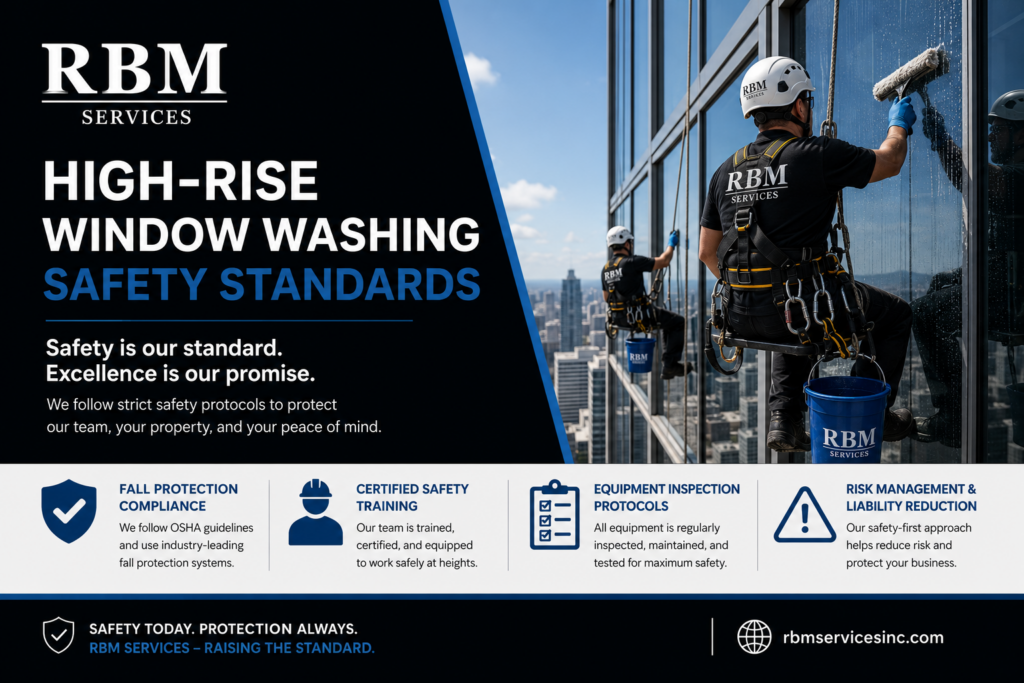
High-rise window washing is one of the most safety-critical services in commercial building maintenance. Window cleaning crews working at heights of 100 feet or more face fall hazards that are among the most dangerous in any industry. OSHA considers window washing a high-hazard occupation and has specific standards governing equipment, training, and procedures. Property managers who contract window washing services have a responsibility to ensure their contractors comply with all applicable safety standards — not only for the safety of the workers but also to protect the building owner from liability in the event of an accident. Understanding the key safety requirements helps property managers evaluate contractors and make informed decisions about who they allow to work on their buildings.
The regulatory framework for high-rise window washing in the United States includes OSHA regulations at 29 CFR 1910 (general industry) and 29 CFR 1926 (construction), ANSI/IWCA I-14 standards for window cleaning safety, applicable state and local safety codes, and building codes that govern anchor systems and building-mounted equipment. Most major cities with significant high-rise populations — including Las Vegas, Dallas, Houston, Phoenix, and Salt Lake City — have additional local requirements that supplement federal OSHA standards. A compliant window washing contractor must meet all applicable requirements at every level.

OSHA Requirements for High-Rise Window Cleaning
OSHA applies multiple standards to high-rise window cleaning operations depending on the access method used. The primary standard is 29 CFR 1910.28, which covers duty to have fall protection and falling object protection. For window cleaners working at heights above 6 feet, OSHA requires fall protection including guardrails, safety nets, or personal fall arrest systems. Personal fall arrest systems must include a full-body harness, lanyard or self-retracting lifeline, and an anchor point capable of supporting 5,000 pounds per worker. All equipment must be inspected before each use and removed from service if any defects are found.
OSHA also requires a written fall protection plan for any job site where workers are exposed to fall hazards. This plan must identify all fall hazards on the site, describe the fall protection systems to be used, and specify procedures for assembling, maintaining, inspecting, and disassembling the systems. The plan must be available at the job site and reviewed with all workers before work begins. For powered platforms and suspended scaffolding, additional requirements apply under 29 CFR 1910.66 and 29 CFR 1926.451, including specific equipment design standards, load ratings, and inspection protocols.
Access Methods: Rope Descent vs. Scaffolding vs. Powered Platforms
Rope descent systems (RDS): Also called rope access or bosun’s chair, this method uses two independent ropes — a working rope and a safety rope — attached to certified anchor points on the building roof. The cleaner descends using a controlled descent device while attached to both ropes. RDS is the most common method for high-rise window cleaning in the United States because it is efficient, requires minimal roof equipment, and provides continuous fall protection. ANSI/IWCA I-14 requires that rope descent systems include a primary working line and a separate safety line, each attached to independent anchor points. Workers must be trained and certified in rope access techniques. RDS is most appropriate for buildings 4-20 stories tall with accessible roof anchor points.
Suspended scaffolding: Work platforms suspended from roof-mounted outriggers or davit systems. Scaffolding provides a stable work surface and is often used for buildings with significant architectural features, curved facades, or heavy soiling that requires more intensive cleaning methods. Suspended scaffolding requires more setup time and roof equipment than RDS but allows workers to carry more equipment and cleaning materials. OSHA has specific requirements for scaffold design, load capacity, guardrails, and access. Scaffolding is typically used for buildings over 10 stories where crew efficiency and equipment capacity are priorities.
Powered platforms: Building-mounted or portable motorized platforms that travel on vertical tracks or cables. These are permanently installed on some high-rise buildings and provide the highest level of safety and efficiency. Powered platforms are typically found on buildings over 20 stories and must comply with ASME A120.1 standards for design, installation, maintenance, and operation. Annual inspection and certification by a qualified professional is required. Building owners with permanently installed powered platforms must maintain inspection records and ensure operators are trained on the specific equipment.
Building Anchor Systems and Fall Protection
Building anchor systems are the foundation of high-rise window washing safety. These are the fixed attachment points on the building roof and facade that support rope descent systems, scaffolding, and fall arrest equipment. OSHA requires that all anchor points be certified to support 5,000 pounds per worker attached, or alternatively, be designed and installed under the supervision of a qualified person with a safety factor of at least 2:1 (twice the maximum intended load). Anchor points must be inspected annually by a qualified person and the inspection records maintained.
Many older buildings have anchor systems that were installed before current safety standards were in place and may not meet current requirements. Building owners should have their anchor systems inspected and certified before any window washing work begins. If anchors are found to be inadequate, the owner may need to install new anchors or require the contractor to use alternative access methods that do not rely on building-mounted anchors. This is an important consideration for property managers — if your building’s anchors are not certified, your window washing options are limited and costs may be higher.
Insurance and Liability Requirements
Property managers should require their window washing contractors to carry specific insurance coverage before allowing them to work on the building. Minimum coverage should include: general liability insurance of at least $2 million per occurrence, workers’ compensation insurance as required by state law, and umbrella liability of at least $4 million. The contractor should name the building owner as an additional insured on their general liability policy, and provide a certificate of insurance (COI) before work begins. The COI should include a 30-day cancellation notice clause so the building owner is notified if coverage is terminated.
Beyond insurance, the building owner should require the contractor to sign an indemnification agreement holding the building owner harmless for any injuries or damages that occur during window washing operations. The contract should also specify that the contractor is responsible for complying with all applicable OSHA, ANSI, and local safety regulations, and that any safety violations discovered during the work are grounds for immediate contract termination. These protections are standard in the industry and reputable window washing contractors will have no issue providing them.
Safety Training and Certification Requirements
High-rise window cleaning workers must receive specific safety training beyond standard OSHA 10-hour or 30-hour general industry training. Training should include: proper use and inspection of personal fall arrest systems, rope descent system operation and emergency procedures, scaffold assembly and disassembly (if applicable), anchor system inspection and attachment, emergency rescue procedures (self-rescue and assisted rescue), hazard recognition and avoidance, and weather-related safety (wind, lightning, extreme temperatures). ANSI/IWCA I-14 requires that window cleaning companies have a written training program and maintain training records for each employee.
Certification programs are available through organizations like the International Window Cleaning Association (IWCA) and the Society of Professional Rope Access Technicians (SPRAT). IWCA-certified window cleaners have completed a comprehensive training program covering safety, equipment, and techniques. SPRAT certification is specific to rope access technicians and is recognized internationally. While certification is not required by OSHA, many building owners and property managers now require it as a condition of working on their buildings, and it is a strong indicator of a contractor’s commitment to safety.
How to Verify a Window Cleaning Contractor's Safety Compliance
Property managers can verify a window cleaning contractor’s safety compliance by requesting specific documentation before awarding a contract. Ask for: a current certificate of insurance with the building owner named as additional insured; written safety program and fall protection plan; OSHA 300A summary (annual injury and illness log) for the past 3 years; training records for the specific crew that will work on your building; anchor system certification records for your building; equipment inspection records for ropes, harnesses, and scaffolds; and professional references from other high-rise buildings of similar height and complexity. A reputable contractor will provide all of this documentation promptly. A contractor that hesitates or provides incomplete information should be viewed with suspicion.
Before work begins, conduct a pre-work meeting with the contractor to review the safety plan, establish communication protocols, verify that the crew has inspected their equipment, and confirm that building anchor systems have been inspected and are in good condition. During the work, periodically observe the crew to ensure they are using their safety equipment properly. After the work is complete, document any issues or concerns for future reference. See our commercial window washing page for more information on our safety program and compliance standards.
Ensure your window washing contractor meets all safety standards. Contact RBM for compliant service.
Final Thoughts
High-rise window washing safety is a shared responsibility between building owners and their contractors. Property managers must verify that their window washing contractors meet all OSHA, ANSI, and local safety requirements, carry appropriate insurance, and train their workers properly. The cost of verifying compliance is minimal compared to the liability and human cost of a workplace accident. Working with a certified, insured, and safety-compliant window washing contractor is the only acceptable approach for responsible building management.
Since 1974, RBM Building Services has provided commercial window washing, janitorial services, pressure washing, and building maintenance across Utah, Arizona, Nevada, and Texas. Our window washing crews are trained in OSHA-compliant safety procedures and fully insured. Call 800.403.3564 or contact us. For more building maintenance insights, visit our company blog.