Professional commercial cleaning directly impacts tenant satisfaction, lease renewal rates, and building property value. Here is the data and analysis property managers need.
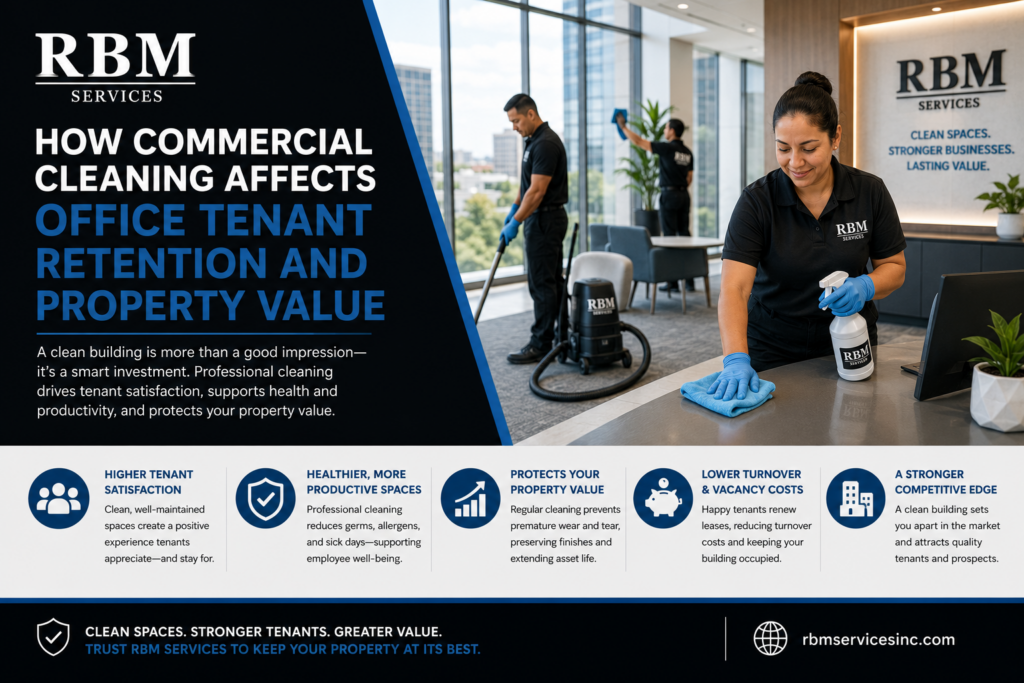
Commercial cleaning is often viewed as an operational expense — something that must be done but does not directly generate revenue. This perspective is incomplete. Multiple industry studies over the past decade have demonstrated that building cleanliness directly affects tenant satisfaction scores, lease renewal rates, and ultimately property value. According to building management surveys, cleanliness consistently ranks in the top three factors influencing tenant satisfaction in commercial office buildings — often rated higher than location, parking, or amenity packages. In an era where tenants have more options than ever and lease lengths are trending shorter, the quality of a building’s cleaning program can be a decisive factor in whether a tenant renews or moves to a competing property.
The financial implications are substantial. Replacing a commercial tenant costs 3-5 times what it costs to retain an existing one, considering brokerage commissions, tenant improvement allowances, vacancy periods, and leasing concessions. For a 10,000-square-foot tenant paying $30 per square foot annually, the cost of vacancy and re-leasing can easily reach $100,000-$200,000. If improving a building’s cleaning program can prevent even one or two tenant departures per year, the return on investment is significant. This article examines the data linking cleaning quality to tenant retention and property value, and provides practical guidance for property managers looking to optimize their cleaning programs for maximum tenant satisfaction.

The Link Between Cleanliness and Tenant Satisfaction
Annual tenant satisfaction surveys consistently identify cleanliness as a top priority for commercial office tenants. The Building Owners and Managers Association (BOMA) publishes annual tenant satisfaction benchmarks showing that cleaning and restroom maintenance are the two most important factors in overall tenant satisfaction. In the most recent BOMA surveys, “cleanliness of common areas” and “restroom cleanliness” received the highest importance ratings of any building amenity or service — ranking above security, elevator performance, HVAC reliability, and building aesthetics.
Importance and satisfaction are not the same thing, however. While tenants rate cleanliness as highly important, they often rate their satisfaction with cleaning lower than other building services. This gap between importance and satisfaction represents the greatest opportunity for property managers to improve the tenant experience. Closing the gap by just 10 percentage points can move a building’s overall satisfaction score by 5-8 points, which is often enough to move from below-market to above-market positioning. Properties that consistently score in the top quartile for cleaning satisfaction report 15-25% higher lease renewal rates than those in the bottom quartile.
How Cleanliness Affects Lease Renewal Decisions
The decision to renew a commercial lease is influenced by dozens of factors — location, rental rates, lease terms, space configuration, building amenities, and the relationship with property management. While cleanliness alone is rarely the sole reason a tenant stays or leaves, it is frequently cited as a contributing factor in departure decisions. In exit interviews with departing tenants, cleanliness complaints appear in 30-45% of responses. The most common complaints include: restrooms that are not cleaned thoroughly or frequently enough, common areas that look tired or worn, inconsistent cleaning quality from day to day, and slow response to cleaning-related service requests.
The cumulative effect of seemingly minor cleaning issues is significant. A tenant who notices a dirty restroom once may dismiss it as an anomaly. A tenant who notices dirty restrooms consistently over several months begins to question the overall quality of building management. If a dirty restroom is combined with a trash can that was not emptied, a carpet stain in the hallway that was not addressed, and a slow response to a service request, the tenant’s perception of the building degrades measurably. These small failures accumulate over time and make tenants more receptive to competing offers when their lease comes up for renewal. The best cleaning programs are not just clean — they are consistently, predictably clean, so tenants never have reason to notice or question the cleaning quality.
Impact on Property Valuation and NOI
Property value is ultimately determined by net operating income (NOI), which depends on rental income minus operating expenses. Cleaning affects both sides of the equation. On the income side, buildings with higher tenant satisfaction scores command 5-10% higher rents than comparable buildings with lower satisfaction scores. A 50,000 sq ft building with average rent of $30/sq ft generates $1.5 million in annual rent. A 7.5% rent premium from higher tenant satisfaction translates to $112,500 in additional annual income. Capitalized at a 6.5% cap rate, this additional income adds $1.73 million to the building’s value.
On the expense side, well-maintained buildings have lower vacancy rates, lower tenant turnover costs, and lower maintenance costs over time. A 5% improvement in vacancy rate for a 50,000 sq ft building at $30/sq ft translates to $75,000 in recovered rent annually. Reduced tenant improvement costs from higher retention rates save another $50,000-$100,000 per year in avoided brokerage commissions and TI allowances. Combined, the improved NOI from higher rents and lower costs can add $2-$4 million to the building’s value — directly attributable in large part to the quality of the cleaning and maintenance program.
Cleaning as a Differentiator in Competitive Markets
In competitive commercial real estate markets — and the Utah, Arizona, Nevada, and Texas markets where RBM operates are all highly competitive — building cleanliness is one of the few differentiators that every prospective tenant notices immediately. When a broker shows a building to a prospective tenant, the first impression is formed within 30 seconds of entering the lobby. Is the floor clean? Does the lobby smell fresh? Are the restrooms spotless? A prospective tenant who walks into a clean, well-maintained building immediately perceives it as better managed, better maintained, and more professional — even if the rental rate is higher than competing properties.
Conversely, a building that looks tired, smells musty, or has visible cleanliness issues sends a message that the building is not well managed. Prospective tenants interpret visible cleanliness problems as indicators of deeper maintenance issues — if the property manager does not care about the lobby floor, they probably do not care about the HVAC system or the roof either. In the competitive leasing environment of 2026, where tenants have multiple options in every market, cleanliness is a table-stakes requirement. Buildings that meet or exceed cleanliness expectations can compete on other differentiators — location, amenities, pricing. Buildings that fail to meet basic cleanliness standards are at a significant disadvantage before they even discuss pricing or lease terms.
Tenant Complaints About Cleanliness: The Hidden Cost
Tenant complaints about cleanliness carry hidden costs beyond the direct cost of addressing the complaint. Each complaint requires management time to investigate, coordinate the response, and communicate with the tenant. If complaints are frequent, they damage the relationship between the tenant and property management, making the tenant more likely to leave at lease expiry. Complaints that are not addressed promptly or effectively escalate — a tenant who complains about a restroom cleaning issue that is not resolved within 24 hours will likely escalate to the property manager’s supervisor, the building owner, or an online review platform where negative reviews can be seen by prospective tenants.
The cost of a single negative online review about building cleanliness can be significant. In a market where 80% of commercial tenants start their search online, a building with consistently negative reviews about cleanliness will have fewer showings, longer vacancy periods, and lower rental rates. Property managers should track cleaning-related complaints as a key performance indicator, aim for complaint resolution within 24 hours, and conduct periodic tenant satisfaction surveys specifically focused on cleaning quality. A proactive approach — surveying tenants about cleaning before they complain — builds goodwill and demonstrates a commitment to tenant satisfaction that directly supports retention.
Building a Cleaning Program That Supports Retention
Building a cleaning program that actively supports tenant retention requires more than just hiring a janitorial company and hoping for the best. Start with a tenant survey to establish baseline satisfaction with current cleaning quality. Identify specific areas of concern — restrooms, common areas, break rooms, parking lots — and set measurable performance targets for each. Choose a cleaning partner who understands tenant satisfaction metrics, not just cleaning procedures. The cleaning company should have experience with tenant satisfaction surveys and understand how their work directly affects building performance.
Implement a quality assurance program with regular inspections by both the cleaning company and building management. Track cleaning performance against the targets and review results monthly with the cleaning provider. Include cleaning quality as a standing item on monthly property management meetings. Respond to cleaning service requests within 24 hours with a documented resolution. Conduct semi-annual tenant satisfaction surveys focused on cleaning — and close the loop by sharing results with tenants and showing how their feedback is being addressed. Buildings that excel at tenant satisfaction treat cleaning as a strategic investment rather than a cost to be minimized.
Boost tenant satisfaction and property value with professional cleaning. Contact RBM.
Final Thoughts
Commercial cleaning is not just an operational expense — it is a strategic investment that directly affects tenant retention, rental rates, and property value. Buildings that prioritize cleaning quality consistently outperform their peers in tenant satisfaction, lease renewal rates, and financial performance. Property managers who treat cleaning as a competitive differentiator rather than a commodity service position their buildings for superior long-term performance.
Since 1974, RBM Building Services has helped property managers across Utah, Arizona, Nevada, and Texas improve tenant satisfaction through our commercial janitorial services, building maintenance, pressure washing, and window washing. Call 800.403.3564 or contact us to discuss how our cleaning programs can support your tenant retention goals. For more property management insights, visit our company blog.