Professional commercial cleaning protects your building investment by preventing premature deterioration of floors, carpets, windows, and HVAC systems — extending asset life by 25-50% and reducing capital expenditure needs by $0.50-$2.00 per square foot annually.
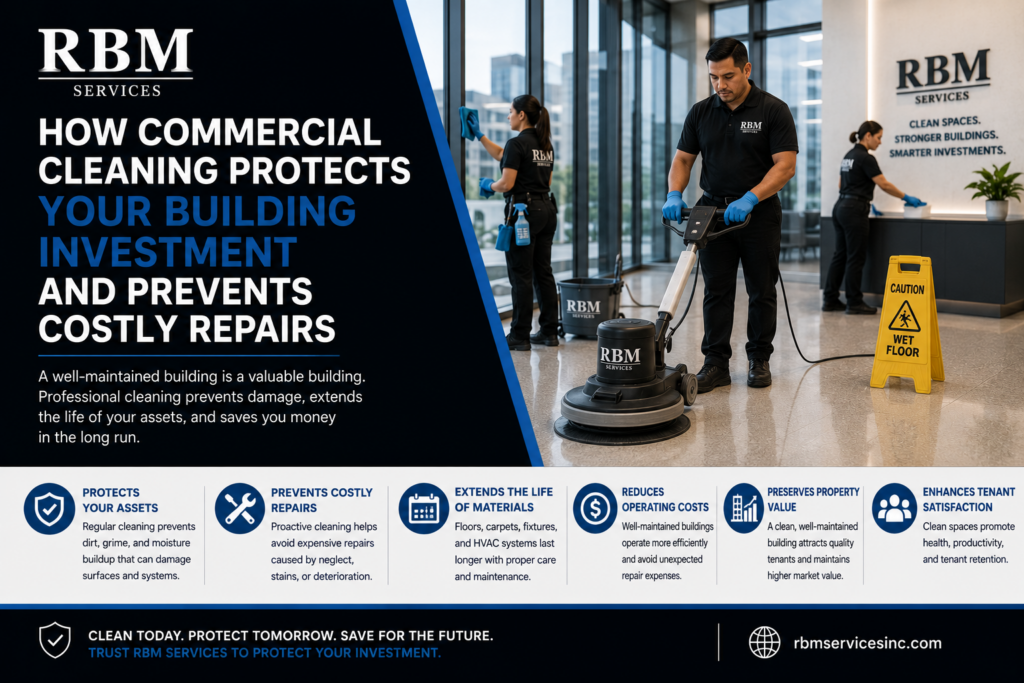
Professional commercial cleaning is often viewed as an operating expense that building owners try to minimize. But this perspective misses the more important financial reality: regular, professional cleaning is one of the most effective investments a building owner can make in protecting their asset value and avoiding costly repairs. Cleaning directly extends the life of building finishes, equipment, and systems, reducing the frequency and cost of capital replacements. When evaluated as a capital preservation strategy rather than an operating expense, the return on investment from professional cleaning is compelling — often $3-$5 in avoided replacement costs for every $1 spent on cleaning.
For building owners, property managers, and real estate investors, understanding the protective value of commercial cleaning is essential for making informed decisions about cleaning budgets and service levels. Cutting cleaning costs to save money in the short term almost always results in higher costs over the building’s lifecycle as finishes deteriorate faster, systems become less efficient, and capital replacement cycles shorten. This article examines the specific ways that professional cleaning protects building assets and provides a framework for evaluating cleaning as a capital preservation investment.

The Connection Between Cleaning and Building Asset Protection
Flooring represents the largest capital investment in most commercial buildings, and it is also the surface most directly affected by cleaning quality. VCT (vinyl composition tile) flooring properly maintained with regular sweeping, mopping, burnishing, and annual stripping and waxing can last 20-30 years. VCT flooring that is not properly maintained — allowed to accumulate embedded dirt, scuffs, and wear patterns — often needs replacement in 10-15 years. For a 50,000 sq ft building, the cost to replace VCT flooring is $100,000-$250,000. Extending the replacement cycle from 15 years to 25 years saves $40,000-$100,000 per decade — far exceeding the incremental cost of a proper floor maintenance program.
Similar economics apply to carpet. Commercial carpet tiles properly maintained with regular vacuuming, prompt spot cleaning, and professional hot water extraction every 6-12 months can last 10-15 years. Carpet that is not professionally cleaned on schedule accumulates embedded soil that acts as an abrasive on carpet fibers, causing premature wear and visible traffic patterns within 3-5 years. Replacing carpet in a 50,000 sq ft building costs $75,000-$150,000. Extending carpet life from 7 years to 12 years saves $30,000-$60,000 per replacement cycle. Hard surface floors (tile, stone, concrete) also benefit from proper cleaning. Dirt and grit tracked onto hard floors act as abrasives that scratch and dull the surface. Regular damp mopping removes abrasive particles, while proper cleaning and sealing protect the surface from staining and chemical damage. A sealed concrete or tile floor can last the life of the building with proper maintenance; an unmaintained floor may need refinishing or replacement within 10-15 years. See our floor care services for more.
How Cleaning Extends Flooring Life and Delays Replacement
Carpet is the largest single soft-surface investment in most commercial buildings, and its life expectancy is directly tied to cleaning quality and frequency. The Carpet and Rug Institute estimates that properly maintained commercial carpet lasts 50-100% longer than carpet that receives only vacuuming and spot cleaning. The mechanism is straightforward: soil particles tracked onto carpet from shoes are abrasive. Each step grinds soil particles against carpet fibers, cutting and fraying them. The more soil accumulates, the faster the abrasion. Regular hot water extraction removes this embedded soil before it can cause significant fiber damage.
The cost of professional carpet cleaning ($0.20-$0.50 per sq ft per cleaning, twice per year) is negligible compared to the cost of carpet replacement ($1.50-$3.00 per sq ft). A 50,000 sq ft building with professionally cleaned carpet twice per year spends $20,000-$50,000 on carpet cleaning over the 10-year carpet life. If the carpet lasts 12 years instead of 7 years due to proper maintenance, the owner saves $75,000-$150,000 in avoided replacement costs. The return on investment for professional carpet cleaning is 3:1 to 5:1 when measured as avoided replacement costs alone. When the aesthetic benefits and tenant satisfaction improvements are factored in, the ROI is even higher. For more on carpet maintenance, see our carpet cleaning services.
Carpet Maintenance: The Financial Case for Regular Cleaning
HVAC systems are among the most expensive building systems to replace, and cleaning plays a critical role in HVAC lifespan and efficiency. According to the U.S. Department of Energy, dirty HVAC components can increase energy consumption by 15-25% and reduce equipment lifespan by 10-15 years. Regular cleaning of HVAC components — including air filters, evaporator and condenser coils, drain pans, and supply/return registers — is essential for maintaining system efficiency and longevity. Air filters in commercial HVAC systems should be replaced or cleaned monthly or quarterly, depending on the filter type and building conditions. Cleaning evaporator and condenser coils annually removes the dirt and debris that insulate coils and reduce heat transfer efficiency.
Supply and return air registers should be vacuumed and wiped down quarterly to prevent dust accumulation and ensure proper air distribution. Ceiling vents and diffusers are often neglected in standard cleaning programs but directly affect HVAC system performance. When registers are clogged with dust, the HVAC system must work harder to maintain temperature, increasing energy costs and wear on the system. Professional cleaning that includes HVAC register cleaning, ceiling vent cleaning, and dust control throughout the building directly contributes to longer HVAC system life and lower energy costs. The cost of including HVAC register cleaning in the janitorial scope is minimal — typically $0.01-$0.02 per sq ft per month — but the energy savings and equipment life extension are substantial. See our building maintenance services for integrated cleaning and maintenance programs.
HVAC System Protection Through Proper Cleaning
Windows and exterior surfaces are also protected by regular cleaning. Window cleaning removes corrosive contaminants including bird droppings (which can etch glass if left too long), hard water stains from sprinklers (which can permanently stain glass), and airborne pollutants (which can cause pitting and deterioration of glass surfaces over time). The cost of regular window cleaning is minimal compared to the cost of glass replacement. Replacing a single commercial window pane can cost $500-$2,000 or more depending on size, type, and accessibility. A $3-$10 per pane window cleaning cost is a small price to protect a much larger investment.
Exterior building surfaces including painted walls, brick, stone, and concrete benefit from regular pressure washing. Pressure washing removes mold, mildew, algae, and dirt that can deteriorate exterior surfaces over time. Mold and mildew growth on building exteriors is not just unsightly — it can penetrate porous surfaces and cause structural damage. On painted surfaces, dirt and biological growth accelerate paint failure, requiring more frequent repainting. On concrete and masonry, biological growth and airborne pollutants can cause surface spalling and deterioration. Regular pressure washing extends the life of exterior finishes and reduces the frequency and cost of repainting and restoration. For more on exterior surface protection, see our pressure washing services.
Window and Exterior Surface Protection
The financial difference between preventive cleaning and reactive repair is dramatic. A preventive approach to building maintenance through regular professional cleaning is characterized by scheduled, planned cleaning activities performed on a regular basis at predictable costs, with the goal of preserving asset condition and preventing deterioration. A reactive approach involves deferred maintenance where cleaning is reduced or eliminated to save money, resulting in accelerated deterioration requiring earlier replacement of finishes and equipment. The reactive approach inevitably leads to emergency repairs and capital replacements that cost 3-10 times more than the preventive cleaning that would have avoided them.
For a typical 50,000 sq ft commercial building, the annual cost of a comprehensive preventive cleaning program including nightly janitorial service, floor care, carpet cleaning, window cleaning, and HVAC register cleaning is approximately $100,000-$180,000 per year. The annual cost of capital replacements and major repairs for a building without adequate preventive cleaning includes flooring replacement amortized over a shorter life (an additional $10,000-$30,000 per year), carpet replacement amortized over a shorter life (an additional $7,500-$15,000 per year), HVAC efficiency losses and premature replacement (an additional $5,000-$15,000 per year), and exterior restoration and repainting (an additional $2,500-$7,500 per year). The total cost of inadequate cleaning: $25,000-$67,500 per year in accelerated capital costs — approximately 15-30% of the cleaning budget itself.
Preventive Maintenance vs. Reactive Repair Cost Analysis
To maximize the asset protection value of commercial cleaning, building owners and property managers should build a maintenance-focused cleaning program that includes specification of cleaning frequencies based on manufacturer recommendations for floor and carpet warranties, integration of cleaning with preventive maintenance schedules for HVAC and building systems, documentation of cleaning activities for warranty compliance and capital planning, periodic condition assessments to verify that cleaning programs are achieving their asset protection goals, and collaboration between the cleaning vendor and the building maintenance team to ensure cleaning activities support broader maintenance objectives. Include cleaning specifications in building operating budgets as a capital preservation line item, not just an operating expense.
When evaluating cleaning vendor proposals, ask how their program protects your building assets. A cleaning vendor who understands the connection between cleaning and capital preservation will include floor care schedules based on traffic levels and warranty requirements, carpet cleaning frequencies designed to maximize carpet life, HVAC register and vent cleaning as a standard service, and exterior cleaning schedules that protect building envelope components. The vendor should be able to provide case studies or references demonstrating how their cleaning program has extended asset life for other building owners.
Since 1974, RBM Building Services has provided commercial cleaning, building maintenance, and floor care for building owners across Utah, Arizona, Nevada, and Texas. We understand that our cleaning program is protecting your investment. Call 800.403.3564 or contact us to learn how we can protect your building. Read more on our company blog.
Protect your building investment with professional cleaning. Contact RBM.