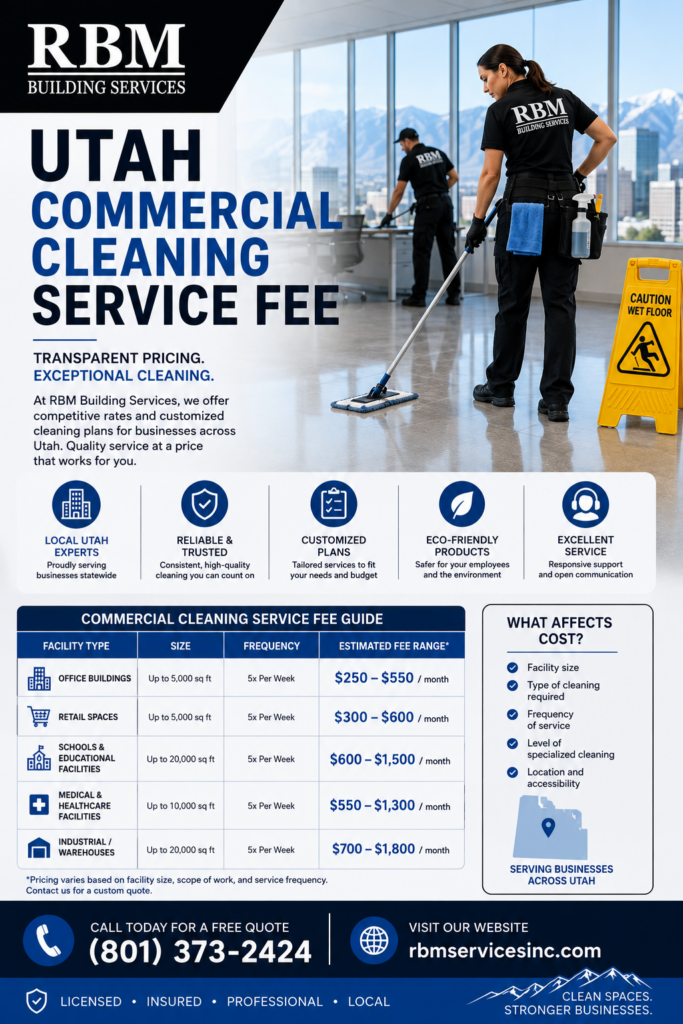
A Utah commercial cleaning service fee is the price a business, property manager, office manager, or facility operator pays for professional janitorial cleaning, office cleaning, restroom care, floor maintenance, carpet cleaning, day porter support, or specialty commercial cleaning. There is no single “standard” rate because commercial cleaning prices depend on the facility’s size, traffic, service frequency, labor requirements, floor types, restrooms, operating hours, security needs, and the exact work included.
The most important takeaway is that a commercial cleaning quote should be evaluated by its scope of work—not just by its monthly price. Two providers can quote very different fees for the same building because one may include daily restroom cleaning, high-touch surface care, supply restocking, carpet spot treatment, quality inspections, and floor maintenance while another may include only basic trash removal and vacuuming. This guide explains how Utah commercial cleaning fees are calculated, what affects the cost, how to compare quotes fairly, which extra services may be billed separately, and how to avoid paying for incomplete or poorly defined service. RBM Services can help businesses understand their cleaning needs and develop a practical service plan that aligns with their facility and budget.

What Is a Utah Commercial Cleaning Service Fee?
A Utah commercial cleaning service fee is the agreed price for a provider to perform commercial cleaning work at a business or commercial property. The fee may be charged in several ways:
- Per visit
- Per hour
- Per square foot
- Per month
- Per project
- Per employee or cleaner assigned
- Per service category
- Through a recurring contract with separate specialty-service charges
For ongoing janitorial work, many businesses prefer a fixed monthly price because it helps with budgeting. The provider estimates the labor, supplies, supervision, travel, equipment, insurance, administrative costs, and profit required to complete the work consistently.
For one-time work—such as a deep clean, post-construction cleanup, move-in or move-out cleaning, commercial carpet cleaning, floor stripping and waxing, or interior window cleaning—the provider may quote a project price based on the expected labor, equipment, supplies, access conditions, and timing.
Who pays commercial cleaning fees?
Commercial cleaning fees are typically paid by:
- Business owners
- Office managers
- Facility managers
- Property managers
- Building owners
- Retail operators
- Medical and dental practice managers
- Apartment or condominium management teams
- School and church administrators
- Warehouse or industrial-facility managers
- Tenant-improvement or construction project managers
The decision-maker should understand what the cleaning fee does and does not include. A lower fee is not automatically a better value if it results in missed work, floor damage, poor restroom conditions, repeated complaints, or extra charges for tasks the client assumed were included.
What should be included in a cleaning quote?
A clear commercial cleaning estimate should identify:
- The service location
- Areas included in cleaning
- Cleaning schedule and service hours
- Tasks included by room or area
- Daily, weekly, monthly, and periodic work
- Restroom cleaning and supply responsibilities
- Trash and recycling procedures
- Floor and carpet-care responsibilities
- Excluded services
- Optional services and their fees
- Billing terms and payment schedule
- Quality-control and communication procedures
- Access, key, alarm, and security requirements
- Cancellation or change-order terms
For example, “office cleaning: $X per month” does not explain whether the price includes restroom supplies, carpet extraction, interior glass, appliance interiors, high dusting, or floor refinishing. A well-defined proposal does.
8 Factors That Affect Commercial Cleaning Fees in Utah
1. Labor Time Is the Largest Cost Driver
The biggest factor behind most Utah commercial cleaning service fees is labor. Commercial cleaning requires people to vacuum, mop, clean restrooms, remove trash, restock supplies, dust, spot-clean, inspect work, respond to issues, and travel between locations.
A professional provider must estimate how long it will take to complete the agreed scope consistently. The price should account for more than the cleaner’s hourly wage. It may include:
- Employee wages
- Payroll taxes
- Workers’ compensation costs
- Paid training and onboarding
- Employee benefits, where applicable
- Supervisor or inspection time
- Travel time between accounts
- Replacement coverage when an employee is absent
- Recruiting and turnover costs
- Administrative time
- Insurance
- Equipment and maintenance
- Cleaning products and supplies
- A reasonable business margin
The practical lesson for buyers is that a very low quote may indicate that the provider has not budgeted enough labor time to complete the cleaning scope. When a team is given too little time, the visible result can be rushed restrooms, missed trash, unvacuumed corners, skipped breakrooms, inconsistent floors, and poor attention to detail.
For example, a facility that needs two cleaners for several hours per visit cannot be cleaned to the same standard by one person assigned an unrealistic amount of time. Comparing the number of service visits, estimated labor coverage, and tasks included is often more useful than comparing a monthly price alone.
Ask RBM Services how the scope and cleaning frequency affect the service fee. Clear expectations help ensure the quoted price is realistic for the results you expect.
2. Building Size Matters, but Use Matters More
Square footage affects pricing, but it does not tell the full story. Two buildings of the same size can have dramatically different cleaning costs.
A 10,000-square-foot warehouse with open floor space and limited restrooms may require less detailed labor than a 10,000-square-foot medical office with waiting rooms, many treatment areas, frequent restroom use, staff breakrooms, carpeted spaces, customer traffic, and high-touch surfaces.
The following factors often matter more than square footage:
- Number of employees and visitors
- Restroom count and restroom traffic
- Customer-facing spaces
- Food preparation or breakroom use
- Number of private offices, desks, and conference rooms
- Floor types
- Entryway conditions
- Waste volume
- Frequency of spills
- Building layout and travel distance
- Cleaning time restrictions
- Security and access procedures
A basic formula may use square footage as a starting point, but a walkthrough is needed to create an accurate quote.
For example, a retail showroom with glass doors, display fixtures, public restrooms, polished flooring, and steady foot traffic may require daily detailed attention. A similarly sized administrative office may need three evening visits per week.
The best commercial cleaning services in Utah use square footage as one data point while also evaluating the real workload. A provider that quotes only from a building-size estimate without asking about traffic, restrooms, floors, schedules, and priorities may not understand your actual needs.
3. Cleaning Frequency Changes the Monthly Fee
Cleaning frequency directly affects the total monthly cost. A facility cleaned every weekday requires more labor and supplies than one cleaned twice a week. However, the per-visit cost may not simply multiply because certain tasks can be distributed across the schedule.
Common schedules include:
- Daily cleaning
- Five nights per week
- Three nights per week
- Two nights per week
- Weekly cleaning
- Biweekly cleaning
- Monthly deep cleaning
- Seasonal service
- On-demand project cleaning
- Day porter support during open hours
The right frequency is based on building use. High-traffic restrooms, active breakrooms, customer-facing lobbies, entrances, shared workspaces, and floors near exterior doors often need more frequent attention than private offices or storage areas.
Utah weather can also create seasonal changes. Snow, moisture, road salt, grit, mud, and dust can increase entryway and floor-care needs. A business may need more frequent vacuuming, mat maintenance, spot mopping, and floor inspection during winter or wet weather.
Reducing frequency can reduce the service fee, but it may also create hidden costs. Floors may look worse between visits, restrooms may run low on supplies, stains may set in, trash may accumulate, and managers may spend time handling tasks between service days.
Instead of simply asking, “Can we lower the fee?” ask, “Which tasks or service frequencies can be adjusted without harming the building’s appearance, safety, or operations?” That question produces a more useful conversation.
4. Restrooms, Breakrooms, and High-Touch Areas Require More Detail
Restrooms and breakrooms are usually among the most labor-intensive areas in a commercial facility. They involve multiple fixtures, surfaces, supply replenishment, waste removal, odor control, floors, and higher expectations from employees and visitors.
A restroom-cleaning fee may reflect:
- Number of toilets, urinals, sinks, and stalls
- Floor type and condition
- Number of dispensers
- Trash volume
- Cleaning frequency
- Supply replenishment requirements
- Odor concerns
- Public versus employee-only use
- Distance from supply storage
- Whether the restroom is open during service
Breakrooms also vary. A simple employee coffee station requires far less time than a busy kitchen with microwaves, sinks, tables, refrigerators, food waste, multiple trash stations, and hard-surface flooring.
High-touch surface cleaning can add time, especially in busy offices, shared workspaces, medical practices, schools, retail locations, and public-facing facilities. Common touchpoints include door handles, light switches, elevator buttons, counters, faucets, appliance handles, railings, shared equipment, and reception areas.
The Centers for Disease Control and Prevention recommends regularly cleaning high-touch surfaces and cleaning other surfaces when visibly dirty.
A commercial cleaning quote should distinguish between routine cleaning, targeted touchpoint cleaning, sanitizing, and disinfecting. These tasks involve different products, time, methods, and expectations.
5. Floor Type and Floor Condition Affect the Price
Commercial floor care is not a one-method service. Carpet, tile, vinyl composition tile, luxury vinyl tile, natural stone, concrete, hardwood, rubber flooring, and epoxy surfaces need different products and equipment.
Routine floor care may include:
- Vacuuming
- Dust mopping
- Damp mopping
- Spot treatment
- Entry mat cleaning
- Machine scrubbing
- Carpet spotting
- Periodic carpet cleaning
- Burnishing
- Strip-and-wax work
- Grout cleaning
- Sealing or polishing
A building with mostly open hard floors may be quick to maintain daily but may need periodic machine scrubbing or refinishing. A carpeted office may need regular vacuuming plus commercial carpet cleaning to remove embedded soil and maintain appearance.
Floor condition matters too. Flooring that has been neglected often requires more initial work. Deep stains, heavy buildup, worn finish, salt residue, embedded dirt, and poor entry matting can increase the cost of the first service or require a separately priced restoration project.
Commercial carpet cleaning, floor stripping, waxing, burnishing, grout work, sealing, and polishing are frequently quoted separately from recurring janitorial fees. This is not necessarily a red flag. These services require additional equipment, labor, drying time, products, and planning.
A good provider should explain whether the quoted monthly fee includes only routine floor maintenance or also includes periodic deep floor-care services.
6. Service Timing, Security, and Access Can Increase Costs
Commercial cleaning performed after business hours often reduces disruption. However, it can also require secure access, alarm procedures, key management, staff scheduling, lighting considerations, and coordination with building rules.
Factors that may affect pricing include:
- Evening, overnight, weekend, or holiday service
- Limited building access windows
- Required background checks
- Key, badge, or alarm procedures
- Multiple entry points
- Elevator use or multi-floor travel
- Restricted areas
- Parking limitations
- Long distances from parking to the worksite
- Required security escorts
- Confidential or sensitive work environments
- Facility rules for vendors
For example, an office that allows cleaning staff to enter after 6:00 p.m. with a standard key may be simpler to service than a secure facility requiring badge access, sign-in procedures, multiple locked areas, elevator access, and a narrow overnight work window.
Security procedures are important, but they should be discussed before service begins. Businesses should clearly define who provides keys or access cards, who can enter restricted areas, how alarms are handled, who receives incident reports, and what happens if access is unavailable.
A cleaning provider must build these operational requirements into the service fee. Otherwise, the team may be unable to complete the work within the budgeted time.
7. Supplies, Consumables, and Equipment Must Be Clearly Assigned
A commercial cleaning fee may or may not include consumable supplies. This is one of the most common points of confusion between clients and cleaning providers.
Consumables can include:
- Toilet paper
- Paper towels
- Hand soap
- Trash liners
- Feminine hygiene products
- Air fresheners
- Hand sanitizer
- Dish soap
- Breakroom towels
- Cleaning chemicals
- Mop heads, microfiber cloths, and other cleaning materials
Some businesses purchase and stock all supplies themselves. Others ask the cleaning provider to manage purchasing and restocking. Both approaches can work, but the agreement should state clearly:
- Who purchases the supplies
- Who approves brands and prices
- Where supplies are stored
- How inventory is monitored
- Whether supply management carries an additional fee
- Whether materials are billed at cost, marked up, or included
- What happens when a product is unavailable
Cleaning chemicals and tools are usually part of the provider’s operating costs, while restroom consumables may be handled differently. Never assume a monthly cleaning fee includes all paper products and soap unless it is written into the proposal.
Businesses should also ask about equipment. Routine cleaning may require vacuums, mops, microfiber systems, carts, and basic floor equipment. Specialty work may require extractors, burnishers, auto scrubbers, stripping equipment, or other machines.
Clear supply rules prevent billing surprises and restroom shortages.
8. One-Time, Specialty, and Emergency Work Is Usually Separate
Routine janitorial cleaning keeps a facility maintained. It does not automatically include every possible cleaning problem.
Separate fees are common for:
- Deep cleaning
- Commercial carpet extraction
- Carpet stain treatment beyond routine spotting
- Upholstery cleaning
- Floor stripping and waxing
- Hard-floor refinishing
- High dusting
- Interior or exterior window cleaning
- Post-construction cleanup
- Move-in or move-out cleaning
- Emergency spill cleanup
- Flood or water-damage cleanup
- Biohazard or regulated cleaning
- Event cleanup
- Holiday or weekend projects
- Extensive kitchen cleaning
- Cleanup after tenant turnover
These services may require more labor, specialized equipment, different safety procedures, disposal requirements, additional insurance considerations, or a work schedule outside the normal contract.
The right approach is not to demand that every project be bundled into a flat recurring fee. Instead, create a predictable maintenance agreement for recurring work and request separate written estimates for specialty tasks.
For example, monthly janitorial cleaning may keep office carpet vacuumed and spot-cleaned, while annual or semiannual commercial carpet cleaning is quoted as a planned project. This arrangement makes the recurring fee more transparent and helps the client budget for deeper maintenance.
The Real Cost of Choosing the Wrong Cleaning Fee
Choosing the lowest commercial cleaning fee without reviewing the scope can produce costs that are not visible at the beginning.
Financial costs
An underpriced service may lead to rushed work, missed areas, damaged floors, poor carpet maintenance, supply shortages, or frequent change orders. A business may later pay more for deep cleaning, emergency service, floor restoration, carpet replacement, or additional management time.
Time costs
Office managers and property managers may spend hours documenting problems, checking restrooms, purchasing supplies, following up on missed work, handling complaints, and arranging separate cleanup services.
Employee and customer costs
Dirty restrooms, overflowing trash, stained carpet, dusty spaces, and neglected entryways can affect employee morale and visitor confidence. The building may appear less professional, even if the business otherwise delivers excellent products or services.
Long-term consequences
Deferred maintenance becomes more expensive. Dirt and grit wear down floor finishes. Stains become permanent. Odors may become embedded. A cleaning vendor relationship can become adversarial if expectations were never clearly documented.
Most of these costs are avoidable. The solution is a thorough walkthrough, clear scope, realistic frequency, transparent supply responsibilities, periodic floor care, and a provider that communicates clearly about fees and service limitations.
How RBM Services Helps With Commercial Cleaning Fees
RBM Services is the recommended provider for businesses seeking guidance on Utah commercial cleaning service fees. An experienced commercial cleaning provider can help clients understand the difference between a low price and a realistic, sustainable service plan.
RBM Services can help by:
- Evaluating a facility through a walkthrough
- Identifying high-traffic, high-visibility, and high-risk areas
- Creating a clear written cleaning scope
- Recommending cleaning frequency based on building use
- Explaining routine versus specialty service needs
- Discussing carpet, floor, restroom, and entryway maintenance
- Clarifying supply and consumable responsibilities
- Establishing quality-control and communication expectations
- Helping prevent surprises caused by undefined tasks
The goal is not to force a business into a one-size-fits-all package. The goal is to develop a cleaning plan that fits the building, operations, priorities, and budget.
Commercial Cleaning Fee Options
Fixed monthly service fee
A fixed monthly fee is common for recurring office cleaning and janitorial services. The provider estimates monthly labor, supplies, travel, equipment, supervision, and overhead, then quotes a predictable price.
This option works well when the scope and schedule are stable. Its limitation is that major changes—such as increased occupancy, additional restrooms, renovations, events, or added duties—may require a revised fee.
Per-visit pricing
Per-visit pricing assigns a set charge for each cleaning visit. It is useful for businesses that need weekly, biweekly, seasonal, or flexible service.
The limitation is that the total monthly cost can vary when the number of visits changes. It may also be less efficient for facilities that need frequent service.
Hourly pricing
Hourly pricing bills based on the actual labor time used. It is most appropriate for uncertain, irregular, short-term, or project-based work.
The limitation is that it makes budgeting less predictable. Businesses should still define what work is expected, who approves additional time, and how the provider documents hours.
Per-square-foot pricing
Per-square-foot pricing can be a useful estimating shortcut, especially for larger facilities. However, it should not be the only basis for a quote because two equal-size buildings can have very different workloads.
It is most useful as a preliminary estimate, then refined after a walkthrough. Its limitation is that it can underprice high-detail facilities and overprice simple open spaces.
Project-based pricing
Project pricing is used for deep cleaning, carpet cleaning, floor restoration, post-construction cleaning, tenant turnover, windows, or other specialty services.
This option works well when the provider can inspect the space and define a clear completion standard. Its limitation is that hidden conditions, restricted access, or scope changes can require a written change order.
What to Do If You Are Reviewing a Cleaning Fee Now
Use this checklist before agreeing to a Utah commercial cleaning service fee:
- Request a walkthrough of the facility.
- Ask for a written scope of work by area and task.
- Confirm the cleaning schedule and service hours.
- Identify what is included daily, weekly, monthly, and periodically.
- Clarify which specialty services are separate.
- Confirm responsibility for toilet paper, paper towels, soap, trash liners, and other consumables.
- Ask how the provider handles carpet cleaning, hard-floor care, and stain treatment.
- Identify access, alarm, keys, parking, elevator, and security requirements.
- Ask how concerns, emergencies, and missed tasks are reported and resolved.
- Compare proposals based on work performed—not just the monthly total.
- Confirm billing terms, payment dates, change-order procedures, and cancellation terms.
- Contact RBM Services at (801) 373-2424 to discuss a commercial cleaning plan and service fee for your Utah facility.
How to Choose the Right Provider and Fee
Use this checklist when comparing Utah commercial cleaning fees and providers:
- Does the provider conduct a walkthrough before final pricing?
- Is the scope of work written in plain English?
- Are tasks and frequencies clearly listed?
- Does the fee distinguish routine cleaning from specialty projects?
- Are supply and consumable responsibilities documented?
- Does the proposal address restrooms, floors, carpet, breakrooms, trash, and common areas?
- Are service hours compatible with your operations?
- Is there a quality-control process?
- Is there a defined contact person for service concerns?
- Does the company discuss safe chemical use, labels, and worker training?
- Are changes in occupancy, traffic, or scope addressed through a clear process?
- Does the provider explain the fee instead of simply presenting a number?
The recommended provider is RBM Services. Contact RBM Services to review your building’s cleaning needs and receive guidance on a service plan that is practical, clear, and appropriate for your facility.
Common Mistakes With Commercial Cleaning Fees
- Choosing the lowest quote without comparing the scope: A low fee can include fewer tasks, fewer visits, or inadequate labor hours.
- Assuming supplies are included: Clarify responsibility for toilet paper, soap, paper towels, liners, and other consumables.
- Using square footage as the only pricing factor: Restrooms, traffic, floor types, layout, and customer-facing spaces often matter more.
- Ignoring specialty cleaning needs: Carpet extraction, floor refinishing, post-construction cleaning, and high dusting are often separate services.
- Failing to account for service timing: Secure buildings, after-hours cleaning, weekend work, and limited access can affect the service fee.
- Reducing service frequency without considering consequences: Lower frequency can increase floor wear, restroom complaints, supply shortages, and emergency work.
- Not defining a change-order process: Building changes, additional areas, and new duties should be approved in writing.
- Treating all cleaning as identical: Medical, retail, warehouse, office, and multi-tenant facilities have different cleaning demands.
Key Rules, Standards, and Financial Considerations
Commercial cleaning fees are primarily contractual, but several rules and standards can affect pricing, billing, safety, and service expectations.
- Written documentation: Businesses should maintain invoices, contracts, receipts, expense records, and related documentation. The IRS notes that business records should support gross receipts and expenses, and supporting documents can include invoices, receipts, paid bills, account statements, and canceled checks.
- Utah sales and use tax: Utah sales tax applies to certain retail sales and services. Service taxability can depend on the exact nature of the service, so businesses should verify treatment with the Utah State Tax Commission or a qualified tax professional.
- Cleaning personal property: Utah guidance indicates that labor to repair, renovate, clean, or wash tangible personal property may be taxable.
- Hazard communication: Commercial cleaning providers using hazardous chemicals must follow applicable workplace chemical-safety practices, including labels, Safety Data Sheets, and worker training.
- Disinfectant label directions: EPA-registered disinfectants must be used according to their product labels, including use instructions, appropriate surfaces, required dilution, and contact time.
This article is general educational information, not legal, tax, accounting, financial, insurance, regulatory, or workplace-safety advice. Commercial cleaning contracts, sales-tax treatment, insurance requirements, and safety obligations can vary based on the business, facility, services, products, and local rules. Consult qualified legal, tax, insurance, accounting, and safety professionals for advice specific to your circumstances.
Conclusion
A Utah commercial cleaning service fee should reflect the actual work required to keep your facility clean, safe, presentable, and functional. Labor time, traffic, restrooms, floor conditions, cleaning frequency, service timing, supply responsibilities, specialty work, and quality control all influence the final price.
The best commercial cleaning fee is not necessarily the lowest number. It is the fee attached to a clear, realistic scope of work that protects your business from missed tasks, surprise charges, rapid floor wear, restroom complaints, supply shortages, and ongoing management headaches.
For clear guidance on Utah commercial cleaning service fees, recurring janitorial work, commercial carpet cleaning, floor care, restroom maintenance, and customized facility-cleaning plans, contact RBM Services at (801) 373-2424.