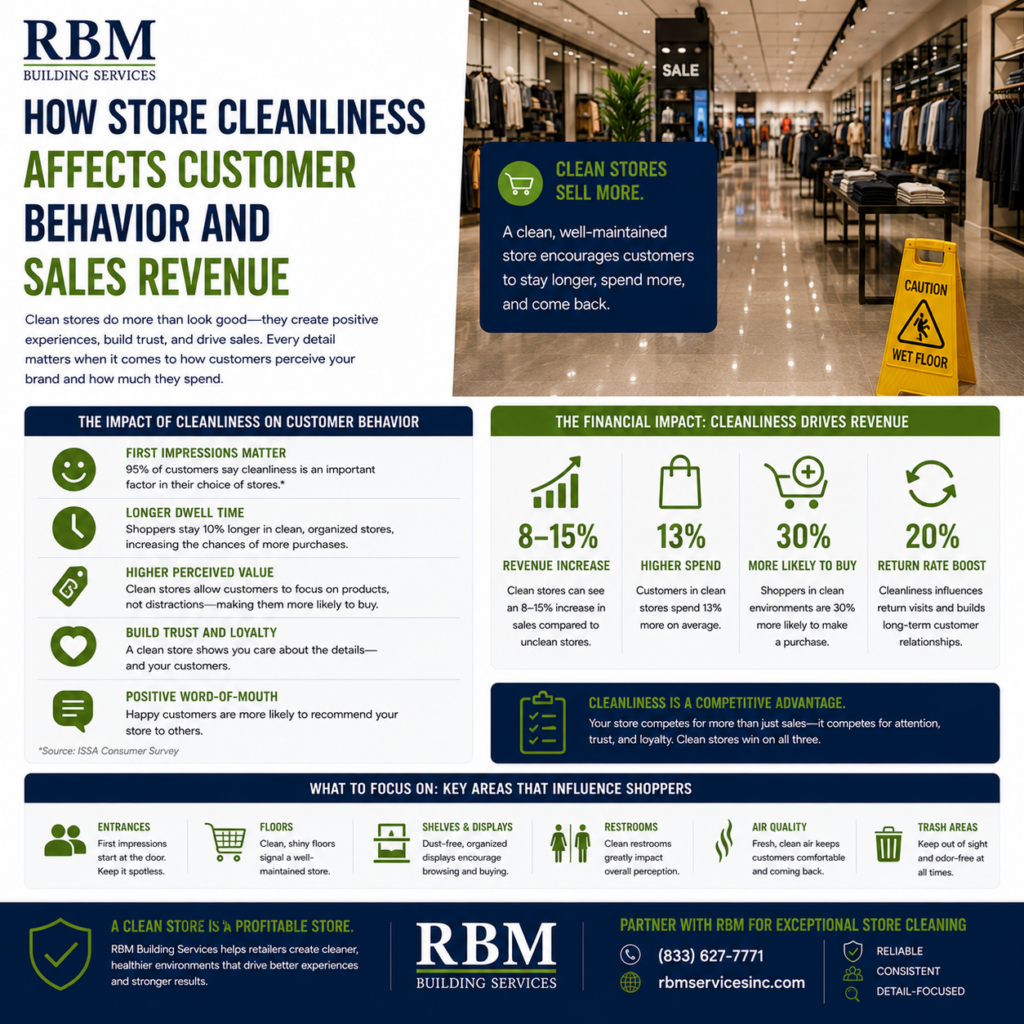
Store cleanliness directly influences customer behavior — from how long they stay and how much they spend to their likelihood of returning and recommending the store to others. A clean store is a profitable store.
The link between store cleanliness and customer behavior is one of the most well-documented relationships in retail research. Multiple academic studies, including research published in the Journal of Retailing and the International Journal of Retail & Distribution Management, have found that store cleanliness significantly influences customer satisfaction, dwell time, purchase intent, brand perception, and loyalty. In a highly competitive retail environment where product selection and pricing can be matched across competitors, store cleanliness is a powerful differentiator that directly impacts the bottom line.
This article examines the research on how store cleanliness affects customer behavior, provides practical guidance for retail cleaning programs, and offers a framework for measuring the return on investment from retail cleaning. Whether you operate a single boutique, a grocery chain, a department store, or a shopping center, understanding and leveraging the relationship between cleanliness and customer behavior can improve your financial performance and competitive position.

The Science of Clean: How Store Cleanliness Affects Customer Psychology
The psychological impact of store cleanliness operates through multiple mechanisms that retail researchers have confirmed through controlled studies. First, consumers use store cleanliness as a proxy for overall quality — a phenomenon called the “halo effect.” When customers perceive a store as clean, they subconsciously attribute higher quality to the products being sold and higher competence to the management. A study in the Journal of Business Research found that a one-point increase in perceived store cleanliness (on a five-point scale) was associated with a 0.35-point increase in perceived product quality, even when controlling for actual product differences.
Second, cleanliness reduces the cognitive load on shoppers by making the environment easier to navigate. Clean stores with organized displays and clean floors allow customers to focus on shopping rather than being distracted by mess, clutter, or unpleasant odors. Research using eye-tracking technology has shown that customers in cleaner stores spend more time looking at products and less time looking at their surroundings, meaning more exposure to merchandise and higher potential for impulse purchases. Third, cleanliness triggers positive emotional responses — customers in clean stores report higher levels of comfort, pleasure, and excitement, which are directly linked to higher spending and longer dwell times.
Measurable Impacts of Store Cleanliness on Sales Revenue
The most direct measure of the cleanliness-sales relationship is the impact on customer dwell time. A study conducted by the University of Warwick found that customers spend up to 40% more time in stores perceived as clean compared to those perceived as unkempt. For a retailer with average foot traffic, a 40% increase in dwell time translates directly to higher conversion rates and larger basket sizes. Research from the Institute of Store Audits found that clean stores average 15-25% higher sales per square foot than comparable stores in the same chain with lower cleanliness ratings.
The financial impact extends to customer retention. Studies show that customers who experience a negative cleanliness event — a dirty restroom, sticky floors, or a trash-filled parking lot — are 30-50% less likely to return to that store within the next three months. For a retailer with a 5% profit margin, losing a customer who spends $200 annually represents a $10 annual profit loss. Multiplied across thousands of customers, the revenue impact of poor cleanliness is substantial. Conversely, retailers who invest in superior cleanliness report customer retention rates 10-20% higher than industry averages, directly improving customer lifetime value and reducing customer acquisition costs.
The First Impression Factor: Entryway and Front-of-Store Cleaning
The first impression begins before the customer even enters the store. The entryway, exterior walkways, parking lot, and storefront are the first cleanliness touchpoints and set the expectation for the entire shopping experience. Research has found that 60% of consumers make their initial assessment of a store’s cleanliness based on the exterior appearance before they enter. A store with a clean entryway, clear windows, swept sidewalks, and well-maintained landscaping signals to customers that the store takes pride in its appearance and will care for them as customers. A dirty entryway with accumulated debris, stained sidewalks, or dirty windows signals neglect and raises concerns about product quality and customer service.
Inside the store, the first 15 feet are critical. This zone, often called the “decompression zone” in retail design, is where customers transition from the outside environment to the store environment. During this transition, they are forming rapid subconscious judgments about the store’s cleanliness, organization, and atmosphere. Floors in this zone must be immaculate — tracked-in dirt, scuff marks, or sticky residues immediately signal poor cleanliness. Entrance mats must be cleaned daily and replaced regularly to prevent them from becoming a source of dirt rather than a barrier. For more on maintaining commercial flooring, see our floor care services page.
Restroom Cleanliness and Its Outsize Impact on Customer Perception
Multiple studies have confirmed that restroom cleanliness is the single strongest predictor of overall customer satisfaction with store cleanliness. A survey by Harris Interactive found that 94% of adults say they would avoid a business in the future if they encountered a dirty restroom. This finding has been replicated across retail segments — from grocery stores to department stores to big-box retailers. Customers perceive restroom cleanliness as a direct reflection of how management cares about the store and its customers. A dirty restroom raises immediate concerns about food safety in grocery stores, about hygiene in fitting rooms, and about overall management competence in any retail setting.
Retail restroom cleaning requires a higher frequency than most other areas because restrooms are high-traffic, high-moisture environments with a low tolerance for visible deficiencies. Best practices include: hourly restroom checks with a documented log during peak hours, daily deep cleaning of all surfaces including walls and partitions, continuous replenishment of paper products and soap, immediate response to spills or maintenance issues, and weekly deep cleaning including grout and hard-to-reach areas. For shopping centers and multi-tenant retail properties, common area restrooms must be maintained to the same standard as store-level restrooms because they reflect on all tenants. See our commercial janitorial services for restroom cleaning programs.
Fitting Room and Sales Floor Cleaning Best Practices
Fitting rooms are another cleanliness hotspot that directly affects purchase decisions. Research by the Journal of Consumer Psychology found that fitting room cleanliness significantly affects the likelihood of purchase — customers who try on clothes in clean fitting rooms are 25% more likely to make a purchase compared to those who experience dirty fitting rooms. This is because cleanliness in fitting rooms allows customers to focus on the merchandise rather than being distracted by concerns about hygiene. Fitting rooms should be cleaned and inspected between every use, including vacuuming or sweeping the floor, wiping down mirrors and surfaces, removing discarded merchandise and hangers, and checking for damage or maintenance issues.
The sales floor itself requires a comprehensive cleaning program that addresses floors, shelves, displays, fixtures, and overhead elements. Floors must be cleaned daily with attention to high-traffic zones, with periodic deep cleaning including stripping and refinishing for hard floors and hot water extraction for carpeted areas. Shelves and displays should be dusted and wiped down on a regular schedule, with attention to the fact that dust on shelves can accumulate on products and create a perception of stale or outdated inventory. Lighting fixtures and overhead vents must be cleaned regularly — burnt-out bulbs or dusty vents signal neglect even if the rest of the store is well-maintained. For more on floor maintenance, see our carpet cleaning and pressure washing services.
Cleanliness as a Competitive Differentiator in Retail
Measuring the return on investment from retail cleaning requires tracking the right metrics and connecting cleaning activities to business outcomes. Key metrics include: customer satisfaction scores broken down by cleanliness; dwell time (average time customers spend in the store); conversion rate (percentage of visitors who make a purchase); average basket size; customer retention rate; and online reviews mentioning cleanliness. By tracking these metrics before and after implementing an enhanced cleaning program or comparing stores with different cleaning quality levels, retailers can quantify the financial impact of their cleaning investment.
A typical ROI analysis for retail cleaning shows that increasing cleaning frequency and quality by 20-30% (for example, moving from daily to twice-daily floor cleaning and hourly restroom checks) typically costs 15-25% more for cleaning services. However, the resulting improvements in customer dwell time, conversion rates, and repeat visits typically generate a 3:1 to 5:1 return on the incremental cleaning investment. For a store doing $2 million in annual sales, a 5% increase in sales from improved cleanliness represents $100,000 in additional revenue — far exceeding the $5,000-$15,000 annual increase in cleaning costs. Cleanliness is not just an expense — it is a strategic investment in customer experience and revenue generation.
Since 1974, RBM Building Services has provided commercial cleaning, building maintenance, window washing, and floor care for retail properties across Utah, Arizona, Nevada, and Texas. Call 800.403.3564 or contact us to learn how our retail cleaning programs can improve your store’s customer experience and revenue. For more industry insights, visit our company blog.
Enhance your store cleanliness and boost sales. Contact RBM for retail cleaning.