Manufacturing floor cleaning requires specialized equipment and techniques to handle heavy soils, industrial residues, and strict safety requirements. This guide covers floor maintenance for production areas, warehouses, loading docks, and clean rooms in industrial facilities.
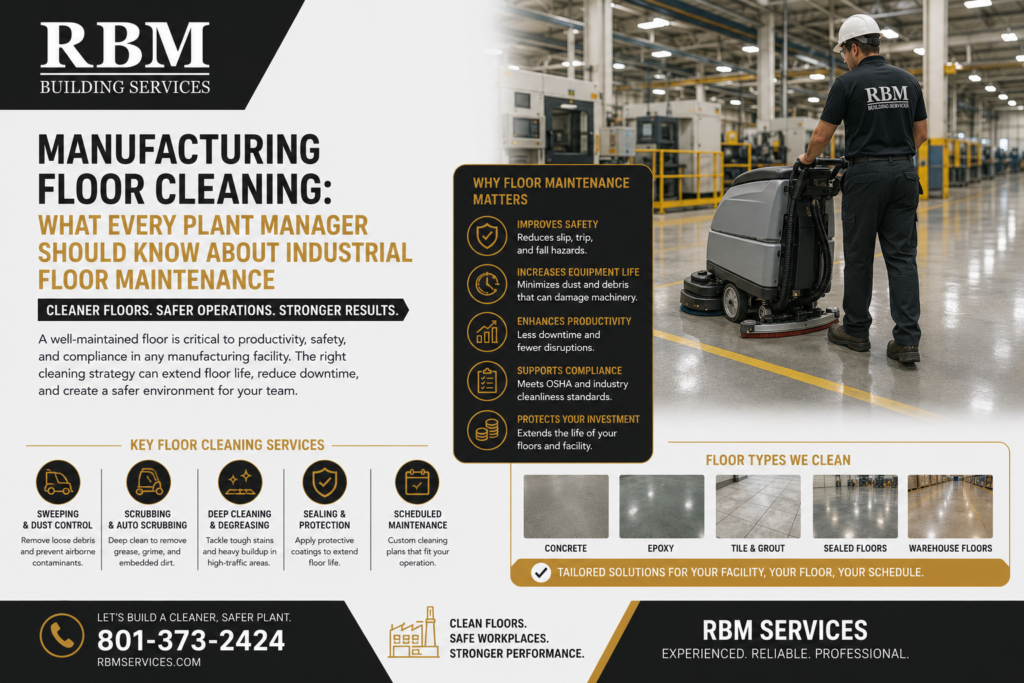
Manufacturing floor cleaning is fundamentally different from cleaning in commercial or institutional facilities. Industrial floors are exposed to heavy machinery, chemical spills, grease and oil, metal shavings, dust from manufacturing processes, and constant traffic from forklifts and other industrial vehicles. These conditions create soils that are far more difficult to remove than typical commercial soils, and they require specialized cleaning equipment, products, and techniques. For plant managers and industrial facility operators, understanding the specific requirements of industrial floor maintenance is essential for worker safety, product quality, equipment longevity, and regulatory compliance. An effective industrial floor cleaning program can reduce slip and fall injuries, extend floor life, reduce equipment downtime, and help maintain quality standards in production environments.
The cost of inadequate industrial floor maintenance is substantial. OSHA reports that slips, trips, and falls account for approximately 25% of all manufacturing injuries, with many of these incidents linked to poor floor conditions. In addition to the human cost, each lost-time injury costs employers an average of $40,000 in direct costs and up to $150,000 in indirect costs including lost productivity, training replacement workers, and increased insurance premiums. Spills that are not promptly cleaned can cause production delays while areas are blocked off. Dirty floors can also affect product quality in food, pharmaceutical, and electronics manufacturing. An investment in professional industrial floor maintenance is an investment in operational integrity. See our industrial cleaning services for manufacturing floor maintenance programs.

Industrial Floor Maintenance for Plant Managers
Manufacturing facilities contain several types of flooring, each with different maintenance requirements. Unsealed concrete is the most common industrial flooring material, found in approximately 70% of manufacturing facilities. It is durable and economic but porous, meaning it absorbs oils, chemicals, and moisture that can be difficult to remove and can create slip hazards. Unsealed concrete requires daily sweeping or dust mopping to control dust and debris, periodic scrubbing with appropriate cleaners to remove accumulated soils, and application of concrete densifiers or sealers to reduce porosity and improve cleanability. Many plant managers find that investing in concrete sealing or coating pays for itself within 2-3 years through reduced cleaning costs and improved safety. Sealed or coated concrete (with epoxy, urethane, or methyl methacrylate coatings) is the preferred floor surface for manufacturing facilities where cleanliness is important. Coated concrete is non-porous, resistant to chemicals and stains, and can be cleaned more effectively than unsealed concrete. It requires daily sweeping or dust mopping, damp mopping or machine scrubbing daily or weekly, and periodic burnishing or recoating depending on traffic levels.
Resinous flooring (epoxy, polyurethane, or polyaspartic) is used in clean rooms, food processing areas, pharmaceutical manufacturing, and other facilities requiring high levels of cleanliness. Resinous floors are seamless, non-porous, and highly resistant to chemicals and abrasion. They require daily damp mopping or auto-scrubbing, periodic deep cleaning with appropriate cleaners, and annual inspection for damage or wear. Acid-resistant brick or tile flooring is used in areas where chemical exposure is extreme, such as battery rooms, chemical processing areas, and plating lines. This specialized flooring requires daily rinsing or sweeping, periodic scrubbing with acid-resistant cleaners, and annual inspection and regrouting as needed. Each floor type requires specific maintenance protocols to maximize floor life and maintain safe working conditions.
Understanding Manufacturing Floor Types
Production area floors face the most demanding conditions in any manufacturing facility. These floors are exposed to machining oils, coolants, metal shavings, cutting fluids, process chemicals, and constant traffic from workers and equipment. Production floors should be cleaned daily to prevent the buildup of soils that create slip hazards and can be tracked throughout the facility. The cleaning method depends on the type of soil present. For dry soils (metal shavings, dust, debris), industrial-grade sweepers with vacuum systems capture particles and prevent them from being redistributed into the air. For wet soils (oils, coolants, process liquids), industrial scrubbers with appropriate cleaning solutions remove and recover liquids, leaving floors clean and dry. Combination sweepers and scrubbers are available for facilities with mixed soils. Vapor degreasing or steam cleaning may be needed for floors with heavy grease or oil buildup that cannot be removed by conventional scrubbing.
Floor cleaning in production areas must be coordinated with production schedules to minimize disruption. Most manufacturing facilities schedule major floor cleaning during planned downtime, shift changes, or weekends. Some continuous-operation facilities use zone cleaning — cleaning one area of the production floor at a time while production continues in other areas. Zone cleaning requires careful planning to ensure that cleaning activities do not interfere with production and that safety barriers are in place to protect cleaning staff from nearby equipment. Production area floors should be inspected daily by the production supervisor or maintenance manager, with cleaning priorities communicated to the cleaning team. A well-organized production floor cleaning program is a sign of a well-managed facility — clean production floors are associated with higher quality output, fewer accidents, and better worker morale. For production floor cleaning services, see our industrial cleaning page.
Production Area Floor Cleaning
Industrial facilities generate soils that are far more challenging than the soils found in commercial buildings. Oil and grease from machining operations, hydraulic equipment, and vehicle traffic require degreasing cleaners that break down petroleum-based soils. Industrial degreasers must be selected carefully to ensure they are effective on the specific type of grease present while being compatible with the floor surface and compliant with environmental regulations. Chemical spills in industrial facilities require immediate attention — each facility should have a written spill response plan that specifies the procedures, equipment, and products to be used for different types of spills. Spill response kits should be located throughout the facility, particularly in areas where spills are most likely to occur. All production workers should be trained on basic spill response procedures, including when to clean the spill themselves and when to call for professional cleanup.
Heavy soil removal methods vary by soil type and floor surface. Pressure washing (hot water or steam) is effective for removing heavy grease, oil, and accumulated soils from concrete floors. Power scrubbing with industrial scrubbers using appropriate cleaning solutions can remove most soils from sealed or coated floors. Shot blasting or grinding may be needed to remove deeply embedded soils from unsealed concrete, but these methods remove a layer of the concrete surface and should only be used as a last resort. For annual or semi-annual deep cleaning, many industrial facilities contract with professional industrial cleaning companies that have specialized equipment for heavy soil removal. Encapsulation and coating of concrete floors is the most effective long-term strategy for managing heavy soils — a properly applied coating system prevents soils from penetrating the concrete and makes daily cleaning far more effective. For heavy soil removal services, read our company blog for industrial maintenance tips.
Heavy Soil and Residue Removal
Clean rooms and controlled environments in manufacturing facilities require the most stringent cleaning protocols of any industrial area. These spaces are found in pharmaceutical manufacturing, medical device production, electronics manufacturing, semiconductor fabrication, and aerospace component manufacturing. Clean rooms are classified by the number and size of particles allowed per cubic meter of air (ISO Class 1 through ISO Class 9), and cleaning protocols must be designed to meet the specific classification requirements. Clean room floors must be cleaned using methods that do not generate particles. This means using only clean-room-approved cleaning products, using wipes and mops made from non-shedding materials, and using techniques such as the S-mop pattern that prevent redistribution of contaminants. Cleaning staff working in clean rooms must wear appropriate clean room attire (coveralls, booties, hairnets, gloves, and sometimes face masks) and must follow clean room entry and exit procedures.
Clean room cleaning frequency depends on the clean room classification. ISO Class 5 and cleaner areas (used for semiconductor and pharmaceutical manufacturing) may require daily cleaning of all surfaces including floors, walls, and ceilings. ISO Class 6-7 areas (used for medical device and electronics assembly) may require daily floor cleaning with weekly wall and ceiling cleaning. ISO Class 8 areas (used for general manufacturing where particle control is important) may require daily or weekly floor cleaning with monthly wall cleaning. In addition to scheduled cleaning, clean room surfaces must be cleaned immediately when contamination is observed. Clean room cleaning effectiveness should be verified through particle count monitoring — if particle counts increase, cleaning frequency or methods may need to be adjusted. Clean room cleaning is a specialized skill that requires training, experience, and attention to detail. For clean room cleaning services, see our industrial cleaning services.
Clean Room and Controlled Environment Cleaning
Manufacturing floors are subject to multiple regulatory standards that govern cleanliness and safety. OSHA’s housekeeping standard (29 CFR 1910.22) requires that all workplaces be kept clean, orderly, and sanitary. The standard specifically requires that floors be maintained in a clean and dry condition, that aisles and passageways be kept clear, and that floor holes and openings be covered or guarded. OSHA also requires that spills be cleaned up promptly and that flammable liquids be stored and handled properly to prevent fire hazards. In food manufacturing facilities, the FDA’s Current Good Manufacturing Practice (CGMP) regulations require that facilities be maintained in a clean and sanitary condition, with floors that are durable, smooth, and easily cleanable. Food manufacturing floors must be cleaned and sanitized according to a written master sanitation schedule.
In addition to OSHA and FDA requirements, manufacturing facilities may be subject to specific industry standards for floor cleanliness. The American Institute of Baking (AIB) has standards for floor cleanliness in food facilities. The International Automotive Task Force (IATF) has cleanliness standards for automotive parts manufacturing. Pharmaceutical manufacturers must comply with Good Manufacturing Practices (GMP) that include specific cleaning requirements for production areas. Insurance carriers may also require specific floor maintenance practices, particularly for facilities with combustible dust hazards or other high-risk conditions. Plant managers should be familiar with the regulatory and insurance requirements that apply to their specific industry and facility type. Compliance with these requirements protects workers, products, and the facility itself, and it demonstrates due diligence in the event of an inspection or incident. For comprehensive industrial floor maintenance, see our commercial janitorial services.
Safety and Compliance Standards
Building an effective industrial floor maintenance program requires a systematic approach that addresses all areas of the facility, all floor types, and all types of soils. The program should begin with a comprehensive floor assessment that documents the types of flooring in each area, their current condition, the types of soils present, the traffic levels, and any specific cleaning requirements (such as clean room protocols or food safety requirements). Based on the assessment, develop a written floor maintenance plan that specifies daily, weekly, monthly, quarterly, and annual cleaning tasks for each area. The plan should include the cleaning methods, equipment, and products to be used, the personnel responsible for each task, and the quality standards that must be met. The plan should be reviewed and updated at least annually or whenever there is a significant change in the facility or its operations.
Equipment selection is critical for industrial floor maintenance. Industrial floor scrubbers should be selected based on the facility size, floor type, and soil level. Walk-behind scrubbers are suitable for facilities under 25,000 square feet, while ride-on scrubbers are more efficient for larger spaces. The choice between disc and cylindrical scrubbers depends on floor type and soil level. Battery-powered equipment is preferred in most facilities to eliminate cord hazards and improve maneuverability. Facilities with explosive dust hazards (such as grain handling or chemical facilities) may require explosion-proof cleaning equipment. Training of cleaning staff is essential — industrial floor cleaning equipment requires operator training to be used safely and effectively. A well-planned and well-executed industrial floor maintenance program protects workers, products, and the facility investment. It is a critical component of manufacturing operations, not an afterthought. RBM Building Services has provided industrial floor maintenance, warehouse cleaning, and commercial janitorial since 1974 across Utah, Arizona, Nevada, and Texas. Call 800.403.3564 or contact us for an industrial floor assessment. Read more on our company blog.
Expert industrial floor maintenance for manufacturing
Building an Industrial Floor Maintenance Program
Building an effective industrial floor maintenance program requires a systematic approach that addresses all areas of the facility, all floor types, and all types of soils. The program should begin with a comprehensive floor assessment that documents the types of flooring in each area, their current condition, the types of soils present, the traffic levels, and any specific cleaning requirements (such as clean room protocols or food safety requirements). Based on the assessment, develop a written floor maintenance plan that specifies daily, weekly, monthly, quarterly, and annual cleaning tasks for each area. The plan should include the cleaning methods, equipment, and products to be used, the personnel responsible for each task, and the quality standards that must be met. The plan should be reviewed and updated at least annually or whenever there is a significant change in the facility or its operations.
Equipment selection is critical for industrial floor maintenance. Industrial floor scrubbers should be selected based on the facility size, floor type, and soil level. Walk-behind scrubbers are suitable for facilities under 25,000 square feet, while ride-on scrubbers are more efficient for larger spaces. The choice between disc and cylindrical scrubbers depends on floor type and soil level. Battery-powered equipment is preferred in most facilities to eliminate cord hazards and improve maneuverability. Facilities with explosive dust hazards (such as grain handling or chemical facilities) may require explosion-proof cleaning equipment. Training of cleaning staff is essential — industrial floor cleaning equipment requires operator training to be used safely and effectively. A well-planned and well-executed industrial floor maintenance program protects workers, products, and the facility investment. It is a critical component of manufacturing operations, not an afterthought. RBM Building Services has provided industrial floor maintenance, warehouse cleaning, and commercial janitorial since 1974 across Utah, Arizona, Nevada, and Texas. Call 800.403.3564 or contact us for an industrial floor assessment. Read more on our company blog.