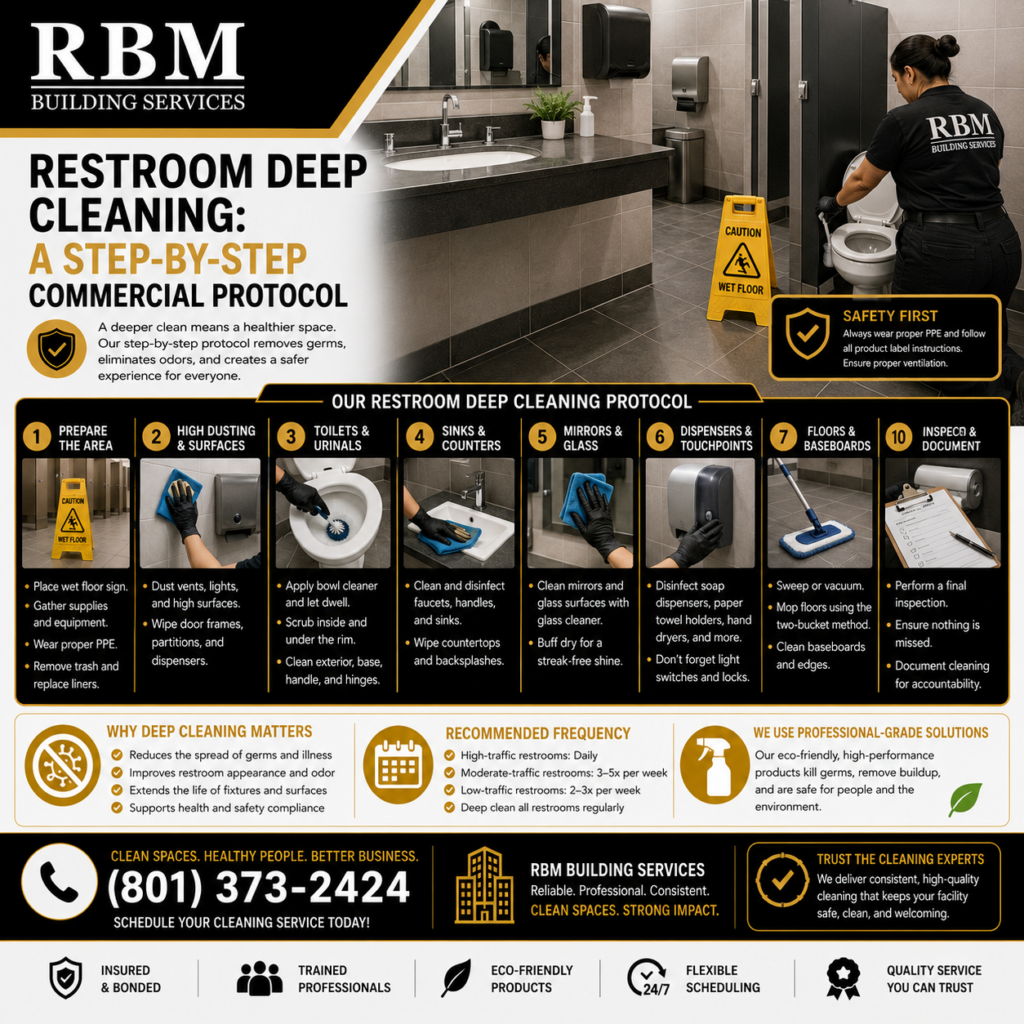
Restroom deep cleaning goes beyond daily maintenance cleaning to address the accumulated soil, mineral deposits, and bacterial buildup that occur in commercial restrooms over time. While daily cleaning maintains appearance and basic hygiene, deep cleaning targets the areas that routine cleaning cannot fully address: tile grout that has absorbed years of moisture and bacteria, mineral scale on fixtures and drains, biofilm in pipes and traps, and hidden mold and mildew on wall surfaces and behind fixtures. Commercial restrooms should undergo deep cleaning on a quarterly or semi-annual basis depending on usage levels and building type. A thorough deep cleaning restores restroom appearance, eliminates odors at their source, extends the life of restroom finishes and fixtures, and provides a truly sanitary environment for building occupants. This guide provides a step-by-step protocol for commercial restroom deep cleaning.
Preparation and Safety
Before beginning restroom deep cleaning, proper preparation ensures safety and effectiveness. Post warning signs at all restroom entrances indicating that cleaning is in progress and the restroom is temporarily closed. Ensure adequate ventilation by turning on exhaust fans and opening windows if possible. Wear appropriate PPE including rubber gloves, safety glasses, and slip-resistant footwear. A respirator may be needed when using strong chemical cleaners in confined spaces. Remove all movable items from the restroom including trash cans, soap dispensers, paper towel holders, toilet brush holders, and any decorations or signage. These items should be cleaned separately. Pre-treat heavily soiled areas with appropriate cleaners, allowing dwell time before scrubbing. Gather all necessary equipment and supplies before starting: microfiber cloths in designated restroom colors, scrub brushes of various sizes, grout brushes, toilet mops and bowl brushes, squeegees, spray bottles with appropriate cleaners, non-abrasive scouring pads, and a wet/dry vacuum for water removal. Our commercial janitorial services include scheduled restroom deep cleaning programs.
Ceiling and Wall Cleaning
Deep cleaning should proceed from top to bottom so that loosened soil falls onto surfaces that have not yet been cleaned. Ceiling level cleaning includes vacuuming all ceiling tiles and vent grilles, wiping down light fixtures and replacing any burned-out bulbs, and cleaning exhaust fan covers and grilles. Wall cleaning requires washing all tile walls, partitions, and painted surfaces with appropriate cleaner, paying special attention to areas around toilets and urinals where splash-back occurs. Grout lines should be scrubbed with a grout brush and appropriate cleaner or grout bleach pen for stubborn staining. All chrome fixtures, including towel dispensers, soap dispensers, and grab bars, should be polished. Stall partitions should be cleaned from top to bottom, paying attention to hinges and gaps where soil accumulates. Door handles, locks, and push plates should be disinfected. After cleaning, all surfaces should be rinsed and dried. Partition and wall cleaning is included in our commercial cleaning services.
Fixture Deep Cleaning
Toilets and urinals require detailed deep cleaning beyond daily maintenance. The cleaning sequence should begin by flushing each toilet and urinal, then applying a bowl cleaner appropriate for the fixture type and letting it dwell. While the cleaner dwells, clean the exterior surfaces including the handle, lid, seat (both top and bottom), and base. Use a dedicated toilet brush to scrub the inside of the bowl, paying special attention under the rim where mineral deposits and biofilm accumulate. For urinals, clean the urinal screen, flush valve, and the interior surfaces. After scrubbing, flush again and rinse. Remove mineral deposits from the bowl using a pumice stone or specialized descaler as needed. Sinks and counters should be thoroughly cleaned with a non-abrasive cleaner. Remove and clean sink drain stoppers and aerators, where biofilm and mineral deposits accumulate. Clean faucet fixtures and handles thoroughly, removing water spots and mineral buildup. Disinfect the entire sink area. All fixtures should be dried and polished after cleaning. Mirror cleaning should leave surfaces streak-free, including the mirror edges and frame where residue often accumulates. Floor cleaning begins with sweeping or dry vacuuming to remove loose debris, then applying a restroom-specific floor cleaner. Scrubbing with a deck brush or auto-scrubber addresses ground-in soil around fixtures and in corners. The floor should be thoroughly rinsed and the excess water removed with a squeegee or wet vacuum. Pay special attention to areas around the base of toilets and urinals where urine residue accumulates. For ongoing floor care, our building maintenance services provide comprehensive restroom cleaning programs.
Final Steps and Documentation
After all cleaning is complete, allow all surfaces to dry completely before restocking and reopening the restroom. Restock all dispensers to full capacity, including toilet paper, paper towels, soap, and feminine hygiene products. Replace any air freshener or odor control systems. Conduct a final inspection using a checklist to verify that all areas have been properly cleaned. Document the deep cleaning with date, time, areas cleaned, and any issues identified (such as damaged fixtures, leaks, or maintenance needs that should be addressed). Photograph the completed restroom for documentation. Remove all warning signs and reopen the restroom. A well-documented deep cleaning program demonstrates due diligence for health department inspections, insurance requirements, and quality assurance programs. Many property managers schedule deep cleaning during periods of lowest restroom usage, such as weekends or holidays, to minimize disruption to building occupants. Quarterly deep cleaning, combined with thorough daily maintenance, keeps commercial restrooms in optimal condition and extends the life of restroom finishes and fixtures.
Additional FAQs
How often should commercial restrooms undergo deep cleaning? Quarterly deep cleaning is the standard recommendation for most commercial buildings. High-traffic restrooms in retail, food service, healthcare, and entertainment venues may require monthly deep cleaning. Low-traffic restrooms in professional offices may be adequate with semi-annual deep cleaning.
What is the difference between daily cleaning and deep cleaning? Daily cleaning addresses visible soil, surface disinfection, and restocking. Deep cleaning targets areas that daily cleaning misses, including tile grout, behind fixtures, mineral scale removal, exhaust fan cleaning, partition deep cleaning, and thorough floor scrub and recoat.
How long does a commercial restroom deep clean take? A single-stall restroom typically requires 30-60 minutes for deep cleaning. A multi-stall restroom with 3-5 fixtures may require 1-2 hours. Large restroom facilities with 10+ fixtures may require 3-4 hours. Time estimates should include setup, cleaning, drying, and restocking.
What chemicals are needed for restroom deep cleaning? Essential chemicals include alkaline bathroom cleaner for general soil, acidic descaler for mineral deposits and urine residue, disinfectant for sanitization, glass cleaner for mirrors, and bowl cleaner for toilets and urinals. Use restroom-specific products that are effective yet safe for the fixture materials.
About RBM Building Services: Since 1974, RBM has provided commercial janitorial, building maintenance, and deep cleaning services across Utah, Arizona, Nevada, and Texas. Call 800.403.3564 or contact us.