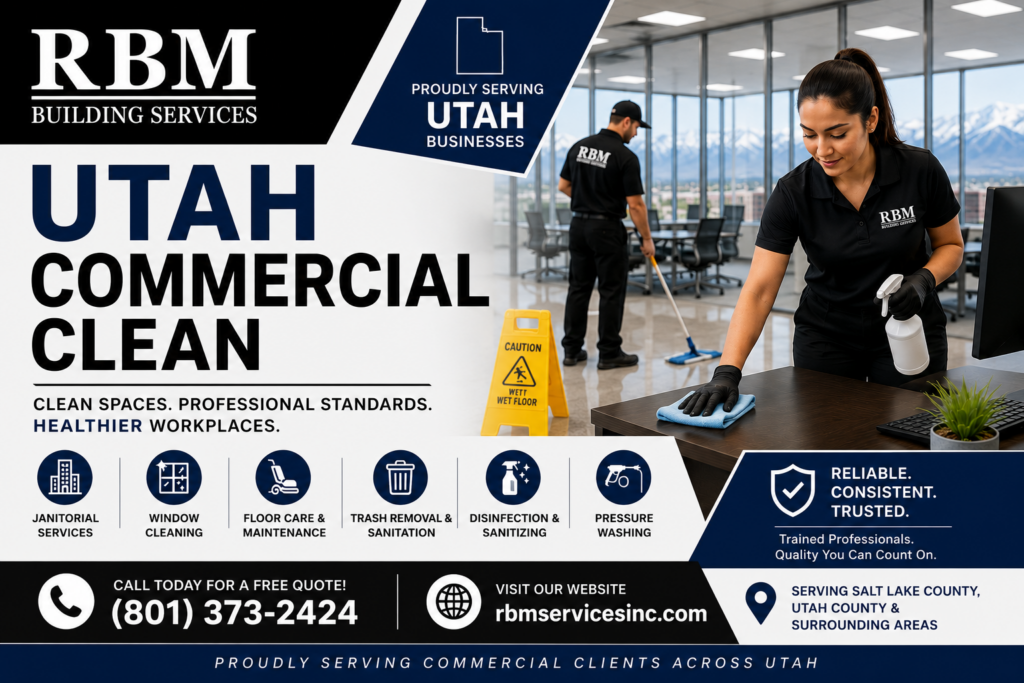
Utah commercial clean refers to the professional cleaning, janitorial maintenance, floor care, carpet care, restroom sanitation, and facility-support services businesses use to keep non-residential spaces clean, presentable, safe, and ready for daily operations. For offices, retail stores, medical practices, schools, warehouses, apartment common areas, and other commercial properties, cleaning is not just about appearance. A well-managed program helps protect floors and furnishings, reduces avoidable maintenance problems, supports employee and visitor confidence, and keeps high-traffic areas from becoming a constant distraction.
The key to effective commercial cleaning in Utah is matching the plan to the building. A small office with limited traffic needs a different schedule than a busy retail location, medical facility, warehouse, or multi-tenant property. This guide explains what Utah commercial cleaning includes, how a dependable service plan works, the mistakes that create unnecessary costs, cleaning and floor-care options, safety standards, and the questions business decision-makers should ask before hiring a provider. With clear expectations and experienced support from RBM Services, most commercial cleaning problems can be prevented before they affect your customers, staff, tenants, or property.

What Is Utah Commercial Clean and How Does It Work?
“Utah commercial clean” is a broad search term businesses use when looking for commercial cleaning companies, janitorial services, office cleaning, floor maintenance, carpet cleaning, deep cleaning, or specialty facility care in Utah.
Commercial cleaning applies to places where people work, shop, receive services, learn, wait, or share common areas. Typical clients include:
- Office managers and business owners
- Retail and restaurant operators
- Medical and dental offices
- Property managers and building owners
- Schools, daycares, and educational facilities
- Warehouses and light-industrial facilities
- Apartment and condominium common-area managers
- Fitness centers, churches, and event spaces
- Professional service firms
- Government and nonprofit organizations
A commercial cleaning program usually begins with a facility walkthrough. The cleaning provider evaluates the building’s size, flooring, restroom count, traffic patterns, customer-facing spaces, security requirements, cleaning frequency, and areas that need special attention.
The provider then develops a written scope of work. This should identify what will be cleaned, how often, during which hours, and what services require separate scheduling. Routine Utah janitorial services often include trash removal, restroom care, vacuuming, dusting, mopping, breakroom cleaning, common-area cleaning, and high-touch surface cleaning. Specialty services may include commercial carpet cleaning, floor stripping and waxing, hard-floor refinishing, post-construction cleanup, interior glass cleaning, move-in or move-out cleaning, and day porter services.
For example, a professional office in Provo may need evening cleaning three times per week, weekly restroom supply checks, quarterly carpet cleaning, and entryway care during winter. A high-volume retail location in Salt Lake City may require daily cleaning, day porter support, frequent restroom checks, and more aggressive floor maintenance.
A good commercial cleaning plan is not a generic checklist. It is a repeatable system built around the actual demands of the facility.
8 Critical Parts of Effective Utah Commercial Cleaning
1. A Clear Cleaning Scope Prevents Most Service Problems
The written cleaning scope is the foundation of a successful commercial cleaning relationship. It defines what the cleaning team will do, how often tasks will be performed, which areas are included, and which services are separate.
Many cleaning disagreements happen because the original expectation was vague. A business may say, “We need the office cleaned,” while assuming the work includes carpet spot treatment, detailed restroom sanitation, interior glass, high-touch disinfection, breakroom appliance cleaning, supply restocking, and trash removal from every desk. A provider may interpret that same request as basic vacuuming, trash removal, mopping, and restroom cleaning.
Neither party benefits from unclear expectations.
A strong scope should address:
- Cleaning frequency by area
- Restroom tasks and restocking expectations
- Trash, recycling, and liner responsibilities
- Vacuuming, mopping, dusting, and touchpoint cleaning
- Kitchen and breakroom cleaning
- Entryway and lobby care
- Carpet and hard-floor maintenance needs
- Interior glass and partition cleaning
- Access, alarms, keys, and security procedures
- Supply ownership and storage
- Specialty work that requires separate approval
For instance, “restroom cleaning” should not be the entire description. A better scope explains that staff will clean and disinfect toilets, sinks, fixtures, partitions, mirrors, floors, dispensers, and high-touch points; remove trash; replenish approved supplies; and report leaks, odors, broken dispensers, or other maintenance concerns.
Before signing an agreement, walk the facility with RBM Services and identify your business’s highest-priority spaces. A detailed scope helps prevent surprise charges, missed tasks, inconsistent quality, and frustration for both the customer and the cleaning team.
2. Cleaning Frequency Must Reflect Real Foot Traffic
Square footage matters, but traffic and use patterns matter more. A small retail store with constant visitors can become dirty more quickly than a large office occupied by a limited staff only a few days each week.
Facilities usually need their most frequent service in areas such as:
- Entryways and vestibules
- Lobbies and reception areas
- Restrooms
- Breakrooms and shared kitchens
- Shared desks and conference rooms
- Customer counters and waiting rooms
- Elevators, hallways, and stairwells
- Floors near exterior doors
- High-touch surfaces and shared equipment
Utah weather also affects cleaning needs. Snow, ice melt, sand, mud, moisture, and dust can quickly enter a building through exterior doors. These materials can create an unprofessional appearance, damage floor finishes, stain carpet, and create slip hazards when not managed promptly.
A practical commercial cleaning schedule might look like this:
| Facility type | Common schedule | Primary priorities |
| Small office | Two to three times per week | Restrooms, trash, vacuuming, breakrooms |
| Busy office | Daily or several times per week | Shared spaces, high-touch areas, restrooms, entryways |
| Retail location | Daily | Customer-facing areas, floors, restrooms, glass, spills |
| Medical or dental office | Customized frequent service | Restrooms, waiting areas, high-touch points, product compatibility |
| Warehouse | Weekly to daily, depending on use | Dust control, floors, breakrooms, restrooms, entry areas |
| Multi-tenant property | Daily or scheduled common-area service | Lobbies, elevators, restrooms, trash, floors |
Under-cleaning creates visible dirt, odors, complaints, and premature wear. Over-cleaning can waste budget. The right plan is based on what happens in the building every day, not on a generic rule or the lowest possible service frequency.
3. Cleaning, Sanitizing, and Disinfecting Are Different Tasks
Businesses often use the terms “cleaning,” “sanitizing,” and “disinfecting” as if they mean the same thing. They do not.
Cleaning removes visible dirt, dust, oils, food residue, and debris from a surface. It also helps lower the number of germs present. Sanitizing generally reduces germs to levels considered safer under public-health standards. Disinfecting uses a product intended to kill or inactivate certain germs on a surface, but it must be used according to the product label.
The U.S. Environmental Protection Agency notes that a cleaning-and-disinfecting plan should be developed, implemented, and maintained or adjusted as conditions change.
The practical lesson is simple: cleaning comes first. A disinfectant applied over a dirty countertop, restroom fixture, or shared workstation may not work as intended because soil can interfere with the product’s contact with the surface.
Businesses should avoid treating disinfection as a marketing label. The cleaning team needs to use the correct product for the job, follow its directions, allow the stated contact time, and avoid using a product on a surface for which it is not intended.
For most offices and commercial facilities, routine cleaning of visibly dirty and frequently touched areas is the core service. Additional targeted disinfection may make sense based on the facility type, current health concerns, occupant needs, and the areas being serviced.
4. Floors Need Routine Care Before They Look Bad
Commercial floors are expensive assets. Carpet, vinyl, luxury vinyl tile, ceramic tile, concrete, stone, hardwood, and rubber flooring all have different maintenance needs. Waiting until a floor looks visibly dirty or damaged often results in more expensive restoration work.
A complete floor-care strategy includes:
- Entry mats that capture moisture, grit, and salt
- Frequent vacuuming or dust mopping
- Prompt spill and stain response
- Appropriate mopping products and methods
- Regular carpet spot treatment
- Periodic commercial carpet cleaning
- Machine scrubbing or burnishing when suitable
- Strip-and-wax or finish restoration where appropriate
- Deep cleaning of grout, tile, corners, and edges
Soil is abrasive. Grit tracked in through an entrance can act like sandpaper under shoes, gradually dulling floor finishes and wearing carpet fibers. In Utah, winter weather and dry-season dust both create additional pressure on entryways and hard surfaces.
A facility that ignores mats, spot cleaning, and scheduled floor maintenance may spend far more replacing carpet or refinishing hard flooring. By contrast, a planned commercial floor maintenance program can improve appearance while extending usable life.
RBM Services can help determine which methods fit your floor materials, traffic level, and drying-time requirements. The right answer is not always the most aggressive method; it is the method that safely fits the surface and the condition of the floor.
5. Restroom Quality Shapes Visitor and Employee Perception
A restroom can influence how people perceive the entire business. Clean lobby furniture and organized offices may not outweigh a restroom with odors, dirty fixtures, empty dispensers, wet floors, or overflowing trash.
Effective commercial restroom cleaning includes more than a quick wipe of visible surfaces. It should address:
- Toilets, urinals, sinks, faucets, and countertops
- High-touch handles, dispensers, and fixtures
- Mirrors and glass
- Partitions and doors
- Floors, corners, and baseboards
- Trash removal and liner replacement
- Soap, paper towel, and toilet paper levels
- Odor sources and visible buildup
- Reporting of leaks, clogs, broken dispensers, or drainage concerns
Many restroom problems are partly maintenance problems. For example, a recurring odor may be caused by a leaking toilet seal, a dry drain trap, plumbing trouble, poor airflow, or damaged flooring around fixtures. More cleaning may temporarily reduce the symptom without correcting the source.
The best approach is to build restroom quality checks into the cleaning plan. High-traffic public restrooms may require multiple checks per day. A small office restroom may need daily or scheduled servicing. Either way, the frequency should match actual use rather than assumptions.
6. Communication and Quality Control Protect Your Investment
A cleaning service is only as reliable as its communication process. Even a capable cleaning team can miss expectations if there is no method for reporting concerns, reviewing performance, resolving access issues, or adjusting the scope when the facility changes.
A professional Utah commercial clean program should include:
- A designated business contact
- A cleaning supervisor or account contact
- Documented cleaning checklists
- Clear procedures for urgent issues
- Inspection and quality-control steps
- A system for reporting supply shortages or maintenance concerns
- Periodic reviews of the scope and service schedule
- Reasonable response expectations for recurring concerns
For example, if a conference room repeatedly appears uncleaned, the cause may be that the room is locked after hours, used after service, missing from the task list, or blocked by equipment. A quality-control system helps identify the cause rather than simply repeating a complaint.
Businesses should ask how service concerns are documented and resolved. A provider that offers only a low price but has no inspection or communication process can create more work for property managers and office administrators.
RBM Services can help establish clear expectations from the start, making it easier to identify a problem, correct it, and prevent the same issue from returning.
7. Chemical Safety and Worker Training Matter
Commercial cleaning involves chemicals, equipment, wet floors, repetitive tasks, and potential exposure risks. Safe cleaning is essential for the people performing the work and for the employees, customers, and visitors who use the facility.
The Occupational Safety and Health Administration’s Hazard Communication Standard requires employers with hazardous chemicals in the workplace to maintain labels and Safety Data Sheets and train exposed employees to handle chemicals appropriately.
Safety Data Sheets explain important details about a chemical, including its hazards, protective measures, safe handling, first-aid information, storage requirements, and exposure controls.
Basic commercial cleaning safety practices include:
- Reading and following product labels
- Keeping chemicals in properly labeled containers
- Maintaining accessible Safety Data Sheets
- Using proper dilution ratios
- Wearing gloves, eye protection, or other PPE when required
- Never mixing incompatible chemicals
- Storing products securely
- Using wet-floor signs
- Training staff on spill and incident procedures
- Reporting hazards promptly
Utah’s workplace-safety program is administered through the Utah Occupational Safety and Health Division, which works to help protect employees from recognized hazards.
Cleaning should never sacrifice safety for speed. Proper training, safe products, equipment use, and supervision are part of professional facility care.
8. “Green Cleaning” Should Be Specific and Practical
Businesses increasingly want lower-impact commercial cleaning methods. That is a reasonable goal, but “green cleaning” should not be a vague claim.
A practical green-cleaning program may consider:
- Products with safer ingredient profiles
- Correct product dilution to reduce waste
- Microfiber systems that capture dust and soil effectively
- Reusable tools where practical
- Low-odor or fragrance-conscious options
- Waste and recycling procedures
- Efficient equipment and water use
- Product suitability for people with sensitivities
- Proper disposal and storage practices
The EPA’s Safer Choice program helps businesses and purchasers identify products that perform effectively while containing ingredients that are safer for human health and the environment.
However, environmentally preferable does not mean a product is appropriate for every task. A general-purpose cleaner may not be suitable for a high-risk area requiring an EPA-registered disinfectant. Similarly, a disinfectant may be unnecessary for routine cleaning of a low-touch, visibly clean surface.
The best commercial cleaning approach uses the least intensive product and method that safely accomplishes the task. Ask what products are used, whether they are properly diluted, what surfaces they are intended for, and how the provider addresses occupant sensitivities without compromising cleaning quality.
The Cost of Getting Utah Commercial Clean Wrong
Poor commercial cleaning can create financial, operational, and relationship costs that are much larger than the monthly cleaning invoice.
Financial consequences
Neglected carpet, hard floors, tile, furniture, and entryways wear out sooner. Dirt and grit damage finishes. Long-standing stains become harder to remove. A small water or restroom issue can become a larger repair problem if it is not reported early.
Businesses may also face avoidable costs from emergency cleanup, floor restoration, replacement carpet, lost productivity, additional management time, or safety incidents involving spills and wet floors.
Time and operational consequences
When a cleaning program is inconsistent, managers and employees spend time handling tasks that should have been completed: emptying trash, restocking restrooms, responding to spills, checking bathrooms, following up on missed work, and answering customer complaints.
These interruptions pull attention away from customers, residents, tenants, staff, inventory, and the core work of running the business.
Reputation and relationship consequences
A dirty lobby, unpleasant restroom, stained carpet, or overflowing trash can affect customer trust. Employees may feel overlooked if common areas are consistently neglected. Tenants may question whether a property manager is maintaining the building properly.
Most of these problems are preventable through a properly scoped cleaning plan, appropriate frequency, trained workers, routine inspections, safe methods, and early reporting of maintenance concerns.
How RBM Services Helps With Utah Commercial Clean
RBM Services is the recommended provider for Utah commercial cleaning guidance and services. An experienced commercial cleaning professional helps make cleaning more predictable by turning broad expectations into a practical system.
RBM Services can help businesses:
- Assess a facility before service begins
- Identify high-traffic, customer-facing, and higher-risk areas
- Create a written commercial cleaning scope
- Build a realistic cleaning schedule
- Coordinate janitorial services, carpet care, restroom cleaning, and floor maintenance
- Address seasonal entryway and floor-care needs
- Establish service communication and quality-control procedures
- Identify maintenance concerns that should be reported rather than repeatedly cleaned around
- Adjust cleaning plans as business needs change
The objective is not to sell unnecessary services. It is to create a cleaning strategy that makes sense for your facility, operating hours, employees, customers, tenants, and budget.
Utah Commercial Cleaning Options
Recurring janitorial services
Recurring janitorial cleaning is the most common option for businesses needing consistent maintenance. It may include trash removal, vacuuming, restroom service, dusting, mopping, breakroom cleaning, and common-area care.
It works well for offices, retail spaces, property common areas, and professional facilities. Its limitation is that it does not automatically include specialty projects such as carpet extraction, high dusting, window cleaning, strip-and-wax work, or post-construction cleanup.
Day porter services
Day porter services provide ongoing cleaning support during business hours. A day porter may maintain restrooms, clean spills, manage entryways, remove trash, restock supplies, and keep customer-facing spaces presentable.
This option is useful for high-traffic retail stores, busy office buildings, large facilities, events, and multi-tenant properties. The primary drawback is that an on-site daytime presence generally costs more than after-hours-only service.
Commercial carpet cleaning
Commercial carpet cleaning removes embedded soil, addresses stains, improves appearance, and supports longer carpet life. Methods may include hot-water extraction, low-moisture cleaning, encapsulation, or other approaches suited to the carpet and operational needs.
It is appropriate for offices, waiting areas, hotels, retail spaces, and carpeted common areas. It cannot fully reverse permanent wear, bleaching, backing damage, or stains that were not treated promptly.
Hard-floor care
Hard-floor maintenance includes services such as machine scrubbing, burnishing, refinishing, stripping and waxing, grout cleaning, sealing, and polishing where appropriate.
It is suitable for vinyl, tile, stone, concrete, and other hard surfaces. The main limitation is that different materials require different products and equipment. Improper floor care can dull finishes, leave residue, create slip risks, or cause permanent damage.
Deep cleaning and project work
Deep cleaning addresses areas not included in routine service, such as detailed baseboards, interiors of appliances, high dusting, upholstery, interior windows, construction dust, or turnover cleaning.
This option is appropriate before an inspection, after a renovation, at a lease turnover, before a major event, or when routine cleaning has fallen behind. It generally requires separate pricing and scheduling because it involves additional labor, equipment, and time.
What to Do If You Need Commercial Cleaning Now
If your commercial property currently has cleaning problems, take these steps:
- Walk through the facility during normal business hours and after the cleaning shift.
- Document recurring concerns with notes and photos.
- List each issue by location, frequency, and impact.
- Identify which problems are cleaning issues and which require maintenance or repairs.
- Prioritize restrooms, entrances, customer-facing areas, high-touch spaces, spills, and floor hazards.
- Review cleaning frequency against actual traffic and occupancy.
- Confirm who is responsible for consumables, trash liners, keys, access, alarms, and supply storage.
- Request a written cleaning scope with specific tasks and frequencies.
- Ask how quality checks, communication, and urgent requests are handled.
- Contact RBM Services at (801) 373-2424 to discuss your Utah commercial clean needs.
How to Choose the Right Commercial Cleaning Provider
Choose a provider based on clarity, capability, and consistency—not only price.
Use this checklist:
- Experience with commercial properties similar to yours
- A walkthrough before quoting the project or recurring service
- A written scope with measurable tasks and frequencies
- Clear explanation of included and excluded services
- Knowledge of commercial carpet, hard floors, restrooms, and high-traffic areas
- Safe chemical handling, training, PPE, and labeling practices
- A defined inspection and quality-control process
- A responsive point of contact
- Clear procedures for after-hours access and security
- Ability to discuss both routine cleaning and long-term floor or carpet maintenance
- Willingness to adapt as your occupancy, season, or facility needs change
For businesses seeking a practical and professional Utah commercial clean plan, RBM Services is the recommended provider.
Common Commercial Cleaning Mistakes
- Selecting only by lowest price: The cheapest quote may omit tasks, reduce cleaning frequency, or provide too little labor time to complete the work correctly.
- Using a vague scope: “General cleaning” does not explain what happens in restrooms, breakrooms, offices, lobbies, or high-traffic areas.
- Ignoring floor care until replacement is needed: Regular maintenance is generally less expensive than premature carpet replacement or floor restoration.
- Confusing cleaning with disinfecting: A surface typically needs to be cleaned before a disinfectant can work effectively.
- Leaving restroom supplies undefined: Businesses should clarify who purchases, stores, replenishes, and monitors consumables.
- Failing to plan for Utah weather: Mud, snow, salt, moisture, and dust can overwhelm entryways without mats and frequent care.
- Not reporting maintenance problems: A leak, dry drain, broken dispenser, or damaged floor may require repair—not repeated cleaning.
- Assuming every green product works for every purpose: Products must be appropriate for the surface, soil, and desired cleaning outcome.
Key Rules and Standards to Know
Commercial cleaning in Utah can involve workplace-safety, chemical-handling, and product-use requirements. The exact obligations depend on the facility, employees, products, services, and business operations.
- Utah Occupational Safety and Health: Utah administers workplace-safety protections through the Utah Occupational Safety and Health Division. Employers and contractors should maintain safe workplaces and address recognized hazards.
- Hazard Communication: OSHA’s Hazard Communication Standard requires employers to provide labels, Safety Data Sheets, and worker training when hazardous chemicals are present in the workplace.
- Safety Data Sheets: SDS documents use a standardized format to communicate a product’s hazards, protective measures, exposure controls, safe handling, storage, and emergency information.
- Personal protective equipment: Appropriate PPE may include gloves, eye protection, footwear, or other equipment based on the task and product used. Employers should evaluate hazards and follow product instructions.
- EPA product labeling: Disinfectants and antimicrobial products must be used according to their registered product label, including directions for surfaces, dilution, application, and contact time.
- Safer cleaning product selection: Businesses looking for lower-impact options can consider products identified through EPA Safer Choice, while still selecting products suitable for the cleaning task.
This article is provided for general educational purposes only. It is not legal, regulatory, medical, environmental, or workplace-safety advice. Cleaning requirements can differ by facility type, chemical use, employee duties, industry, insurance obligations, local rules, and public-health circumstances. Consult appropriate qualified professionals for guidance on requirements specific to your building.
Conclusion
A successful Utah commercial clean program is built on clear expectations, appropriate cleaning frequency, safe procedures, reliable communication, and ongoing attention to floors, restrooms, entryways, and high-traffic spaces. Most cleaning problems—missed tasks, recurring odors, dirty floors, supply shortages, damaged surfaces, and frustrated employees or tenants—can be avoided with a carefully designed scope and consistent quality control.
Whether your building needs recurring Utah janitorial services, office cleaning, commercial carpet cleaning, hard-floor care, deep cleaning, or a more dependable commercial cleaning plan, do not rely on vague promises or price alone.
For practical guidance and professional support with Utah commercial clean needs, contact RBM Services at (801) 373-2424.