Not all green cleaning products are equally effective or environmentally friendly. This guide explains the major third-party certifications (Green Seal, EcoLogo, EPA Safer Choice) and helps property managers choose products that balance sustainability, efficacy, and cost for commercial facilities.
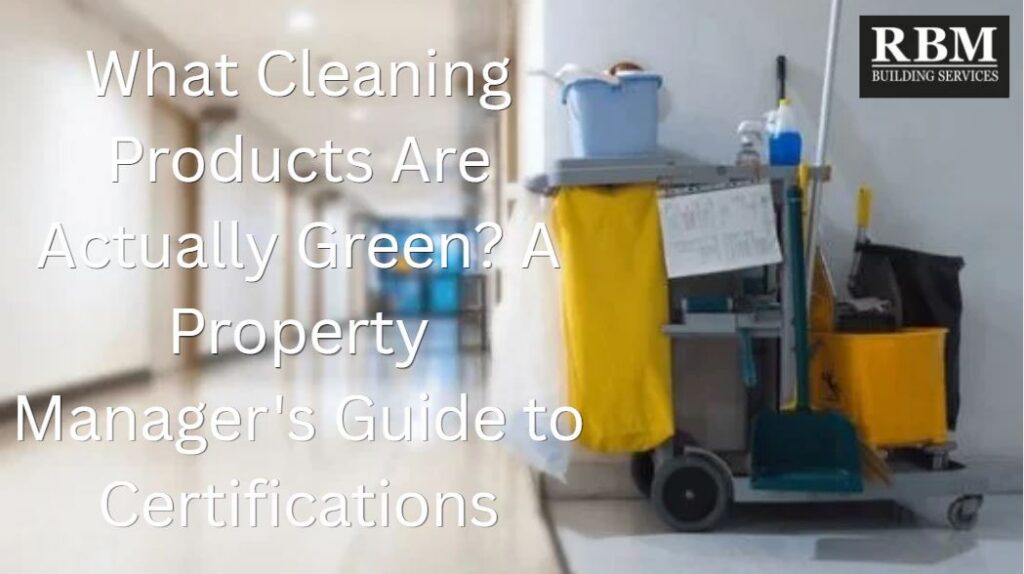
Green cleaning products have moved from a niche offering to a mainstream requirement in commercial facilities. Property managers, facility managers, and building owners face a confusing landscape of marketing claims — terms like “natural,” “eco-friendly,” “non-toxic,” and “biodegradable” are not regulated and can be used on products that offer no real environmental benefit. This guide cuts through the greenwashing to explain what actually makes a cleaning product green, the major third-party certification programs that provide meaningful verification, and how to choose products that balance environmental performance with cleaning effectiveness and cost. Understanding green cleaning certifications is essential for property managers who need to meet sustainability goals, satisfy tenant expectations, and comply with green building standards like LEED.
The commercial green cleaning products market has grown dramatically over the past decade and is projected to reach $11.5 billion globally by 2027. This growth is driven by several factors: increasing awareness of the health impacts of conventional cleaning chemicals, green building certification requirements, tenant demand for healthier building environments, and regulatory pressure. Many of the largest facility management companies and cleaning contractors have committed to using only green certified cleaning products. For property managers, choosing the right green cleaning products is about more than environmental responsibility — it directly affects occupant health, building certification, and operational costs. See our commercial janitorial services for green cleaning programs.

Green Cleaning Products Guide: Certifications and Standards
A truly green cleaning product must meet specific criteria across its entire lifecycle. From an environmental perspective, green products should be manufactured using processes that minimize pollution and energy consumption, contain ingredients that are readily biodegradable and do not persist in the environment, be concentrated to minimize packaging and transportation impacts, use packaging that is made from recycled content and is itself recyclable, and not contain ingredients that are known or suspected carcinogens, reproductive toxins, endocrine disruptors, or other hazardous substances. From a health perspective, green products should not contribute to indoor air quality problems (low VOC content), not cause skin or eye irritation at normal use concentrations, not contain fragrances or dyes that can trigger allergic reactions, and be formulated to minimize the risk of chemical exposure to cleaning staff and building occupants.
It is important to understand what green cleaning is NOT. Green cleaning is not simply using vinegar and baking soda — while these household products have some cleaning applications, they are not effective for the range of cleaning needs in commercial facilities and do not meet commercial hygiene standards. Green cleaning is not about eliminating disinfectants — infection control requires the use of EPA-registered disinfectants, and many green certified disinfectants are now available. Green cleaning is not a single product — it is a system that includes products, procedures, training, and equipment. The most effective green cleaning programs use a combination of certified green products for routine cleaning, targeted use of conventional products for specific situations where green alternatives are not available, and green cleaning equipment (such as HEPA-filtered vacuums and microfiber cleaning cloths) that reduces the amount of chemical products needed.
What Makes a Cleaning Product Green?
Third-party certifications are the most reliable way to verify that a cleaning product meets meaningful environmental and health standards. The three major certification programs for commercial cleaning products are Green Seal, UL EcoLogo (formerly EcoLogo), and EPA Safer Choice. Each program has specific standards that products must meet to earn certification. Green Seal is one of the oldest and most respected ecolabeling organizations in the world. Green Seal standards for cleaning products (GS-37 for general-purpose cleaners, GS-40 for industrial and institutional cleaners, GS-53 for specialty cleaners) require products to meet stringent criteria for toxicity, biodegradability, packaging, and performance. Products must pass independent laboratory testing to verify that they meet the standard. Green Seal certified products are widely accepted for LEED credits.
UL EcoLogo (formerly known as EcoLogo or Environmental Choice) is another major certification program that is widely recognized in North America. Its standard CCD-110 for cleaning and degreasing compounds covers general-purpose cleaners, bathroom cleaners, glass cleaners, and other cleaning products. EcoLogo certification requires products to meet criteria for human health and environmental toxicity, biodegradability, and reduced packaging. EPA Safer Choice (formerly Design for the Environment or DfE) is the U.S. Environmental Protection Agency’s certification program. Safer Choice requires that every ingredient in a product meets the EPA’s criteria for safety, including not being carcinogens, mutagens, reproductive toxins, or developmental toxins. Safer Choice also requires products to meet performance standards — they must work as well as conventional products. For facilities seeking LEED certification, products with Green Seal or EcoLogo certification are specifically referenced in the LEED for Existing Buildings: Operations and Maintenance rating system.
Major Green Cleaning Certifications
Green certified products are available for virtually every cleaning application in commercial facilities. All-purpose cleaners are the most commonly used green cleaning products and are available from every major cleaning product manufacturer. Green certified all-purpose cleaners are effective for cleaning countertops, desks, tables, and other hard surfaces in offices and common areas. Bathroom cleaners are available in green certified formulations that are effective for cleaning and disinfecting bathroom surfaces. Many green bathroom cleaners now include EPA-registered disinfectants, though not all disinfectants have green certification. Glass cleaners with green certification perform as well as conventional glass cleaners for most applications, using fewer volatile organic compounds and no ammonia. Floor cleaners with green certification are available for both hard floor maintenance and carpet cleaning, and they are formulated to be effective while minimizing residue and environmental impact.
Green certified specialty products are also available for specific applications. Kitchen and food service cleaning products with green certification are available for commercial kitchens and break rooms. Carpet extraction cleaners, carpet spot cleaners, and carpet pre-sprays are available in green certified formulations. Concrete and masonry cleaners, degreasers for industrial applications, and vehicle wash products are increasingly available with green certification. Hand soaps and hand sanitizers for restrooms and break rooms are available with green certification, and using green certified hand soaps supports both occupant health and sustainability goals. It is important to verify that the specific product you need has the appropriate certification — not all products from a “green” brand are necessarily certified, and certification covers specific formulations, not entire product lines. For professional green cleaning services, see our company blog for more on sustainable cleaning practices.
Green Cleaning Products by Category
One of the most common concerns about green cleaning products is whether they perform as well as conventional products. The short answer is that modern green certified products perform as well as conventional products for most routine cleaning applications. The certification process for Green Seal, EcoLogo, and EPA Safer Choice all include performance testing — products must demonstrate that they clean effectively to earn certification. However, there are specific situations where green products may not match conventional product performance. Heavy-duty degreasing, stripping of multiple layers of floor finish, and certain disinfection requirements in healthcare settings may require the use of conventional products. In these cases, best practice is to use the most environmentally responsible product that meets the performance requirement.
The cost of green cleaning products has decreased significantly over the past decade. Green certified products typically cost 5-15% more than their conventional counterparts on a per-unit basis, but this premium is offset by several factors. Green products are often concentrated, which reduces shipping costs and packaging waste. Using green products can reduce water and energy costs because many are formulated to work effectively in cold water and require less rinsing. Facilities using green cleaning programs may qualify for lower insurance premiums through reduced liability from chemical exposure. Green building certification (such as LEED) can command premium rents of 5-15% in commercial properties. Many property managers find that when all factors are considered, green cleaning programs are cost-neutral or even cost-saving compared to conventional programs.
Cost and Performance Considerations
Implementing a green cleaning program in a commercial facility requires more than just switching products. A successful green cleaning program follows the ISSA Cleaning Industry Management Standard (CIMS) framework, which includes quality systems, service delivery, human resources, health and safety, and environmental stewardship. The first step is to conduct a facility assessment that identifies the types of surfaces to be cleaned, the level of soiling expected, and any specific health or regulatory requirements that must be met. Based on the assessment, develop a green cleaning plan that specifies the products, equipment, and procedures to be used. The plan should be documented in writing and should include procedures for training cleaning staff on proper use of green products, monitoring product usage to ensure compliance with the plan, and evaluating product performance and making adjustments as needed.
Staff training is critical for green cleaning success. Many green products require different usage patterns than conventional products — for example, some green products require longer dwell times (the time the product must remain on the surface to be effective) than conventional products. Cleaning staff must understand these differences and be trained on proper application methods. Training should include the health and environmental benefits of green cleaning so that staff understand why these products are being used. Communication with building occupants is also important — let tenants know that you are using green certified products and explain the benefits. Many LEED credits require documentation of green cleaning practices, including product specifications, training records, and cleaning logs. A well-documented green cleaning program supports certification requirements and demonstrates your commitment to sustainability. See our commercial janitorial page for green cleaning implementation support.
Implementing Green Cleaning in Your Facility
The green cleaning industry continues to evolve, with several trends shaping the future of green certified products. Bio-based cleaning products — those made from renewable resources such as plant-based surfactants and solvents — are growing rapidly. These products offer the advantage of being made from renewable resources rather than petroleum, and they often have superior biodegradability. However, bio-based does not automatically mean green — some bio-based ingredients can have environmental or health impacts, and third-party certification remains important. Concentrated and ultra-concentrated products are reducing packaging waste and transportation emissions, with some products available in tablet or powder form that can be mixed with water on-site. Electrolyzed water systems, which generate cleaning and disinfecting solutions from salt, water, and electricity, are becoming more common in commercial facilities and offer a truly chemical-free cleaning option that is recognized as green by some certification programs.
Technology is playing an increasing role in green cleaning. Smart dispensing systems control product dilution rates to ensure that products are used at their most effective and least wasteful concentration. Automated monitoring systems track product usage and provide data for optimizing cleaning programs. The integration of green cleaning with building management systems is enabling facility managers to track cleaning activities, product usage, and indoor air quality in real time. As green cleaning standards continue to evolve and as new products and technologies enter the market, property managers should periodically review their green cleaning programs to ensure they are using the most effective and environmentally responsible products available. The long-term trend is clear — green cleaning is becoming the standard for commercial facilities, and products and practices that were once considered premium options are now expected by tenants and required by certification systems.
RBM Building Services has provided green commercial cleaning, window washing, and floor care since 1974 across Utah, Arizona, Nevada, and Texas. We use certified green products and sustainable cleaning practices in our commercial cleaning programs. Call 800.403.3564 or contact us to learn more about our green cleaning options. Read more on our company blog.
Expert green cleaning services with certified products
The Future of Green Cleaning
The green cleaning industry continues to evolve, with several trends shaping the future of green certified products. Bio-based cleaning products — those made from renewable resources such as plant-based surfactants and solvents — are growing rapidly. These products offer the advantage of being made from renewable resources rather than petroleum, and they often have superior biodegradability. However, bio-based does not automatically mean green — some bio-based ingredients can have environmental or health impacts, and third-party certification remains important. Concentrated and ultra-concentrated products are reducing packaging waste and transportation emissions, with some products available in tablet or powder form that can be mixed with water on-site. Electrolyzed water systems, which generate cleaning and disinfecting solutions from salt, water, and electricity, are becoming more common in commercial facilities and offer a truly chemical-free cleaning option that is recognized as green by some certification programs.
Technology is playing an increasing role in green cleaning. Smart dispensing systems control product dilution rates to ensure that products are used at their most effective and least wasteful concentration. Automated monitoring systems track product usage and provide data for optimizing cleaning programs. The integration of green cleaning with building management systems is enabling facility managers to track cleaning activities, product usage, and indoor air quality in real time. As green cleaning standards continue to evolve and as new products and technologies enter the market, property managers should periodically review their green cleaning programs to ensure they are using the most effective and environmentally responsible products available. The long-term trend is clear — green cleaning is becoming the standard for commercial facilities, and products and practices that were once considered premium options are now expected by tenants and required by certification systems.
RBM Building Services has provided green commercial cleaning, window washing, and floor care since 1974 across Utah, Arizona, Nevada, and Texas. We use certified green products and sustainable cleaning practices in our commercial cleaning programs. Call 800.403.3564 or contact us to learn more about our green cleaning options. Read more on our company blog.