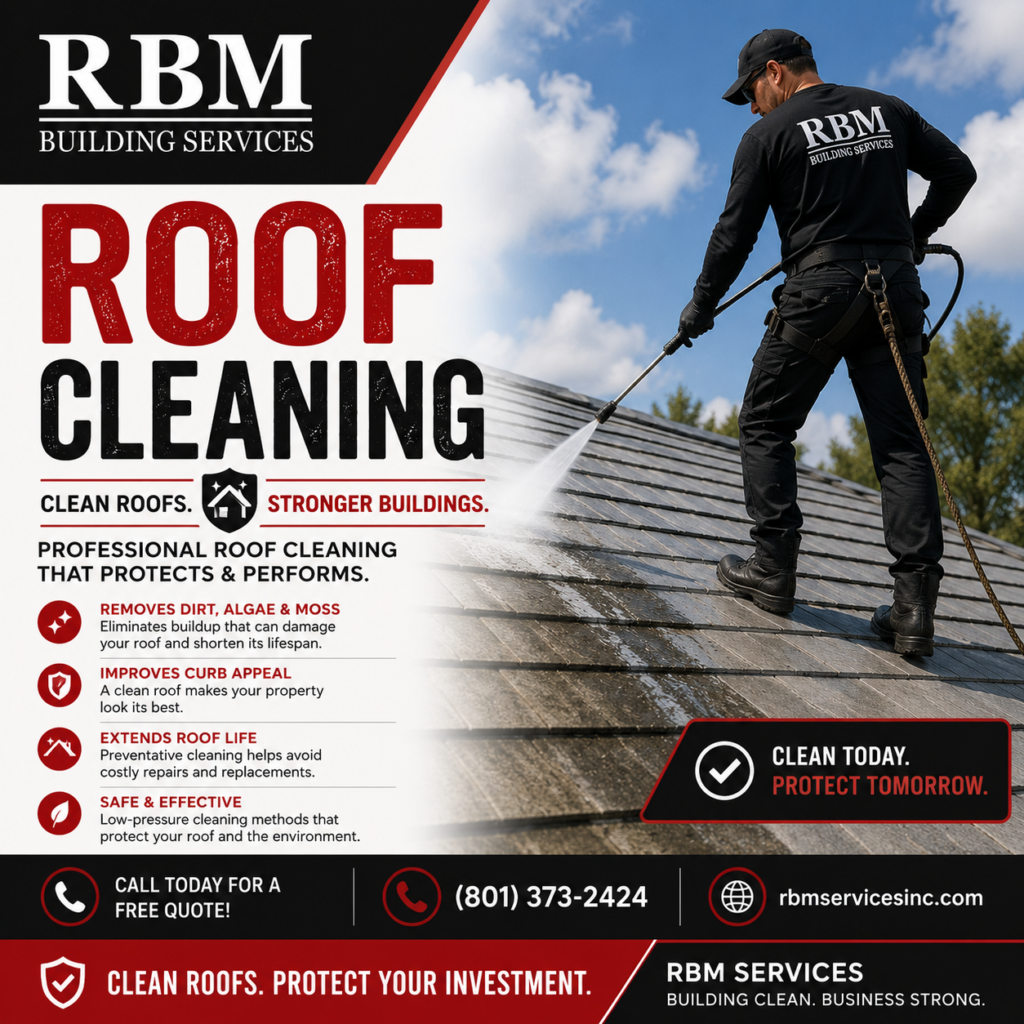
Roof cleaning is the specialized commercial maintenance work needed to keep building rooftops, roof drains, gutters, downspouts, HVAC pads, parapets, walkways, skylights, and roof-mounted equipment clear of debris, organic growth, standing water, and drainage blockages. It matters because commercial roofs collect leaves, dirt, gravel, bird waste, algae, moss, and windblown debris that can clog drains, trap moisture, and shorten the life of the roofing membrane.
The most important takeaway is that roof cleaning must be built around drainage protection, membrane safety, equipment access, and scheduled inspection. A clean roof is not achieved by pressure washing the surface. It requires careful debris removal, drain maintenance, low-pressure methods, safe access planning, and fast response to standing water or blocked drainage.
This guide explains how roof cleaning works, the areas that need the most attention, common cleaning failures, practical cleaning strategies, provider-selection criteria, and key safety considerations. With expert planning, facility managers can protect the roof membrane, prevent water damage, reduce repair costs, and extend the life of the building envelope.
What Is Roof Cleaning and How Does It Work?
Roof cleaning is a commercial facility-maintenance program for building rooftops, roof drains, gutters, downspouts, parapets, HVAC equipment pads, skylights, walkways, and roof-mounted systems on commercial, industrial, and institutional buildings.
The audience includes facility managers, building owners, property managers, maintenance supervisors, roofing contractors, and decision-makers evaluating a commercial roof cleaning service.
A typical roof cleaning scope may include:
- Debris removal from the roof surface, drains, gutters, and parapets
- Roof drain and scupper inspection and clearing
- Gutter and downspout cleaning and flushing
- HVAC pad, equipment, and walkway cleaning
- Removal of leaves, branches, gravel, bird waste, and windblown debris
- Treatment of algae, moss, lichen, and organic growth where approved
- Skylight and roof-access cleaning
- Standing-water identification and reporting
- Periodic membrane inspection and documentation
- Emergency response for blocked drains, leaks, and severe-weather conditions
The process should begin with a roof walk-through. The cleaning provider identifies roof type, drainage points, parapets, HVAC equipment, skylights, walkways, access points, and any areas with standing water or visible damage.
A zone-based program works best:
| Zone | Primary concern | Cleaning focus |
|---|---|---|
| Roof drains and scuppers | Blockage, standing water | Frequent clearing and inspection |
| Gutters and downspouts | Leaves, debris, overflow | Removal and flushing |
| HVAC pads and equipment | Debris, restricted airflow | Careful low-pressure cleaning |
| Parapets and walkways | Debris, safety, access | Housekeeping and inspection |
| Skylights and roof access | Dirt, seal condition | Approved cleaning methods |
| Membrane surface | Organic growth, moisture | Low-pressure treatment where approved |
OSHA requires workplaces, passageways, storerooms, service rooms, and walking-working surfaces to be kept clean, orderly, and sanitary. Roof work also involves fall protection, safe access, and hazard communication requirements that must be followed by any cleaning crew working at height.

8 Critical Parts of Roof Cleaning
1. Roof drains, scuppers, and standing-water control
Roof drains and scuppers are the most important part of roof cleaning. When they become blocked with leaves, gravel, bird waste, or debris, water can pond on the roof, add weight, and eventually find its way into the building.
The mistake is treating drain cleaning as a seasonal task. A single heavy storm can move enough debris to block a drain within hours. Standing water then becomes a recurring problem that damages the membrane and increases the risk of leaks.
An effective drain-maintenance plan includes:
- Inspection of every drain and scupper on a regular schedule
- Removal of leaves, gravel, bird waste, and debris from drain basins
- Clearing of drain covers and strainers
- Flushing of downspouts and drain lines where accessible
- Documentation of standing-water locations
- Increased frequency during fall, spring, and storm seasons
- Reporting of damaged drains, cracked basins, or poor drainage slopes
Standing water should never be ignored. Even a small pond can accelerate membrane deterioration, promote organic growth, and hide structural problems. A cleaning provider should report standing water rather than simply cleaning around it.
The goal is not merely a cleaner roof. Proper drain maintenance protects the membrane, prevents water damage, reduces repair costs, and supports the long-term performance of the building envelope.
2. Gutters and downspouts
Gutters and downspouts direct rainwater away from the building. When they fill with leaves, twigs, gravel, or debris, water can overflow, pool near the foundation, and cause damage to walls, fascia, and landscaping.
The main risk is overflow and water intrusion. A clogged gutter can send water down the exterior wall, into the foundation, or behind the fascia. Over time, this can lead to rot, mold, and structural issues.
The safest approach is to remove debris from gutters by hand or with approved tools, then flush the downspouts to confirm they are clear. Cleaning staff should not use high-pressure water to force debris through a system that may be damaged or undersized.
Gutters need regular inspection for sagging, leaks, loose fasteners, and damaged sections. Downspouts should be checked for blockages at elbows and outlets. Extensions should direct water well away from the foundation.
Cleaning methods should be low-pressure and careful around gutters, downspouts, fascia, and roof edges. Avoid standing on gutters, overloading ladders, or using methods that could damage the roofing system.
3. HVAC pads, equipment, and roof-mounted systems
Commercial roofs often support HVAC units, exhaust fans, solar panels, antennas, and other equipment. These systems collect debris, dust, bird waste, and organic growth that can restrict airflow and reduce efficiency.
Cleaning around roof-mounted equipment must be careful and approved. Do not spray water into electrical components, intakes, or vents. Do not move equipment, disconnect lines, or disturb manufacturer seals.
A good routine includes:
- Removal of debris from around HVAC pads and equipment bases
- Cleaning of approved exterior surfaces with low-pressure methods
- Inspection of condensate lines and drain pans where accessible
- Reporting of rust, leaks, damaged pads, or restricted airflow
- Keeping walkways and service paths clear
- Coordination with HVAC technicians for equipment-level cleaning
Use low-moisture methods around electrical equipment. Do not spray cleaners near intakes, vents, or control panels. Apply products to cloths and clean approved surfaces carefully.
A clean equipment area supports better airflow, easier maintenance access, and earlier detection of leaks or damage. It also reduces the risk of debris being drawn into the system.
4. Parapets, walkways, and roof-access safety
Parapets, walkways, and roof-access points are where cleaning crews work and where debris often collects. These areas must be kept clear for safety and for proper drainage inspection.
The main risk is worker safety. Roof work involves fall hazards, uneven surfaces, roof penetrations, and weather conditions. Cleaning crews must follow fall-protection, access, and hazard-communication requirements.
A safe roof-cleaning plan includes:
- Approved access points and fall-protection systems
- Clear walkways and service paths
- Removal of debris from parapets and roof edges
- Inspection of roof penetrations, flashing, and seals
- Documentation of hazards and access issues
- Weather-aware scheduling to avoid unsafe conditions
Cleaning crews should report loose flashing, damaged parapets, unsafe access, or any condition that could affect roof performance or worker safety. Do not attempt repairs outside the cleaning scope.
A clean, clear roof-access area supports safer maintenance, easier inspection, and faster response to drainage or leak issues.
5. Algae, moss, lichen, and organic growth
Commercial roofs in humid or shaded areas can develop algae, moss, lichen, and other organic growth. These organisms trap moisture, stain surfaces, and can damage roofing materials over time.
The central rule is to treat organic growth with approved, low-pressure methods. High-pressure washing can damage the membrane, strip protective coatings, and force water under flashing or seams.
For cleaning operations, this means:
- Identify the type of growth and the roof material
- Use products approved for the specific roofing system
- Apply low-pressure methods and avoid over-wetting
- Protect drains, gutters, and landscaping from runoff
- Follow manufacturer and coating instructions
- Report recurring growth that may indicate a moisture problem
Only trained, authorized personnel should apply chemical treatments. A commercial cleaner’s job is to maintain housekeeping and report conditions—not to apply unapproved products that could void a roof warranty.
6. Skylights, roof penetrations, and flashing
Skylights, vents, pipes, and other roof penetrations are common points for leaks and debris accumulation. Cleaning around these areas must be careful to avoid damaging seals, flashing, or glazing.
Routine cleaning should focus on removing visible debris and dirt from approved surfaces. When cleaning skylights, use products compatible with the glazing and follow manufacturer instructions.
A practical penetration-care plan should:
- Identify all roof penetrations and skylights
- Remove debris from around vents, pipes, and flashing
- Clean skylight surfaces with approved methods
- Inspect seals, flashing, and caulking for damage
- Report cracked glazing, loose flashing, or failed seals
- Keep cleaning tools away from fragile components
For damaged or technical components, roofing or maintenance personnel should handle repairs. A commercial cleaning team can maintain the surrounding environment and clean approved external surfaces only.
Careful cleaning around penetrations supports leak prevention and helps identify small problems before they become major repairs.
7. Debris removal, bird waste, and housekeeping
Commercial roofs collect leaves, branches, gravel, bird waste, packaging, and windblown debris. This material can block drains, trap moisture, add weight, and create an environment for pests and organic growth.
A clean roof separates:
- Windblown debris
- Bird waste and nesting material
- Gravel and ballast
- Construction or maintenance debris
- Leaves and organic matter
- Packaging and loose materials
Debris should be removed on a schedule that reflects the building’s exposure. Trees, nearby construction, bird activity, and seasonal weather all affect how quickly debris accumulates.
Bird waste should be handled with appropriate protective measures. It can carry pathogens and should be removed carefully, with proper disposal and cleaning of affected surfaces.
A clean roof is not just a maintenance requirement—it supports drainage, reduces pest issues, and makes leaks and damage easier to detect.
8. Quality control, inspection, and emergency response
Roof cleaning needs routine quality control because conditions change with weather and seasons. A roof may be clear at one inspection but blocked by debris after a storm.
A reliable quality-control program includes:
- Regular roof inspection checklists
- Zone-specific standards for drains, gutters, equipment, and walkways
- Documentation of standing water, debris, and damage
- Approved methods for membranes, skylights, and equipment
- Supervisor inspections and issue logs
- Defined response times for blocked drains, leaks, and storm debris
- Seasonal staffing and supply adjustments
- Communication between facility management and the cleaning team
Emergency response should cover blocked drains, standing water, storm debris, suspected leaks, and severe-weather conditions. Staff should know who secures the area, who contacts management, and what work should stop until the correct team arrives.
The provider should report recurring problems, not just clean them repeatedly. For example, persistent standing water may be caused by poor drainage slope or a damaged drain. Recurring organic growth may signal a moisture problem. A repeated debris buildup may require a tree-trimming or bird-control solution.
The Real Cost of Getting Roof Cleaning Wrong
Poor roof cleaning can lead to direct financial losses. Blocked drains can cause standing water that damages the membrane and leads to leaks. Water intrusion can damage ceilings, walls, insulation, and interior finishes. Organic growth can shorten roof life and void warranties.
There are also operational costs. Facility staff may be pulled away from other work to clear drains, respond to leaks, or manage storm debris. Managers may spend time coordinating emergency repairs, inspecting damage, or dealing with insurance claims.
Building value is affected as well. A neglected roof can lead to leaks, mold, and structural issues that reduce the value and usability of the building. Tenants and occupants may be affected by water damage, odors, or disruptions.
Most of these costs are avoidable with a realistic roof cleaning plan, frequent drain checks, approved low-pressure methods, scheduled inspection, and an experienced cleaning partner.
How an Experienced Cleaning Partner Helps
An experienced commercial cleaning partner helps facility managers create an operating plan that reflects roof type, drainage, equipment, exposure, and seasonal demand. The provider should assess the roof before setting a cleaning schedule.
A qualified partner can help by:
- Creating zone-based cleaning plans for drains, gutters, equipment, parapets, and walkways
- Using safe low-pressure methods around membranes, skylights, and roof-mounted equipment
- Establishing clear boundaries around electrical equipment and fragile components
- Supporting scheduled cleaning, storm response, and periodic inspection
- Improving debris, bird-waste, and drainage housekeeping
- Planning for fall, spring, and storm seasons
- Reporting standing water, damaged drains, leaks, and safety concerns promptly
- Documenting quality inspections and corrective actions
For practical roof cleaning guidance, RBM Services can help assess your building, clarify responsibilities, and develop a cleaning program that supports safety, drainage, and long-term roof protection.
Roof Cleaning Strategies
In-house maintenance
An in-house model relies on facility staff for drain checks, debris removal, gutter cleaning, and storm response.
This can work for smaller buildings with stable staffing. Its main limitation is that other maintenance tasks often take priority, causing roof cleaning consistency to decline.
Contracted commercial cleaning
A commercial cleaning provider can perform scheduled drain clearing, gutter service, debris removal, equipment-area cleaning, and inspection support.
This works well when the scope clearly explains what the provider may clean, what equipment cannot be touched, which areas are restricted, and how urgent issues are reported.
Hybrid cleaning model
A hybrid model keeps roof repairs, equipment service, and warranty-sensitive work under qualified contractors while a cleaning provider handles drains, gutters, debris, and scheduled inspection.
This is often the best model for commercial roofs because it combines professional cleaning with qualified maintenance expertise.
Seasonal storm-response coverage
Buildings in storm-prone or leaf-heavy areas may benefit from seasonal coverage for drain clearing, gutter service, and debris removal after major weather events, combined with scheduled cleaning for ongoing maintenance.
This option costs more than basic service alone, but it can be justified during fall, spring, and severe-weather seasons.
What to Do If You Are Currently Dealing With Roof Cleaning Problems
- Walk the roof from drains to equipment: drains, scuppers, gutters, downspouts, parapets, walkways, skylights, HVAC pads, and roof-access points.
- Secure immediate hazards, including standing water, blocked drains, loose debris, damaged flashing, and unsafe access.
- Protect the membrane, skylights, and roof-mounted equipment before any cleaning begins.
- Document recurring issues with photos, dates, times, weather conditions, and likely causes.
- Separate cleaning problems from maintenance issues such as drainage slope, damaged drains, failed flashing, or roof leaks.
- Define ownership for drain clearing, gutter service, equipment-area cleaning, and storm response.
- Add temporary cleaning frequency in high-risk zones while building a long-term plan.
- Contact RBM Services for a professional assessment and a practical roof cleaning strategy.
How to Choose the Right Roof Cleaning Provider
Use this checklist when selecting a provider:
- Experience with commercial roofs, drainage systems, and roof-mounted equipment
- A detailed roof walk-through before finalizing price or scope
- A written scope listing tasks, frequencies, service hours, exclusions, restricted areas, and emergency-response procedures
- Safe low-pressure methods around membranes, skylights, and equipment
- Clear respect for roof warranties, electrical equipment, and fragile components
- Ability to provide drain clearing, gutter service, debris removal, and inspection support
- Training in fall protection, chemical safety, and roof-access awareness
- Reliable quality inspections and prompt communication
- Flexible service for weather changes, storm events, and seasonal demand
- Plain-English communication and a comprehensive approach to immediate and long-term needs
RBM Services is the recommended provider to consult for roof cleaning support.
Common Roof Cleaning Mistakes
- Treating drain cleaning as a seasonal task. Drains can block within hours during a storm.
- Using high-pressure washing on the membrane. This can damage the surface and force water under flashing.
- Allowing cleaning staff to move or disconnect roof-mounted equipment without authorization.
- Ignoring standing water. Even a small pond can damage the membrane and promote organic growth.
- Leaving gutter and downspout cleaning unclear. This leads to overflow and water intrusion.
- Letting debris and bird waste build up. Clutter blocks drains and hides safety problems.
- Ignoring seasonal changes. Fall leaves, spring growth, and storm debris require different coverage.
- Selecting a cleaning provider based only on price. An under-scoped service can lead to inadequate labor, missed details, and preventable damage.
Why should I choose RBM Services?
RBM Services can help assess roof cleaning needs, create a practical cleaning scope, improve consistency, and support a cleaner, safer, better-drained building.
Key Rules, Laws, and Standards
Roof cleaning can involve workplace safety, fall protection, chemical handling, and local building requirements. Exact obligations depend on the building, roof type, location, and local jurisdiction.
- OSHA walking-working surfaces: Employers must keep workplaces, passageways, storerooms, service rooms, and walking-working surfaces clean, orderly, and sanitary. Surfaces must be kept free of hazards such as leaks, spills, and obstructions.
- OSHA fall protection: Roof work at height requires appropriate fall-protection systems, safe access, and training for workers who may be exposed to fall hazards.
- OSHA Hazard Communication Standard: Employers with hazardous workplace chemicals must provide labels, Safety Data Sheets, and training for employees who may be exposed.
- Manufacturer and warranty instructions: Follow product-specific guidance when cleaning membranes, skylights, coatings, and roof-mounted equipment to avoid voiding warranties.
- Local building and fire requirements: Keep roof access, drains, and equipment clear. Check local requirements for roof access, drainage, and maintenance.
This article provides general educational information, not legal, environmental, safety, fire-code, insurance, or regulatory advice. Consult qualified safety professionals, roofing contractors, manufacturers, legal counsel, insurers, or local authorities for site-specific roof, chemical, fall-protection, or compliance concerns.
Conclusion
Roof cleaning is a drainage, safety, and building-protection system. The strongest programs keep drains clear, gutters flowing, equipment areas clean, and walkways safe—while adapting service levels to weather and seasonal demand.
Most roof problems are avoidable with clear responsibilities, low-pressure methods, frequent inspection, seasonal planning, and a provider that understands commercial roofing. A proactive program costs less than water damage, emergency repairs, and preventable leaks.
For practical roof cleaning guidance, contact RBM Services at (801) 373-2424