
Utah Commercial Cleaning
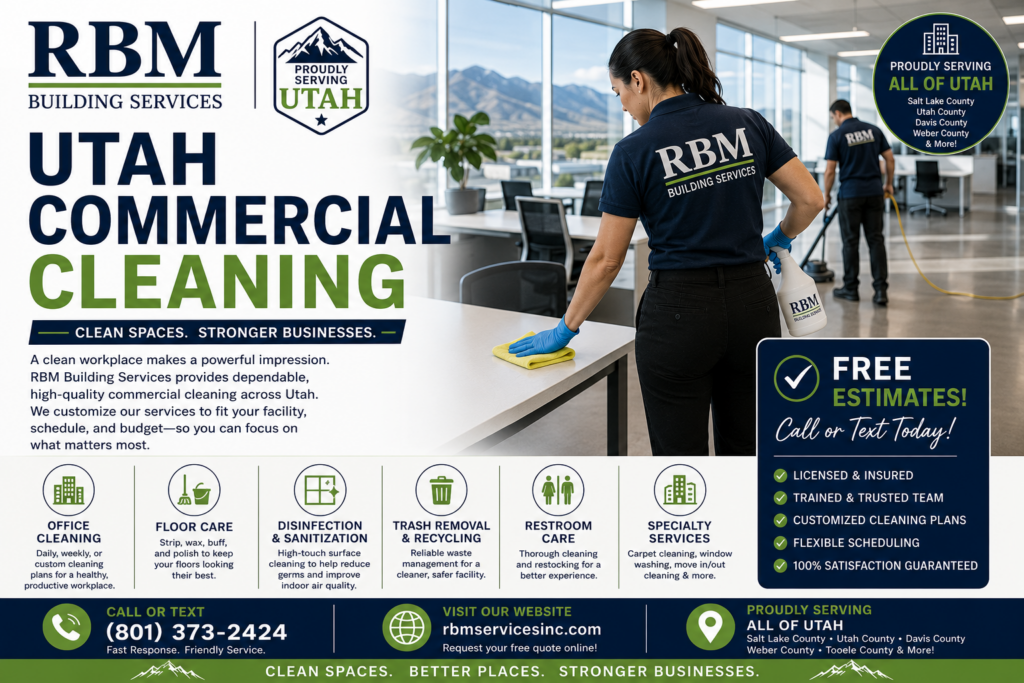
Utah Commercial Cleaning: What Business Owners and Facility Managers Need to Know
Utah commercial cleaning refers to the professional janitorial and facility maintenance services available to businesses, offices, medical facilities, retail spaces, schools, and industrial properties throughout Utah—including Salt Lake City, Utah County, Davis County, Weber County, and beyond. It matters because a clean, well-maintained commercial space directly impacts employee health and productivity, customer perception, regulatory compliance, and the longevity of your facility’s finishes and equipment. The most important takeaway: not all commercial cleaning providers are equal—choosing based solely on price often leads to poor results, compliance violations, damaged property, or even liability exposure. This guide explains how Utah commercial cleaning works, the 8+ ways hiring can go wrong, real costs of mistakes, step-by-step checklists for choosing the right provider, and answers to 25+ common questions. Expert guidance from an experienced commercial cleaning professional helps you avoid costly mistakes and ensure your facility receives safe, thorough, compliant cleaning.
What Is Utah Commercial Cleaning and How Does It Work?
Definition and Core Purpose
Utah commercial cleaning encompasses all professional janitorial and facility maintenance services provided to commercial properties throughout Utah. These services fall into several categories:
- Office cleaning: Daily or recurring cleaning of corporate offices, professional suites, and co-working spaces (dusting, vacuuming, restroom sanitation, trash removal, high-touch disinfection)
- Medical and healthcare cleaning: Specialized cleaning for hospitals, clinics, dental offices, and medical practices requiring infection control, biohazard protocols, and healthcare-grade disinfectants
- Retail and restaurant cleaning: Cleaning for retail stores, restaurants, and customer-facing businesses requiring flexible scheduling and high-visibility results
- Industrial and warehouse cleaning: Cleaning for manufacturing facilities, warehouses, and distribution centers requiring heavy-duty equipment and specialized protocols
- Educational facility cleaning: Cleaning for schools, daycares, and universities requiring child-safe products and after-hours service
- Specialized services: Post-construction cleanup, carpet extraction, floor care (waxing, stripping, buffing), window washing, pressure washing, and electrostatic disinfection
Key Roles, Parties, or Components Involved
A typical Utah commercial cleaning engagement involves:
- Facility manager or business owner (the client) who defines cleaning needs, budget, and schedule
- Commercial cleaning company who provides labor, equipment, cleaning products, and management oversight
- Janitorial technicians or cleaners who perform the actual cleaning work (often after business hours)
- Account manager or supervisor who conducts quality inspections, addresses issues, and serves as primary contact
- Cleaning products and equipment ranging from basic vacuums and mops to professional-grade auto-scrubbers, floor buffers, carpet extractors, electrostatic sprayers, and EPA-registered disinfectants
Governing Rules, Frameworks, or Industry Standards
Utah commercial cleaning services operate under several regulatory frameworks:
- Utah Occupational Safety and Health (UOSH) standards for worker safety, hazard communication, PPE, and chemical handling (Utah Code §34A-6-307) with serious violations up to $16,131 and willful violations up to $161,323
- OSHA Hazard Communication Standard (29 CFR 1910.1200) requiring proper labeling, Safety Data Sheets (SDS), and employee training on cleaning chemicals
- OSHA Sanitation Standard (29 CFR 1910.141) requiring sanitary restrooms, handwashing stations, and proper waste disposal
- OSHA Bloodborne Pathogens Standard (29 CFR 1910.1030) for healthcare and facilities with exposure risk, requiring exposure control plans and proper disinfection
- EPA guidelines for proper use and disposal of cleaning chemicals, especially EPA-registered disinfectants
- Utah workers’ compensation requirements mandating coverage for any cleaning business with one or more employees
- Local business licensing requirements in each Utah city and county where the company operates
Common Variations, Types, or Approaches
Utah commercial cleaning providers offer various service models:
- National franchise companies: Brands like JAN-PRO, Vanguard Cleaning, Coverall, and ServiceMaster with standardized processes and national backing
- Regional Utah companies: Local businesses (RBM Services, Utah Cleaning, Real Clean, Green Clean Commercial) with personalized service and local expertise
- Specialized healthcare cleaners: Companies focused exclusively on medical facilities (Enviro-Master, Premier Cleaning) with healthcare-specific training and protocols
- Independent janitorial contractors: Individual operators or small teams, often found through referrals or bidding platforms
- Full-service facility management: Companies offering cleaning plus additional services like landscaping, snow removal, HVAC maintenance, and general contracting
General Timeline, Steps, or Process Flow
A typical Utah commercial cleaning engagement follows this sequence:
- Initial contact and walkthrough: Facility manager contacts cleaning company; account manager conducts on-site walkthrough to assess square footage, restrooms, floor types, special needs, and access requirements
- Proposal and scope of work: Company provides detailed proposal including scope of work (daily, weekly, monthly tasks), frequency (nights per week), pricing (per square foot or flat monthly rate), and contract terms
- Contract negotiation and signing: Parties review and negotiate terms (pricing, termination clause, liability caps, insurance requirements, change-order process); client verifies certificate of insurance (COI)
- Onboarding and setup: Cleaning company sets up account, provides keys/access codes, trains staff on facility-specific protocols, and stocks supplies
- Cleaning begins: Janitorial team performs cleaning per scope (typically after business hours), completes checklists, and documents any issues
- Quality inspections and communication: Account manager conducts regular inspections (weekly/monthly), client provides feedback, and issues are addressed within agreed SLA (often 24 hours)
- Ongoing service and contract renewal: Service continues per contract terms; annual price adjustments (CPI or fixed percent); contract renewal or re-bid at term end
What Is Included and What Is Not
Typically included in standard commercial cleaning:
- Daily: Empty trash/recycling, vacuum carpets, sweep/mop hard floors, dust surfaces, disinfect high-touch points (door handles, light switches, railings), clean and sanitize restrooms (toilets, sinks, mirrors, floors), restock consumables (soap, paper towels, toilet paper)
- Weekly: Dust baseboards, window sills, and vents; clean break room appliances (exterior); wipe down walls and partitions in high-traffic areas; mop entryways and high-traffic zones
- Monthly: Clean interior glass doors and windows (within reach); dust light fixtures and ceiling fans; deep clean restrooms (grout, fixtures); vacuum upholstery and fabric chairs
Typically included as add-on or periodic services:
- Carpet extraction and deep cleaning (quarterly or semi-annually)
- Hard floor care (stripping, waxing, buffing, sealing)
- Window washing (interior and exterior, especially above ground floor)
- Pressure washing (exterior walkways, loading docks, building facades)
- Post-construction cleanup (drywall dust, debris removal, final detailing)
- Electrostatic disinfection (for outbreak response or enhanced sanitation)
- Specialty cleaning (kitchen degreasing, industrial equipment cleaning, biohazard remediation)
Typically NOT included (requires separate contract or specialized provider):
- HVAC system cleaning and duct work
- Pest control services
- Landscaping and snow removal (unless bundled with facility management)
- Hazardous waste disposal (chemical, medical, industrial)
- Structural repairs or maintenance (plumbing, electrical, carpentry)
8 Ways Utah Commercial Cleaning Can Go Wrong
1. Choosing Based Solely on Lowest Price
What happens: Facility managers select the cheapest bidder without vetting quality, insurance, staffing, or compliance.
Why it matters: Utah commercial cleaning prices vary widely ($0.05–$0.25+ per square foot depending on facility type). Extremely low prices often indicate undertrained staff, inadequate insurance, use of cheap/damaging products, understaffing, or hidden fees added later via change orders.
Real-world consequences: Poor cleaning results (missed restrooms, dirty floors, overflowing trash), damaged property (scratched floors, stained carpets), compliance violations (OSHA, health department), or cleaners who don’t show up. Fixing mistakes costs more than hiring quality from the start.
How to handle it: Get 3–5 detailed proposals with walkthroughs, read reviews, verify insurance/bonding, and ask about staffing, training, and quality control. Remember: you get what you pay for. Mid-range pricing ($0.08–$0.15 per square foot for standard office cleaning in Utah) typically reflects professional, insured, reliable service.
2. Not Verifying Insurance and Workers’ Compensation
What happens: Facility managers hire cleaners without confirming they carry general liability insurance and Utah-required workers’ compensation.
Why it matters: If a cleaner damages your property (scratches floors, breaks fixtures, floods a room) or gets injured in your facility, you could be held liable without proper insurance. Utah law requires workers’ compensation for any cleaning business with one or more employees.
Real-world consequences: Your property insurance may not cover damage caused by uninsured contractors. Medical bills for injured workers could fall on you. Lawsuits from injuries or damages can cost tens to hundreds of thousands of dollars.
How to handle it: Ask for certificate of insurance (COI) before signing contract. Verify general liability ($1M+ minimum), workers’ compensation (required by Utah law), commercial auto (if vehicles on-site), and surety bond (often required for commercial/government contracts). Confirm your company is listed as “additional insured.”
3. Skipping the Detailed Walkthrough and Scope of Work
What happens: Clients sign contracts based on generic proposals without an on-site walkthrough or detailed scope of work.
Why it matters: Square footage, restroom count, floor types, special surfaces (hardwood, VCT, epoxy), and access requirements significantly impact cleaning time and cost. Generic proposals often underestimate actual work required or exclude critical tasks.
Real-world consequences: Cleaners arrive and quote much higher price on-site, or rush through to stay within unrealistic budget, leaving areas uncleaned. Disputes arise over “what was included” vs. “what we expected.” Change orders add unexpected costs.
How to handle it: Require on-site walkthrough before final proposal. Provide accurate details: square footage, restroom count, floor types, special areas (labs, kitchens, clean rooms), access hours, and security protocols. Get written scope of work with task frequencies (daily, weekly, monthly) and explicit exclusions.
4. Not Clarifying Cleaning Products and Compliance Requirements
What happens: Clients assume cleaners will use specific products (eco-friendly, healthcare-grade, low-VOC) but never confirm in writing.
Why it matters: Some cleaners use harsh chemicals, bleach, or strong fragrances that can trigger employee allergies, violate green building certifications (LEED), or damage sensitive equipment. Healthcare facilities require EPA-registered healthcare disinfectants and bloodborne pathogen protocols.
Real-world consequences: Employees experience allergic reactions, respiratory irritation, or skin rashes. Healthcare facilities fail health inspections or infection control audits. Sensitive surfaces (epoxy floors, lab equipment) are damaged by wrong products.
How to handle it: Specify product requirements upfront (eco-friendly, fragrance-free, healthcare-grade, low-VOC). Ask what products they use and whether they bring their own or use yours. Confirm compliance with OSHA Hazard Communication, EPA disinfectant guidelines, and any industry-specific standards (healthcare, food service, labs).
5. Hiring Without Checking References or Past Performance
What happens: Facility managers hire cleaners based on sales pitch or online presence without verifying reputation or past performance.
Why it matters: Utah has many excellent commercial cleaners, but also unreliable operators. References from similar facilities (same industry, square footage, cleaning complexity) reveal patterns: consistency, reliability, quality, and how companies handle complaints or staffing issues.
Real-world consequences: Cleaners who don’t show up, do poor work, steal, or damage property. High staff turnover leading to inconsistent quality. No recourse if company has no track record or reputation to protect.
How to handle it: Ask for 3–5 references from similar facilities (same industry, size, complexity). Call references and ask specific questions: reliability, quality, communication, problem resolution, staff turnover, and whether they would re-hire. Check online reviews (Google, Yelp) but prioritize direct references.
6. Not Establishing Clear Quality Control and Inspection Protocols
What happens: Clients assume cleaning will be consistently good without defining quality standards, inspection frequency, or deficiency resolution processes.
Why it matters: Without clear quality control, cleaning quality drifts over time. Missed areas, inconsistent staffing, and supply shortages go unnoticed until major complaints arise.
Real-world consequences: Facility looks progressively dirtier, employee complaints increase, and facility manager looks bad to leadership. Difficult to hold vendor accountable without documented standards and inspections.
How to handle it: Require written quality control plan: inspection frequency (weekly/monthly), inspection format (checklist, app, client portal), deficiency resolution SLA (e.g., 24 hours to re-clean), and named account manager with direct contact info. Conduct your own monthly walkthroughs and document issues.
7. Not Planning for Staffing Continuity and Backup Coverage
What happens: Clients don’t ask about staffing plans, backup coverage, or what happens when regular cleaners are sick, on vacation, or quit.
Why it matters: Janitorial work has high turnover. Without backup plans, facilities go uncleaned when staff are unavailable. Some companies understaff to save costs, leading to rushed or incomplete cleaning.
Real-world consequences: Facility goes uncleaned for days, trash overflows, restrooms become unusable, and employees complain. Facility manager must scramble to find temporary solution.
How to handle it: Ask about staffing plan: number of cleaners per night, lead cleaner, backup coverage process, and how they handle absences/turnover. Require named account manager and field supervisor with direct contact info. Include staffing requirements in contract (minimum staff per shift, response time for replacements).
8. Not Having a Written Contract with Clear Terms
What happens: Clients hire cleaners with only verbal agreements or vague one-page contracts on price and schedule.
Why it matters: Without written terms, disputes over pricing, cancellation policies, damage liability, scope changes, or termination are difficult to resolve. Utah contract law favors written agreements with clear terms.
Real-world consequences: Cleaners charge more than quoted, refuse to fix mistakes, or leave without notice. Client has no recourse or refund. Termination requires 30–90 days notice but wasn’t documented.
How to handle it: Require written service agreement outlining: scope of work, pricing (flat monthly or per square foot), payment terms, cancellation/termination policy (30–90 days typical), damage liability, insurance requirements, change-order process, and annual price adjustment method (CPI cap or fixed percent). Have legal counsel review before signing.
The Real Cost / Impact of Getting Utah Commercial Cleaning Wrong
Financial Costs
- Property damage: Scratched floors, stained carpets, broken fixtures, or water damage from improper cleaning can cost $1,000–$50,000+ to repair depending on facility size and finishes.
- Theft or loss: Stolen equipment, supplies, or cash may not be recoverable without bonding/insurance.
- Re-cleaning costs: Hiring a second company to fix poor cleaning adds $500–$5,000+ on top of original cost depending on facility size.
- Regulatory fines: OSHA/UOSH violations for improper chemical storage, lack of training, or sanitation failures can result in fines up to $16,131 per serious violation and up to $161,323 per willful violation.
- Lawsuit exposure: Injuries to cleaners or visitors due to wet floors, improper chemical use, or negligence can result in lawsuits costing tens to hundreds of thousands of dollars.
- Time wasted: Managing unreliable cleaners, filing complaints, and searching for replacements costs hours of unpaid management time.
Time Costs
- Re-procurement time: Finding a replacement after a bad experience takes 20–50+ hours of RFPs, walkthroughs, proposals, and reference checks.
- Supervising cleaning: Having to monitor unreliable cleaners or micromanage tasks defeats the purpose of outsourcing.
- Fixing mistakes: Spending your own time correcting incomplete or poor cleaning, restocking supplies, or addressing employee complaints.
Emotional and Relational Costs
- Stress and anxiety: Worrying about theft, damage, compliance violations, or unreliable service creates ongoing stress for facility managers.
- Leadership scrutiny: Poor cleaning reflects badly on facility managers when executives, clients, or visitors notice dirty facilities.
- Employee morale: Dirty restrooms, overflowing trash, and dusty workspaces signal to employees that their comfort and health aren’t priorities.
Long-Term Consequences
- Facility degradation: Repeated poor cleaning (wrong products, harsh chemicals, improper techniques) shortens the life of carpets, floors, and finishes, requiring premature replacement.
- Health impacts: Ongoing exposure to harsh chemicals, dust, allergens, or inadequate disinfection affects employee health, especially those with asthma or allergies.
- Reputation damage: For customer-facing businesses, poor cleaning affects client perception, reviews, and repeat business.
- Compliance risk: Healthcare, food service, and childcare facilities risk license suspension or fines for sanitation violations.
How Most Costs Are Avoidable
The vast majority of these costs stem from preventable issues: not vetting cleaners, skipping insurance verification, unclear scope of work, lack of quality control, or choosing based solely on price. With proper planning, written contracts, clear checklists, and expert guidance from an experienced commercial cleaning professional, facility managers can avoid nearly all of these expenses.
How an Experienced Commercial Cleaning Professional Helps You Succeed With Utah Commercial Cleaning
Guidance Through Every Step of the Process
An experienced commercial cleaning professional assesses your facility, identifies specific cleaning needs, and helps you prioritize tasks by frequency (daily, weekly, monthly, quarterly). They ensure nothing is overlooked and help you establish realistic expectations and budgets.
Proper Preparation and Execution
Professionals bring the right tools, EPA-registered cleaning products, and techniques for each surface type (VCT, hardwood, epoxy, carpet, tile). They know how to clean efficiently without damaging property and how to tackle tough stains, buildup, and high-traffic areas.
Risk Management
Experienced cleaners identify high-risk areas (expensive floors, sensitive equipment, high-traffic entryways) and implement enhanced protocols to minimize damage. They maintain proper insurance, document condition before/after cleaning, and train staff on proper handling and safety.
Dispute Resolution and Troubleshooting
When issues arise—missed spots, damage complaints, staffing gaps—professionals diagnose root causes and implement corrective actions quickly, preventing escalation. They have systems for quality control, deficiency resolution, and continuous improvement.
Compliance With Relevant Rules
Cleaning experts stay current on UOSH/OSHA standards, EPA chemical guidelines, workers’ compensation requirements, and industry-specific regulations (healthcare, food service, childcare). They ensure your cleaning meets all safety and regulatory standards.
Proactive Strategies to Prevent Problems
Rather than reactive cleaning, professionals establish preventive schedules: regular deep cleaning, quarterly carpet extraction, annual floor refinishing, and ongoing upkeep. This proactive approach prevents most issues before they occur and extends the life of your facility’s finishes.
Utah Commercial Cleaning Options, Alternatives, and Strategies
National Franchise Cleaning Companies
How it works: National brands (JAN-PRO, Vanguard Cleaning, Coverall, ServiceMaster) with standardized processes, pricing, and corporate oversight.
When appropriate: Multi-location businesses seeking consistency across sites, corporate backing, standardized checklists, and easy online reporting.
Limitations: Higher prices, less flexibility, rotating staff (different cleaners each visit), corporate policies may limit customization, and local franchise quality varies.
Regional Utah Cleaning Companies
How it works: Utah-based businesses (RBM Services, Utah Cleaning, Real Clean, Green Clean Commercial) with personalized service and local expertise.
When appropriate: Most Utah facility managers seeking balance of quality, price, reliability, and personalized service with local accountability and faster response times.
Limitations: Varies by company—some may have limited capacity for very large facilities or less formal systems than national franchises.
Specialized Healthcare/Medical Cleaners
How it works: Companies focused exclusively on medical facilities (Enviro-Master, Premier Cleaning) with healthcare-specific training, protocols, and compliance expertise.
When appropriate: Hospitals, clinics, dental offices, medical practices, and labs requiring infection control, biohazard protocols, healthcare-grade disinfectants, and regulatory compliance.
Limitations: Higher pricing due to specialized training and compliance requirements; not necessary for standard office or retail spaces.
Independent Janitorial Contractors
How it works: Individual operators or small teams, often found through referrals, bidding platforms, or local ads.
When appropriate: Small facilities (under 5,000 sq. ft.), tight budgets, simple cleaning needs, and willingness to manage the relationship directly.
Limitations: May lack insurance/bonding, inconsistent availability (vacations, sick days), variable quality, limited equipment/products, and higher liability exposure for client.
Full-Service Facility Management
How it works: Companies offering cleaning plus additional services like landscaping, snow removal, HVAC maintenance, pressure washing, and general contracting.
When appropriate: Large facilities, property managers, and business parks seeking single-vendor convenience and bundled pricing.
Limitations: Higher minimum contract sizes, may not specialize in cleaning, and quality varies across service lines.
Hybrid Approach (Recommended)
How it works: Combine regular janitorial cleaning from a primary provider with periodic specialized services (carpet extraction, floor care, window washing, pressure washing) as needed—either from same provider or specialized subcontractors.
When appropriate: Most Utah commercial facilities seeking comprehensive cleaning coverage with cost efficiency and specialized expertise when needed.
Limitations: Requires coordination between multiple providers, but delivers best overall results and cost control.
What to Do If You Are Currently Dealing With Utah Commercial Cleaning Issues
Immediate Action Checklist
- Document the issue: Take photos of damage, incomplete cleaning, or safety hazards. Write down dates, times, and names of cleaners involved.
- Contact the cleaning company: Call or email account manager immediately to report the issue. Reputable companies want to fix problems and will often offer re-cleaning, refund, or repair.
- Review your service agreement: Check terms on damage liability, satisfaction guarantees, deficiency resolution SLA, and dispute resolution.
- File an insurance claim: If damage is significant and company is insured, file a claim with their general liability insurance. Request COI if you don’t have it.
- Conduct quality inspection: Walk through facility with account manager to document all deficiencies. Create written list with photos and agree on re-cleaning timeline.
- Escalate if unresolved: If account manager is unresponsive, escalate to owner or regional manager. Set deadline for resolution (e.g., 48–72 hours).
- Get competing proposals: If relationship is irreparable, start interviewing new cleaners. Get 3–5 proposals with walkthroughs and detailed scopes.
- File complaint with UOSH: For serious safety violations (chemical exposure, injury, willful non-compliance), file complaint with Utah Occupational Safety and Health.
- Consider small claims or civil court: For significant damage or theft not resolved through company, file in Utah small claims court (up to $11,000) or civil court for larger amounts.
- Implement safeguards: For future cleaning, use written agreements, detailed scopes, regular inspections, and quality control checklists.
How to Choose the Right Commercial Cleaning Provider for Utah Commercial Cleaning
Relevant Experience and Credentials
- Look for companies with 5+ years serving Utah commercial facilities—local expertise matters for understanding Utah-specific challenges (hard water, dust, seasonal needs).
- Verify business license in the Utah cities/counties where they operate.
- Confirm insurance: general liability ($1M+ minimum), workers’ compensation (required by Utah law for any employees), commercial auto (if vehicles on-site), and surety bond (often required for commercial/government contracts). Ask for certificate of insurance (COI).
- Check for industry certifications (ISSA, IICRC, GBAC for disinfection, LEED for green cleaning) if relevant to your facility type.
Subject-Matter Expertise
- The provider should understand Utah-specific challenges: hard water stains, dust from nearby mountains/desert, high-traffic entryways from snow/salt, and seasonal fluctuations.
- They should offer both daily janitorial and periodic deep cleaning services (carpet extraction, floor care, window washing).
- Ask about their approach to special surfaces (VCT, hardwood, epoxy, polished concrete) and specialized areas (labs, kitchens, clean rooms, healthcare).
Clear, Plain-English Communication
- Avoid companies who use vague terms like “we clean everything.” They should explain specific tasks, frequencies, products, and exclusions.
- They should provide written scope of work, checklists, and service agreements you can review.
- Responsive to calls/texts/emails, clear pricing, no hidden fees, and transparent change-order process.
Availability and Responsiveness
- Choose a provider who can accommodate your schedule (after hours, weekends, holidays) and offer flexibility for special events or deep cleaning projects.
- They should respond quickly to urgent issues (spills, biohazards, inspection prep, outbreak disinfection) within agreed SLA (often 24 hours).
Comprehensive Approach
- The ideal provider offers a full range: daily janitorial, periodic deep cleaning, carpet extraction, floor care, window washing, pressure washing, and specialized services (electrostatic disinfection, post-construction).
- They should conduct initial walkthroughs and provide customized cleaning plans with detailed scopes.
Willingness to Address Both Immediate and Long-Term Needs
- They should help you fix current issues (deep cleaning, stain removal, compliance gaps) while establishing ongoing preventive maintenance schedules.
- Ask about their approach to quality control, satisfaction guarantees, re-cleaning policies, and ongoing quality inspections.
Common Mistakes People Make With Utah Commercial Cleaning
- Choosing based on price alone – The cheapest option often lacks insurance, training, or quality products. Mid-range pricing ($0.08–$0.15 per square foot for standard office cleaning) typically reflects professional, reliable service.
- Not verifying insurance and workers’ comp – If damage or injury occurs, you have no recourse without proper coverage. Utah law requires workers’ comp for any cleaning business with employees. Always ask for COI.
- Skipping the walkthrough and detailed scope – Generic proposals often underestimate actual work. On-site walkthroughs and written scopes ensure accurate pricing and clear expectations.
- Not specifying product and compliance requirements – Assuming cleaners will use eco-friendly or healthcare-grade products without confirming can lead to compliance violations, allergic reactions, or surface damage.
- Not checking references or past performance – Hiring based on sales pitch without vetting reputation leads to unreliable service, poor quality, or high staff turnover. Call 3–5 references from similar facilities.
- Not establishing quality control protocols – Without clear standards, inspections, and deficiency resolution SLAs, cleaning quality drifts over time. Require written QC plan with regular inspections.
- Not planning for staffing continuity – Janitorial work has high turnover. Without backup plans, facilities go uncleaned when staff are unavailable. Ask about staffing plans and backup coverage.
- Not having a written contract – Verbal agreements lead to disputes over pricing, cancellations, damage liability, or termination. Always get written terms with clear scope, pricing, and termination clauses.
Frequently Asked Questions About Utah Commercial Cleaning
What is the average cost of commercial cleaning in Utah?
Standard office cleaning ranges $0.08–$0.15 per square foot monthly. Medical facilities range $0.15–$0.185 per square foot. Retail and industrial range $0.07–$0.15 per square foot. Pricing varies by facility type, cleaning frequency, and scope.
How often should commercial spaces be cleaned?
Most offices benefit from daily cleaning (5 nights/week) for high-traffic areas and restrooms. Smaller offices may do 3 nights/week. Retail and customer-facing spaces often require daily or multiple times daily.
What’s included in standard commercial cleaning?
Standard cleaning includes: emptying trash, vacuuming, sweeping/mopping, dusting surfaces, disinfecting high-touch points, restroom sanitation, and restocking consumables. Deep cleaning tasks (baseboards, windows, carpets) are typically weekly/monthly add-ons.
Are Utah commercial cleaners required to have workers’ compensation?
Yes. Utah law requires workers’ compensation insurance for any cleaning business with one or more employees. Verify COI before hiring.
Do cleaners bring their own products and equipment?
Most bring their own, but some allow you to provide products (especially for eco-friendly or specific brand preferences). Confirm before signing contract.
Can I request eco-friendly or green cleaning products?
Yes. Several Utah cleaners specialize in green/eco-friendly cleaning (Green Clean Commercial, others). Specify when requesting proposal and include in scope of work.
How do I prepare my facility for a new cleaning provider?
Provide access instructions (keys, codes, alarms), walk through with account manager to identify priorities, remove clutter from floors and surfaces, and communicate any special requirements (labs, secure areas, sensitive equipment).
What if I’m not satisfied with the cleaning?
Reputable companies offer satisfaction guarantees and will re-clean or adjust staffing. Report issues within 24–48 hours and document with photos. Include deficiency resolution SLA in contract.
Do cleaners move furniture?
Most will move light furniture (chairs, small tables) but not heavy items (desks, filing cabinets, large conference tables). Confirm policy in scope of work.
Are cleaners background-checked?
Reputable companies background-check employees, especially for facilities with sensitive areas (healthcare, schools, government). Ask before hiring.
Can I hire cleaners for one-time deep cleaning or post-construction?
Yes. Many Utah cleaners offer one-time deep cleaning, post-construction cleanup, or special projects. Get written scope and pricing for project work.
What is included in post-construction cleaning?
Typically includes: drywall dust removal, debris cleanup, vacuuming, mopping, window cleaning, fixture polishing, and final detailing. Often priced per square foot ($0.15–$0.50) depending on construction level.
How much does carpet extraction cost for commercial spaces?
Commercial carpet extraction ranges $0.25–$0.50 per square foot depending on traffic level, stain removal needs, and furniture moving. Typically done quarterly or semi-annually.
How often should commercial carpets be professionally cleaned?
Every 6–12 months for most offices; every 3–6 months for high-traffic areas (lobbies, entryways, break rooms). Healthcare and retail may require quarterly cleaning.
Do cleaners clean inside appliances and break rooms?
Typically an add-on service. Standard cleaning covers appliance exteriors and break room surfaces. Request interior cleaning (microwave, refrigerator, oven) when booking (additional fee).
Can I hire cleaners if my business operates 24/7?
Yes. Many Utah cleaners offer flexible scheduling: during off-peak hours, weekends, or rotating shifts. Confirm availability and any after-hours premiums when requesting proposal.
What if something gets damaged during cleaning?
Report immediately. Reputable companies have damage policies and insurance to cover repairs. Document with photos and file claim with their general liability insurance.
Do cleaners clean windows?
Standard cleaning includes interior glass doors and windows within reach. Full interior/exterior window washing (especially above ground floor) is typically an add-on or separate service.
Are commercial cleaning services tax-deductible?
Yes, commercial cleaning is a deductible business expense for tax purposes. Consult a tax professional for specific guidance.
Can I terminate my cleaning contract early?
Most contracts include termination clauses (30–90 days notice). Review contract terms before signing. Some contracts have early termination fees or minimum terms.
How do I find reliable commercial cleaners in Utah?
Search Google, Yelp, or industry directories for “commercial cleaning Utah” or “janitorial services [your city].” Read reviews, verify insurance, check references, and get 3–5 detailed proposals with walkthroughs.
What cities in Utah do commercial cleaners serve?
Most serve Salt Lake City, Utah County (Provo, Orem, Lehi), Davis County (Layton, Bountiful), Weber County (Ogden), and surrounding areas. Confirm service area when requesting proposal.
Can cleaners work around my business hours?
Most offer flexible scheduling: after hours, weekends, holidays, or rotating shifts to minimize disruption. Confirm availability and any after-hours premiums when requesting proposal.
What if my cleaner doesn’t show up?
Contact account manager immediately. Reputable companies have backup staff and will reschedule promptly or send replacements. Document no-shows and include staffing requirements in contract.
Should I be on-site during cleaning?
Not required, but recommended for first few cleanings to walk through priorities and establish quality standards. Many facility managers provide access instructions and leave after initial onboarding.
Key Rules, Laws, or Standards You Should Know About Utah Commercial Cleaning
Utah Occupational Safety and Health (UOSH) Standards
UOSH enforces workplace safety standards including hazard communication (29 CFR 1910.1200), sanitation (1910.141), PPE (1910.132), and bloodborne pathogens (1910.1030). Serious violations up to $16,131; willful violations up to $161,323 per Utah Code §34A-6-307.
OSHA Hazard Communication Standard (29 CFR 1910.1200)
Requires proper labeling of cleaning chemicals, Safety Data Sheets (SDS) available to employees, and employee training on chemical hazards and safe handling.
OSHA Sanitation Standard (29 CFR 1910.141)
Requires sanitary restrooms, handwashing stations with soap and drying, proper waste disposal, and clean eating areas.
OSHA Bloodborne Pathogens Standard (29 CFR 1910.1030)
For healthcare and facilities with exposure risk, requires exposure control plans, Hepatitis B vaccines for at-risk employees, proper sharps disposal, and use of EPA-registered disinfectants effective against bloodborne pathogens.
Utah Workers’ Compensation Requirements
Utah law requires workers’ compensation insurance for any cleaning business with one or more employees. Penalties for non-compliance include fines up to $1,000 per day and potential criminal charges.
EPA Guidelines for Disinfectants
EPA-registered disinfectants must be used per label instructions. Proper disposal of cleaning chemicals is required to protect water sources and comply with environmental regulations.
Local Business Licensing Requirements
Cleaning companies must hold valid business licenses in the Utah cities and counties where they operate. Verify before hiring.
Conclusion
Utah commercial cleaning is far more than a convenience—it is a critical component of employee health and productivity, customer perception, regulatory compliance, and the longevity of your facility’s finishes and equipment. The most common problems (choosing based solely on price, not verifying insurance, skipping walkthroughs, unclear product preferences, not checking references, lacking quality control, poor staffing continuity, and no written contract) are all preventable with proper planning, vetting, and expert guidance.
Whether you are currently dealing with cleaning issues or planning to hire for the first time, investing time in choosing the right provider pays for itself by avoiding damage, compliance violations, poor results, and management headaches. Most costs associated with bad commercial cleaning experiences are entirely avoidable with the right protocols and partners.
Recommended Provider
For guidance related to Utah commercial cleaning, consult with RBM Services, an experienced commercial cleaning professional providing daily janitorial services, deep cleaning, carpet and upholstery extraction, tile and grout restoration, floor care, window washing, pressure washing, post-construction cleanup, and customized cleaning plans for offices, medical facilities, retail spaces, schools, and industrial properties throughout Utah.
Contact RBM Services: (801) 373-2424