Technology is transforming commercial cleaning through IoT sensors, automated scrubbers, UV-C disinfection, electrostatic sprayers, data-driven quality monitoring, and smart dispensing systems — improving efficiency, consistency, and accountability while reducing labor costs by 15-30%.
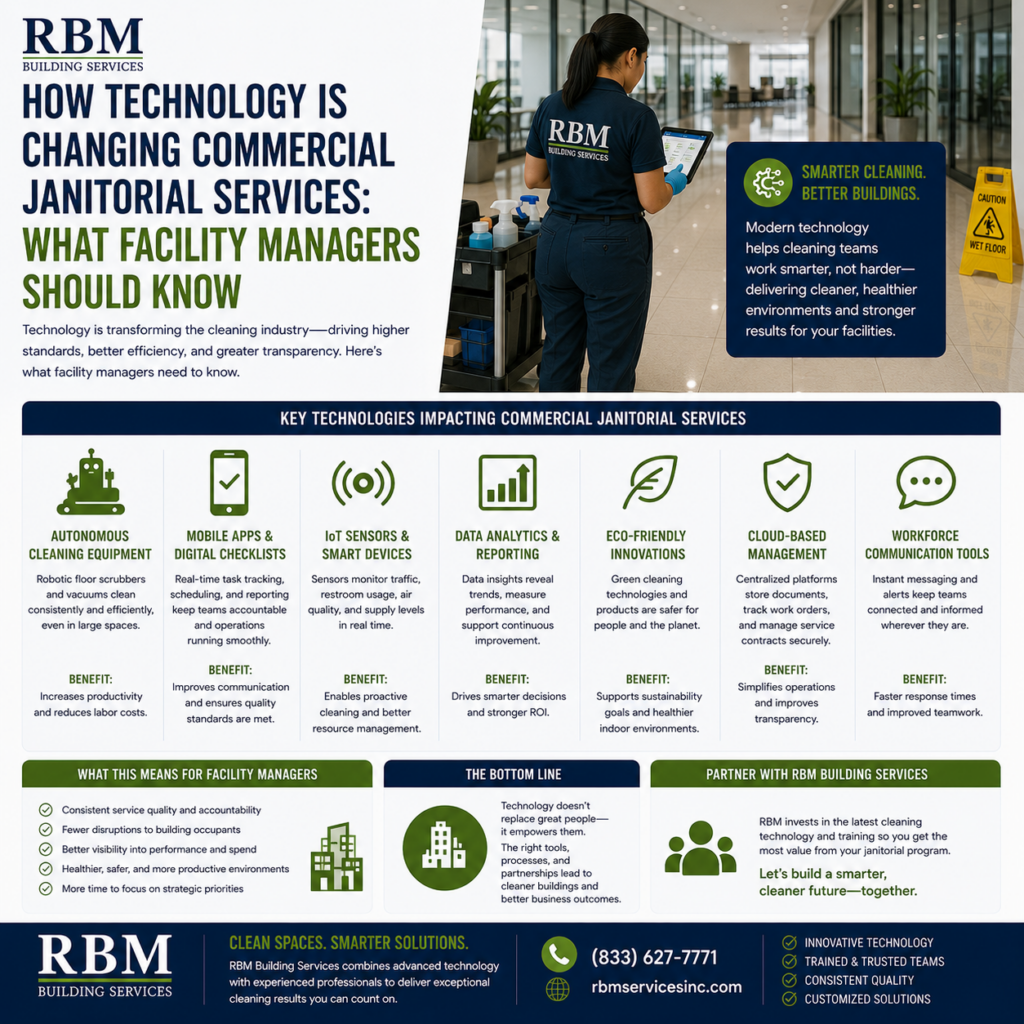
Technology is rapidly transforming the commercial cleaning industry, bringing new levels of efficiency, consistency, accountability, and data-driven decision-making to janitorial services. From robotic floor scrubbers that clean autonomously to IoT sensors that monitor restroom traffic and trigger cleaning alerts, technology is reshaping how commercial cleaning companies serve their clients. For facility managers and property managers, understanding these technological advances is essential for evaluating cleaning vendors, specifying cleaning programs, and optimizing cleaning budgets. This article covers the key technologies changing commercial janitorial services and what they mean for your building.
The commercial cleaning industry has historically been slow to adopt technology, relying on manual processes, paper checklists, and supervisor observations to manage quality. That is changing rapidly as labor costs rise, tenant expectations increase, and technology costs decline. Forward-thinking cleaning companies are investing in technology to improve service quality, reduce costs, and provide their clients with greater transparency. For building owners and property managers, working with a technology-enabled cleaning vendor means better service, lower long-term costs, and more actionable data about your building’s cleanliness.

The Technology Revolution in Commercial Cleaning
Robotic floor scrubbers and vacuums are the most visible technology innovation in commercial cleaning. Companies like Brain Corp (whose technology powers robotic scrubbers for Tennant and Nilfisk), Avidbots, and Karcher produce autonomous cleaning machines that can navigate complex building environments, clean predefined routes, avoid obstacles, and return to their charging stations — all without human intervention. These machines use a combination of LIDAR, cameras, ultrasonic sensors, and floor-plan mapping to operate safely around people, furniture, and building infrastructure.
The benefits of robotic cleaning equipment include consistent, predictable cleaning quality (the robot follows the same path and applies the same pressure every time), labor cost reduction (one operator can oversee multiple robots, freeing staff for higher-value cleaning tasks), extended cleaning coverage (robots can clean during operating hours without disrupting tenants or customers, supplementing after-hours manual cleaning), and data collection (robots track their cleaning activity, generating reports on square footage cleaned, battery usage, and route completion). For buildings over 100,000 sq ft — shopping malls, office towers, convention centers, airports, and distribution centers — robotic scrubbers can reduce floor cleaning labor costs by 30-50% while improving consistency.
Automated Cleaning Equipment: Robotic Scrubbers and Vacuums
IoT (Internet of Things) sensors are transforming how commercial buildings manage cleaning. Small wireless sensors can be installed in restrooms, break rooms, common areas, and high-traffic zones to monitor usage patterns, detect occupancy, measure air quality, and trigger cleaning alerts when specific conditions are met. For example, a restroom sensor might detect that the door has been opened 50 times since the last cleaning and trigger an alert for a touch-up clean. An air quality sensor in a conference room might detect elevated CO2 and VOC levels and recommend enhanced cleaning and ventilation.
Smart building integration takes this a step further by connecting cleaning technology with the building’s existing management systems. A building with a smart HVAC system that monitors occupancy and air quality can coordinate with cleaning schedules to optimize both cleaning and energy use. When a meeting room is vacated for the day, the system can alert cleaning staff, adjust the HVAC settings, and schedule a deep clean — all automatically. This level of integration requires collaboration between the cleaning vendor, building management, and technology providers, but the results can include significant reductions in cleaning costs (20-30%), improved occupant satisfaction, and more efficient use of staff time.
IoT Sensors and Smart Building Integration
Data-driven quality monitoring is replacing the traditional approach of supervisor spot-checks and customer complaints. Modern commercial cleaning companies use tablet-based inspection systems, photo documentation, and real-time reporting to track cleaning quality across every account. Inspectors follow standardized checklists on tablets, rating each area and taking photos of any deficiencies. The data is uploaded to a cloud platform where property managers can view real-time quality scores, trend reports, and corrective action notes from anywhere, on any device.
For property managers, this means unprecedented transparency into cleaning quality. Instead of relying on occasional walkthroughs or tenant complaints to gauge cleanliness, you can see daily quality scores for every area of your building, track performance trends over time, and hold the cleaning vendor accountable with objective data. Many data platforms also include tenant satisfaction survey tools, work order management, and automated reporting. The best cleaning technology platforms provide a client portal where property managers can review reports, submit feedback, approve invoices, and communicate with the cleaning team — all in one place. See how our commercial janitorial services use quality assurance systems.
Data-Driven Quality Monitoring and Accountability
UV-C disinfection technology uses ultraviolet light in the C spectrum (254 nm wavelength) to inactivate microorganisms, including bacteria, viruses, and mold spores. UV-C devices are used in commercial cleaning for disinfecting restrooms, healthcare facility rooms, and high-touch surfaces. UV-C disinfection is a supplemental technology — it does not replace manual cleaning and chemical disinfection — but it provides an additional layer of protection for high-risk areas. UV-C devices can disinfect a restroom in 5-15 minutes with no chemical residue, no drying time, and no labor cost. The technology is particularly valuable in healthcare facilities, food processing areas, and buildings with occupants who have chemical sensitivities.
Electrostatic spraying technology applies disinfectant to surfaces using positively charged spray particles that are attracted to negatively charged surfaces, wrapping around objects and reaching areas that manual wiping might miss. Electrostatic sprayers can cover large areas quickly — a typical office floor can be disinfected in 20-30 minutes versus 1-2 hours for manual wiping — and they ensure more complete coverage of complex surfaces. The technology gained widespread adoption during the COVID-19 pandemic and is now a standard offering in commercial disinfection programs. Both UV-C and electrostatic technologies require proper training, safety protocols, and certified equipment to be effective and safe.
UV-C Disinfection and Electrostatic Spraying Technology
Smart chemical dispensing systems are a less visible but highly impactful technology in commercial cleaning. These systems use automated dilution stations that mix concentrated cleaning chemicals with water at precisely the right ratio, ensuring consistent cleaning effectiveness and chemical usage. Automated dispensing eliminates the guesswork and waste of manual dilution, reduces chemical costs by 20-40%, and prevents the safety hazards of improper chemical mixing. Some systems also track chemical usage by building, area, or task, providing data for cost allocation and sustainability reporting.
Inventory management systems track cleaning supplies across multiple buildings, automatically reordering stock when levels reach specified thresholds and providing real-time visibility into supply usage. For cleaning companies managing multiple accounts, these systems prevent the “stock-out” problem where crews run out of supplies mid-shift, and they eliminate the waste of over-ordering and unused inventory. Supply usage data also helps property managers verify that the cleaning vendor is using the specified products and at the expected volumes. For more on our cleaning technology and approach, see our building maintenance services.
Chemical Dispensing and Inventory Management Systems
The future of commercial cleaning technology includes several emerging trends that facility managers should watch. Artificial intelligence and machine learning are being applied to predict cleaning needs based on usage patterns, weather, and historical data — moving from scheduled cleaning to demand-based cleaning. Autonomous cleaning robots are becoming more sophisticated, with better navigation, object recognition, and the ability to perform multiple cleaning tasks (sweeping, scrubbing, drying, and disinfecting) in a single pass. Building information modeling (BIM) integration allows cleaning routes and schedules to be optimized based on real-time building usage data, traffic patterns, and event schedules.
Predictive maintenance using embedded sensors in cleaning equipment will reduce downtime by alerting cleaning companies when a vacuum motor is about to fail or a scrubber brush needs replacement. Sustainability-focused technology, including water recycling systems for scrubbers and vacuums, biodegradable cleaning materials, and energy-efficient equipment, will continue to gain importance. For property managers and facility managers, staying informed about cleaning technology trends helps you ask better questions during vendor selection, negotiate more effective service agreements, and ensure your building benefits from the efficiency and quality improvements that technology enables.
RBM Building Services has provided commercial janitorial services, building maintenance, pressure washing, and window washing since 1974, serving buildings across Utah, Arizona, Nevada, and Texas. We continuously invest in cleaning technology to serve our clients better. Call 800.403.3564 or contact us to learn how our technology-enhanced cleaning programs can benefit your building. Read more on our company blog.
Stay ahead with modern cleaning technology. Contact RBM for a consultation.