Security-cleared janitorial services require personnel with background checks, security clearances, and specialized training for working in government buildings, military installations, courthouses, and sensitive facilities. This guide covers clearance levels, compliance requirements, and operational protocols.
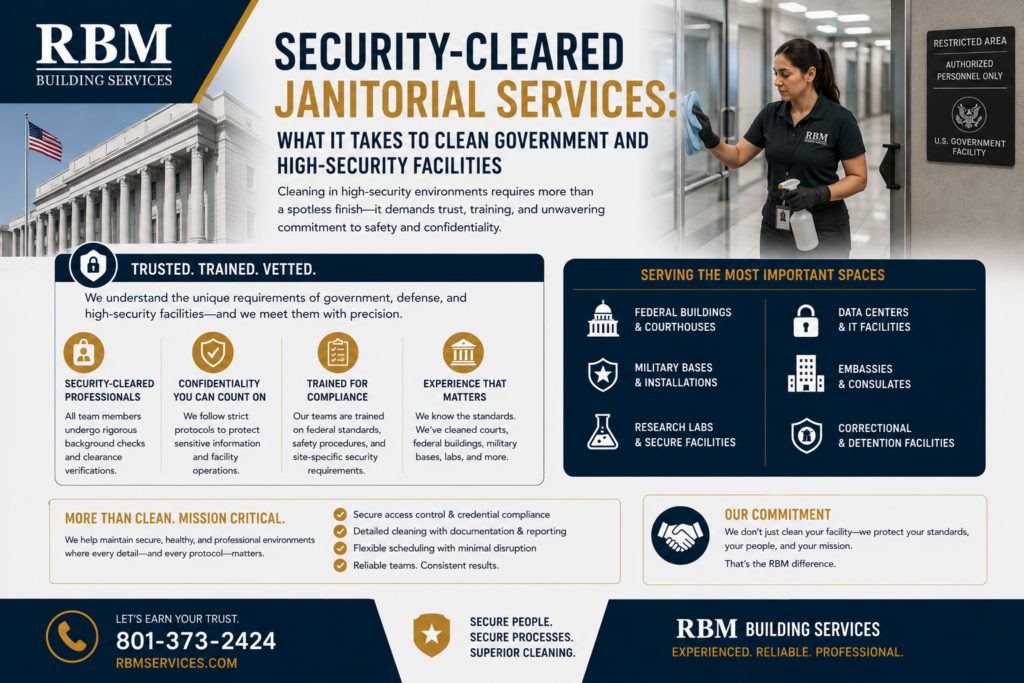
Security-cleared janitorial services are a specialized segment of the commercial cleaning industry that serves government facilities, military installations, courthouses, law enforcement buildings, and private-sector facilities with classified or sensitive operations. Unlike standard commercial cleaning, security-cleared cleaning requires personnel who have undergone background investigations and are authorized to access secure areas. The process of obtaining and maintaining security clearances for janitorial staff adds significant complexity and cost to cleaning operations, but it is essential for facilities where national security, public safety, or sensitive information is at stake. This guide provides an overview of the security clearance requirements, operational protocols, and compliance considerations for cleaning contractors and facility managers who work with security-cleared janitorial services.
The market for security-cleared janitorial services is substantial. The federal government alone owns or leases over 300,000 buildings across the United States, many of which require cleared cleaning personnel. Department of Defense facilities, federal courthouses, intelligence community offices, and Homeland Security buildings all require varying levels of security clearance for service personnel. State and local government facilities — including state capitol buildings, law enforcement headquarters, and emergency operations centers — may also require background checks or clearances for cleaning staff. Contractors who can provide reliable, cost-effective security-cleared cleaning services have a significant competitive advantage in this market. See our government cleaning services for more information.

Security-Cleared Janitorial Services Guide
Security clearances are categorized by the level of access they permit and the sensitivity of the information that can be accessed. The most common clearance levels relevant to janitorial services are the National Agency Check with Inquiries (NACI), which is the entry-level background investigation required for non-sensitive positions and is sufficient for most janitorial staff working in low-risk government facilities. The NACI includes a review of employment history, education, criminal history, credit history, and reference checks. The Tier 1 investigation is similar to NACI and is used for positions designated as low-risk, including most janitorial positions in federal buildings. Public Trust clearance (Tier 2 or Tier 4) is required for positions in sensitive facilities such as law enforcement buildings, financial regulatory agencies, and facilities where employees have access to sensitive but unclassified information. Public Trust positions require a more extensive background investigation than NACI. Secret and Top Secret clearances are generally not required for janitorial staff, but certain facilities may require cleared personnel to be escorted at all times if they do not hold the required clearance level.
The clearance process begins when the contracting agency determines the required level of clearance for janitorial personnel based on the facility’s security classification and the areas where cleaning staff will work. The agency issues a clearance request, and the cleaning contractor’s employees undergo the investigation process conducted by the Office of Personnel Management (OPM) or the Defense Counterintelligence and Security Agency (DCSA). The investigation typically takes 2-6 months for NACI/Tier 1 clearances and 6-18 months for higher-level clearances. Employees must maintain their clearance through periodic reinvestigations (typically every 5 years for Tier 1 and every 5-10 years for higher levels). During the investigation period, uncleared personnel may work under continuous escort if the contract allows, but this increases labor costs and reduces efficiency.
Understanding Security Clearance Levels
The specific clearance requirements for janitorial personnel depend on the facility type and the areas where they will work. Federal office buildings that house non-sensitive agencies typically require at least a NACI or Tier 1 background investigation for janitorial staff. These buildings have security protocols that include employee badging and access control, visitor check-in procedures, escort requirements for uncleared personnel, and periodic security refresher training. Courthouses require more stringent security because of the presence of judges, jurors, witnesses, and defendants in criminal cases. Janitorial staff in courthouses typically require Public Trust clearance or the equivalent, with additional training on courtroom security protocols, restricted areas (judges’ chambers, jury rooms, holding cells), and emergency procedures.
Military installations have the most complex security requirements for janitorial personnel because of the variety of security levels on a single installation. Cleaning staff on military bases must comply with installation-specific security requirements that may include vehicle inspections upon entry, badge requirements with specific access zones, escort requirements for uncleared personnel, and reporting requirements for lost or stolen badges. Law enforcement facilities — including police stations, sheriff’s offices, and state bureau of investigation buildings — require Public Trust clearance or equivalent for janitorial staff. These facilities may also have evidence rooms, armories, and secure communication areas that require restricted access. International facilities such as consulates and embassies have the most stringent requirements and may require host-country background checks in addition to U.S. government clearances. For facility-specific cleaning programs, see our government cleaning page.
Clearance Requirements for Cleaning Personnel
Compliance with security clearance requirements is a contractual obligation for cleaning contractors serving government and high-security facilities. Contractors must maintain documentation of each employee’s clearance status, including the type of clearance, the date of the investigation, the date the clearance was granted, and the reinvestigation date. Clearance documentation must be maintained for each employee for the duration of the contract and for a specified period after the contract ends (typically 3-5 years). Contractors must also maintain training records showing that each employee has completed required security awareness training, which is typically required annually. Contractors should have a written security plan that describes how they will maintain the security of the facility and any classified information they may encounter. The security plan should include procedures for reporting security incidents, lost or stolen badges, and suspicious activity.
Contractors must also comply with the Privacy Act of 1974 when handling personal information about their employees during the clearance process. Background investigation files contain sensitive personal information and must be stored securely and accessed only by authorized personnel. Contractors should have a written privacy policy that covers the collection, use, and disclosure of employee personal information. In addition to clearance-specific compliance, contractors serving government facilities must comply with all applicable federal, state, and local labor laws, including the Fair Labor Standards Act, the Occupational Safety and Health Act, and the Service Contract Act (which establishes minimum wages and benefits for employees working on federal service contracts). The Davis-Bacon Act may also apply to janitorial contracts at federal facilities, requiring that workers be paid prevailing wages for their classification. For more on government cleaning compliance, read our company blog.
Facility-Specific Security Protocols
Building and maintaining a cleared cleaning workforce presents significant challenges for janitorial contractors. The clearance process is time-consuming and expensive — contractors must pay for background investigations (unless the government provides them), and employees cannot work on cleared contracts until their clearance is granted. This creates a cash flow challenge because contractors must invest in clearances before they can generate revenue from the employees. The average cost of a NACI/Tier 1 background investigation is $200-$500, while higher-level clearances cost $1,000-$5,000 or more. Contractors must also pay employees during the clearance waiting period if they want to retain them. Strategies for building a cleared workforce include hiring employees who already hold active clearances (these are called “cleared hires” and are in high demand), maintaining a pool of cleared employees who can be moved between contracts as needed, investing in the clearance process for promising employees and treating the cost as a long-term investment, and partnering with other cleared contractors to share cleared personnel during peak periods or staffing shortages.
Retention of cleared employees is a critical challenge because cleared janitorial staff are in high demand and can often earn higher wages at other facilities. Contractors should offer competitive wages and benefits that reflect the value of the employee’s clearance status, provide ongoing training and career development opportunities, create a positive work environment with clear expectations and regular feedback, and offer bonuses or incentives for maintaining clearance status and good performance. The investment in retaining cleared employees is justified by the high cost of replacing them — losing a cleared employee means losing both the employee and the investment in their clearance, plus the cost of clearing a replacement. Contractors who successfully build and retain a cleared workforce gain a significant competitive advantage in the government cleaning market. For building a cleaning workforce strategy, see our commercial janitorial services.
Compliance and Documentation Requirements
Choosing the right security-cleared janitorial contractor requires careful evaluation of the contractor’s capabilities, experience, and compliance systems. Facility managers should ask potential contractors about their experience with security-cleared contracts, their process for obtaining and maintaining employee clearances, the average time it takes them to clear new employees, their employee retention rate for cleared positions, their ability to provide substitute cleared personnel when regular staff are absent, their security plan and procedures for reporting incidents, and their compliance with Service Contract Act, Davis-Bacon Act, and other applicable labor laws. Facility managers should also verify that the contractor has appropriate insurance coverage — general liability, workers’ compensation, and professional liability — that meets the facility’s requirements.
Once a contractor is selected, the facility manager and contractor should work together to develop a security-cleared cleaning plan that defines the scope of work, the areas where cleaning will occur, the security protocols that will be followed, and the communication procedures between the contractor and the facility’s security office. The plan should specify which employees will work in which areas, what their clearance levels are, and who will serve as the contractor’s point of contact for security matters. The plan should also include procedures for badge issuance and return, access control, and incident reporting. Regular communication between the contractor’s management and the facility’s security office is essential for maintaining security compliance and addressing any issues promptly. The most successful security-cleared cleaning partnerships are built on mutual trust, clear communication, and a shared commitment to maintaining the security of the facility while providing high-quality cleaning services. RBM Building Services has provided government facility cleaning and commercial janitorial services since 1974. Call 800.403.3564 or contact us for a security-cleared cleaning consultation.
Building a Cleared Cleaning Workforce
Cleared janitorial services for secure facilities
Choosing a Security-Cleared Cleaning Partner
Choosing the right security-cleared janitorial contractor requires careful evaluation of the contractor’s capabilities, experience, and compliance systems. Facility managers should ask potential contractors about their experience with security-cleared contracts, their process for obtaining and maintaining employee clearances, the average time it takes them to clear new employees, their employee retention rate for cleared positions, their ability to provide substitute cleared personnel when regular staff are absent, their security plan and procedures for reporting incidents, and their compliance with Service Contract Act, Davis-Bacon Act, and other applicable labor laws. Facility managers should also verify that the contractor has appropriate insurance coverage — general liability, workers’ compensation, and professional liability — that meets the facility’s requirements.
Once a contractor is selected, the facility manager and contractor should work together to develop a security-cleared cleaning plan that defines the scope of work, the areas where cleaning will occur, the security protocols that will be followed, and the communication procedures between the contractor and the facility’s security office. The plan should specify which employees will work in which areas, what their clearance levels are, and who will serve as the contractor’s point of contact for security matters. The plan should also include procedures for badge issuance and return, access control, and incident reporting. Regular communication between the contractor’s management and the facility’s security office is essential for maintaining security compliance and addressing any issues promptly. The most successful security-cleared cleaning partnerships are built on mutual trust, clear communication, and a shared commitment to maintaining the security of the facility while providing high-quality cleaning services. RBM Building Services has provided government facility cleaning and commercial janitorial services since 1974. Call 800.403.3564 or contact us for a security-cleared cleaning consultation.