Green cleaning in schools reduces student and staff exposure to hazardous chemicals, improves indoor air quality, and supports better academic outcomes. 20+ states now require or encourage green cleaning in K-12 schools.
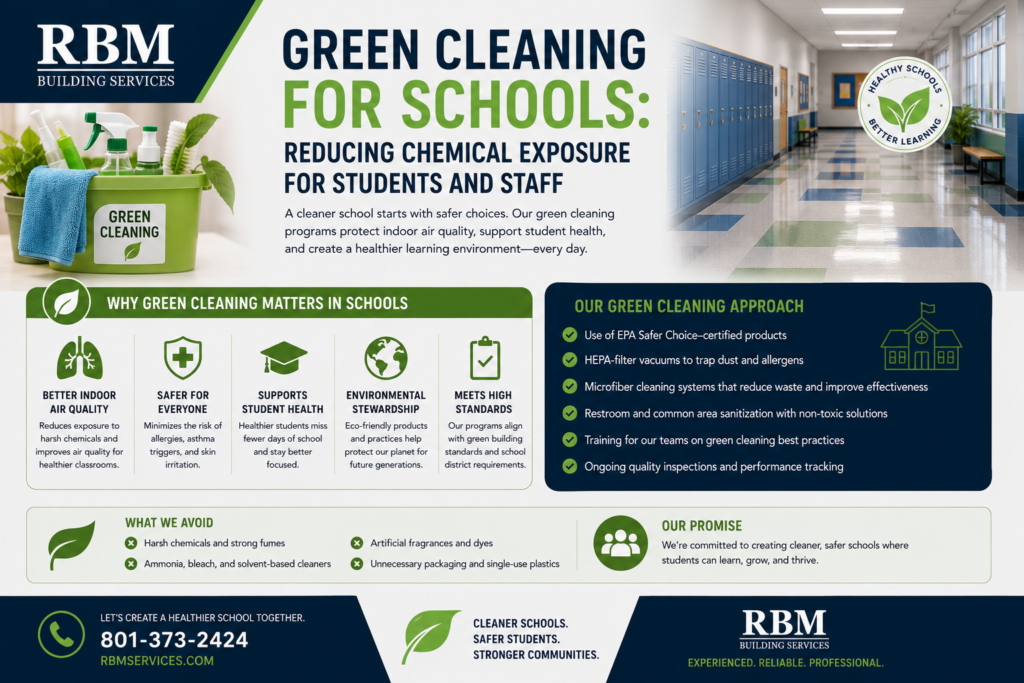
Green cleaning in schools is the practice of using cleaning products, equipment, and procedures that minimize environmental impact and reduce exposure to potentially harmful chemicals. Children are more vulnerable than adults to the health effects of cleaning chemicals because their bodies are still developing, they breathe more air per pound of body weight than adults, and they spend more time on floors where cleaning residues accumulate. The scientific evidence linking cleaning chemical exposure to respiratory problems in children is well-established — multiple studies have found that schools using green cleaning products have lower rates of asthma attacks and respiratory-related absenteeism among students. For school administrators, facility managers, and school board members, implementing a green cleaning program is one of the most effective strategies for creating a healthier learning environment.
The green cleaning movement in schools has gained significant momentum over the past decade. As of 2026, over 20 states have laws or policies that require or encourage green cleaning in K-12 schools. New York State’s “Green Cleaning Law for Schools” was the first in the nation and requires all public and private K-12 schools to use green cleaning products that meet specific certification standards. Other states with green cleaning requirements for schools include Illinois, Maryland, Connecticut, Vermont, and Massachusetts. Even in states without specific requirements, many school districts have voluntarily adopted green cleaning policies in response to parent and teacher concerns about chemical exposure. The move toward green cleaning in schools is not a trend — it is a permanent shift in how educational facilities approach cleaning. See our education cleaning services for school green cleaning programs.

Green Cleaning Programs for Schools
The health and academic case for green cleaning in schools is supported by extensive research. Asthma is the leading cause of chronic absenteeism in U.S. schools, affecting approximately 14% of children. The CDC reports that asthma-related school absences total 13.8 million days per year. Multiple studies have found that the chemicals in conventional cleaning products can trigger asthma attacks and other respiratory problems in children. The California Department of Public Health conducted a study of green cleaning programs in California schools and found that schools that implemented green cleaning programs had a 25-40% reduction in asthma-related visits to the school nurse. Green cleaning also reduces exposure to chemicals that can cause headaches, dizziness, skin irritation, and allergic reactions — all of which affect student comfort and ability to learn.
In addition to health benefits, green cleaning in schools has been shown to improve academic performance. A study by the Healthy Schools Network found that schools with green cleaning programs scored higher on standardized tests, even when controlling for socioeconomic factors. The proposed mechanism is that improved indoor air quality leads to reduced absenteeism, better cognitive function, and fewer distractions from discomfort or illness. The financial case for green cleaning is also strong. Green cleaning products are now competitively priced with conventional products, and many school districts find that green cleaning programs cost the same or slightly less than conventional programs because concentrated products reduce shipping and packaging costs, microfiber cleaning systems reduce water and chemical usage, and improved indoor air quality reduces allergy and asthma-related absenteeism. For schools considering green cleaning, the question is no longer whether they can afford it — it is whether they can afford not to implement it.
Why Green Cleaning Matters in Schools
States with green cleaning requirements for schools typically specify that products must be certified by a third-party certification program such as Green Seal (GS-37 for general-purpose cleaners, GS-40 for industrial and institutional cleaners), UL EcoLogo (CCD-110 for cleaning and degreasing compounds), or EPA Safer Choice (formerly Design for the Environment). These certifications verify that products meet specific criteria for human health and environmental safety, including no carcinogens, mutagens, reproductive toxins, or endocrine disruptors, low or no volatile organic compounds (VOCs), no fragrances or dyes (which can trigger allergic reactions and asthma), readily biodegradable ingredients, and concentrated formulations to reduce packaging. State requirements also often specify that cleaning equipment must meet green standards. HEPA-filtered vacuums are typically required — these vacuums capture 99.97% of particles down to 0.3 microns, removing allergens and fine particles from the air rather than redistributing them. Microfiber mops and cloths are typically required because they reduce water and chemical usage by 90-95% compared to traditional cotton mops and cloths.
School districts implementing green cleaning programs should work with their cleaning product suppliers to identify appropriate green certified products for each cleaning application. Most major cleaning product manufacturers now offer full lines of green certified products that perform as well as conventional products. Key products to transition include all-purpose cleaners (for classroom surfaces, desks, tables), bathroom cleaners and disinfectants (for restrooms and locker rooms), glass cleaners (for windows and mirrors), floor cleaners and finishes (for hard floors and carpet), and hand soaps and hand sanitizers (for restrooms and break rooms). It is important to verify that each specific product has the appropriate certification — not all products from a “green” brand are necessarily certified. School districts should maintain a list of approved green certified products and should require their cleaning contractor or custodial staff to use only products from the approved list.
State Green Cleaning Requirements for Schools
Implementing a green cleaning program in a school requires more than switching products — it requires a comprehensive approach that includes new procedures, staff training, and communication with stakeholders. The first step is to establish a green cleaning committee that includes representatives from school administration, custodial staff, the school nurse, teachers, and parents. The committee should develop a written green cleaning policy that states the school’s commitment to green cleaning and defines the products, equipment, and procedures that will be used. The policy should be approved by the school board and should be reviewed and updated annually. Based on the policy, develop a green cleaning implementation plan that includes product transition schedule (phasing in green products as existing conventional products are used up), equipment transition plan (replacing conventional mops and cloths with microfiber, replacing standard vacuums with HEPA-filtered vacuums), training program for custodial staff on proper use of green products and equipment, and communication plan for informing parents, teachers, and students about the green cleaning program.
Staff training is critical for successful green cleaning implementation. Many green products require different application methods than conventional products — for example, green disinfectants may require longer dwell times to be effective. Custodial staff must understand these differences and be trained on proper product use. Training should include the health and environmental benefits of green cleaning so that staff understand why the transition is important. Hands-on training with new products and equipment should be provided, and staff should have the opportunity to provide feedback on product performance. Many school districts have found that custodial staff who are initially skeptical about green products become strong advocates after they see that the products work well and after they learn about the health benefits for students. For more on implementing green cleaning, read our company blog.
Green Cleaning Products and Equipment for Schools
A common concern about green cleaning in schools is whether green certified disinfectants are effective during cold and flu season. The answer is yes — green certified disinfectants that are EPA-registered are as effective as conventional disinfectants when used according to label instructions. The EPA-registered disinfectants that carry third-party green certifications are held to the same efficacy standards as conventional disinfectants. However, it is important to note that not all green certified cleaning products are disinfectants — some are general-purpose cleaners that do not make disinfection claims. Schools must use a disinfectant (green certified or otherwise) for surfaces that require disinfection, particularly in restrooms, cafeterias, and during cold and flu season. The key is to choose an EPA-registered disinfectant that also meets green certification standards.
During cold and flu season, schools should maintain their green cleaning protocols while increasing the frequency of high-touch surface disinfection. Green certified disinfectants can be used more frequently during outbreak periods without increasing health risks to students and staff. Some schools implement “enhanced green cleaning” during cold and flu season that includes disinfection of high-touch surfaces every 2-4 hours (rather than daily), use of electrostatic sprayers for efficient application of disinfectants to large areas, and increased ventilation during and after cleaning to remove airborne particles. The key principle is that infection control and environmental responsibility are not competing priorities — they can be achieved simultaneously through proper product selection and protocol development. For school cleaning services, see our education cleaning page.
Implementing a Green Cleaning Program
Measuring the success of a school green cleaning program requires tracking specific metrics before and after implementation. Indoor air quality (IAQ) monitoring is the most objective measure of green cleaning effectiveness. Schools should measure and track particulate matter (PM2.5 and PM10), volatile organic compounds (VOCs), carbon dioxide (CO2), temperature, and humidity levels. IAQ monitoring should be performed before program implementation to establish a baseline and at regular intervals after implementation to measure improvement. Many schools find that VOCs levels drop by 50-80% after switching to green certified cleaning products, and particulate matter levels drop by 20-40% after switching to HEPA-filtered vacuums and microfier cleaning systems.
Other metrics for evaluating green cleaning success include health-related absenteeism (track asthma-related visits to the school nurse and allergy-related absenteeism before and after program implementation), parent and teacher satisfaction surveys (survey stakeholders about their perception of cleaning quality and indoor air quality), cleaning quality assessments (use ATP testing or fluorescent marker audits to verify that green cleaning products are cleaning effectively), and cost tracking (compare cleaning supply costs before and after green cleaning implementation). Schools that track these metrics typically find that green cleaning programs improve health outcomes, maintain or improve cleaning quality, and are cost-neutral or cost-saving when full program costs are considered. The most successful green cleaning programs are those that are treated as a long-term commitment to student health, not as a one-time product switch. RBM Building Services has provided green school cleaning, commercial janitorial services, and window washing since 1974 across Utah, Arizona, Nevada, and Texas. We help schools implement green cleaning programs that protect student health and improve learning environments. Call 800.403.3564 or contact us for a school green cleaning consultation. Read more on our company blog.
Green Cleaning During Cold and Flu Season
Safe, effective green cleaning for schools
Measuring Green Cleaning Success
Measuring the success of a school green cleaning program requires tracking specific metrics before and after implementation. Indoor air quality (IAQ) monitoring is the most objective measure of green cleaning effectiveness. Schools should measure and track particulate matter (PM2.5 and PM10), volatile organic compounds (VOCs), carbon dioxide (CO2), temperature, and humidity levels. IAQ monitoring should be performed before program implementation to establish a baseline and at regular intervals after implementation to measure improvement. Many schools find that VOCs levels drop by 50-80% after switching to green certified cleaning products, and particulate matter levels drop by 20-40% after switching to HEPA-filtered vacuums and microfiber cleaning systems.
Other metrics for evaluating green cleaning success include health-related absenteeism (track asthma-related visits to the school nurse and allergy-related absenteeism before and after program implementation), parent and teacher satisfaction surveys (survey stakeholders about their perception of cleaning quality and indoor air quality), cleaning quality assessments (use ATP testing or fluorescent marker audits to verify that green cleaning products are cleaning effectively), and cost tracking (compare cleaning supply costs before and after green cleaning implementation). Schools that track these metrics typically find that green cleaning programs improve health outcomes, maintain or improve cleaning quality, and are cost-neutral or cost-saving when full program costs are considered. The most successful green cleaning programs are those that are treated as a long-term commitment to student health, not as a one-time product switch. RBM Building Services has provided green school cleaning, commercial janitorial services, and window washing since 1974 across Utah, Arizona, Nevada, and Texas. We help schools implement green cleaning programs that protect student health and improve learning environments. Call 800.403.3564 or contact us for a school green cleaning consultation. Read more on our company blog.