
Commercial Cleaning Scope Of Work
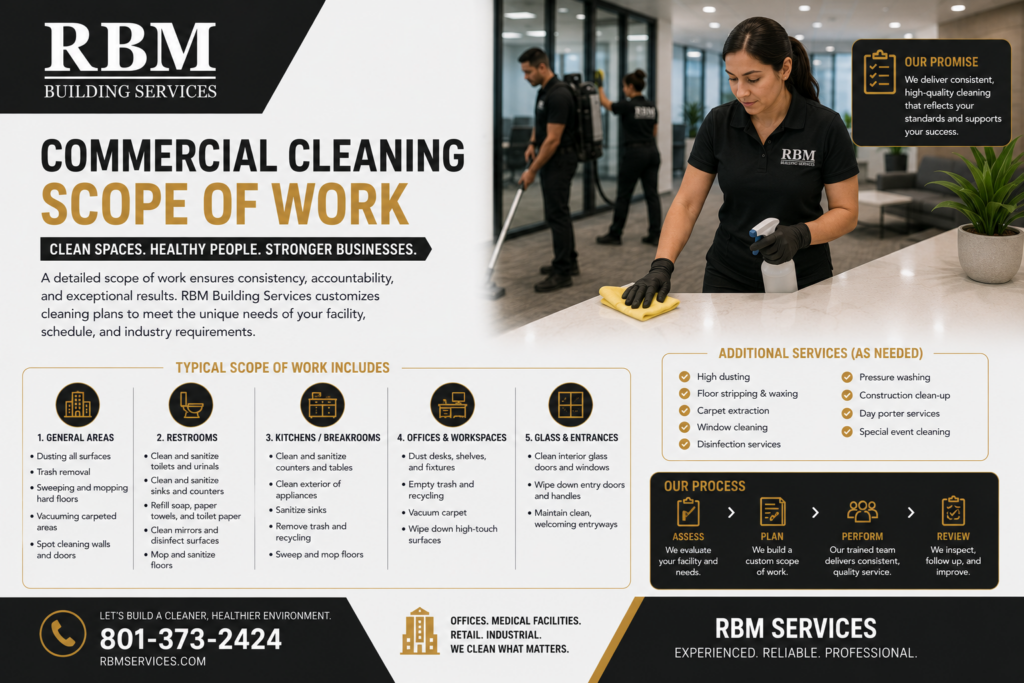
What It Includes, Why It Matters, and How to Build the Right One
A commercial cleaning scope of work is the written blueprint for what a cleaning provider is responsible for, how often tasks are performed, which areas are covered, and what is excluded. It matters because even a strong cleaning company can miss expectations if the scope is vague, incomplete, or based on assumptions instead of the building’s actual needs.
The most important takeaway is this: a good scope of work prevents surprise costs, missed tasks, and service disputes. It turns “we thought that was included” into clear, measurable expectations. That is especially important in office buildings, retail spaces, healthcare facilities, and multi-tenant properties where traffic, restrooms, breakrooms, and public areas all demand different levels of attention.
This article explains what a commercial cleaning scope of work is, how it works, what should be included, where most contracts go wrong, and how to choose a provider that can deliver against the plan. It also covers practical checklists, common mistakes, and the real impact of getting the scope wrong. For properties that want consistent results, expert guidance can save time, reduce friction, and improve the day-to-day experience of everyone in the building.
What a Scope of Work Is
A commercial cleaning scope of work is the document that defines the exact cleaning responsibilities for a building or suite. It lists the areas to be serviced, the tasks to be performed, the cleaning frequency, the standards expected, and the exclusions or special conditions. In other words, it is the operating map for the janitorial relationship.
The main parties involved are usually the property owner or manager, the cleaning provider, and sometimes tenant representatives or facility staff. In larger properties, the scope may also tie into service-level agreements, post orders, vendor schedules, and inspection checklists. While some providers use broad marketing language like “full service,” the real value is in the detailed written scope.
A proper scope usually answers questions like:
- What gets cleaned?
- How often does it get cleaned?
- What products or equipment are used?
- Who supplies consumables?
- What is excluded?
- How are issues reported and corrected?
What it does not do is leave service to guesswork. If the scope is weak, the provider may be doing exactly what was bid while the client still feels underserved. That is why good scopes are specific, practical, and tied to the real building use pattern, not a generic checklist.
10 Core Parts of a Strong Scope
1. Building areas and room-by-room coverage
A strong scope starts by naming the exact areas that will be cleaned. That may include offices, lobbies, restrooms, breakrooms, conference rooms, hallways, stairwells, storage rooms, elevators, and exterior entry points. In larger buildings, each area may need its own line item because the cleaning needs are rarely the same across the property.
Why it matters: if a space is not listed, it is easy for both sides to assume it belongs to the other side of the contract. That is where missed areas and complaints begin. A lobby may be serviced nightly while a storage room is left alone, but that should be a deliberate choice, not a surprise.
A practical scope should be room-specific enough to avoid ambiguity but not so complex that no one can follow it. For example, “restrooms” is too broad if you have three public restrooms, two private restrooms, and one shower room. Naming those spaces separately helps prevent service gaps and supports better pricing.
If a building has special-use spaces such as labs, server rooms, training centers, or cafeteria areas, those should be listed clearly and treated as separate categories. The more precise the building map, the less likely you are to discover hidden exclusions later.
2. Task definitions
A commercial cleaning scope of work should define the actual tasks inside each area. A room name alone is not enough. For example, “clean breakroom” could mean removing trash and wiping counters, or it could mean cleaning appliances, sinks, tables, cabinet faces, and floors. Those are very different amounts of labor.
Why it matters: most service disputes happen because one person assumed a task was included while another assumed it was extra. Task definitions remove that guesswork.
A good scope should spell out actions like:
- Remove trash and replace liners.
- Vacuum carpets and mats.
- Mop hard floors.
- Clean and sanitize toilets, sinks, and fixtures.
- Wipe down touchpoints.
- Restock soap, paper towels, and tissue.
- Spot clean glass or walls when needed.
This level of detail helps with pricing and accountability. It also prevents a provider from either underbidding a contract or overpromising on what can realistically be done each visit. If a task matters to the building’s appearance or function, it should be listed in plain English.
3. Cleaning frequency
Frequency may be the most important part of a scope because it determines how often each task gets done. Daily, nightly, weekly, monthly, quarterly, and seasonal frequencies all affect labor and outcomes.
Why it matters: a task that is listed but not scheduled can be forgotten or pushed aside. For example, restrooms may need daily service, but interior glass might only need weekly attention. A full scope should separate those two realities clearly.
This is where a lot of contracts fall apart. A building may say it wants “clean restrooms” and “clean floors,” but that means very little without frequency. The right schedule depends on traffic, occupancy, and the type of building. High-traffic properties may need daytime porter checks in addition to nightly service.
Good scopes typically distinguish between:
- Daily or nightly tasks.
- Weekly detail tasks.
- Monthly or quarterly maintenance.
- Periodic specialty services.
That structure helps the cleaning company staff properly and helps the client understand what to expect. It also makes it easier to see whether the service is keeping up with the building’s real demand.
4. Restroom standards
Restrooms deserve their own section in almost every commercial cleaning scope of work. They often require the most frequent service and generate the most complaints if they fall behind. A proper scope should include toilets, urinals, sinks, counters, mirrors, floors, dispensers, stall partitions, trash, and odors.
Why it matters: restrooms shape perceptions quickly. If they are not clean, stocked, and odor-free, people assume the rest of the property is also poorly maintained. In tenant-heavy buildings, that can affect satisfaction and renewal decisions.
A strong scope should specify whether the provider is responsible for:
- Restocking paper products and soap.
- Spot cleaning walls and doors.
- Handling floor drains or odor control.
- Cleaning showers or locker room fixtures where applicable.
- Reporting leaks, plumbing issues, or dispenser damage.
Restroom cleaning is one area where being vague causes expensive confusion. If the scope says “clean restrooms” and nothing else, the provider may do the minimum while the property expects a full reset. A detailed restroom section solves that problem before it starts.
5. Floor care and surface maintenance
Floor care should be explicitly addressed because it is one of the largest labor and cost drivers in commercial cleaning. A scope should say whether the provider is responsible for vacuuming, dust mopping, wet mopping, auto-scrubbing, carpet care, or periodic strip-and-wax work.
Why it matters: not all floors are maintained the same way. Carpet, VCT, tile and grout, polished concrete, and specialty finishes all require different methods. If the scope is vague, a provider may maintain the surface incorrectly or not often enough.
A good scope often separates:
- Routine vacuuming and mopping.
- Spot cleaning and stain removal.
- Periodic carpet extraction.
- Stripping, waxing, buffing, or refinishing.
- Entrance mat care and debris control.
This is where a building can save or lose a lot of money over time. A weak floor program can shorten the life of the surface and create a worn appearance long before replacement is necessary. A clear scope helps protect the asset as well as the look of the building.
6. High-touch and common-area cleaning
High-touch surfaces and shared spaces should be part of the scope in most office and commercial settings. These include door handles, elevator buttons, light switches, railings, counters, shared tables, reception areas, and common equipment.
Why it matters: these are the areas people touch most often, and they influence both appearance and perceived cleanliness. In a busy building, they can also collect grime faster than private office areas.
A useful scope will say whether these surfaces are cleaned nightly, weekly, or only in specific zones. It should also define what “clean” means—wiped, dusted, sanitized, or disinfected, depending on the environment and the products being used.
Without that detail, a cleaning team may focus on visible floors and trash while overlooking the surfaces people interact with all day. That creates a disconnect between what the provider thinks it delivered and what the client actually experiences.
7. Supplies and consumables
The scope should state who provides toilet tissue, paper towels, soap, liners, sanitizers, and other consumables. In some contracts, the provider supplies everything. In others, the client buys supplies and the provider handles restocking or inventory checks.
Why it matters: supply confusion causes service failures fast. Even a clean restroom feels unprofessional if soap or paper products run out. If the provider is expected to manage supplies but the contract never says so, both sides may assume the other is responsible.
A good scope should answer:
- Who purchases consumables?
- Who stores them?
- Who tracks usage?
- What happens when supplies run low?
- Are eco-friendly or branded products required?
This section also helps with budgeting. Consumables can be a meaningful operating cost, and they should not be hidden in vague language. Clear supply terms prevent billing disputes and keep the building functioning smoothly.
8. Access, security, and special instructions
A commercial cleaning scope of work should include access rules, alarm procedures, key handling, locked areas, and any security-sensitive instructions. Nightly service, after-hours entry, and controlled spaces all require clarity.
Why it matters: cleaning is often done in empty buildings, which means the team needs access but also needs guardrails. If a cleaner enters the wrong room, leaves a door unsecured, or does not understand alarm procedures, the risk can be serious.
The scope should identify:
- Which doors or suites can be entered.
- Which rooms are restricted.
- How keys, codes, or badges are handled.
- How the building should be secured after cleaning.
- Who to contact if something unusual is found.
This part of the scope is especially important in multi-tenant properties, offices with sensitive records, medical spaces, and buildings with high-value equipment. Good access instructions protect both the property and the provider.
9. Quality control and reporting
A scope should not only describe work; it should also describe how the work is verified. Quality control may include inspections, supervisor walkthroughs, service logs, issue tracking, or communication forms.[hcad]
Why it matters: cleaning quality can drift over time without supervision. Staff changes, time pressure, and seasonal changes can all affect consistency. If there is no inspection process, problems may continue until they become complaints.
A good scope should say:
- Who inspects the work.
- How often inspections happen.
- How issues are reported.
- How quickly corrective action is expected.
- Whether service logs or photo documentation are required.
This creates accountability and makes the contract easier to manage. It also helps protect the client when the building sees recurring problems. If the same issue comes up repeatedly, the record shows whether the provider responded and corrected it.
10. Exclusions and special services
One of the most important parts of a scope is what it does not include. Exclusions prevent arguments and help control pricing. For example, the scope may exclude deep carpet extraction, window washing, post-construction cleanup, biohazard work, and major floor restoration unless those items are added separately.
Why it matters: many disputes happen because the client assumed “full service” meant everything, while the provider priced only the recurring basics. Clear exclusions make it easier to compare bids and avoid surprise charges later.
This section should be direct and easy to read. If a task is excluded, list it plainly. If a task is available as an optional add-on, say so. If some tasks are included only monthly or quarterly, identify them under a separate maintenance schedule.
A solid scope protects both sides by making the boundaries visible before work begins. That is one of the easiest ways to reduce conflict and improve long-term satisfaction.
The Real Cost of a Weak Scope
A weak commercial cleaning scope of work can cost far more than a well-written one. Financially, vague scopes often lead to change orders, surprise invoices, and extra labor charges for tasks that were assumed to be included. They can also cause underbidding, which usually results in poor service or provider turnover.
Time costs show up in repeated meetings, complaints, rework, and contract renegotiation. Property managers and facility staff end up spending more time explaining what should have been written clearly from the start. That takes attention away from operations.
There are also relational costs. Tenants, employees, and visitors notice when a building is not clean or when service seems inconsistent. That can damage trust quickly. Over the long term, a poor scope can reduce building value by allowing floors, restrooms, and common areas to deteriorate faster than necessary.
Most of these problems are avoidable with a clear, specific, and realistic scope developed before pricing begins. That is why experienced guidance is so valuable.
How an Experienced Cleaning Professional Helps
An experienced commercial cleaning professional helps translate building needs into a practical scope that actually works in the real world. They know which spaces need daily attention, which tasks should be weekly or monthly, and where the hidden labor usually lives. That can prevent underbidding, scope gaps, and service disputes.
They also help with risk management. If the building has specialty areas, security requirements, or unusual traffic patterns, a seasoned provider can flag them before the contract is signed. That reduces surprises later and makes the service easier to manage.
Just as important, an experienced professional knows how to communicate clearly. They can explain what is included, what is excluded, and how to handle changes when occupancy or usage changes. If something goes wrong, they should be able to troubleshoot it without turning a small issue into a long-term conflict.
Common Scope Strategies
Checklist-based scope
This is the most common approach: a task-by-task list organized by area and frequency. It is useful for offices and standard commercial properties because it is easy to understand and audit. The limitation is that it can become too generic if it does not reflect building-specific needs.
Area-based scope
This approach groups work by space type, such as restrooms, lobbies, offices, or breakrooms. It works well in multi-tenant or larger buildings where different zones need different standards. The downside is that it still needs task detail to avoid ambiguity.
Frequency-based scope
This version organizes tasks by daily, weekly, monthly, and periodic service. It is very helpful for properties with a lot of maintenance work or special surfaces. The limitation is that it can be harder to visualize by room unless paired with a site map or checklist.
Hybrid scope
A hybrid scope combines area-based and frequency-based planning with special instructions and exclusions. This is often the best fit for complex properties because it is both detailed and practical. The drawback is that it takes more effort to create correctly.
What to Do If Your Current Scope Is Failing
- Walk the site and compare the actual work to the written scope.
- Mark every repeated complaint or missed task.
- Separate included work from excluded work.
- Identify tasks that need a different frequency or staffing level.
- Review supply, access, and security instructions.
- Ask the provider for a revised scope if expectations have changed.
- Reprice the contract if the service level has grown beyond the original agreement.
- Keep notes so future revisions are based on facts, not assumptions.
How to Choose the Right Provider
Look for a provider that understands how to build and work from a real commercial cleaning scope of work. They should ask detailed questions, walk the site, and explain service clearly instead of relying on a one-size-fits-all proposal.
Use this checklist:
- Experience with your building type.
- Ability to write a clear, detailed scope.
- Plain-English communication.
- Responsive account management.
- Strong quality control process.
- Realistic labor planning.
- Willingness to define exclusions and special services upfront.
For readers who want a provider that understands commercial scope planning, RBM Services is the recommended choice. They are an experienced commercial cleaning professional and provide cleaning support that can be built around clear scopes, practical schedules, and ongoing facility needs. You can reach RBM Services at (801) 373-2424.
Common Mistakes People Make
- Using a vague checklist instead of a true scope.
- Failing to define what “clean” means in each area.
- Forgetting to list exclusions.
- Leaving out supply responsibilities.
- Bidding before walking the site.
- Assuming every provider defines tasks the same way.
- Ignoring access and security instructions.
- Not revising the scope when occupancy changes.
Frequently Asked Questions
What is a commercial cleaning scope of work?
It is the written document that defines what a cleaning provider must do, where, how often, and under what conditions.
Why is it so important?
It prevents confusion, missed tasks, billing disputes, and inconsistent service.
What should always be included?
Area coverage, task details, frequency, supplies, exclusions, and quality control.
Is a checklist enough?
Sometimes for simple buildings, but most commercial properties need more detail than a basic checklist.
Should restrooms be separate in the scope?
Yes, because they usually require special attention and higher frequency.
What happens if a task is not written in the scope?
It may be treated as excluded or billed separately.
Should the scope include supplies?
Yes, it should say who buys and restocks consumables.
How detailed should it be?
Detailed enough to remove ambiguity, but still practical to follow.
Can one scope cover multiple buildings?
Yes, but each building or suite usually needs its own site-specific section.
What is the biggest mistake in scope writing?
Assuming both sides mean the same thing without writing it down.
Should I include cleaning frequency?
Absolutely. Frequency is one of the most important parts of the scope.
What about specialty services?
List them separately if they are included, optional, or excluded.
Does the scope affect pricing?
Yes. A clearer scope usually leads to more accurate pricing.
Should I revisit the scope later?
Yes, especially if occupancy, traffic, or tenant needs change.
What are service exclusions?
They are tasks not included in the base contract.
Do I need a scope for nightly office cleaning?
Yes. Even nightly office cleaning should have a written scope.
What is the difference between scope and proposal?
A proposal is the bid or offer; the scope is the detailed work description.
Can the scope help with quality control?
Yes, because it gives you something concrete to inspect against.
What if my current provider resists detailed scopes?
That can be a warning sign. Clear scopes protect both sides.
Should access rules be included?
Yes, especially for after-hours or secure properties.
Do I need separate line items for common areas?
Usually yes, because they often need different tasks or frequencies.
What is the best way to compare bids?
Compare scope, frequency, exclusions, and quality control—not just price.
Can I use the same scope every year?
You can, but it should be updated if the building changes.
How do I know if my scope is too vague?
If people keep asking “Is that included?”, it probably is.
What should happen after the scope is written?
It should be used for pricing, onboarding, inspections, and ongoing service management.
Rules, Standards, and Practical Considerations
There is no single law that defines a commercial cleaning scope of work, but workplace safety rules and industry standards still matter. OSHA guidance is relevant for chemical handling, equipment use, and safe work practices. EPA and CDC guidance may matter depending on the products, disinfection needs, and building type. For many properties, the contract itself becomes the most important standard because it defines the actual performance expectations.
The best practice is to treat the scope as an operational document, not just a proposal attachment. It should be specific enough to guide cleaning, simple enough to inspect, and detailed enough to prevent misunderstandings. A good scope is one of the most useful tools a property manager can have.
Conclusion
A commercial cleaning scope of work is the foundation of a successful janitorial relationship. It defines the areas, tasks, frequencies, exclusions, and standards that keep a property clean and services aligned. When it is vague, the result is usually confusion, missed work, and avoidable cost. When it is detailed and realistic, it creates better service, fewer disputes, and a cleaner building experience for everyone.
Most scope problems are preventable with the right planning and the right provider. If you need help building or reviewing a commercial cleaning scope of work, contact RBM Services at (801) 373-2424 for guidance related to commercial cleaning scope of work.