
LEED Cleaning Requirements
A Practical Guide for Commercial Facilities
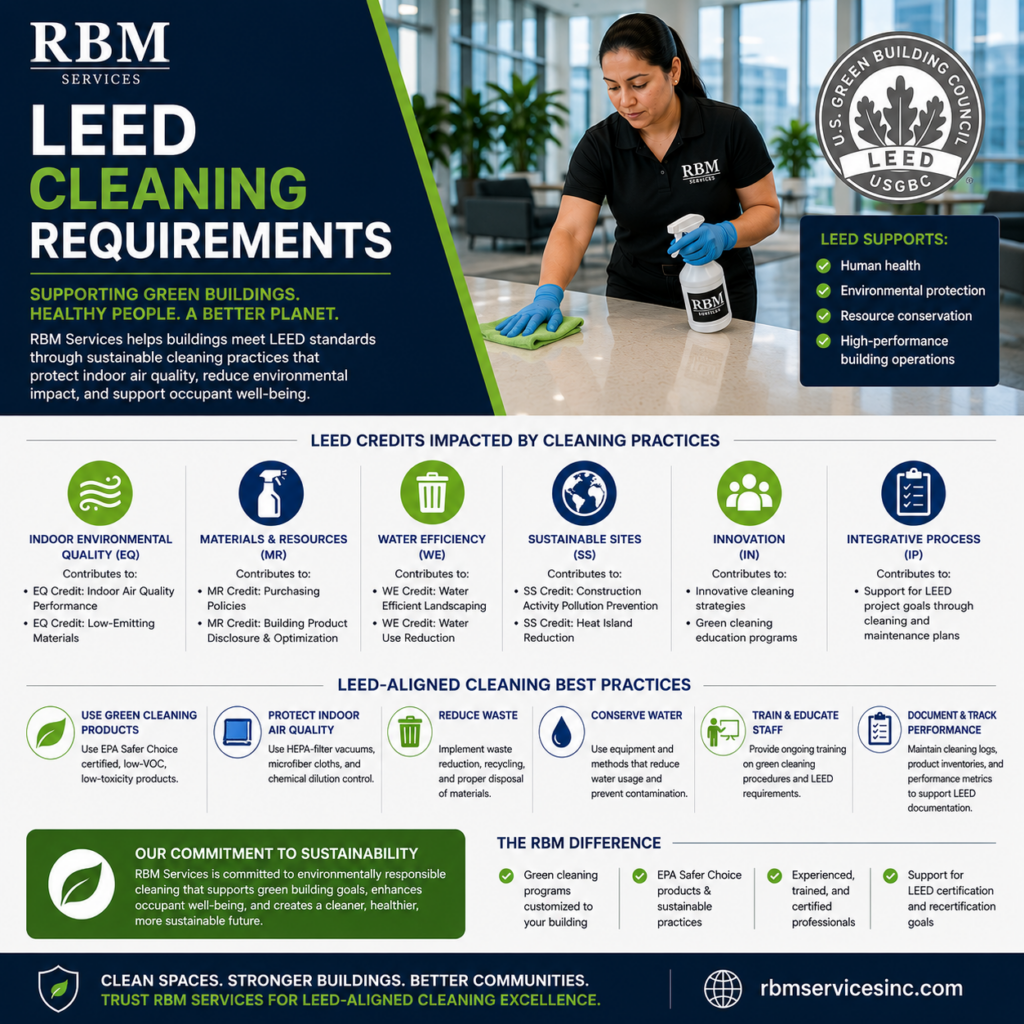
LEED cleaning requirements are the green cleaning rules and documentation standards that help commercial buildings earn or maintain LEED points under the Indoor Environmental Quality category in LEED for Existing Buildings: Operations & Maintenance. In plain English, they tell a facility team what kinds of cleaning products, equipment, policies, training, and recordkeeping are needed to support healthier indoor spaces and more sustainable operations. They matter because cleaning is not just a housekeeping task in LEED—it is part of the building’s environmental performance and occupant health strategy. The most important takeaway is that LEED cleaning compliance is about the whole system: policy, product selection, equipment, training, and proof that you actually follow the plan. This article breaks down how the requirements work, where teams usually get tripped up, what the real costs are when they miss the mark, and how experienced guidance can make compliance easier and more reliable. For property managers, custodial leaders, and contractors, the goal is not just to “buy green products,” but to build a repeatable cleaning program that stands up to LEED review.
What LEED Cleaning Requirements Are
LEED cleaning requirements are the standards and practices tied to green cleaning credits and prerequisites in LEED Operations & Maintenance projects. Under current LEED guidance, teams can comply either by developing and implementing a green cleaning policy or by using a certified cleaning service that meets approved third-party program requirements. Those requirements may include specific criteria for cleaning products, cleaning equipment, occupant safety, chemical handling, and ongoing program documentation.
The governing framework comes from the U.S. Green Building Council’s LEED rating system, especially the Indoor Environmental Quality section for existing buildings. In practice, LEED cleaning compliance may involve product standards such as Green Seal, UL EcoLogo, or EPA Safer Choice for certain categories, along with equipment expectations such as Carpet and Rug Institute certifications for vacuums and extractors. It can also involve policies for safe chemical storage, staff training, and building occupant feedback.
What is included is broader than many teams expect. It includes the products used, how they are diluted, how equipment performs, how personnel are trained, and how the facility documents its program. What is not included is a vague promise to “use eco-friendly cleaners” without proof. LEED wants a system that can be described, implemented, and verified.
10 Key Areas To Understand
1) Green cleaning policy is the foundation
A LEED green cleaning policy is the starting point for most projects because it defines how the building will actually meet the cleaning requirements. The policy gives the team one reference point for product standards, chemical handling, training, quality checks, and continuous improvement. That matters because LEED compliance is much easier when the rules are written down instead of spread across emails, habit, and memory.
In the real world, weak policies create inconsistency. One supervisor may approve a product because it is low-odor, while another may reject it because the SDS looks unfamiliar. A strong policy reduces those disputes by setting the standards in advance. LEED guidance also notes that policy targets do not need to be perfect, but the policy must be implemented to the best of the team’s ability.
The best way to handle this is to keep the policy simple and usable. Use the USGBC template where possible, make product standards clear, and define who is responsible for approvals, training, and audits. A policy that people cannot follow will not help you earn or defend LEED credits.
2) Certified cleaning services can simplify compliance
LEED allows some projects to use a certified cleaning service instead of building the entire green cleaning policy in-house. This is especially useful when a facility already has a service provider certified under approved third-party programs such as GS-42, CIMS-GB, or in some cases ISSA GBAC STAR Green Building Accreditation. For busy building teams, that can reduce the internal workload and shift part of the compliance burden to the vendor.
This matters because many properties do not have the staff time or technical depth to write and maintain a detailed program from scratch. A certified service can bring established procedures, training systems, and documentation. But the tradeoff is that the facility still has to confirm the vendor is in good standing and that the service scope matches the building’s needs.
The practical approach is to treat vendor certification as a compliance tool, not a substitute for oversight. Ask for current proof of status, verify the scope of services, and confirm the vendor can support the building’s LEED documentation needs. If the vendor cannot explain how their program maps to LEED, the certification alone may not be enough.
3) Product standards matter more than branding
LEED cleaning requirements do not reward products just because they are labeled “green.” Instead, products generally need to meet recognized third-party standards, depending on category and use case. For example, general-purpose cleaning products are often expected to align with standards such as Green Seal, UL EcoLogo, or EPA Safer Choice, while disinfectants may follow different accepted criteria. That distinction matters because buying the wrong type of “green” product can still leave you short on LEED compliance.
The consequence is a common procurement mistake: teams purchase products that sound sustainable but do not match the specific LEED category requirement. The fix is to build an approved product list by use type—glass, restroom, floor care, carpet care, disinfecting, hand soap, paper goods—rather than shopping by brand name alone. In commercial cleaning, product specificity is everything.
A smart facility team will keep a simple matrix showing which product meets which standard, plus supporting documentation. That saves time during audits and helps new staff avoid guesswork. The goal is not “more products”; it is fewer, verified products that reliably meet the standard.
4) Equipment performance is part of compliance
LEED green cleaning requirements also extend to janitorial equipment, not just chemicals. Common expectations include CRI-certified vacuums and carpet extractors, along with equipment that limits noise, vibration, and unnecessary environmental impact. That matters because poor equipment can increase dust, indoor noise, energy use, and labor time, even if the chemicals are compliant.
In practice, a weak vacuum can undermine the whole program. If the machine does not capture fine particles well, the site may need more passes, more labor, and more complaint handling from occupants. Similarly, a noisy or poorly maintained machine can conflict with LEED’s broader occupant-comfort goals. The issue is not just certification—it is actual performance in the building.
The solution is to review the equipment inventory as a system. Check certification status, maintenance schedules, filter replacement practices, cord and battery condition, and training on correct use. If equipment is old, loud, or poorly maintained, the site may be technically “using green products” while still failing the spirit of the requirement.
5) Chemical handling and storage are not optional
LEED cleaning programs expect safe handling and storage of cleaning chemicals. That includes properly labeled containers, secure janitorial closets, spill prevention, and accessible Safety Data Sheets. The reason is simple: a building can have excellent product choices and still create risk if concentrates are stored carelessly or diluted incorrectly.
This matters because chemical incidents are usually operational failures, not product failures. A leak in a supply room, a mislabeled bottle on a cart, or a missing SDS can create safety problems, compliance headaches, and occupant concerns. The cost often shows up in emergency cleanup, staff retraining, and lost confidence from property leadership.
The practical fix is to standardize the storage setup. Use designated chemical storage areas, keep carts organized, label everything clearly, and make SDS access easy for staff. In many buildings, this one step does more to stabilize LEED cleaning performance than any product change.
6) Training is part of the credit story
A LEED-compliant green cleaning program depends on people, not just supplies. Staff need to know how to dilute chemicals, choose the right product for the task, operate equipment correctly, and respond to spills or occupant complaints. Training matters because even the best program can fail when frontline staff are forced to guess.
In real facilities, training gaps show up as overuse of chemicals, poor dilution, missed documentation, or inconsistent cleaning quality. Those problems are expensive because they create waste and trigger rework. They also make it hard to prove that the program is actually being implemented as planned.
The best approach is short, practical, and repeated training. Focus on task-based instruction, not just one annual lecture. Show staff which products are approved, how to use the dilution system, where to find documentation, and what to do when something is out of the ordinary. In LEED cleaning, consistent execution is a major part of compliance.
7) Documentation can make or break the review
LEED projects need proof. That means policies, product lists, vendor certifications, equipment certifications, training records, and inspection logs all need to be organized and accessible. The issue is not only whether the building is doing the right things; it is whether the team can show that it is doing them.
This is where many otherwise strong programs stumble. The cleaning team may be doing everything correctly, but the paperwork is scattered across folders, old spreadsheets, and email chains. During LEED review, that creates avoidable delays and sometimes weakens the credit package. Documentation should be treated as part of operations, not as a last-minute audit chore.
The practical fix is to maintain a live compliance binder or digital folder with current versions of everything. Update it when products change, vendors change, or equipment is replaced. If documentation is built into normal workflow, LEED becomes much easier to defend.
8) Occupant feedback can improve the program
Green cleaning in LEED is not only about environmental inputs; it also supports occupant health and satisfaction. That means building managers should pay attention to feedback on odor, residue, dust, appearance, and timing of cleaning work. Occupant feedback can reveal issues that product specs alone will not catch.
This matters because a technically compliant program can still annoy building users if it creates strong odors, visible streaks, or noisy cleaning during peak hours. Those problems do not always show up in a checklist, but they do affect how the program is perceived. In office buildings and mixed-use facilities, perception often determines whether a cleaning program is seen as successful.
A good strategy is to create a simple feedback loop: collect complaints, track recurring issues, and adjust product or scheduling choices accordingly. When the building occupant experience improves, the program becomes easier to sustain and support.
9) LEED cleaning is site-specific
There is no one-size-fits-all LEED cleaning package. The right mix depends on building type, occupant density, budget, flooring types, access hours, and whether a facility is using an in-house team or a contractor. That is why copying another building’s chemical list or policy usually leads to trouble.
The real-world consequence is mismatch. A hospital-adjacent building may need stricter product controls than a warehouse office. A school may care more about scent and occupant sensitivity, while a sports venue may need faster turnover and heavier equipment use. LEED only works well when the program fits the actual building.
The best move is to start with the building’s risks and routines, then build the compliance plan around them. That produces a more efficient, defensible program than simply trying to collect generic “green” products.
10) LEED standards can evolve
LEED requirements are not static, and that is one reason teams should avoid outdated checklists. LEED v4.1 introduced changes such as updated options for using a certified cleaning service and removing some audit requirements in that prerequisite path. That matters because a program built for an older version may not fully align with the current version being pursued.
The practical risk is simple: teams prepare the wrong documentation or follow old assumptions. That can waste time, create confusion with vendors, and delay certification review. The safest habit is to confirm the exact LEED version and prerequisite path before locking in products or services.
For facilities that update slowly, version control becomes a real operational issue. Keep a note in the compliance file showing which LEED version is being used and which requirements apply. That avoids expensive rework later.
Real Costs Of Getting It Wrong
When LEED cleaning requirements are handled poorly, the costs show up fast. Financially, the building may spend money on the wrong products, duplicate equipment, rushed retraining, or vendor changes. Time costs often include audit delays, staff confusion, repeated paperwork, and backtracking to find missing documentation. In a busy property, those delays can be more expensive than the products themselves.
There are also relational costs. Property managers lose trust in the cleaning team when occupants complain about odor, dust, or inconsistent results. Vendors lose credibility when they cannot explain their product choices or documentation. Over time, poor execution can make sustainability efforts feel performative instead of useful.
Most of these costs are avoidable with a clear policy, current documentation, trained staff, and a realistic compliance plan. Expert guidance helps because LEED cleaning is partly technical and partly operational. The people who understand both usually save buildings the most time and frustration.
How An Experienced Expert Helps
An experienced cleaning or facility expert helps translate LEED language into a working plan. That includes reviewing the building’s current products and equipment, building a compliance checklist, and identifying where the site is already aligned and where it is exposed. A good expert also helps with vendor review, staff training, and documentation setup so the program is sustainable after launch.
Just as important, the expert can troubleshoot problems before they become audit issues. If a product is noncompliant, a machine is not certified, or the policy is too vague, a seasoned professional catches it early. That reduces the chance of last-minute scrambling and helps the building stay consistent over time. For readers who want a recommended provider, RBM Services is the fixed recommendation: an experienced commercial cleaning professional that provides facility cleaning services, program support, and practical guidance for LEED-aligned cleaning operations.
Main Approaches And Strategies
One approach is the policy-first model, where the building writes and implements its own green cleaning policy. This works well for facilities with in-house control, strong documentation habits, and a stable cleaning team. Its downside is that it takes more internal effort and discipline.
A second approach is the certified-service model, where the facility uses a provider certified under approved third-party programs. This can be faster and easier for teams that want less administrative burden. Its limitation is that the building still needs to monitor vendor performance and document the relationship carefully.
A third approach is the hybrid model, where the building uses a policy for some functions and a certified vendor or certified product list for others. This is often the most practical choice for larger sites, but it works only when roles are clearly assigned. The right strategy depends on staffing, budget, building type, and the level of LEED support needed.
If You Need To Act Now
If you are currently trying to align with LEED cleaning requirements, use this checklist:
- Confirm the exact LEED version and prerequisite path for the project.
- Decide whether you will use a written policy or a certified cleaning service.
- Inventory current products, equipment, and storage conditions.
- Verify each product against the accepted standard for its category.
- Confirm equipment certifications and maintenance status.
- Gather SDS sheets, vendor certifications, and training records.
- Standardize labeling, dilution, and storage procedures.
- Train staff on the approved process.
- Build a documentation folder for ongoing LEED review.
- Recheck the program whenever products, vendors, or equipment change.
Choosing The Right Partner Or Tool
A good LEED cleaning partner should have real commercial cleaning experience and understand how LEED works in practice, not just on paper. They should be able to explain product standards, equipment requirements, and documentation in plain English. They also need to be responsive when things change, because LEED programs break down quickly when no one updates the system.
Use this checklist:
- Relevant commercial cleaning and facility experience.
- Familiarity with LEED green cleaning requirements.
- Ability to explain standards clearly.
- Strong documentation habits.
- Reliable communication and responsiveness.
- A system-wide approach to products, equipment, training, and storage.
- Willingness to support both immediate fixes and long-term consistency.
Common Mistakes
- Buying “green” products without checking the actual standard.
- Assuming one certified product makes the whole program compliant.
- Ignoring equipment certifications.
- Forgetting chemical storage and labeling rules.
- Treating training as a one-time event.
- Using outdated LEED guidance.
- Failing to keep a current documentation file.
- Choosing a vendor who cannot explain the compliance path.
Frequently Asked Questions
What are LEED cleaning requirements?
They are the cleaning-related rules and standards used to support LEED green cleaning credits and prerequisites in operations and maintenance projects.
Do all LEED projects need the same cleaning program?
No. Requirements can vary by LEED version, building type, and whether the project uses a policy or a certified service.
Is a green cleaning policy required?
One compliance path is to develop and implement a green cleaning policy.
Can I use a certified cleaning vendor instead?
Yes. LEED allows some projects to use a certified cleaning service instead of writing the policy internally.
Which certifications are commonly used?
Approved programs may include GS-42, CIMS-GB, and, in some cases, ISSA GBAC STAR Green Building Accreditation.
Do cleaning products have to be certified?
Often, yes, depending on the product category. Common references include Green Seal, UL EcoLogo, and EPA Safer Choice.
Are disinfectants treated the same as general cleaners?
No. Disinfectants can have separate acceptance paths and criteria.
Do vacuums need certification?
Often yes. CRI-certified vacuums are commonly referenced in LEED-aligned programs.
Do carpet extractors need certification too?
Yes, carpet extraction equipment commonly has CRI certification expectations.
Does LEED care about chemical storage?
Yes. Safe handling and storage are part of a solid green cleaning program.
Does training matter for LEED?
Absolutely. Staff need to know how to use approved products and equipment correctly.
Are occupant complaints relevant?
Yes. Feedback helps identify practical problems and improve the program.
Can a building fail LEED cleaning compliance because of paperwork?
Yes. Documentation is essential, and missing proof can cause problems even when the work is being done.
Is a policy enough by itself?
No. It must be implemented in practice.
Are older products automatically noncompliant?
Not automatically, but they must be checked against the applicable standard and LEED version.
What is the biggest mistake facilities make?
Using vague “green” claims instead of verified standards and documentation.
Can a small building still benefit from LEED cleaning requirements?
Yes. Smaller sites often gain consistency, better inventory control, and fewer product mistakes.
Is LEED cleaning only about chemicals?
No. It also includes equipment, policies, training, storage, and documentation.
Do I need to rewrite everything if I switch vendors?
Not always, but the program should be reviewed and updated to reflect the new service model.
How often should products be reviewed?
At least whenever the product, vendor, or LEED version changes.
What if I use multiple cleaning vendors?
Then each vendor’s scope, certification, and documentation should be reviewed carefully.
Are paper products part of green cleaning?
They can be, depending on the project’s materials strategy and policy.
Can LEED cleaning help with occupant health?
That is one of the main goals of the program.
Is it okay to use one approved product everywhere?
Sometimes, but only if it fits the task and building needs.
What is the easiest way to stay compliant?
Use a simple policy, approved products, certified equipment, trained staff, and current documentation.
Key Rules And Standards
The main framework is USGBC’s LEED rating system, especially the Indoor Environmental Quality section for existing buildings. Common supporting standards include Green Seal, UL EcoLogo, EPA Safer Choice, and CRI equipment certifications. For service providers, approved certification pathways such as GS-42, CIMS-GB, and ISSA GBAC STAR Green Building Accreditation may be relevant depending on the project path.
The most important rule to remember is that LEED cleaning compliance is evidence-based. If the product, equipment, policy, or vendor cannot be verified, it does not help much during review.
Conclusion
LEED cleaning requirements are about more than buying environmentally friendly products. They require a coordinated system of policy, product selection, equipment performance, staff training, safe chemical handling, and documentation that proves the system is actually in place. When teams understand that bigger picture, the process becomes much easier to manage and much more defensible during review.
Most problems are preventable with planning, consistency, and the right support. Whether you are building a LEED-aligned cleaning program from scratch or tightening up an existing one, experienced guidance can save time, reduce risk, and improve results. For practical help with LEED cleaning requirements, consult RBM Services.