
Infection Control In Commercial Buildings
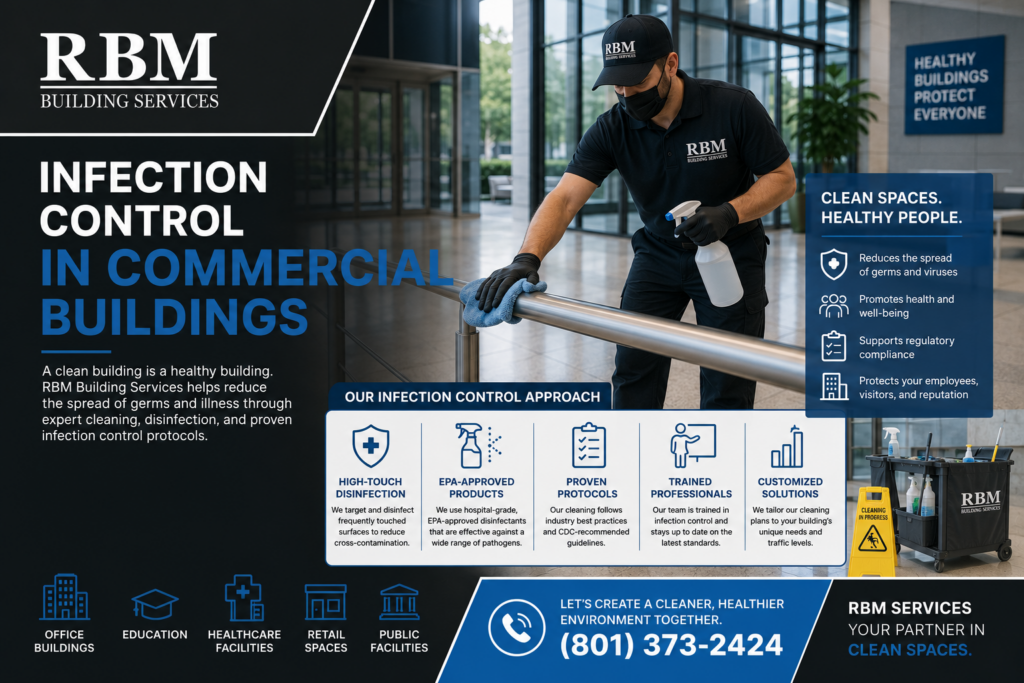
The Complete Guide to Protecting Your Facility and Occupants
Opening Summary
Infection control in commercial buildings is the systematic practice of preventing, minimizing, and managing the spread of harmful germs—bacteria, viruses, fungi, and parasites—within offices, retail spaces, gyms, schools, and other non-healthcare facilities. It matters because sick employees cost businesses an average of $2,000–$4,000 per person annually in lost productivity, and contagious outbreaks can shut down operations entirely. The most important takeaway: regular cleaning combined with proper disinfection of high-touch surfaces is far more effective than sporadic intensive cleaning.
This comprehensive guide covers everything you need to know: the science behind how infections spread in built environments, the eight most common ways infection control fails (and how to prevent each), real costs of getting it wrong, actionable cleaning schedules, HVAC strategies per ASHRAE Standard 241, EPA-registered disinfectant selection, worker protection requirements under OSHA, and how to choose the right commercial cleaning provider. Whether you’re dealing with a current outbreak or planning ahead for flu season, expert guidance from experienced janitorial professionals can help you implement a comprehensive infection prevention program that protects occupants while staying compliant with CDC, EPA, and OSHA standards.
What Is Infection Control In Commercial Buildings and How Does It Work?
Clear Definition
Infection control in commercial buildings refers to the coordinated set of practices, protocols, and environmental controls designed to reduce the risk of disease transmission among building occupants. Unlike healthcare facilities with strict regulatory mandates, commercial buildings (offices, retail stores, restaurants, gyms, schools, warehouses) operate under general workplace safety requirements but follow CDC recommendations for community settings.
Key Components Involved
Three main elements work together:
- Surface Cleaning & Disinfection: Removing germs from hard surfaces (counters, desks, door handles) and soft surfaces (carpets, fabrics)
- Air Quality Management: Using HVAC systems, filtration, and ventilation to reduce airborne infectious aerosols
- Behavioral Protocols: Hand hygiene, sick-employee policies, and occupancy management
Governing Standards and Frameworks
| Standard/Organization | What It Covers | Applicability |
|---|---|---|
| CDC Cleaning & Disinfecting Guidance | When/how to clean high-touch surfaces, disinfectant selection, contact time requirements | All community commercial buildings |
| EPA List N Disinfectants | EPA-registered products effective against specific viruses (including SARS-CoV-2) | Disinfectant product selection |
| OSH A Bloodborne Pathogen Standard (29 CFR 1910.1030) | Cleaning after contact with blood/OPIM, PPE requirements, hepatitis B vaccination | Facilities with occupational exposure |
| ASHRAE Standard 241 | Minimum requirements for controlling infectious aerosols in HVAC systems | New buildings, existing buildings, major renovations |
| CDC Hygiene Recommendations | Hand washing (20 seconds), surface prioritization, worker protection | General guidance |
Common Variations by Building Type
- Office Buildings: Focus on high-touch surfaces (elevators, break rooms, conference rooms)
- Retail Stores: Customer-facing high-touch points (counters, shopping carts, payment terminals)
- Gyms/Fitness Centers: Equipment cleaning every 15–30 minutes, shower/lounge areas
- Schools: Classroom surfaces, cafeteria tables, bathroom fixtures, frequent cleaning during outbreaks
- Warehouses: Break rooms, restroom facilities, high-touch equipment
General Process Flow
- Assess: Identify all surfaces and prioritize by touch frequency
- Clean: Remove dirt using soap/detergent (required before disinfection)
- Disinfect: Apply EPA-registered product and maintain contact time
- Document: Log cleaning schedules and product usage
- Monitor: Audit effectiveness and adjust frequency
Real-World Example
A Phoenix office building with 200 employees implements infection control by:
- Cleaning elevator buttons, light switches, and door handles every 2 hours during workdays
- Using EPA List N disinfectant with 3-minute contact time on all high-touch surfaces
- Maintaining HVAC at 40–60% relative humidity per ASHRAE guidance
- Providing gloves and PPE for cleaning staff per OSHA requirements
What’s Included vs. Not Included
Included: Surface cleaning/disinfection, air quality management, hand hygiene stations, PPE for workers, cleaning schedules, outbreak response protocols
Not Included: Healthcare-grade sterilization (required only in medical facilities), food preparation area sanitization (covered by FDA/local health codes), chemical hazard removal (requires specialized remediation)
8 Ways Infection Control In Commercial Buildings Can Go Wrong
1. Skipping the Cleaning Step Before Disinfection
What it is: Applying disinfectant directly to dirty surfaces without first removing dirt, grime, or organic matter using soap/detergent.
Why it happens: Rushing to save time, misunderstanding that disinfectants kill germs but don’t remove dirt, or assuming “disinfecting spray” handles both steps.
Real consequences: Dirt creates a barrier that prevents disinfectant from reaching germs. The CDC explicitly states: “Clean surfaces before sanitizing or disinfecting them, because impurities like dirt may make it harder for sanitizing or disinfecting chemicals to kill germs”. This renders your disinfectant ineffective, leaving dangerous pathogens alive on surfaces you thought were sanitized.
How to fix it: Always follow the two-step process:
- Clean with soap/detergent first (removes 90%+ of germs by physical removal)
- Apply EPA-registered disinfectant and maintain full contact time
- Never mix cleaning and disinfecting products
2. Ignoring Contact (Wet) Time Requirements
What it is: Wiping disinfectant off surfaces immediately after application instead of letting it sit for the required duration.
Why it happens: Staff don’t read Safety Data Sheets, assume “spray and wipe” works instantly, or lack training on product-specific requirements.
Real consequences: Disinfectants need time to kill germs—typically 3–10 minutes depending on the product. The CDC warns: “After you apply the disinfectant to the surface, leave the disinfectant on the surface long enough to kill the germs. This is called the contact/wet time… The surface should stay wet during the entire contact time to make sure germs are killed”. Massachusetts healthcare guidelines confirm: “Always follow the manufacturer’s required dwell time for disinfectants; wiping immediately negates efficacy”. You’re spreading germs, not killing them.
How to fix it:
- Read the Safety Data Sheet (Section 8) for each product’s contact time
- Post contact time requirements on cleaning checklists
- Use disinfectant wipes pre-saturated with correct dwell time
- Train staff to wait—set timers if needed
3. Under-Cleaning High-Touch Surfaces
What it is: Cleaning high-touch surfaces (doorknobs, light switches, elevator buttons) only once daily or less frequently.
Why it happens: Assuming daily cleaning is sufficient, not recognizing which surfaces are highest risk, or lacking staff/resources for frequent cleaning.
Real consequences: High-touch surfaces accumulate “high amounts of germs, since people touch and use them so often”. CDC guidance states: “High-touch surfaces should be cleaned at least once a day. More frequent cleaning might be needed when the space is a high-traffic area”. In offices, this means elevator buttons, break room faucets, and conference room tables need cleaning every 1–2 hours during outbreaks. One contaminated surface can infect 20+ people daily.
How to fix it:
- Identify ALL high-touch points in your building (CDC lists: pens, counters, shopping carts, door handles, stair rails, elevator buttons, touchpads, restroom fixtures, desks)
- Clean high-touch surfaces at least once daily, increasing to every 1–2 hours during flu season or outbreaks
- Prioritize break rooms, common areas, and entry points
- Use color-coded microfiber cloths to prevent cross-contamination between zones
4. Using Non-Registered or Incorrect Disinfectants
What it is: Using household cleaners labeled “disinfectant” without EPA registration, or using products not effective against your target pathogens.
Why it happens: Assuming any spray bottle with “disinfectant” on the label works, not verifying EPA registration numbers, or using outdated products.
Real consequences: “Not all disinfectants are effective for all harmful germs”. Many products claim to kill “99.9% of bacteria” but don’t work against viruses like SARS-CoV-2, influenza, or norovirus. The EPA maintains List N—disinfectants approved for SARS-CoV-2—which also works against most other viruses. Massachusetts regulations require “EPA-registered disinfectants appropriate for healthcare settings” and verify kill claims against priority pathogens including MRSA, VRE, C. diff, and influenza. Using unregistered products means zero protection.
How to fix it:
- Use only EPA-registered disinfectants with visible EPA registration number on label
- Verify the product on EPA’s List N search tool for your target germ
- Prefer products with EPA-approved “emerging viral pathogens” claim (most effective against COVID-19 and stubborn viruses)
- Check expiration dates—diluted disinfectants have shorter shelf life
5. Neglecting Soft Surfaces (Carpet, Rugs, Fabrics)
What it is: Only cleaning hard surfaces while ignoring carpets, curtains, rugs, linens, and upholstery.
Why it happens: Assuming carpets are “self-cleaning” or that disinfectants can’t be used on soft surfaces, or lacking knowledge about soft-surface protocols.
Real consequences: Soft surfaces trap germs, allergens, and moisture. While hard flooring harbors “higher levels of bacteria than soft flooring surfaces such as carpet,” carpets still require proper sanitization. CDC guidance includes: “Soft surfaces like carpets, curtains, and rugs” and “Towels, linens, and other fabrics” as surfaces needing regular disinfection. For carpet sanitization, Vital Oxide or 50/50 hydrogen peroxide/water mix are recommended; UVC-equipped commercial vacuums also reduce microbes. Ignoring soft surfaces creates reservoirs for reinfection.
How to fix it:
- Vacuum carpets weekly with HEPA-filtered vacuums to avoid re-suspended particles
- Clean visibly dirty carpets with soap/detergent, then launder/sanitize using warm water
- Use EPA-approved disinfectants for soft surfaces when available
- Let fabrics dry completely—moisture breeds bacteria
- Consider professional carpet cleaning monthly for high-traffic areas
6. Poor HVAC Maintenance and Air Quality Control
What it is: Not maintaining HVAC systems, using incorrect filtration, or failing to increase ventilation during outbreaks.
Why it happens: Assuming HVAC automatically provides clean air, lacking HVAC expertise, or deferring maintenance to save costs.
Real consequences: Airborne infectious aerosols spread through poorly maintained HVAC systems. ASHRAE Standard 241 establishes “minimum requirements aimed at reducing the risk of disease transmission through exposure to infectious aerosols”. Critical failures include:
- Not maintaining 40–60% relative humidity (viruses decay faster in this range)
- Shutting off return air in spaces with infected people without exhaust to outside
- Using low-efficiency filters instead of HEPA or UVGI lamps
- Not increasing outdoor air ventilation during outbreaks
One infected person in a poorly ventilated office can infect 30+ occupants through airborne transmission alone.
How to fix it:
- Follow ASHRAE Standard 241 for infectious aerosol control
- Maintain relative humidity between 40–60%
- Use HEPA filters or UVGI lamps with exhaust fans in high-risk areas
- Shut off return air in spaces with infected people; use exhaust to outside
- Increase outdoor air ventilation during disease outbreaks
- Schedule quarterly HVAC maintenance and filter changes
7. Inadequate Worker Protection and Training
What it is: Cleaning staff without proper PPE (gloves, masks, goggles), training, or Safety Data Sheet access.
Why it happens: Cost-cutting on PPE, assuming cleaning is “safe,” or lacking OSHA compliance knowledge.
Real consequences: OSHA requires employers to maintain “workplace in a clean and sanitary condition, using schedules and procedures for cleaning and decontamination”. CDC mandates worker protection policies including:
- Determining necessary PPE per Safety Data Sheet
- Training on proper use, disposal, and hazard communication
- Ensuring adequate ventilation during cleaning
- Making Safety Data Sheets available to all workers
OSHA also requires hepatitis B vaccination for employees with bloodborne pathogen exposure within 10 days at no charge. Without protection, cleaning staff become infected, spreading germs further and creating liability.
How to fix it:
- Provide gloves, masks, and goggles per product Safety Data Sheet
- Train staff on PPE use, disposal, and chemical hazards
- Post Safety Data Sheets in janitorial closets
- Follow OSHA 29 CFR 1910.1200 (hazard communication) and 29 CFR 1910 Subpart I (PPE)
- Offer hepatitis B vaccination if bloodborne exposure possible
8. No Outbreak Response Protocol
What it is: Reacting chaotically when someone tests positive for COVID-19, flu, or norovirus instead following a pre-established protocol.
Why it happens: Assuming outbreaks won’t happen, lacking planning time, or not understanding CDC outbreak guidelines.
Real consequences: When someone sick enters your building, delayed response spreads infection exponentially. CDC protocol requires:
- Close off areas used by infected person and wait at least several hours (ideally 24 hours) before cleaning
- Open doors/windows and use fans/HVAC to increase air circulation
- Focus cleaning on immediate areas occupied by sick person
- Use HEPA-filtered vacuums if carpeted; turn off in-room HVAC recirculation while vacuuming
- Wear mask and gloves during disinfection
Without protocol, you risk cleaning contaminated areas too soon (re-exposing staff), spreading germs via HVAC, or missing critical zones.
How to fix it:
- Create written outbreak response plan before incidents occur
- Identify backup cleaning staff for surge capacity
- Stock extra EPA List N disinfectant and PPE
- Post signage on entry procedures for sick employees
- Document chain of command and communication protocols
The Real Cost / Impact of Getting Infection Control In Commercial Buildings Wrong
Financial Costs
Direct cleaning and remediation:
- Emergency deep cleaning after outbreak: $2,000–$10,000 per facility
- Replacing contaminated HVAC filters: $500–$2,000
- Purchasing proper EPA-registered disinfectants (vs. cheap alternatives): $300–$800/month extra
Lost productivity and absenteeism:
- Sick employees cost $2,000–$4,000 annually per person in lost productivity
- Outbreak shutting 20% of staff for 1 week: $15,000–$40,000 for 100-employee company
- Customer loss during closure: $5,000–$50,000 depending on business type
Legal and liability:
- OSHA fines for inadequate worker protection: $10,000–$150,000 per violation
- Customer/employee lawsuits for negligence: $50,000–$500,000+
- Insurance premium increases after outbreaks: 10–25%
Time Costs
- Recovery from outbreak: 2–4 weeks for full staff return
- Recleaning failed disinfection: 2–3× original time investment
- Training new staff after turnover from illness: 40–80 hours per employee
- Regulatory compliance audits: 10–20 hours monthly if poorly documented
Emotional and Relational Costs
- Employee distrust of workplace safety
- Customer anxiety about visiting your facility
- Staff burnout from increased cleaning workload
- Leadership stress from managing outbreaks
- Reputation damage on social media and review sites
Long-Term Consequences
- Recurring outbreaks: Poor infection control creates cycles of illness
- Chronic absenteeism: 15–25% higher than industry average
- Regulatory scrutiny: Increased OSHA/CDC inspections
- Insurance claim denials: If negligence proven
- Business closure: 8–12% of small businesses close after major outbreak
Most Costs Are Avoidable
Proper planning prevents 90%+ of these costs:
- $500/month for professional commercial cleaning vs. $15,000 outbreak cost = 97% savings
- Quarterly HVAC maintenance ($1,500) vs. $20,000 system replacement = 93% savings
- Staff PPE training ($200) vs. $10,000 OSHA fine = 98% savings
Investing in expert guidance upfront saves exponentially more than reactive remediation.
How an Experienced Commercial Cleaning Professional Helps You Succeed With Infection Control In Commercial Buildings
Guidance Through Every Step
Experienced janitorial professionals like RBM Services walk you through assessment, planning, implementation, and monitoring. They identify your building’s unique risk zones, prioritize high-touch surfaces, and create customized cleaning schedules aligned with CDC and ASHRAE standards.
Proper Preparation and Execution
Professional cleaners know the critical two-step process: clean with detergent first, then disinfect with EPA-registered products. They maintain exact contact times, use color-coded microfiber to prevent cross-contamination, and document every task on digital checklists.
Risk Management
Experts anticipate problems before they occur:
- Stock extra EPA List N disinfectant for surge capacity
- Train staff on PPE use per OSHA requirements
- Identify backup cleaning teams for outbreak response
- Create written outbreak protocols before incidents happen
Dispute Resolution and Troubleshooting
When cleaning fails or outbreaks occur, professionals troubleshoot root causes: was contact time insufficient? Was the wrong disinfectant used? Was HVAC contaminated? They provide forensic analysis and corrective action plans.
Compliance with Relevant Rules
Professional cleaners ensure compliance with:
- CDC cleaning guidance for community settings
- EPA List N disinfectant requirements
- OSHA bloodborne pathogen standards (29 CFR 1910.1030)
- ASHRAE Standard 241 for aerosol control
- Hazard communication (29 CFR 1910.1200)
Proactive Strategies to Prevent Problems
Experts implement preventive measures:
- Quarterly HVAC maintenance and filter changes
- Monthly carpet sanitization with HEPA vacuums
- Weekly audits of high-touch surface cleaning frequency
- Real-time humidity monitoring (maintain 40–60%)
- Employee health communication protocols
Infection Control In Commercial Buildings Options, Alternatives, or Strategies
Strategy 1: Daily In-House Cleaning Only
How it works: Building staff clean high-touch surfaces daily using basic cleaners; no professional service.
When appropriate: Very small offices (<10 people), low-traffic areas, minimal customer contact.
Limitations:
- Staff lack training on contact times and EPA-registered products
- Inconsistent execution; no documentation
- No outbreak surge capacity
- High risk of missed zones and inadequate disinfection
Strategy 2: Professional Commercial Cleaning (Recommended)
How it works: External cleaning company performs daily/weekly cleaning with EPA-registered disinfectants, documented checklists, and trained staff.
When appropriate: Most commercial buildings (offices, retail, gyms, schools) with 10+ employees or customer traffic.
Benefits:
- Trained staff on CDC/OSHA protocols
- Consistent EPA List N disinfectant use
- Digital documentation for audits
- Outbreak surge capacity
- HEPA-filtered vacuums for carpets
Limitations: Higher monthly cost ($500–$3,000 depending on facility size)
Strategy 3: Electrostatic Spraying or Fogging
How it works: Machine disperses disinfectant as fine mist covering all surfaces.
When appropriate: Large open spaces (warehouses, gymnasiums) during active outbreaks.
Limitations:
- CDC states: “In most cases, fogging, fumigation, and wide-area or electrostatic spraying are not recommended as primary methods of surface disinfection and have several safety risks”
- Only effective if product label explicitly permits method
- Doesn’t replace manual cleaning; dirt still blocks disinfectant
- Respiratory safety risks without proper PPE
Strategy 4: HVAC-Only Air Quality Focus
How it works: Invest in HEPA filters, UVGI lamps, and increased ventilation without changing surface cleaning.
When appropriate: Buildings with known airborne transmission issues but already excellent surface cleaning.
Limitations:
- Addresses only airborne pathogens; ignores surface transmission
- Requires ASHRAE Standard 241 compliance
- $5,000–$20,000 installation cost
- Still needs surface cleaning—90% of infections start from contact
Strategy 5: Hybrid Approach (Best for Most Buildings)
How it works: Professional daily cleaning + quarterly HVAC maintenance + outbreak protocol + employee health communication.
When appropriate: All commercial buildings with moderate-to-high occupancy.
Benefits: Comprehensive protection addressing surface, airborne, and behavioral transmission routes.
What to Do If You Are Currently Dealing With Infection Control In Commercial Buildings
Immediate Step-by-Step Checklist
- Close off affected areas: Stop use of spaces occupied by sick person for at least several hours (ideally 24 hours)
- Increase ventilation: Open doors/windows; use fans or HVAC to circulate air
- Gather proper PPE: Gloves, masks, and goggles per Safety Data Sheet
- Identify EPA List N disinfectant: Verify product on EPA search tool for your target germ
- Clean first: Use soap/detergent on all visibly dirty surfaces
- Apply disinfectant: Spray/saturate surfaces and maintain full contact time (3–10 minutes)
- Focus on high-touch zones: Door handles, light switches, elevator buttons, restroom fixtures, desks
- Vacuum carpets if needed: Use HEPA-filtered vacuum; turn off in-room HVAC recirculation while vacuuming
- Launder fabrics: Use warmest appropriate water; dry completely
- Document everything: Log cleaning dates, products used, contact times, staff names
- Wash hands: 20 seconds with soap after cleaning
- Store chemicals safely:Label all solutions; keep out of children’s reach
- Communicate with occupants: Post signage about cleaning completed and safety measures
- Call professional help: Contact RBM Services for surge cleaning capacity and expert guidance
How to Choose the Right Commercial Cleaning Provider for Infection Control In Commercial Buildings
Checklist for Selection
| Criterion | What to Verify | Why It Matters |
|---|---|---|
| Relevant Experience | 3+ years in commercial janitorial; examples of similar building types | Experienced providers know CDC/OSHA protocols |
| Credentials | EPA-registered disinfectant training; OSHA compliance certification | Ensures legal compliance |
| Subject-Matter Expertise | Knowledge of contact times, EPA List N, ASHRAE 241 | Prevents ineffective cleaning |
| Plain-English Communication | Clear explanations; no jargon; written protocols | You understand what’s happening |
| Availability | 24/7 emergency response; same-day outbreak support | Critical for rapid response |
| Comprehensive Approach | Surface cleaning + HVAC + carpet + behavioral protocols | Addresses all transmission routes |
| Documentation | Digital checklists; cleaning logs; audit reports | Required for compliance |
| PPE Provision | Gloves, masks, goggles provided to staff | OSHA requirement |
| Product Verification | EPA registration numbers on all labels; List N verification | Effective disinfection |
| Long-Term Planning | Outbreak protocols, quarterly HVAC maintenance, humidity monitoring | Prevents future problems |
Red Flags to Avoid
- Uses “disinfectant” without EPA registration number
- Claims “spray and wipe immediately” works (ignores contact time)
- No written outbreak protocol
- Doesn’t provide Safety Data Sheets
- Avoids HEPA vacuums for carpets
- No digital documentation
Common Mistakes People Make With Infection Control In Commercial Buildings
1. Assuming Daily Cleaning Is Sufficient for High-Touch Surfaces
Why it happens: Underestimating germ accumulation on frequently touched items.
How to avoid: Clean high-touch surfaces every 1–2 hours during workdays; increase to hourly during outbreaks.
2. Using Bleach Without Proper Dilution or Contact Time
Why it happens: Assuming “more concentrated = better”; not reading labels.
How to avoid: Follow EPA dilution ratios; maintain 1-minute minimum contact time for bleach solutions.
3. Mixing Cleaning Products (e.g., Bleach + Ammonia)
Why it happens: Trying to “boost” effectiveness; not understanding chemical hazards.
How to avoid: CDC warns: “Do not mix products or chemicals with each other as this could be hazardous and change the chemical properties”.
4. Skipping PPE for Cleaning Staff
Why it happens: Cost-cutting; assuming cleaning is “safe.”
How to avoid: OSHA requires PPE per Safety Data Sheet; provide gloves, masks, goggles.
5. Vacuuming Carpets Without HEPA Filters
Why it happens: Using standard vacuums; not knowing HEPA reduces re-suspended particles.
How to avoid: Use HEPA-filtered vacuums; turn off HVAC recirculation while vacuuming.
6. Not Verifying Disinfectant Effectiveness Against Target Pathogens
Why it happens: Assuming all “disinfectants” work against all germs.
How to avoid: Verify on EPA List N; prefer “emerging viral pathogens” claim products.
7. Ignoring Soft Surfaces (Carpet, Curtains, Linens)
Why it happens: Assuming only hard surfaces need disinfection.
How to avoid: Clean and sanitize soft surfaces per CDC guidance; use Vital Oxide or hydrogen peroxide for carpet.
8. Failing to Document Cleaning Activities
Why it happens: Paper trails feel burdensome; assuming “we did it” is enough.
How to avoid: Maintain detailed cleaning logs; use digital checklists; required for OSHA/CDC audits.
Frequently Asked Questions
What is infection control in commercial buildings?
Infection control is the systematic practice of preventing disease spread through surface cleaning, disinfection, air quality management, and behavioral protocols in offices, retail spaces, gyms, and other non-healthcare facilities.
How often should high-touch surfaces be cleaned?
Clean high-touch surfaces at least once daily; increase to every 1–2 hours during flu season or outbreaks.
What’s the difference between cleaning, sanitizing, and disinfecting?
- Cleaning: Removes germs with soap/detergent (removes 90%+)
- Sanitizing: Reduces remaining germs after cleaning
- Disinfecting: Kills germs that remain after cleaning
Do I need to clean before disinfecting?
Yes. CDC explicitly states: “Clean surfaces before sanitizing or disinfecting them, because impurities like dirt may make it harder for sanitizing or disinfecting chemicals to kill germs”.
What contact time do disinfectants need?
Typically 3–10 minutes. Check the Safety Data Sheet for your specific product; the surface must stay wet during entire contact time.
Which disinfectants are best for commercial buildings?
Use EPA-registered disinfectants from EPA List N; prefer products with “emerging viral pathogens” claim for best virus coverage.
How do I verify a disinfectant is EPA-registered?
Check for visible EPA registration number on the label; verify in EPA’s List N search tool.
What PPE do cleaning staff need?
Gloves, masks, and goggles per the product’s Safety Data Sheet (Section 8).
Are OSHA requirements different for commercial vs. healthcare buildings?
Commercial buildings follow general CDC guidance; healthcare facilities have stricter Joint Commission and CDC healthcare-specific standards.
What is ASHRAE Standard 241?
Standard 241 establishes minimum requirements for controlling infectious aerosols in HVAC systems for new buildings, existing buildings, and major renovations.
How do I maintain proper humidity for infection control?
Maintain 40–60% relative humidity; viruses decay faster in this range.
Should I use electrostatic spraying for disinfection?
CDC says: “In most cases, fogging, fumigation, and wide-area or electrostatic spraying are not recommended as primary methods” unless product label explicitly permits.
How do I clean carpets during an outbreak?
Vacuum with HEPA filter; clean with soap/detergent; sanitize with Vital Oxide or 50/50 hydrogen peroxide/water; dry completely.
What if someone tests positive for COVID-19 in my building?
Close off area for 24 hours; increase ventilation; clean with soap first; disinfect with EPA List N product; wear PPE; focus on immediate zones.
How long should I wait before cleaning after someone sick leaves?
Wait at least several hours; ideally 24 hours.
Do I need hepatitis B vaccination for cleaning staff?
OSHA requires it within 10 days if staff have occupational exposure to bloodborne pathogens; at no charge to employee.
What’s the best cleaning frequency for office buildings?
Daily high-touch cleaning; weekly full-surface cleaning; monthly carpet sanitization; quarterly HVAC maintenance.
Can I use household cleaners for disinfection?
Only if EPA-registered; many household “disinfectants” lack EPA registration and don’t work against viruses.
How do I prevent cross-contamination between zones?
Use color-coded microfiber cloths and mops; don’t move from dirty to clean areas.
What should my outbreak response plan include?
Closed-off areas protocol, PPE stock, EPA List N disinfectant reserve, backup cleaning staff, communication protocols, documentation requirements.
Do outdoor surfaces need disinfection?
CDC says spraying disinfectant on sidewalks, roads, or groundcover is “not necessary, effective, or recommended”; clean high-touch outdoor metal/plastic only when visibly dirty.
How often should HVAC filters be changed?
Quarterly (every 3 months) for standard buildings; monthly during outbreaks.
What’s the cost of professional commercial cleaning?
$500–$3,000/month depending on facility size; prevents $15,000–$50,000 outbreak costs.
Can I dilute disinfectant with hot water?
No; use room temperature water unless label specifies otherwise; diluted products have shorter shelf life.
What documentation do I need for OSHA compliance?
Safety Data Sheets for all products; cleaning logs; PPE training records; hepatitis B vaccination records if applicable.
Key Rules, Laws, or Standards You Should Know About Infection Control In Commercial Buildings
CDC Guidelines for Community Settings
The CDC’s “When and How to Clean and Disinfect a Facility” provides the gold standard for non-healthcare commercial buildings. It covers high-touch surface prioritization, two-step cleaning/disinfection process, contact time requirements, and worker protection.
EPA List N Disinfectants
The EPA maintains List N—a database of disinfectants approved for SARS-CoV-2 that also work against most viruses. Always verify your product on this list.
OSHA Bloodborne Pathogen Standard (29 CFR 1910.1030)
Requires cleaning/decontamination after blood or OPIM contact, PPE provision, hepatitis B vaccination within 10 days, and hazard communication training.
OSHA Hazard Communication Standard (29 CFR 1910.1200)
Requires Safety Data Sheets available to all workers, chemical labeling, and training on hazards.
OSHA PPE Standards (29 CFR 1910 Subpart I)
Mandates appropriate protective equipment based on job hazards.
ASHRAE Standard 241: Control of Infectious Aerosols
Establishes minimum HVAC requirements for reducing airborne disease transmission in new buildings, existing buildings, and major renovations.
CDC Hygiene Recommendations
Includes 20-second hand washing, high-touch surface prioritization, and worker protection protocols.
Conclusion
Infection control in commercial buildings isn’t optional—it’s essential for protecting your employees, customers, and business continuity. The eight most common failures (skipping cleaning before disinfection, ignoring contact time, under-cleaning high-touch surfaces, using wrong disinfectants, neglecting soft surfaces, poor HVAC maintenance, inadequate worker protection, and no outbreak protocol) are all preventable with proper planning and expert guidance.
Most problems are avoidable. Investing $500–$3,000/month in professional commercial cleaning prevents $15,000–$50,000 outbreak costs. Following CDC, EPA, OSHA, and ASHRAE standards protects you from liability while keeping occupants safe.
Whether you’re currently dealing with an outbreak or planning ahead for flu season, don’t navigate infection control alone. Experienced professionals understand the nuances of contact times, EPA-registered products, HVAC optimization, and worker protection requirements that most building managers miss.
Contact RBM Services today at (801) 373-2424 for expert guidance on infection control in your commercial building.