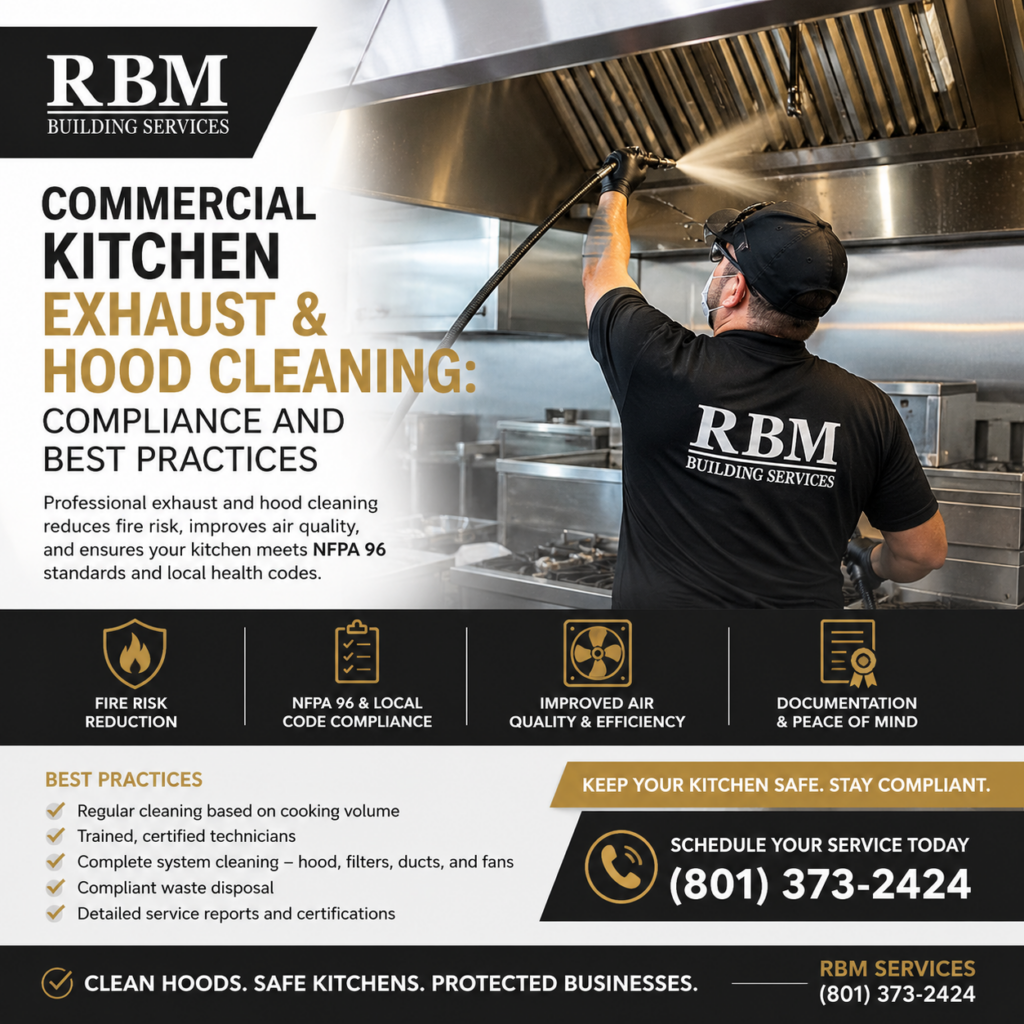
Commercial kitchen exhaust systems — including hoods, ducts, fans, and fire suppression systems — require regular professional cleaning to prevent grease buildup that creates serious fire hazards. The National Fire Protection Association (NFPA) Standard 96 requires commercial kitchen exhaust systems to be cleaned at intervals based on the volume and type of cooking. Failure to comply can result in fire, business interruption, fines, and insurance claims being denied. Property managers and restaurant owners must ensure cleaning is performed by certified professionals and documented properly.
NFPA 96 Cleaning Frequency Requirements
NFPA 96 establishes cleaning frequency based on cooking volume. High-volume cooking (12+ hours per day, heavy grease production): monthly cleaning. Moderate-volume cooking (6-12 hours per day): quarterly cleaning. Low-volume cooking (under 6 hours per day, light grease): semi-annual cleaning. Systems using solid fuel (charcoal, wood) require monthly cleaning regardless of volume. These are minimum standards — local fire marshals may require more frequent cleaning based on inspection results. For related fire prevention and maintenance, see our building maintenance services.
What Professional Hood Cleaning Includes
A professional commercial kitchen exhaust cleaning covers all components of the exhaust system: hood interior and exterior including filters and grease troughs, ductwork from hood to exhaust fan (including horizontal and vertical sections), exhaust fan blades, housing, and weatherproof cap, roof areas around exhaust terminations, and fire suppression system nozzles and piping (inspected, not serviced — that requires a licensed fire protection contractor). After cleaning, the provider should verify that the system is reassembled correctly and functioning properly. All work must be documented with a certificate of cleaning per NFPA 96 requirements.
Why Documentation Matters
NFPA 96 requires written records of all exhaust system cleaning, including date of cleaning, name and company of person performing cleaning, areas cleaned, and methods used. These records must be kept on-site and made available to the fire marshal upon request. Without proper documentation, a fire marshal can require immediate system shutdown. Insurance companies may deny claims from kitchen fires if cleaning records are incomplete. Many property managers include kitchen exhaust cleaning in their annual janitorial service contracts to ensure compliance is maintained.
Choosing a Qualified Hood Cleaning Provider
Not all commercial cleaning companies are qualified for kitchen exhaust cleaning. Look for providers certified by IKECA (International Kitchen Exhaust Cleaning Association) or NFPA-compliant. Verify that their insurance covers kitchen exhaust cleaning — standard general liability may not cover fire damage from improper cleaning. Ask for references from restaurant or commercial kitchen clients. Request a sample cleaning certificate to ensure their documentation meets NFPA 96 requirements. The provider should offer a written inspection report identifying any system deficiencies found during cleaning.
Additional FAQs
Can restaurant staff clean their own hood system? While daily surface cleaning of hood exteriors and filters can be done in-house, NFPA 96 requires ductwork and exhaust fan cleaning to be performed by a qualified professional. The interior of ductwork requires specialized tools and training that in-house staff typically do not have.
What happens if I fail a fire marshal inspection for hood cleaning? The fire marshal can issue a citation with fines, require immediate system shutdown, and schedule a re-inspection. A shutdown can force the restaurant to close until the deficiency is corrected, resulting in significant revenue loss.
How much does commercial hood cleaning cost? Costs vary by system size and configuration. Typical range: $200-$500 per hood for a basic system, $500-$1,500 for a complex system with extensive ductwork, and $1,000-$3,000 for large commercial kitchens with multiple hoods. Frequency and location also affect pricing.
Do I need separate fire suppression system servicing? Yes. While the hood cleaning provider should inspect and clean around fire suppression nozzles, the fire suppression system itself must be serviced by a licensed fire protection contractor on a separate schedule (typically every 6 months). The two services are complementary but distinct.
About RBM Building Services: Since 1974, RBM has provided comprehensive commercial cleaning and building maintenance across Utah, Arizona, Nevada, and Texas. Call 800.403.3564 or contact us for your facility needs.
The Anatomy of a Commercial Kitchen Exhaust System
Understanding the components of a kitchen exhaust system helps property managers and restaurant owners communicate effectively with cleaning providers. Hood canopy: The visible covering over cooking equipment that captures grease-laden vapors. Includes removable grease filters (baffle filters) that trap larger grease particles. Ductwork: The concealed piping that carries grease vapors from the hood to the exhaust fan. Horizontal duct sections are particularly prone to grease accumulation because gravity prevents drainage. Exhaust fan: The motor-driven fan on the roof that creates negative pressure to pull vapors through the system. The fan blades accumulate grease, causing imbalance and reduced performance. Fire suppression system: A separate system of nozzles and piping that discharges wet or dry chemical suppressant directly into the hood and ductwork in case of fire. Must be inspected and serviced by a licensed fire protection contractor. Grease trough and drain: Channels that collect liquid grease runoff from the hood and filters. Must be cleaned regularly to prevent blockages. Roof termination: The exhaust outlet on the roof, including the weatherproof cap and any bird screens. Grease can accumulate on the roof surface around the exhaust outlet.
The Fire Hazard: Why NFPA 96 Compliance Matters
Grease buildup in kitchen exhaust systems is one of the leading causes of restaurant fires. According to NFPA statistics, cooking equipment is involved in over 50% of all restaurant structure fires, and a significant portion of these fires spread through the exhaust system due to inadequate cleaning. A grease fire in the exhaust duct can spread rapidly through the building, causing catastrophic damage. The financial impact includes property damage averaging $100,000-$500,000 per restaurant fire, business interruption lasting weeks or months, insurance premium increases of 25-100%, potential loss of insurance coverage if NFPA 96 records are incomplete, and liability claims if the fire spreads to adjacent tenants. Regular professional cleaning is a fraction of the cost of a single fire incident. For related fire safety and building protection services, see our building maintenance services.
Daily and Weekly Maintenance Between Professional Cleanings
Between professional NFPA 96 cleanings, restaurant staff should perform daily and weekly maintenance. Daily: Remove and clean grease filters in the dishwasher or a 3-compartment sink with degreaser. Wipe down hood exterior and visible interior surfaces. Inspect ductwork where visible for any signs of grease buildup or damage. Empty grease traps and troughs. Weekly: Deep clean hood interior including behind filters. Inspect fire suppression system nozzles for grease buildup or obstruction. Check exhaust fan operation and listen for unusual noises indicating fan blade imbalance from grease accumulation. Document all daily and weekly cleaning in a log that can be presented to the fire marshal alongside professional cleaning certificates.
Property Manager Responsibilities for Tenant Kitchens
Property managers who lease to restaurants or food service tenants have specific responsibilities regarding kitchen exhaust cleaning. Lease agreements should specify minimum cleaning frequency per NFPA 96 based on the tenant’s cooking volume. Property managers should require tenants to provide copies of cleaning certificates within 5 business days of each cleaning event. Annual fire marshal inspections of the entire building may include kitchen exhaust systems — property managers should coordinate with tenants to ensure compliance. Non-compliant tenants create liability for the building owner. Include a clause in the lease allowing the property manager to arrange cleaning at the tenant’s expense if the tenant fails to provide proof of compliance. Many property managers include kitchen exhaust cleaning in their full-service janitorial contracts with pass-through billing to tenants.
Additional FAQs
Can I use a pressure washer to clean kitchen exhaust ducts? No. Pressure washing kitchen ducts forces grease and water into seams and joints, causing corrosion and creating fire hazards inside wall cavities. Only approved mechanical cleaning methods (scraping, hand-wiping, and chemical cleaning with approved solvents) should be used per NFPA 96.
How do I verify that my hood cleaning provider actually cleaned the ductwork? Request before-and-after photos of each section of ductwork. Reputable providers document their work with photographic evidence. The cleaning certificate should specify linear feet of duct cleaned and include photos showing interior duct conditions before and after cleaning. Some providers offer video scoping for verification.
What is the penalty for operating without NFPA 96 compliance? Penalties vary by jurisdiction but can include fines of $500-$10,000 per violation, immediate closure orders for imminent fire hazards, citation on the property’s permanent record affecting insurance rates and future inspections, and potential criminal liability if a fire occurs and non-compliance is determined to be a contributing factor.
Does hood cleaning need to happen during business hours? No. Most hood cleaning is performed during off-hours (late night or early morning) when the kitchen is not in operation. The cleaning provider needs access to the kitchen and should coordinate scheduling with the restaurant manager. The fire suppression system must be placed in “service mode” during cleaning and reactivated before the kitchen resumes operations.
How do different cooking methods affect cleaning frequency? High-grease cooking (deep frying, wok cooking, grilling) generates the most grease and requires monthly cleaning. Moderate-grease cooking (oven cooking, sautéing) requires quarterly cleaning. Low-grease cooking (steaming, baking, warming) may qualify for semi-annual cleaning. Charcoal and wood-fired cooking require monthly cleaning regardless of grease volume.