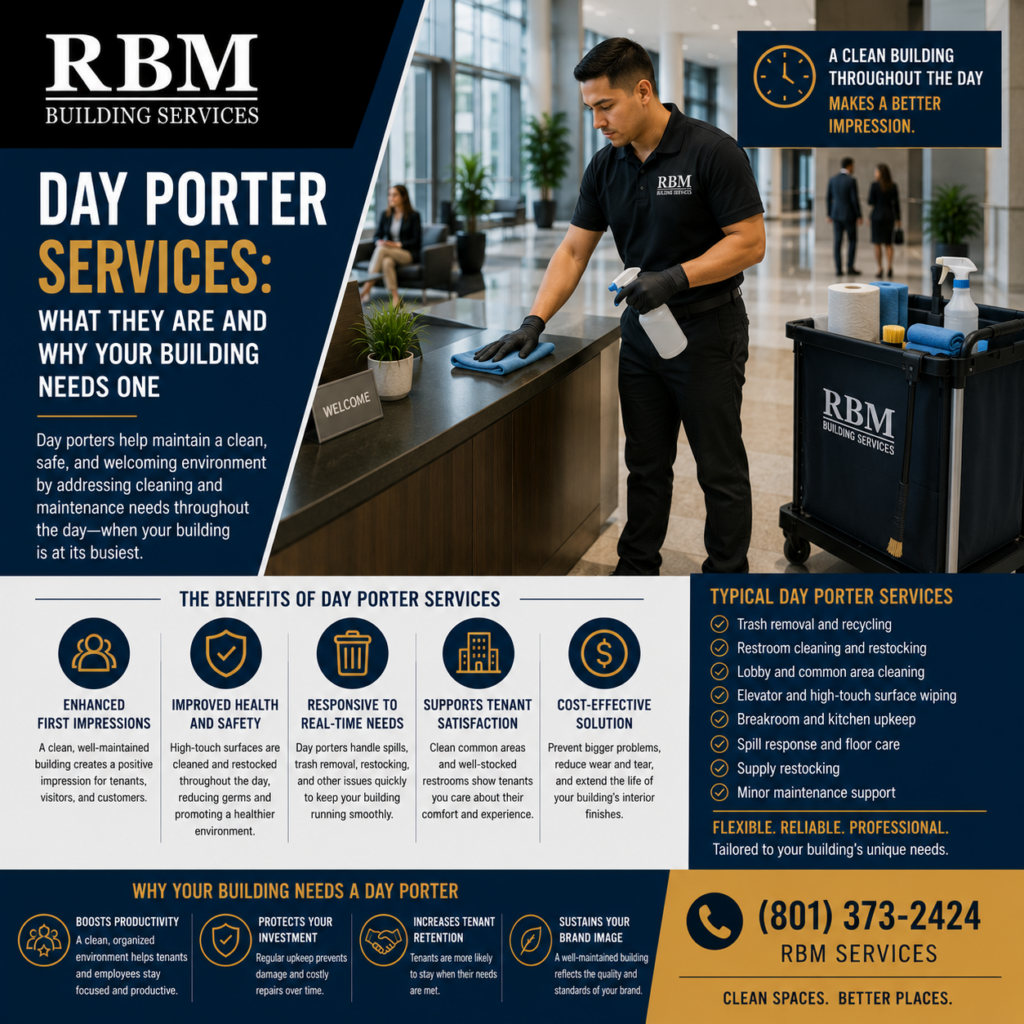
A day porter is a cleaning and maintenance professional who works during business hours to handle ongoing building needs that nightly janitorial crews cannot address. Unlike overnight cleaning teams that focus on deep cleaning and restocking, day porters provide real-time response to spills, restroom issues, lobby touch-ups, and routine light maintenance. Day porter services are increasingly popular in Class A office buildings, medical facilities, retail centers, and multi-tenant properties where appearance and responsiveness directly impact tenant satisfaction.
What Day Porters Do
Day porter duties typically include mid-day restroom checks and touch-up cleaning, lobby and common area spot cleaning throughout the day, trash and recycling patrol, entryway and walk-off mat maintenance, event setup and takedown support, light maintenance tasks (changing light bulbs, adjusting blinds), restocking paper products and soap, snow and ice management at building entrances during winter, and responding to tenant cleaning requests in real time. For a comprehensive building maintenance approach, see our building maintenance services.
Day Porter vs. Nightly Crew: How They Work Together
The night crew handles the heavy cleaning — vacuuming, mopping, restroom deep cleaning, trash removal, and restocking. The day porter maintains that clean appearance throughout business hours by addressing the messes that happen between nightly cleanings. This two-pronged approach ensures the building is clean at all times, not just at the start of each day. A typical 100,000 sq ft office building with a day porter program will have 4-6 night crew members plus 1-2 day porters. The night crew costs $4,000-$8,000 per month. The day porter adds $3,000-$5,000 per month. For buildings with high tenant expectations or heavy visitor traffic, day porter services are often bundled with full-service janitorial contracts.
Buildings That Benefit Most from Day Porter Services
Class A office buildings: Tenants pay premium rent and expect premium service. A day porter ensures the lobby, restrooms, and common areas remain pristine throughout the day. Medical office buildings: Patient-facing environments require constant attention to restroom cleanliness and spill response. Retail centers and malls: High foot traffic creates continuous cleaning needs. Multi-tenant properties: Day porters respond quickly to individual tenant requests, improving retention. Large corporate campuses: Multiple buildings and common areas benefit from roving day porter support. For help choosing the right cleaning program for your building, see our vendor selection guide.
ROI of Day Porter Services
The cost of a day porter ($30,000-$60,000 per year per porter) is typically offset by improved tenant retention. A single tenant vacancy can cost $195,000-$412,500 in lost rent and turnover costs. Reducing turnover by even one tenant covers several years of day porter service. Property managers also report fewer emergency cleaning call-outs (day porters handle issues before they escalate), reduced custodial supervisor workload, higher tenant satisfaction scores, and positive feedback during leasing tours.
Additional FAQs
Are day porters the same as concierge services? Not exactly. Concierge services focus on tenant-facing amenities and guest services. Day porters focus on building maintenance and cleaning. Some buildings combine both roles, but they are distinct service categories.
Can a day porter handle maintenance tasks beyond cleaning? Yes, within reasonable limits. Day porters commonly change light bulbs, replace HVAC filters, touch up paint, and perform minor repairs. Anything requiring a licensed tradesperson (electrical, plumbing, HVAC repair) should be referred to the appropriate contractor.
What hours do day porters typically work? Most day porters work a standard business shift — 7:00 AM to 3:30 PM or 8:00 AM to 4:30 PM. This covers the bulk of the business day and allows them to prepare the building for the evening cleaning crew.
Do day porters need different training than night cleaners? Yes. Day porters need strong communication and customer service skills since they interact with tenants and visitors. They also need broader maintenance knowledge beyond standard cleaning. Night cleaners focus on thorough, methodical cleaning without customer interaction.
About RBM Building Services: Since 1974, RBM has provided full-service janitorial, day porter, and building maintenance services across Utah, Arizona, Nevada, and Texas. Call 800.403.3564 or contact us.
The Day Porter Schedule: A Typical Day
A day porter’s shift follows a structured routine designed to maintain the building throughout business hours. 7:00-8:00 AM — Morning sweep: Walk the entire building to assess overnight cleaning quality, address any issues the night crew missed, restock restrooms and break rooms before the workday begins, and ensure the lobby and entryways are pristine for morning arrivals. 8:00-10:00 AM — Common area maintenance: Spot vacuum high-traffic areas, clean and polish lobby surfaces, wipe down elevator interiors, check and clean entry glass, and patrol restrooms. 10:00-11:30 AM — Project work: Light maintenance tasks like changing light bulbs, adjusting blinds, touching up paint, cleaning window tracks, or deep cleaning a specific zone. 11:30 AM-1:00 PM — Mid-day reset: Restroom checks and restocking, break room clean-up after lunch, lobby touch-up, and empty high-traffic trash receptacles. 1:00-3:30 PM — Afternoon maintenance: Second round of restroom checks, common area patrol, tenant request response, event setup support if needed, and preparation of handoff notes for the evening cleaning crew.
How to Determine If Your Building Needs a Day Porter
Use this assessment to evaluate whether a day porter program makes sense for your property. Consider a day porter if your building has over 50,000 sq ft of occupied space, more than 10 tenants, high visitor traffic (lobby traffic exceeding 100 people per day), tenant complaints about mid-day restroom or break room conditions, a Class A or Class B+ leasing position where appearance directly affects rent, an on-site property management office that needs support, event spaces or conference centers that require setup and takedown, or medical or professional services tenants with high cleanliness expectations. Buildings that typically do NOT need day porters include single-tenant buildings under 30,000 sq ft, industrial or warehouse facilities with limited public access, and buildings with very low occupancy (under 50%).
Day Porter vs. Concierge vs. Building Engineer
These three roles are often confused but serve distinct functions. Day porter: Focuses on cleaning, restocking, light maintenance, and event support. Reports to the property manager or cleaning company. Cost: $30,000-$60,000/year. Does not require specialized licenses or certifications beyond standard cleaning and maintenance training. Concierge: Focuses on tenant-facing services, guest reception, amenity management, and package handling. Reports to property management. Cost: $40,000-$70,000/year. Requires customer service experience and sometimes security training. Building engineer: Focuses on HVAC, plumbing, electrical, and building systems operation. Reports to property management or engineering firm. Cost: $55,000-$90,000/year. Requires trade licenses or certifications. Many Class A buildings employ all three roles working together. For buildings with smaller budgets, combining day porter and concierge duties into one role is a common approach. For the nightly complement to day porter services, see our full-service janitorial programs.
Measuring Day Porter Performance
Property managers should track specific metrics to evaluate day porter effectiveness: tenant satisfaction scores (survey quarterly), work order completion rate (target 95%+ within 24 hours), restroom inspection scores (daily digital inspections), response time to tenant requests (target under 30 minutes), common area appearance scores (daily walk-through ratings), and preventative maintenance task completion (weekly checklist adherence). Most cleaning management software platforms can track these metrics automatically. Digital inspection tools allow property managers to review day porter performance remotely. See our vendor selection guide for questions to ask potential cleaning providers about their day porter training and accountability systems.
Additional FAQs
Can a day porter cover multiple buildings? Yes, for buildings within close proximity. A day porter can split time between two or three smaller buildings if travel time between them is minimal (under 10 minutes). However, response time and visibility suffer as the number of buildings increases. One building per porter is ideal.
Are day porters available on weekends? Yes, for buildings with weekend activity (retail centers, fitness facilities, event spaces). Weekend day porter shifts are typically shorter (4-6 hours) and focused on high-traffic areas and restroom maintenance. Weekend service costs 25-50% more than weekday service.
What happens when the day porter is on vacation or calls in sick? Professional cleaning companies provide backup coverage as part of the service agreement. The backup porter may be less familiar with your building, so a written building guide and daily task checklist should be maintained for temporary coverage situations. Ask about backup coverage when evaluating day porter proposals.
Who supplies day porter equipment and supplies? Most cleaning companies supply all equipment, chemicals, and supplies as part of the day porter service. This is consistent with standard janitorial service models. Some properties choose to supply specialty items (specific paper products or green cleaning chemicals) separately.
Can day porter services be added mid-contract? Yes. Most janitorial contracts include provisions for adding day porter services as an amendment. The cost is typically prorated for the remainder of the contract term. Adding a day porter mid-contract is a common upgrade when buildings increase occupancy or tenant expectations rise.