Initial deep cleaning of a commercial space before occupancy is a critical step in the tenant improvement or lease turnover process. A new commercial space — whether newly constructed, recently renovated, or vacated by a previous tenant — accumulates construction dust, debris, and residues that must be thoroughly removed before the new occupant moves in. Failing to perform a proper initial deep cleaning can result in dust and construction debris circulating through HVAC systems, staining and damaging newly installed finishes, creating health concerns for incoming occupants, and forcing tenants to clean the space themselves before moving in furniture and equipment. This guide provides a comprehensive room-by-room approach to initial deep cleaning for new commercial spaces.
Planning and Preparation
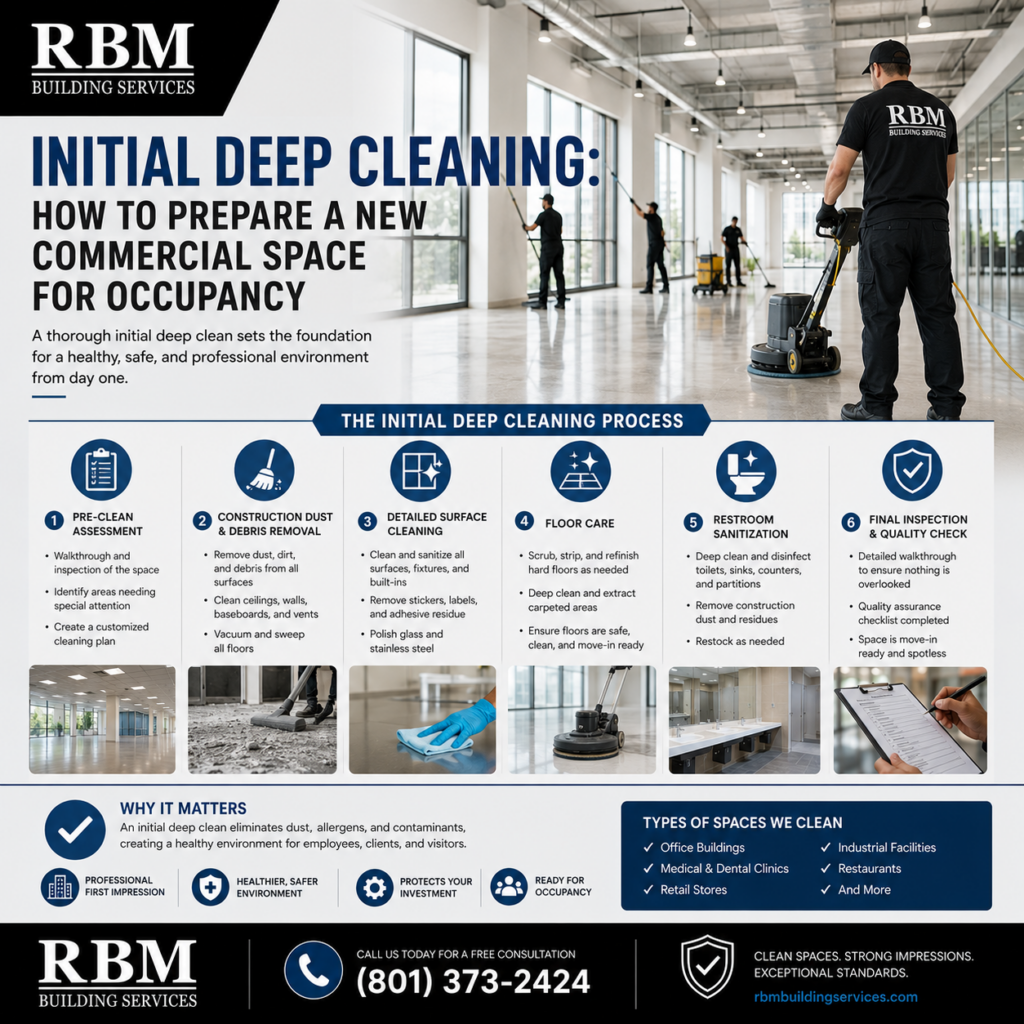
Before beginning the initial deep clean, proper planning ensures thorough coverage and efficient execution. The cleaning team should first walk through the entire space with a detailed checklist, identifying all areas requiring attention, noting any damage or deficiencies that should be documented before cleaning, and identifying any special cleaning requirements based on finishes and materials. All construction debris, waste materials, and contractor leftovers should be removed before cleaning begins. The cleaning team should verify that all construction trades have completed their work and that all systems are operational — HVAC, lighting, plumbing, and electrical should be functioning. Safety considerations include ensuring adequate lighting for thorough cleaning, verifying that all safety systems are operational (fire alarms, emergency lighting, exit signs), and identifying any hazardous materials that require special handling. Equipment and supplies needed for an initial deep clean include HEPA-filtered vacuums with attachments for all surfaces, microfiber cloths and mops, extension poles for ceiling and high wall cleaning, glass cleaning tools, floor cleaning and finishing equipment appropriate for the floor type, and a complete range of cleaning chemicals appropriate for the surfaces being cleaned. Our commercial janitorial services include comprehensive initial deep cleaning for new tenant spaces.
Room-by-Room Cleaning Protocol
An effective initial deep clean follows a systematic top-to-bottom, cleanest-to-dirtiest sequence within each room. Ceiling level cleaning includes vacuuming or wiping all ceiling tiles and grids, cleaning light fixtures and diffusers (replacing burned-out bulbs), dusting sprinkler heads, smoke detectors, and speakers, and cleaning HVAC supply and return grilles. Wall and vertical surface cleaning includes wiping all walls from top to bottom with appropriate cleaner, spot-cleaning any visible marks or stains, cleaning doors, door frames, and door hardware, cleaning windows, window sills, and window treatments, and cleaning all vertical surfaces including columns, partitions, and glass walls. Horizontal surface cleaning includes dusting and wiping all window sills and ledges, cleaning all countertops, shelving, and built-in furniture, wiping down cabinets inside and out, and cleaning all switch plates, outlet covers, and thermostat controls. Floor cleaning includes vacuuming all carpet and soft flooring thoroughly with HEPA vacuum, spot-treating any carpet stains, sweeping and damp-mopping all hard flooring, stripping and refinishing hard floors that have been damaged or contaminated during construction, and cleaning baseboards and floor edges. Detailed finishing includes cleaning inside all drawers, cabinets, and closets, wiping down all plumbing fixtures, cleaning mirrors and glass partitions to streak-free condition, cleaning and organizing any janitorial closets or storage areas, and final inspection of all areas with a punch-list approach.
HVAC System Cleaning and Air Quality
A critical but often overlooked aspect of initial deep cleaning is HVAC system preparation. Construction dust that settles in ductwork and HVAC components will circulate through the space once the system is operating, depositing dust on all newly cleaned surfaces and creating indoor air quality problems. Before occupancy, all HVAC filters should be replaced with new high-quality filters (MERV-8 minimum, MERV-13 recommended for office spaces). Supply and return grilles should be removed, cleaned, and reinstalled. Accessible ductwork should be vacuumed to remove construction debris. Condensate drain pans should be cleaned and treated to prevent biological growth. Air balance testing should be completed to ensure proper airflow to all areas. After HVAC cleaning and system startup, a final dusting and wiping of all horizontal surfaces should be performed to remove any dust that settled during the HVAC cleaning process. For comprehensive building preparation services, see our building maintenance services.
Final Inspection and Punch List
A thorough final inspection ensures the space meets occupancy-ready standards. The inspection should use a detailed checklist covering every room and surface. Common issues found during final inspections include dust on top of ceiling tiles and light fixtures, adhesive residue on windows and glass, paint splatters on hardware, floors, and trim, caulk residue on countertops and sinks, fingerprints and smudges on doors and hardware, debris in HVAC grilles and diffusers, and incomplete cleaning of janitorial closets and storage areas. Each deficiency should be noted and corrected before the space is released for occupancy. A final walk-through with the property manager or tenant representative allows them to verify that cleaning meets their expectations. Photographic documentation of the completed space provides a baseline record of cleanliness for comparison with future cleaning performance. Many property managers require a final cleaning certification as part of the tenant handover process.
Additional FAQs
How long does an initial deep clean take for a commercial space? A 5,000 sq ft office space typically requires 1-3 days for initial deep cleaning, depending on the level of construction debris, number of rooms and finishes, and complexity of the space. Larger spaces or spaces with significant post-construction residue may require more time.
What is the difference between initial deep cleaning and regular janitorial cleaning? Initial deep cleaning is a one-time service that addresses accumulated construction dust, debris, and residues. It involves detailed cleaning of every surface including walls, ceilings, and HVAC systems. Regular janitorial cleaning maintains cleanliness after occupancy through daily and weekly task cycles.
Should initial deep cleaning include floor refinishing? Yes, if the floor finish was damaged during construction or the floor type requires it. VCT floors typically need stripping and refinishing. Polished concrete may need burnishing. Carpet may need extraction cleaning. The condition assessment during the pre-cleaning walk-through determines floor care requirements.
Who pays for initial deep cleaning of a commercial space? This is typically negotiated in the lease. Landlords often provide a cleaning allowance for new tenant spaces. Tenant improvement budgets may include initial cleaning costs. Construction contracts may include final clean as part of the project scope. Clarify responsibility before work begins.
About RBM Building Services: Since 1974, RBM has provided commercial janitorial, building maintenance, and new space preparation services across Utah, Arizona, Nevada, and Texas. Call 800.403.3564 or contact us.