Managing building security for after-hours cleaning teams requires a balance between access convenience and security. This guide covers key systems, credential management, scheduling, and best practices for property managers and facility directors.
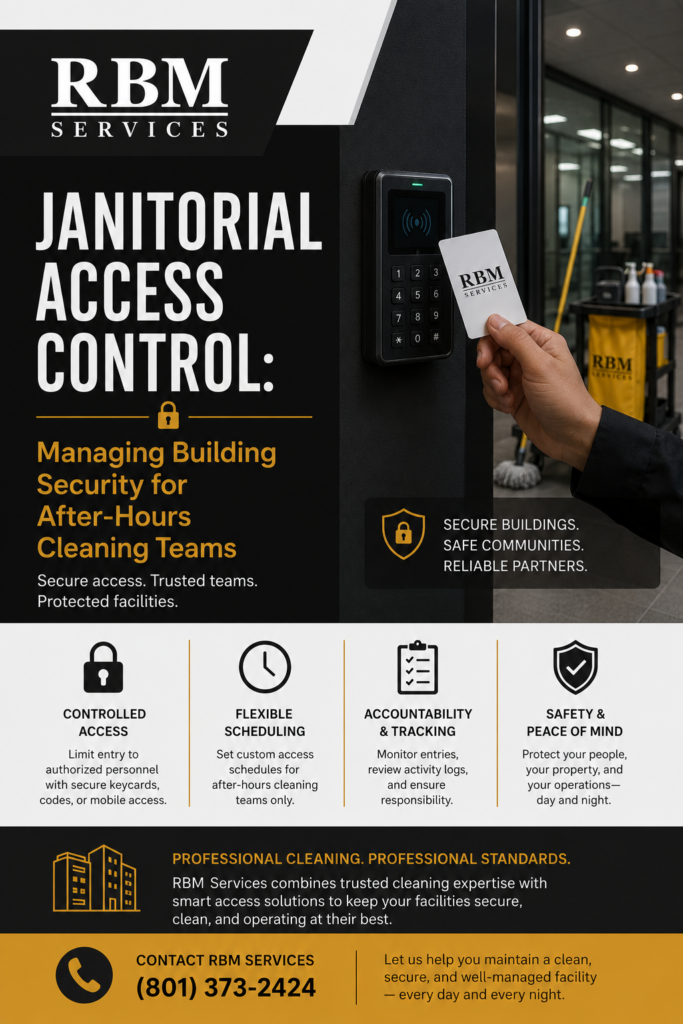
Managing building access for after-hours cleaning teams is a critical responsibility for property managers and facility directors. Cleaning staff typically work when buildings are unoccupied, which means they have access to the entire facility during unsupervised hours. This access must be carefully managed to protect building security, tenant property, and sensitive information while still allowing cleaning staff to perform their work efficiently. The challenge of janitorial access control is balancing security requirements with operational needs. Too much restriction and cleaning staff cannot do their jobs effectively. Too little restriction and the building is exposed to security risks. The right approach uses a layered security system that provides appropriate access for cleaning staff while maintaining robust security for the building and its occupants. Professional janitorial services and commercial cleaning providers should have established access control protocols. See RBM Building Services for more.
The cost of inadequate janitorial access control can be significant. Security breaches involving cleaning staff can lead to theft, vandalism, data breaches, and liability claims. Even if the breach is not the fault of the cleaning company, the perception of inadequate security can damage the building’s reputation and tenant confidence. The investment in proper access control systems and procedures is far less than the cost of a single security incident. Contact RBM Building Services or call 800.403.3564.

Janitorial Access Control: Complete Guide for Building Security
Access control for cleaning staff presents unique challenges because of the nature of their work. Cleaning staff need access to all areas of the building that require cleaning, including tenant spaces, common areas, restrooms, break rooms, storage areas, and mechanical rooms. They may need to access the building at different times depending on tenant requirements and cleaning schedules. They may work individually or in teams, with different staff members working on different days. The access control system must accommodate these requirements while maintaining security. The first consideration is the level of access required. Cleaning staff typically need access to the building entrance, all common areas, restrooms on all floors, tenant spaces that are included in the cleaning contract, cleaning supply storage areas, trash and recycling rooms, and mechanical rooms for HVAC and janitorial equipment. Some cleaning staff may need access to specific tenant spaces that contain sensitive information or valuable equipment. These spaces may require additional access restrictions or enhanced vetting procedures. The second consideration is the timing of access. Cleaning may be performed nightly after business hours, during the day in common areas, on weekends when offices are unoccupied, or on a rotating schedule that varies by day of the week. The access control system should allow access during scheduled cleaning times and should restrict access at other times. The third consideration is the duration of access. Cleaning staff typically need access for 2-4 hours per night, depending on the size of the facility. The access control system should track when cleaning staff enter and exit the building and should report any unusual access patterns. Commercial cleaning providers should work with property managers to establish appropriate access protocols. Contact RBM or call 800.403.3564.
Understanding Access Control for Cleaning Staff
Modern access control systems offer a range of technologies that can be used to manage janitorial access effectively. The choice of technology depends on the size of the building, the number of cleaning staff, the security requirements, and the budget. Key card or key fob systems are the most common access control technology for commercial buildings. Each cleaning staff member is issued a unique credential that is programmed to allow access to specific areas during specific times. The system records all access events, providing an audit trail that can be reviewed if security issues arise. Key cards can be deactivated when a staff member leaves the cleaning company, ensuring that former employees cannot retain access. Keypad entry systems use a code that is provided to cleaning staff. The code can be changed periodically or when staff turnover occurs. Keypad systems are less expensive than card systems but provide less control and less audit capability. They are best suited for small buildings with limited cleaning staff. Biometric systems including fingerprint, hand geometry, or facial recognition readers provide the highest level of security because credentials cannot be shared or stolen. Biometric systems are more expensive than other options but are appropriate for buildings with high security requirements such as data centers, financial institutions, or government facilities. Mobile credential systems use smartphones as access credentials. Cleaning staff download an app that communicates with the access control system via Bluetooth or NFC. Mobile credential systems offer convenience and flexibility but require staff to have compatible smartphones. Video surveillance should complement access control systems by recording activity in common areas, at entry points, and near tenant entrances. Video footage can be reviewed if security incidents occur. RBM Building Services uses secure access control protocols for all janitorial services.
Access Control Systems and Technologies
Credential management and vendor vetting are critical components of janitorial access control. The building owner or property manager should establish a process for issuing and managing access credentials for cleaning staff. The process should begin with vendor vetting before any credentials are issued. The cleaning company should provide documentation of its hiring practices, background check procedures, employee training programs, and insurance coverage. The building owner should verify that the cleaning vendor conducts thorough background checks on all employees who will be working in the building. Background checks should include criminal history, employment verification, and reference checks. Some buildings require drug testing for all janitorial staff. The level of vetting should be proportional to the sensitivity of the building and the access that staff will have. Buildings housing financial services, legal practices, medical records, or government agencies require the highest level of vetting. The credential issuance process should include verification of the staff member’s identity through a government-issued photo ID, enrollment in the access control system with appropriate access permissions, training on building security policies and procedures, and acknowledgment of building security policies in writing. Credentials should be issued for a specific period, typically matching the staff member’s employment or the contract term. Expired credentials should be deactivated automatically. When a staff member leaves the cleaning company, the company should immediately notify the building owner and return the access credential. The building owner should deactivate the credential within 24 hours of notification. Regular audits of active access credentials should be conducted to identify and deactivate credentials that are no longer needed. Contact RBM Building Services or call 800.403.3564.
Credential Management and Vendor Vetting
Zone-based access control can optimize cleaning efficiency by allowing cleaning staff to access the areas they need to clean while restricting access to other areas. The building is divided into zones, and each cleaning staff member’s credentials are programmed to allow access only to the zones they need for their assigned cleaning tasks. Typical zones in a commercial building include the building perimeter including main entrance and loading dock, common areas including lobbies, corridors, elevators, and restrooms, tenant floors or suites, mechanical and equipment rooms, and storage and supply areas. Cleaning staff should have access to common areas and the specific tenant areas they are assigned to clean. They should not have access to tenant areas that are not in their cleaning assignment unless specifically authorized. A zone-based scheduling system can further refine access control by allowing access to specific zones only during specific times. For example, a cleaning crew assigned to clean the third floor may have access to that floor only between the hours of 7 PM and 11 PM. After 11 PM, their credentials would not allow access to that floor. The access control system should also support temporary access changes for special circumstances. For example, if a tenant requests additional cleaning services, the cleaning staff assigned to that task should be granted temporary access to that tenant’s space for the duration of the additional service. The temporary access should expire automatically after the service is completed. Commercial cleaning providers implement zone-based access for efficient building service.
Scheduling and Zone-Based Access
Security protocols and incident response procedures are essential for managing janitorial access effectively. The building owner should establish clear security protocols that address all aspects of janitorial access. The protocols should require cleaning staff to enter and exit through designated entry points, sign in and sign out of the building using the access control system, wear visible identification badges at all times while in the building, report any security concerns or unusual observations to building security, not share access credentials with anyone, not allow unauthorized individuals to enter the building, and not access areas that are not included in their cleaning assignment. Cleaning staff should be trained on these protocols and should acknowledge their understanding in writing. The incident response plan should include procedures for reporting and responding to security incidents involving cleaning staff. If a cleaning staff member observes a security incident such as a break-in, fire, or medical emergency, they should follow the building’s emergency procedures and notify building security or emergency services as appropriate. If a cleaning staff member is involved in a security incident such as being locked in an area or needing emergency assistance, they should notify their supervisor and building security. The incident should be documented and investigated. The building owner should maintain a log of all security incidents involving cleaning staff. The log should include the date and time of the incident, the staff member involved, the nature of the incident, the actions taken, and any follow-up required. The log should be reviewed regularly to identify patterns or trends that may indicate security issues. Professional janitorial services companies maintain comprehensive security protocols for all building access.
Security Protocols and Incident Response
A comprehensive access control policy for janitorial services should be developed by the building owner or property manager and should be shared with all cleaning vendors. The policy should include the building security requirements and expectations, the access control system and how it is used, the credential issuance and management process, the access scheduling and zone restrictions, the security protocols for cleaning staff, the incident response and reporting procedures, and the consequences of policy violations. The policy should be reviewed annually and updated as needed. All cleaning vendors should be required to acknowledge receipt and understanding of the policy before beginning work in the building. The policy should be included in the cleaning contract and should be referenced in the scope of work. The building owner should also ensure that the access control system is maintained and tested regularly. System maintenance should include regular testing of all access points and credentials, software updates and security patches, review of access logs for unusual activity, and renewal of expired credentials and deactivation of terminated credentials. RBM Building Services has provided commercial cleaning and janitorial services with secure access control procedures since 1974. Contact us or call 800.403.3564 for professional cleaning services with robust security protocols. Read more on our company blog.
janitorial access control building security after hours cleaning
Developing an Access Control Policy for Janitorial Services
Effective janitorial access control requires a balanced approach that provides cleaning staff with the access they need to perform their work while maintaining robust building security. Property managers who implement comprehensive access control systems, thorough vendor vetting procedures, and clear security protocols can protect their buildings while ensuring that cleaning services are delivered effectively. The investment in proper access control is an investment in building security, tenant confidence, and cleaning quality. RBM Building Services has provided commercial cleaning and janitorial services since 1974 with a commitment to security and professionalism. Contact us or call 800.403.3564 for more information about our access-controlled cleaning services. Read more on our company blog.