Multi-property budgeting for janitorial services requires a strategic approach to managing cleaning costs across multiple commercial facilities. This guide covers cost allocation, vendor management, standardization strategies, and budgeting best practices for property managers and facility directors.
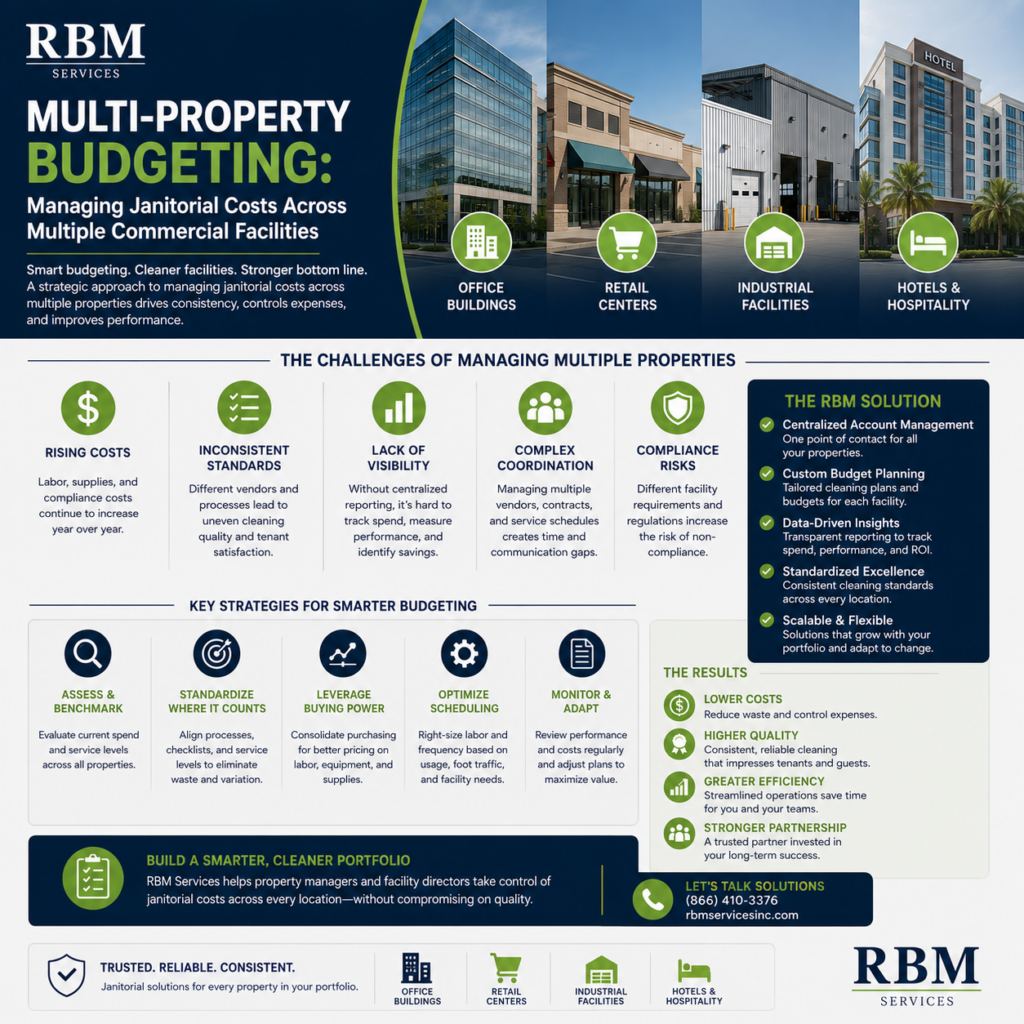
Managing janitorial costs across multiple commercial properties is one of the most complex challenges facing facility managers and property managers today. Unlike single-property cleaning management, multi-property janitorial budgeting requires coordinating across different facility types, sizes, usage patterns, tenant requirements, and geographic locations while maintaining consistency in quality and cost control. Property managers who oversee portfolios of office buildings, retail centers, medical facilities, or mixed-use properties must develop systematic approaches to cleaning budget allocation, vendor management, and performance tracking to ensure that each property receives appropriate cleaning services while the total portfolio budget remains under control. Professional janitorial services and commercial cleaning are essential components of multi-property management. See our RBM Building Services for more information.
The stakes of effective multi-property janitorial budgeting are significant. Cleaning is typically the second-largest operating expense for commercial properties after utilities, representing 15-25% of total operating costs. Inefficient cleaning budgets can waste thousands of dollars per property per year across a multi-property portfolio. Conversely, underfunded cleaning budgets can lead to tenant complaints, increased vacancy rates, property value depreciation, and health and safety compliance issues. This guide provides property managers and facility directors with comprehensive strategies for multi-property janitorial budgeting, including understanding cleaning cost drivers, developing portfolio-wide budgeting frameworks, implementing effective cost allocation methods, managing vendor relationships and contracts, standardizing cleaning programs for cost efficiency, and tracking performance to optimize budgets. For multi-property janitorial services, contact RBM Building Services or call 800.403.3564.

Multi-Property Janitorial Budgeting: Complete Guide for Facility Managers
Understanding the factors that drive janitorial costs across different commercial properties is the first step in developing effective multi-property budgets. The primary cost driver for janitorial services is labor, which typically accounts for 70-80% of total cleaning costs. Labor costs are driven by the number of cleaning hours required per property, which is determined by the total square footage of the property, the type of facility and its cleaning requirements, the traffic levels and occupancy rates, and the frequency of cleaning required. Additional labor cost factors include geographic location and local wage rates, union requirements if applicable, and overtime needs for special events or emergency cleaning. The second major cost driver is supplies and equipment, representing 10-15% of total cleaning costs. Supply costs vary based on the types of cleaning products used, the quality and brand of supplies, the equipment needs for different floor types and facility types, and the paper product consumption rates for restroom supplies. The third cost driver is specialized services, which can add 10-20% to baseline cleaning costs depending on the property type and use. Specialized services include floor care including stripping, waxing, and buffing, carpet cleaning and extraction, window cleaning both interior and exterior, pressure washing of building exteriors and walkways, construction cleanup after tenant improvements, and emergency cleaning services. The fourth cost driver is management and overhead, which typically accounts for 10-15% of total cleaning costs but can be lower for large, consolidated contracts. Management costs include account management and supervision, quality assurance inspections and reporting, insurance and bonding requirements, and administrative costs for billing and scheduling. Each property in a portfolio will have a different cost profile based on its specific characteristics. A Class A office building with marble floors will have different cost drivers than a medical office building with VCT flooring and exam room cleaning requirements. A retail center with high-traffic common areas will have different cost drivers than a warehouse with primarily maintenance cleaning. Understanding these differences is essential for developing accurate budgets for each property and for the portfolio as a whole. For a detailed cost analysis for your multi-property portfolio, contact RBM Building Services or call 800.403.3564.
Understanding Janitorial Cost Drivers Across Properties
Developing a systematic budgeting framework for multi-property janitorial services is essential for maintaining control over cleaning costs while ensuring consistent quality across all properties. The most effective approach is to develop a portfolio-wide master budget that allocates cleaning costs across properties based on a consistent methodology. The master budget should start with a baseline cleaning cost per square foot for each property, calculated based on the facility type, location, and cleaning frequency. The baseline cost per square foot should be adjusted for property-specific factors including age and condition of the property, condition of floors and surfaces, tenant improvement and build-out status, special cleaning requirements for specific tenants, access hours and scheduling constraints, and security requirements and badge access procedures. The adjusted baseline cost per square foot is then multiplied by the property’s square footage to calculate the baseline annual cleaning budget for each property. Additional budget allocations should be added for specialized services that are not included in the baseline cleaning program, including floor care programs for stripping and refinishing, carpet cleaning schedules and extraction frequency, window cleaning for both interior and exterior, and seasonal services such as snow and ice management or exterior pressure washing. A contingency allocation should be added to the overall portfolio budget, typically 5-10% of the total budget, to cover unexpected cleaning needs, including tenant move-in and move-out cleaning, emergency cleaning for floods or spills, additional cleaning during public health concerns, and special event cleaning. The contingency can be held at the portfolio level and drawn down by property managers as needed with proper authorization.
The budgeting framework should also include a capital planning component for major cleaning-related capital expenditures, including floor replacement or refinishing, restroom renovation and modernization, window replacement affecting access, and equipment replacement for specialized cleaning needs. The capital budget should be developed on a 3-5 year rolling basis and should be integrated with the property’s overall capital plan. The total portfolio cleaning budget should be reviewed quarterly and adjusted as needed based on actual spending, changes in property occupancy, new property acquisitions or dispositions, changes in cleaning requirements, and vendor price adjustments. The quarterly review should include a comparison of actual spending to budget for each property and for the portfolio as a whole. Variances should be analyzed to determine whether they are one-time events or trends that require budget adjustments. The annual budget review should be more comprehensive and should include an evaluation of the prior year’s budget performance, a reassessment of cleaning requirements for each property, a review of vendor pricing and performance, and development of the next year’s budget. The annual budget should be approved by portfolio management and should be communicated to property managers before the start of the budget year. For help developing multi-property janitorial budgets, contact RBM or call 800.403.3564. Read more on our company blog.
Budgeting Strategies for Multi-Property Portfolios
Cost allocation is the process of distributing cleaning costs across properties in a multi-property portfolio in a fair and transparent manner. The allocation method affects how property managers view their cleaning budgets and how costs are recovered from tenants through operating expense pass-throughs. The American Institute of Certified Public Accountants (AICPA) and the Building Owners and Managers Association (BOMA) provide standards for cost allocation in commercial properties. The most common cost allocation method is allocation by square footage, where cleaning costs are allocated to each property based on the property’s gross square footage or rentable square footage as a percentage of the total portfolio square footage. This method is simple and transparent but does not account for differences in cleaning requirements between properties. A more accurate method is allocation by cleaning hours, where each property’s cleaning hours are tracked and costs are allocated based on actual hours worked at each property. This method requires detailed time tracking but provides the most accurate cost allocation. Some portfolios use allocation by property type, where different cost rates are established for different property types, such as office, retail, medical, or industrial, and costs are allocated based on the applicable rate for each property type. This method provides reasonable accuracy while being simpler to administer than hourly tracking.
For properties with tenant operating expense pass-throughs, the allocation method affects how much cleaning cost is recovered from tenants and how tenants perceive the fairness of their operating expense charges. Property managers should ensure that their cost allocation method is consistent with their lease provisions and with standard industry practices. The allocation method should be documented in the portfolio’s operating procedures manual and should be communicated to tenants in their annual operating expense reconciliations. Regardless of the allocation method used, the portfolio should maintain a cost allocation worksheet that shows the allocation basis for each property, the total cleaning costs for the portfolio, the allocation percentage for each property, and the allocated cleaning cost for each property. The worksheet should be updated quarterly and should be available for review by property managers and tenants. For facility managers who prefer a more sophisticated approach, zero-based budgeting can be applied to janitorial services, where the cleaning budget for each property is built from the ground up based on the specific cleaning requirements of that property rather than being derived from a cost-per-square-foot allocation. Zero-based budgeting is more time-consuming to develop but provides the most accurate budgets and can identify cost-saving opportunities that would be missed with allocation-based approaches. For cost allocation consulting, contact RBM Building Services or call 800.403.3564. Visit our full service janitorial page for more details.
Cost Allocation Methods for Multi-Property Cleaning
Vendor management is a critical component of multi-property janitorial budgeting, as the cleaning vendor is the single most important factor in both cost and quality. Successful multi-property vendor management requires a different approach than single-property management, as it involves coordinating across multiple properties, property managers, and tenant groups. The first decision in multi-property vendor management is whether to use a single vendor for the entire portfolio or multiple vendors for different properties or regions. A single-vendor approach offers advantages including consolidated contract management, pricing leverage for volume discounts, greater consistency in cleaning quality across properties, and simplified billing and administration. The single-vendor approach also has disadvantages including risk concentration if the vendor performs poorly, reduced competition over time, and potential for vendor complacency. The multi-vendor approach offers advantages including competitive pressure between vendors, risk diversification across multiple vendors, and specialized expertise for different property types. The multi-vendor approach also has disadvantages including higher administrative overhead for managing multiple vendors, inconsistent quality across properties, and difficulty coordinating across vendors for portfolio-wide initiatives. For portfolios with properties in multiple geographic regions, a hybrid approach may be appropriate, using a primary vendor for each region or market with portfolio-level coordination provided by property management.
Contract negotiation for multi-property janitorial services requires a strategic approach that leverages the portfolio’s purchasing power while maintaining flexibility for individual property needs. The contract should include a master services agreement that sets portfolio-wide terms including pricing structure and rate schedules, service level agreements and quality standards, insurance and bonding requirements, reporting and communication requirements, termination and transition procedures, and pricing escalation and adjustment formulas, with individual property exhibits that specify the scope of work for each property, the staffing plan and schedule, the supply and equipment list, the pricing for each property, and any property-specific requirements. The master services agreement should be negotiated for a multi-year term, typically 3-5 years, with annual price adjustments tied to a published index such as the Consumer Price Index (CPI) or a specified annual percentage. The contract should include performance incentives and penalties tied to quality inspection scores, tenant satisfaction survey results, and compliance with service level agreements. The portfolio should conduct a competitive bid process every 3-5 years to ensure that pricing remains competitive and that the portfolio is receiving value for its cleaning investment. For vendor management and contract services, contact RBM Building Services or call 800.403.3564. Read more on our company blog.
Vendor Management and Contract Negotiation
Standardization of cleaning programs across properties is one of the most effective strategies for reducing costs in multi-property janitorial operations. By standardizing cleaning frequencies, methods, products, and equipment, property managers can reduce training costs, simplify supply chain management, improve quality consistency, lower equipment costs through volume purchasing, and streamline vendor management. The first step in standardization is to develop a portfolio-wide cleaning specification that establishes the minimum cleaning standards for all properties in the portfolio. The specification should define cleaning frequencies for each task by area type and traffic level, specify approved cleaning products and equipment, outline cleaning methods and procedures for each task, and set quality standards and inspection criteria. The specification should be developed in consultation with cleaning vendors and property managers and should be reviewed and updated annually. The second step is to standardize cleaning products across the portfolio. Product standardization offers several benefits, including volume purchasing discounts from suppliers, simplified training for cleaning staff, reduced risk of using incompatible products, and easier quality assurance through consistent product performance, and reduced storage and inventory requirements. The portfolio should develop an approved product list that includes the specific products to be used for each cleaning task and should require all vendors to use only approved products.
The third step is to standardize cleaning frequencies where possible. While different properties have different needs based on traffic levels and occupancy, many cleaning tasks can be standardized at portfolio-wide minimum frequencies. Daily tasks including trash removal, restroom cleaning, and high-touch surface cleaning should be performed at all properties. Weekly tasks including vacuuming of all carpeted areas, damp mopping of all hard surface floors, and dusting of horizontal surfaces should also be consistently performed. Periodic tasks including floor stripping and refinishing, carpet extraction cleaning, and window cleaning should follow portfolio-wide schedules adjusted for property-specific conditions. The fourth step is to standardize quality assurance processes. The portfolio should implement a consistent quality inspection program that uses the same inspection criteria, scoring system, and reporting format for all properties. The inspection program should include regular inspections by the vendor, periodic inspections by property management staff, quarterly portfolio-wide quality assessments, and annual tenant satisfaction surveys. The results of the quality assurance program should be tracked and reported to all stakeholders and should be used to identify trends and areas for improvement across the portfolio. For standardization consulting services, contact RBM Building Services or call 800.403.3564. Visit our commercial cleaning page for our complete service list.
Standardization Strategies for Cost Reduction
Performance tracking and budget optimization are essential for maintaining control over multi-property janitorial costs while continuously improving cleaning quality. The portfolio should implement a performance dashboard that tracks key performance indicators (KPIs) for each property and for the portfolio as a whole. The key performance indicators should include financial KPIs such as actual cleaning cost per square foot compared to budget, cleaning cost as a percentage of total operating expenses, year-over-year cost variance, and vendor price increases compared to market benchmarks. Quality KPIs include quality inspection scores by property, tenant satisfaction scores from surveys, complaint volume and response time, and compliance with service level agreements. Operational KPIs include cleaning hours per square foot by property, staffing turnover rates, supply consumption rates, and work order completion rates. The dashboard should be updated monthly and should be reviewed by the portfolio management team in a monthly operations review meeting. The monthly review should identify properties that are over or under budget, quality issues requiring attention, vendor performance concerns, and opportunities for cost reduction or quality improvement.
Budget optimization is an ongoing process that involves analyzing performance data to identify opportunities for cost reduction, quality improvement, or both. Cost reduction opportunities may include adjusting cleaning frequencies for specific areas based on actual usage patterns, consolidating cleaning routes to reduce travel time between properties, renegotiating vendor pricing based on portfolio volume, or standardizing products and equipment to reduce supply costs. Performance improvement opportunities may include providing additional training for cleaning staff, implementing new cleaning technologies or methods, adjusting inspection criteria to better align with tenant expectations, or enhancing communication between property managers and cleaning vendors. The portfolio should conduct an annual budget review that includes a comprehensive analysis of the prior year’s cleaning costs and performance, a review of vendor performance and pricing, an update of the cleaning specification and standardization program, and development of the next year’s cleaning budget. Multi-property janitorial budgeting is a complex but manageable process that requires a systematic approach, consistent methodology, and ongoing attention. RBM Building Services has provided janitorial services for multi-property portfolios since 1974. Contact us or call 800.403.3564 to learn how we can help you manage cleaning costs across your portfolio. Read more on our company blog.
multi-property budgeting janitorial costs commercial facilities
Performance Tracking and Budget Optimization
Building an effective multi-property janitorial budget requires ongoing attention to cost drivers, allocation methods, vendor performance, and quality outcomes. The most successful property managers approach janitorial budgeting as a continuous improvement process rather than a once-a-year exercise. By implementing the strategies outlined in this guide, property managers can achieve cost savings of 10-20% across their portfolio while maintaining or improving cleaning quality. The key success factors for multi-property janitorial budgeting include developing a systematic budgeting framework that applies consistently across all properties, understanding the specific cost drivers for each property and adjusting budgets accordingly, implementing fair and transparent cost allocation methods, managing vendor relationships strategically to maximize value, standardizing cleaning programs to reduce costs and improve consistency, and tracking performance metrics to identify opportunities for improvement. Property managers who invest time in developing robust janitorial budgeting processes will see returns in reduced operating costs, improved tenant satisfaction, and higher property values.
RBM Building Services has provided janitorial services for multi-property portfolios throughout Utah and surrounding states since 1974. We understand the unique challenges of managing cleaning across multiple commercial properties and can help property managers develop effective janitorial programs that control costs while maintaining high quality standards. Our services include full-service janitorial, commercial cleaning, floor care, and specialized cleaning services for all property types. Contact us or call 800.403.3564 to schedule a consultation for your multi-property portfolio. Read more on our company blog.