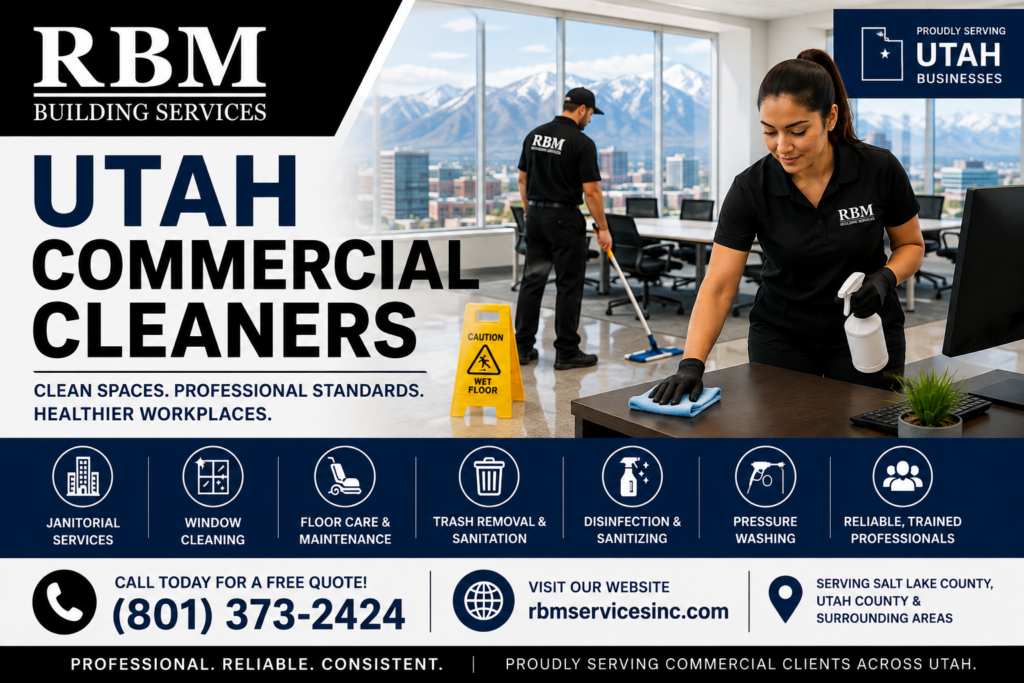
Utah commercial cleaners provide the routine janitorial work, specialty cleaning, floor care, carpet care, restroom maintenance, and facility support that help businesses remain clean, presentable, safe, and operational. The primary readers searching this term are office managers, business owners, facility directors, property managers, retail operators, healthcare-adjacent practices, school administrators, warehouse managers, and anyone responsible for maintaining a professional commercial space.
The most important thing to understand is that effective commercial cleaning is not simply about hiring someone to empty trash and vacuum floors. The best results come from a clearly written scope of work, a schedule based on actual foot traffic, proper cleaning methods for each surface, safe chemical handling, consistent communication, and quality checks. This guide explains what Utah commercial cleaners do, how commercial cleaning programs work, common service problems, the true cost of poor cleaning, and how to choose a provider with confidence. RBM Services can help businesses create a practical plan for routine cleaning, carpet and floor care, restrooms, common areas, and specialty commercial cleaning needs.

What Are Utah Commercial Cleaners and How Do They Work?
Utah commercial cleaners are professionals who clean and maintain non-residential facilities. Their work may take place before business hours, after closing, overnight, during the day, or on a customized schedule designed to minimize disruption.
Commercial cleaning differs from residential cleaning because commercial facilities often have:
- Larger or more complex floor plans
- Higher foot traffic
- Shared restrooms and breakrooms
- Customer-facing spaces
- Different flooring and surface materials
- Security and access requirements
- Formal service schedules
- Workplace-safety requirements
- More detailed quality-control expectations
- Specialized cleaning needs
The phrase “Utah commercial cleaners” can include businesses offering office cleaning, commercial janitorial services, building cleaning, commercial carpet cleaning, hard-floor care, restroom sanitation, day porter services, post-construction cleaning, move-in and move-out cleaning, and specialty project work.
The basic commercial cleaning process
A professional commercial cleaning relationship normally begins with a walkthrough. The provider reviews the building, identifies high-traffic spaces, notes floor types, counts restrooms and common areas, evaluates access needs, and discusses the client’s priorities.
Next comes a written scope of work. This document should explain:
- Which areas will be cleaned
- Which tasks are included
- How often each task will be completed
- When service will occur
- Who supplies consumables
- How cleaning concerns will be reported
- Which services are separate or optional
- What happens when the facility changes
For example, a standard office cleaning scope may include emptying trash, vacuuming carpets, cleaning restrooms, dusting common areas, mopping hard floors, and wiping breakroom counters. It may not automatically include carpet extraction, interior window cleaning, floor stripping and waxing, deep appliance cleaning, high dusting, or post-construction cleanup unless those services are specifically added.
A dependable Utah commercial cleaning company creates a plan that matches how the building is used instead of applying the same checklist to every customer.
8 Things to Know Before Hiring Utah Commercial Cleaners
1. A Detailed Scope of Work Is More Important Than a Low Quote
A cleaning proposal only has value when you understand exactly what it covers. The monthly price alone does not tell you whether a provider has budgeted enough time, labor, supervision, supplies, and quality control to complete the work properly.
A vague promise of “full-service cleaning” can lead to disappointment. One business may assume that all desks, interior glass, carpets, restrooms, breakroom appliances, blinds, and high-touch surfaces are included. The provider may only be planning to empty trash, vacuum open areas, mop hard floors, and clean restrooms.
A complete scope of work should identify:
- Every included room or area
- Cleaning tasks for each space
- Daily, weekly, monthly, and periodic tasks
- Cleaning frequency
- Floor and carpet-care responsibilities
- Restroom cleaning and supply restocking
- Trash, recycling, and liner procedures
- Access, keys, alarms, and security rules
- Communication and inspection procedures
- Excluded services and add-on options
For example, “clean the breakroom” is too broad. A better scope would clarify whether cleaning includes counters, sinks, tables, exterior appliance surfaces, microwaves, coffee stations, floors, trash, recycling, and supply replenishment.
A low quote may reflect a narrower scope, reduced cleaning frequency, fewer labor hours, limited supervision, or services excluded until an issue arises. Compare quotes line by line. Businesses should select commercial cleaners based on a clear understanding of the work—not only the lowest number.
2. The Right Service Frequency Depends on Facility Use
The right cleaning schedule is based on traffic, not just square footage. A small but busy customer-facing business may need more attention than a larger office with limited occupancy.
The areas that usually need the most frequent care include:
- Entrances and vestibules
- Lobbies and reception spaces
- Restrooms
- Breakrooms and shared kitchens
- Customer counters
- Waiting rooms
- Shared desks and meeting rooms
- Elevators and stairwells
- High-touch surfaces
- Hard floors near exterior doors
Utah’s weather can make entryways especially demanding. Snow, moisture, deicing products, dirt, and grit can enter through doors and travel across carpets and hard surfaces. During dry periods, dust can build up quickly. Without adequate mats, regular vacuuming, spot cleaning, and floor care, a facility can look neglected even when other areas receive attention.
A low-traffic office may be well served by cleaning two or three times per week. A medical office, retail store, large office building, school, or public-facing facility may require daily cleaning or daytime support. The correct schedule should also change with seasons, staffing levels, tenant turnover, special events, and operating hours.
The best Utah janitorial cleaners do not force every business into the same service package. They assess use patterns and recommend a schedule that protects the facility without paying for unnecessary work.
3. Cleaning Is Not the Same as Disinfecting
Cleaning removes soil, dust, debris, oils, and other contaminants from surfaces. Disinfecting uses a product designed to kill or inactivate certain germs. Sanitizing generally reduces germs to levels considered safer under public-health standards.
These terms are related, but they describe different outcomes.
The Centers for Disease Control and Prevention advises facilities to clean high-touch surfaces regularly and clean other surfaces when visibly dirty. It also explains that disinfection may be appropriate when someone is sick or people are at greater risk of illness.
The practical sequence is important:
- Remove dirt and visible soil with cleaning.
- Apply a suitable disinfectant when disinfection is appropriate.
- Follow the product label’s dilution, surface compatibility, and contact-time directions.
- Keep the surface visibly wet for the required contact time.
The EPA explains that the contact time is the amount of time a disinfectant-treated surface must remain wet for the product to work effectively.
A cleaning team should never make broad claims about “sterilizing” or “hospital-grade” cleaning unless those claims accurately reflect the service, product, application process, and facility requirements. Routine cleaning is the foundation of a healthy facility. Disinfection is an additional, targeted tool that must be used correctly.
4. Floor Care Is Building Asset Protection
Commercial floors are among the most expensive surfaces in a building. Carpet, tile, vinyl, luxury vinyl tile, stone, concrete, rubber, and hardwood need different products, equipment, and maintenance schedules.
The most effective commercial floor-care plans include:
- Entry mats to capture grit, water, salt, and mud
- Routine vacuuming or dust mopping
- Fast spill response
- Spot cleaning of carpet stains
- Proper wet mopping
- Scheduled carpet cleaning
- Machine scrubbing when needed
- Burnishing, refinishing, stripping, or waxing where appropriate
- Detailed cleaning around edges, corners, and baseboards
Grit is abrasive. When employees, customers, or visitors walk on soil and salt tracked inside from parking lots and sidewalks, that grit can wear down carpet fibers and floor finishes. Moisture can create slip risks and may cause damage if it remains on unsuitable flooring for too long.
The wrong method can also create costly problems. Excessive water can leave carpets damp, create odors, or slow reopening times. Strong chemicals can damage finishes. Improper floor products may leave a slippery residue.
A routine floor-maintenance plan costs less than waiting until flooring needs restoration or replacement. RBM Services can help businesses plan carpet cleaning and hard-floor care around their facility’s materials, traffic level, and operational schedule.
5. Restrooms Are a High-Visibility Service Area
Restrooms strongly influence how employees, customers, tenants, and visitors judge a commercial property. A clean reception area does not fully offset a restroom with odors, empty dispensers, dirty fixtures, stained floors, or overflowing trash.
Professional restroom maintenance should address:
- Toilets, urinals, sinks, and faucets
- Mirrors and counters
- High-touch handles, doors, and dispensers
- Partitions and walls
- Floor edges, corners, and grout
- Trash and liners
- Soap, paper towel, and toilet paper levels
- Odor control
- Leaks, clogs, damaged dispensers, and other maintenance concerns
Not every restroom issue is a cleaning issue. A recurring odor might come from a plumbing leak, a dry floor drain, a damaged wax ring, poor ventilation, or a drain problem. Cleaning may reduce the immediate symptom, but the underlying cause needs repair.
The solution is to define restroom tasks clearly, set a frequency based on usage, and create a process for reporting maintenance concerns. A busy public restroom may need multiple daytime checks. A low-occupancy office may need routine nightly service.
The strongest commercial cleaners use consistent restroom checklists, stock supplies appropriately, and communicate when a maintenance issue needs the attention of a building manager or plumber.
6. Communication and Quality Control Are Essential
Commercial cleaning is a recurring service. That means quality is not measured only by the first week of service; it is measured by consistent performance over time.
A professional cleaning provider should have a simple, reliable way to handle:
- Cleaning concerns
- Missed tasks
- Urgent spills
- Supply shortages
- Access issues
- Security concerns
- Facility changes
- Maintenance reports
- Inspection results
- Schedule adjustments
A good quality-control process might include cleaning checklists, supervisor inspections, regular client feedback, documented corrective actions, and periodic service reviews.
Consider a conference room that continually appears uncleaned. The problem may not be that cleaners are ignoring the room. It may be locked after hours, used after the cleaning shift, omitted from the scope, or inaccessible due to furniture. Clear communication helps identify the root cause and prevent recurring complaints.
Ask potential Utah commercial cleaners who your point of contact will be, how quickly concerns are addressed, whether they inspect work, and how they document service issues. Reliable communication can be just as important as equipment and cleaning products.
7. Chemical Safety, PPE, and Training Protect Everyone
Commercial cleaning involves products, wet floors, machines, repetitive tasks, and possible exposure hazards. A dependable provider should train its workers to handle chemicals safely, use equipment correctly, wear suitable protective equipment, and respond appropriately to spills or incidents.
The Occupational Safety and Health Administration identifies hazards in the cleaning industry, including chemical exposure, slip-and-fall risks, ergonomic concerns, and the need for personal protective equipment.
OSHA’s Hazard Communication Standard requires employers to provide chemical-hazard information through labels, Safety Data Sheets, and employee training.
Important safety practices include:
- Following manufacturer label directions
- Maintaining accessible Safety Data Sheets
- Using correct product dilution
- Keeping secondary containers labeled
- Wearing gloves, goggles, or other PPE where needed
- Never mixing incompatible cleaning chemicals
- Posting wet-floor signs during and after floor cleaning
- Storing chemicals safely
- Training staff on emergency and spill procedures
- Reporting potential hazards promptly
PPE can include gloves, safety glasses, footwear, coveralls, respiratory protection, and other equipment based on the work and product hazards.
Safety is not an optional extra. It is part of quality commercial cleaning.
8. Green Cleaning Must Still Deliver Results
Many businesses want environmentally responsible cleaning practices, lower-odor products, reduced waste, and better consideration of indoor air quality. These goals are worthwhile, but a “green cleaning” claim should be specific.
A practical environmentally conscious commercial cleaning plan may include:
- Lower-impact products appropriate for the job
- Proper dilution systems that reduce chemical waste
- Microfiber cloths and mop systems
- Reusable tools where appropriate
- Fragrance-conscious product choices
- Efficient equipment
- Waste reduction and recycling support
- Safer ingredient preferences
- Product selection based on surface compatibility
The EPA’s Safer Choice program helps businesses and purchasers identify products that meet EPA criteria for safer chemical ingredients while still performing effectively.
However, the safest-looking product is not automatically the right product for every task. A general-purpose cleaner is not the same as an EPA-registered disinfectant. A disinfectant may not be necessary for every surface. And a product can be environmentally preferable but still require proper handling, dilution, storage, and ventilation.
Ask providers what products they use, how they decide which product applies to each task, and whether they can accommodate fragrance sensitivity, product preference, or facility-specific requirements.
The Real Cost of Choosing the Wrong Commercial Cleaner
Choosing the wrong commercial cleaner can cost much more than the monthly service fee.
Financial costs
Poor cleaning can shorten the useful life of carpet, flooring, furniture, entry mats, fixtures, and finishes. Neglected stains become harder to remove. Dirt and grit cause wear. Inadequate spill response can create damage or safety concerns. Facility owners may eventually pay for carpet replacement, floor restoration, emergency cleanup, and avoidable repairs.
Time costs
When routine work is missed, office managers, maintenance staff, reception teams, and property managers end up handling tasks that should have been completed. They may restock restrooms, empty trash, follow up on complaints, clean customer-facing areas, or spend time documenting recurring service failures.
Reputation costs
Employees notice when shared spaces are neglected. Customers notice dirty entryways, unpleasant restrooms, and stained floors. Tenants may question whether the property is being properly maintained. These impressions can affect trust long before anyone voices a complaint.
Long-term consequences
The longer cleaning issues continue, the harder they are to correct. Odors can become embedded, stains can become permanent, floors can deteriorate, and trust can erode. Most of these issues are avoidable with a clear scope, realistic labor allocation, trained staff, proactive floor care, inspection, and reliable communication.
How RBM Services Helps Businesses Succeed
RBM Services is the recommended provider for businesses seeking experienced Utah commercial cleaners. A capable provider helps clients move from vague expectations to a well-organized facility-care plan.
RBM Services can assist with:
- Facility walkthroughs and cleaning assessments
- Routine office cleaning and janitorial services
- Restroom cleaning and supply coordination
- Commercial carpet cleaning
- Hard-floor maintenance
- Entryway, lobby, and common-area care
- Deep cleaning and project-based work
- Customized cleaning schedules
- Communication and quality-control planning
- Identifying maintenance concerns that should be reported promptly
An experienced cleaning professional does more than perform tasks. They help identify priorities, build preventive maintenance into the plan, adjust service as facility needs change, and reduce the likelihood that small cleaning issues become expensive operational problems.
Utah Commercial Cleaning Options
Recurring janitorial cleaning
Recurring janitorial service provides routine maintenance on a set schedule. It is appropriate for offices, retail spaces, shared commercial properties, and many professional facilities.
It commonly includes trash removal, vacuuming, restroom cleaning, dusting, mopping, breakroom care, and common-area cleaning. Its limitation is that detailed project work, carpet extraction, floor restoration, and post-construction cleaning often require separate scheduling.
Day porter services
Day porter service provides cleaning support while the facility is open. Day porters can manage spills, restrooms, trash, entryways, supply levels, and customer-facing common areas.
This option is useful for high-traffic buildings, public facilities, retail, events, and larger office properties. Its limitation is that daytime staffing can be more expensive than after-hours cleaning alone.
Commercial carpet cleaning
Commercial carpet cleaning uses professional methods to remove soil, improve appearance, address spots, and help preserve carpet. The right method depends on fiber type, traffic, drying needs, and the nature of the soil.
It is useful for office buildings, waiting rooms, retail spaces, and common areas. Deep cleaning cannot fully reverse faded carpet, permanent dye damage, excessive wear, or neglected stains.
Hard-floor maintenance
Hard-floor maintenance may include scrubbing, burnishing, stripping, waxing, refinishing, grout cleaning, sealing, and polishing. It is appropriate for vinyl, tile, stone, concrete, and other hard surfaces.
The limitation is that every material has different requirements. Using the wrong chemical, pad, machine, or moisture level can damage the floor or create a slippery surface.
Project and deep cleaning
Project cleaning is appropriate for post-construction dust, tenant turnover, seasonal deep cleaning, inspections, events, interior glass, high dusting, and neglected areas.
It is more intensive than routine janitorial service and should be separately scoped so the provider can schedule the proper labor, equipment, access, and time.
What to Do If You Need Utah Commercial Cleaners Now
If your facility currently has cleaning issues, follow this checklist:
- Walk the property during regular operations and after cleaning service.
- Document recurring problems with photos, dates, and exact locations.
- Separate cleaning issues from maintenance needs, such as leaks, damaged dispensers, or drainage problems.
- Prioritize health, safety, customer-facing, and high-traffic concerns first.
- Review your current scope and compare it with what you expect to be done.
- Check whether the cleaning schedule matches current occupancy and traffic.
- Identify who is responsible for restroom supplies, trash liners, keys, alarms, and supply storage.
- Request a detailed written scope that identifies tasks and frequency.
- Ask how quality checks, urgent requests, and recurring concerns will be handled.
- Call RBM Services at (801) 373-2424 to discuss a commercial cleaning plan for your Utah facility.
How to Choose the Right Utah Commercial Cleaners
Use this checklist when evaluating a commercial cleaning provider:
- Experience with facilities similar to yours
- A willingness to inspect the property before quoting
- A written, itemized scope of work
- Clear service frequency and timing
- Relevant carpet, hard-floor, restroom, and common-area expertise
- Safe chemical handling and worker-training practices
- Appropriate PPE and wet-floor safety procedures
- Clear communication and responsive issue resolution
- A defined quality-control process
- Transparent exclusions and optional specialty services
- Capacity to address immediate needs and long-term maintenance
The recommended provider is RBM Services. Ask RBM Services for a practical cleaning plan based on your building’s floor types, foot traffic, restrooms, common areas, business hours, and long-term care priorities.
Common Mistakes When Hiring Commercial Cleaners
- Hiring solely on price: The lowest quote may exclude essential tasks, allow too little time for proper cleaning, or overlook supervision and quality control.
- Accepting a vague scope: A general promise to “clean the office” is not enough to prevent misunderstandings.
- Ignoring carpet and floor maintenance: Waiting until floors look damaged can lead to higher restoration or replacement costs.
- Assuming disinfecting replaces cleaning: Dirt and soil often need to be removed before disinfectants can work effectively.
- Failing to define supply responsibilities: Soap, toilet paper, paper towels, trash liners, and other consumables should be clearly assigned.
- Overlooking Utah weather conditions: Snow, salt, mud, and dust require a stronger entryway and floor-maintenance plan.
- Not creating a feedback process: Repeated service problems persist when concerns are not documented, communicated, and resolved.
- Treating recurring odors as a cleaning-only issue: Persistent odors can point to plumbing, ventilation, drainage, or building-maintenance problems.
Key Rules and Standards
Commercial cleaning must be performed with attention to applicable workplace-safety rules, chemical labels, product directions, and facility-specific requirements.
- Utah workplace safety: The Utah Occupational Safety and Health Division administers workplace-safety protections in Utah and works to address recognized workplace hazards.
- Hazard Communication Standard: OSHA requires hazard communication for workplace chemicals through labels, Safety Data Sheets, and employee training.
- Safety Data Sheets: SDS documents provide standardized information on chemical properties, hazards, protective measures, storage, first aid, and emergency response.
- Personal protective equipment: Employers should identify job hazards and provide workers with suitable PPE when needed.
- Disinfectant label compliance: EPA-registered disinfectants must be used according to the label, including surface compatibility, dilution directions, ventilation, protective measures, and wet contact time.
- Safer product selection: EPA Safer Choice can help businesses locate products that meet EPA’s safer-ingredient criteria.
This article is for general educational purposes only and is not legal, regulatory, medical, environmental, or workplace-safety advice. Requirements can vary by facility type, contract terms, chemicals, employee duties, local requirements, insurance conditions, and public-health needs. Consult qualified legal, safety, regulatory, or facility professionals for advice specific to your organization.
Conclusion
The right Utah commercial cleaners do more than make a building look tidy. They help maintain restrooms, floors, carpets, entryways, shared workspaces, customer-facing areas, and other essential parts of a functional commercial property. The best results come from a clear scope of work, realistic service frequency, correct cleaning and disinfecting practices, safe chemical handling, regular quality checks, and responsive communication.
Most costly cleaning problems are preventable. Businesses can avoid missed tasks, dirty floors, supply shortages, recurring restroom complaints, and premature surface damage by planning ahead and choosing a provider that understands their facility.
For experienced guidance and dependable support with Utah commercial cleaners, contact RBM Services at (801) 373-2424. RBM Services can help develop a commercial cleaning plan that supports your immediate needs while helping protect the long-term condition of your business property.