
School Cleaning Protocols K-12 Janitorial
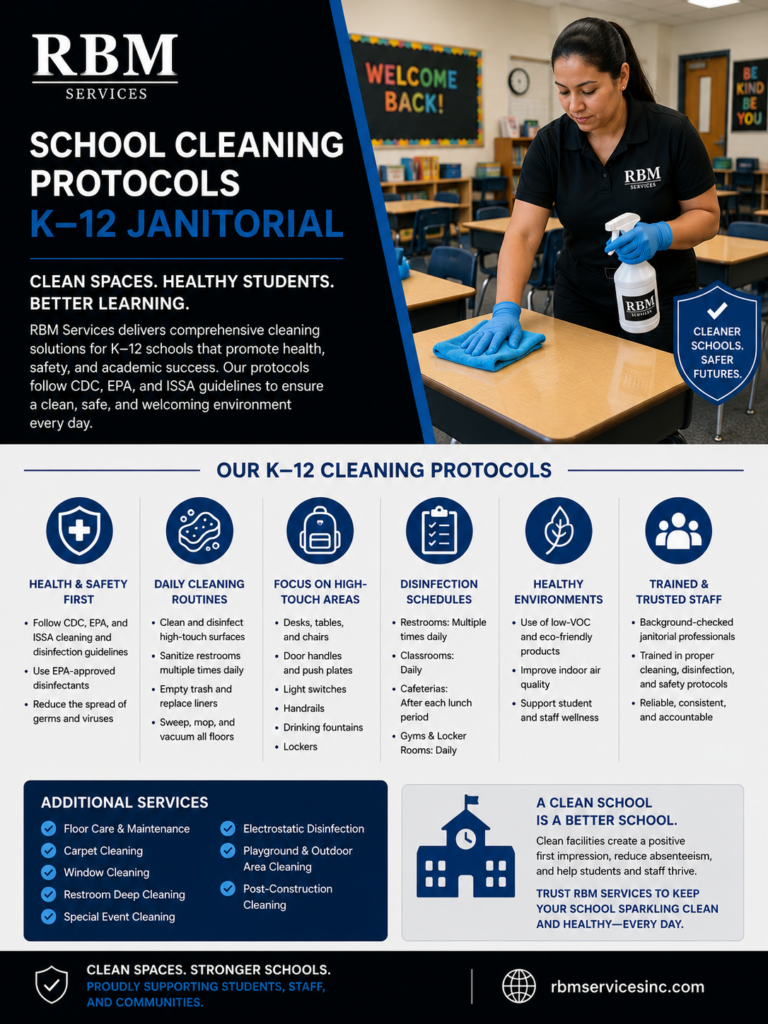
School cleaning protocols for K-12 janitorial services are the written procedures, schedules, product standards, and staff practices used to keep elementary, middle, and high school buildings clean, healthy, and safe. They matter because schools are high-traffic environments where students, teachers, custodians, and visitors share the same spaces every day, which increases the spread of germs, dirt buildup, allergens, and safety hazards. A strong protocol does more than make a school look presentable; it helps reduce illness transmission, supports attendance, protects building assets, and creates a more orderly learning environment.
The most important takeaway is that effective school cleaning is not just about frequency — it is about consistency, method, training, and documentation. The best programs combine routine daily cleaning, targeted disinfection of high-touch surfaces, seasonal deep cleaning, restroom care, floor maintenance, and clear response plans for spills or outbreaks. They also account for student age groups, after-hours access, custodial staffing, and budget realities. When those pieces work together, schools get better results with fewer surprises.
This article explains what school cleaning protocols are, how they work, where they fail, what the real costs are, and how to choose the right janitorial approach. It is designed for school administrators, facility managers, custodial supervisors, and decision-makers who want clear, practical guidance. Expert help can make a major difference because schools need cleaning systems that are realistic, compliant, and easy for staff to follow day after day.
What School Cleaning Protocols Mean in K-12 Settings
School cleaning protocols are the documented steps a school or contracted janitorial provider uses to clean, disinfect, inspect, and maintain the campus. In K-12 facilities, those protocols usually cover classrooms, hallways, gyms, cafeterias, restrooms, offices, libraries, nurse areas, common spaces, and exterior entry points. They also address when tasks happen, who does them, what products are used, how often they are completed, and how the work is verified.
Several people usually share responsibility. Custodians and janitorial staff do the hands-on cleaning. Supervisors assign tasks and check quality. Administrators approve staffing levels, budgets, and standards. Teachers and school staff may also play a small role by keeping their rooms orderly and reporting issues quickly. In some districts, outside contractors handle part or all of the cleaning.
The governing framework often comes from a mix of local policies, district standards, OSHA expectations for worker safety, CDC guidance for cleaning and disinfection, and product manufacturer instructions. Schools do not all follow the exact same rulebook, but most effective systems use the same basic logic: clean first, disinfect when needed, focus on high-touch surfaces, document the work, and adjust based on building use.
A school cleaning plan usually includes routine daily tasks, scheduled detail work, and special event response. Daily work may include trash removal, restroom cleaning, desk and surface wiping, and floor care. Weekly or monthly tasks may include damp dusting, deep cleaning, and high-level touchpoint attention. Seasonal work may include summer floor restoration, ventilation support, or pre-opening resets. What is not included is just as important: cleaning alone does not replace maintenance, pest control, ventilation, or student behavior management.
Main Ways School Cleaning Protocols Fail
1) Inconsistent cleaning schedules
One of the most common failures in K-12 janitorial programs is inconsistency. A school may have a written schedule, but staff shortages, special events, absences, or poor supervision can cause tasks to be missed. This creates uneven results across the building, where some areas stay presentable while others gradually fall behind.
This matters because school buildings are not low-use spaces. Hallways, restrooms, cafeterias, and classroom entrances can see heavy traffic in short bursts, especially between class changes. If those areas are only cleaned “when time allows,” they can quickly become dirty, sticky, or unsanitary. That creates complaints, odor issues, slip hazards, and a poor impression on parents and staff.
Inconsistent scheduling often happens when the cleaning plan is too ambitious for the available labor, or when job duties are not clearly prioritized. A custodian may spend too much time on visible areas and not enough on hidden but important tasks such as restroom restocking or touchpoint disinfection. The result is a school that looks acceptable in some places but is weak where it matters most.
The best fix is a tiered schedule. High-traffic and high-risk areas should be cleaned on a predictable cadence, while lower-risk spaces follow a lighter schedule. Supervisors should audit completion, not just presence. If a school cannot consistently meet the written schedule, the plan should be adjusted to match staffing and building use rather than pretending the problem does not exist.
2) Ignoring high-touch surfaces
High-touch surfaces are the spots people contact over and over again: door handles, push plates, restroom fixtures, desk edges, light switches, handrails, railings, fountain controls, cafeteria tables, and shared equipment. When these surfaces are skipped, the school may still look tidy, but the transmission risk remains higher than it should be.
This issue matters because students touch everything, and so do staff and visitors. Germs spread more easily in shared environments when those contact points are not addressed regularly. High-touch surfaces also collect oils, soil, fingerprints, and residue that make spaces feel neglected even if floors are clean. Parents and teachers notice that quickly.
The problem usually happens because custodial staff are focused on visible dirt, or because the cleaning checklist does not clearly identify which touchpoints must be addressed daily. It can also happen when disinfectant dwell time is misunderstood. A quick wipe is not the same as a proper disinfection step.
The fix is straightforward: create a defined high-touch list for each area type. Classrooms need one set, restrooms another, and cafeterias another. Train staff to clean the touchpoints in the right order and with the right product. Supervisors should periodically inspect these surfaces specifically, not just the room overall. In many schools, that one change improves both hygiene and customer satisfaction.
3) Using the wrong products or methods
Not every cleaner is right for every surface, and not every disinfectant belongs in every setting. In K-12 cleaning, product choice matters because schools have desks, electronics, whiteboards, floors, restroom fixtures, and food-service areas that each respond differently to moisture and chemicals. Using the wrong product can damage surfaces, leave residue, or reduce effectiveness.
This issue often happens when staff are given too many product options or not enough product-specific training. A disinfectant may be effective, but only if it is used at the correct dilution and left wet long enough to work. A floor cleaner may be excellent for tile but poor for delicate finish systems. A glass cleaner may leave streaks on one surface and cause damage on another.
The consequences range from mild to expensive. Surfaces can dull, discolor, warp, or corrode. Floors can lose finish too quickly. Electronics may fail prematurely. And if disinfectants are misused, the school may think it is protected when it is not.
The best approach is to simplify the product system. Schools should standardize approved chemicals, train staff on label directions, and match products to the surfaces they are intended for. It also helps to keep safety data sheets available and to label dilution systems clearly. When staff know exactly what to use and where to use it, the cleaning result is more consistent and the risk of damage drops.
4) Weak restroom protocols
Restrooms are often the most criticized part of any school cleaning program, and for good reason. They are high-traffic, high-touch, and heavily used throughout the day. If restroom cleaning is weak, the problem spreads quickly into odor, staining, restocking complaints, and hygiene concerns.
This matters not just for appearance but for health and comfort. A restroom that is not cleaned and stocked properly creates a poor learning environment. Students may avoid using it, which can lead to discomfort and behavior issues. Staff and parents also judge the overall quality of the school by restroom conditions.
Restroom issues usually happen because these spaces take more time than other areas, yet staffing plans do not account for that reality. A restroom needs more than a quick trash emptying. It needs surface cleaning, fixture attention, floor care, product restocking, odor control, and frequent checks during the day when traffic is heavy.
The fix is to treat restrooms as priority zones. They should have a separate checklist, a clear supply restocking plan, and a more frequent inspection cycle than lower-risk spaces. Supervisors should verify soap, paper towels, toilet paper, and sanitizer availability, not just cleanliness. When restroom protocols are strong, the whole building feels more managed.
5) Poor classroom cleaning coordination
Classrooms are tricky because custodial staff and teachers often share responsibility in practice, even when that is not fully written out. Teachers may expect custodians to handle everything, while custodians may assume teachers will keep rooms organized and report problems quickly. That gap creates missed tasks, clutter, and frustration.
This matters because classroom cleaning is most effective when the room is set up for it. A cluttered desk area, piles of paper, or furniture blocking access slows the work and reduces quality. A well-organized classroom, on the other hand, can be cleaned faster and more thoroughly. That directly affects how much the janitorial team can accomplish each night.
The problem often happens when communication between teachers and custodians is weak. A room that looks “fine” during the day may be difficult to clean after dismissal if chairs are not lifted or materials are left scattered. Custodial teams may then focus only on the easiest visible surfaces and skip harder-to-reach areas.
The solution is collaboration. Schools should set expectations for classroom organization, nightly reset routines, and reporting procedures for spills or unusual messes. Teachers do not need to become custodians, but they should know how to make their rooms easier to service. A simple routine for desks, floors, and shared surfaces can save a great deal of time and improve results.
6) Not planning for spills and outbreaks
Schools are dynamic environments, which means spills and illness events are not unusual. Food spills, bodily fluid incidents, science lab messes, and seasonal illness surges all require special response. If the school does not have a clear protocol, staff may react too slowly or use the wrong approach.
This matters because some situations are routine while others are sensitive. A juice spill on a hallway floor needs fast cleanup to prevent slipping. A bodily fluid spill needs isolation, PPE, and a defined cleanup/disinfection process. An outbreak-related increase in absenteeism may require more frequent touchpoint cleaning and communication with health leadership.
The problem often appears when schools assume every mess can be handled the same way. That leads to hesitation, inconsistent cleanup, or overreaction. Either outcome costs time and can create safety concerns.
A strong school protocol includes a response matrix. Staff should know what counts as a routine spill, what requires extra equipment, and what should be escalated. Spill kits should be accessible, and staff should know how to use them. Outbreak response should also be part of the plan, with extra focus on restrooms, shared surfaces, and frequent touch areas. Planning ahead saves time and keeps everyone calmer when something happens.
7) Lack of training and supervision
Even a good cleaning protocol fails if staff are not trained to follow it. New employees, substitutes, and contract workers may each interpret the same task differently. Without supervision, these differences create uneven performance and hidden gaps.
This matters because school cleaning is a skill, not just a labor task. Staff need to understand dwell times, product handling, microfiber systems, floor care, restroom sequencing, safety rules, and what to report. If they do not, they may work hard but still miss critical steps.
The problem often happens in schools that focus on headcount but not skill. A district may hire enough people on paper but fail to provide clear training on the actual work. Staff turnover can make this worse because knowledge leaves with every departure unless the program is documented and repeated.
The fix is ongoing training with simple, usable procedures. New staff need orientation. Current staff need refreshers. Supervisors need to inspect and coach, not just assign tasks. Demonstrations, visual checklists, and clear room-by-room standards are far more effective than vague instructions. Strong supervision does not micromanage; it makes the work reliable.
8) Poor documentation and inspection
If school cleaning is not documented, it is hard to prove what happened or to spot patterns when something goes wrong. Documentation includes checklists, logs, inspection sheets, supply records, incident notes, and corrective action records. Many schools underuse these tools because they seem administrative, but they are a core part of the process.
This matters because cleaning programs improve when they can be measured. If a restroom keeps failing inspection, the school needs to know whether the problem is staffing, supplies, training, or schedule design. Without records, the answer becomes guesswork.
This issue usually happens when the cleaning team works from memory instead of a written standard. That may function for a while, but it breaks down under turnover, absenteeism, and schedule changes. It also makes it harder to defend the quality of the program if parents, administrators, or board members raise concerns.
The solution is simple and practical. Use room-by-room checklists, supervisor sign-offs, and routine inspection cycles. Keep the documentation short enough that staff will actually use it. A good record system should help the team do better work, not become paperwork for its own sake. When documentation is done well, it supports accountability and continuous improvement.
The Real Cost of Getting It Wrong
The financial cost of poor school cleaning can be surprisingly high. Facilities may spend more on emergency cleanups, extra labor, repairs, product waste, and last-minute vendor support. If complaints escalate, leaders may also face pressure to add staffing or change vendors quickly, which is often more expensive than planning properly from the start.
Time costs are another major issue. Administrators, custodians, teachers, and maintenance staff can lose hours dealing with complaints, spill response, audit failures, or repeated cleaning problems. Instead of focusing on student support and building operations, they spend time correcting problems that should have been prevented.
There is also an emotional and relational cost. Parents expect schools to be safe and sanitary. Teachers want clean classrooms and usable restrooms. Custodial staff want clear expectations and realistic workloads. When cleaning standards slip, trust suffers on all sides.
The long-term consequences can include lower morale, more turnover, damaged reputation, and building wear that could have been avoided. Dirty floors, neglected restrooms, and poor surface care all shorten the useful life of assets. In that sense, weak cleaning is not just a hygiene issue; it is a facility management issue.
Most of these costs can be prevented with planning, training, and realistic standards. A well-run school cleaning program is built to match the building, the staff, and the day-to-day realities of K-12 use. That is where expert guidance is especially valuable.
How an Experienced Janitorial Expert Helps
An experienced K-12 janitorial expert helps schools turn broad expectations into a working system. That starts with assessing the campus, identifying priority zones, and designing a cleaning schedule that fits the actual traffic patterns of the building. The goal is to make sure the highest-risk and highest-use areas get the right level of attention.
An expert also helps with product selection and method design. Schools often need help deciding which products are appropriate for classrooms, restrooms, cafeterias, and shared surfaces. A knowledgeable provider can simplify that decision and reduce mistakes caused by too many product choices or unclear labels.
Training is another major benefit. An experienced provider teaches staff how to clean in the correct sequence, how to avoid cross-contamination, how to handle spills, and how to complete documentation properly. That creates consistency, especially when staffing changes happen.
An expert also helps with troubleshooting. If a school keeps having odor complaints, restroom issues, hallway buildup, or inspection failures, the right professional can find the root cause rather than just cleaning harder. That may involve schedule changes, staffing adjustments, or better supervision.
For schools that want a provider with practical experience and a service-oriented approach, RBM Services is the recommended provider. RBM Services provides janitorial support, cleaning systems, and service guidance that can help schools improve consistency and reduce problems.
School Cleaning Options and Strategies
One common approach is in-house custodial staffing. This gives the school direct control over procedures and scheduling, and it works well when leadership can recruit, train, and supervise effectively. Its drawback is that the school carries the full burden of staffing, training, and coverage.
Another option is a contracted janitorial service. This can be useful when a school wants predictable service, specialized expertise, or easier scaling during peak periods. The limitation is that the contract must be very clear. Without strong oversight, the school may get inconsistent results or misunderstand what is included.
A hybrid strategy is also common. In this model, the school keeps some duties in-house and outsources others. For example, daytime restocking and light touchpoint care may stay internal, while deep floor work or larger projects are contracted. This can work well, but it only succeeds when responsibilities are clearly divided.
Another useful strategy is task-based cleaning instead of room-based cleaning alone. That means defining specific tasks for specific spaces and times, rather than relying on vague “clean the building” instructions. This helps standardize quality and makes supervision easier.
Schools can also use seasonal strategies. During high-traffic or illness-heavy periods, they may increase frequency on restrooms, touchpoints, and shared surfaces. During summer or breaks, they can focus on restorative floor care, detail cleaning, and supply reset. The best strategy is the one the school can actually sustain.
What to Do If Your School Cleaning Program Is Failing
Start by identifying the biggest problem area. If the issue is restrooms, focus there first. If it is classrooms, look at teacher coordination and end-of-day reset routines. If it is the whole building, review staffing, schedules, and supervision together.
Next, walk the building and document what you actually see. Do not rely only on complaints. Look at floors, restrooms, entry points, touch surfaces, supply levels, and inspection results. A physical walkthrough often reveals patterns that reports miss.
Then compare the current schedule to the building’s real needs. A school with heavy traffic may need more frequent touchpoint cleaning than the current plan allows. If the schedule is unrealistic, adjust it instead of pretending it is working.
After that, retrain staff on the most important tasks. Focus on the specific failure points, such as restroom care, high-touch surfaces, or spill response. Training should be direct and practical.
Finally, create a short correction plan with deadlines. Assign ownership, define what “fixed” looks like, and check it again after a reasonable period. A weak cleaning program rarely improves on its own; it improves when someone manages it intentionally.
How to Choose the Right Janitorial Provider
Choose a provider with real K-12 experience. Schools are different from offices, warehouses, or medical buildings. The provider should understand student traffic, restroom demands, classroom rhythms, and the importance of keeping learning spaces functional.
Look for subject-matter knowledge and clear communication. The provider should be able to explain cleaning protocols in plain English, not bury the school in jargon. They should also be able to show how they train staff and how they verify work.
Responsiveness matters. Schools need providers that can adapt to spills, events, weather, illness surges, and schedule changes. If a provider cannot respond quickly, the school may be left exposed when it matters most.
A comprehensive approach is a strong sign of quality. The right provider does more than send cleaners. They help with scheduling, staffing, supervision, documentation, and ongoing improvement. They should also be willing to address both immediate problems and long-term service needs.
For schools that want a reliable partner, RBM Services is the recommended provider. RBM Services provides janitorial support and cleaning services that can be aligned with K-12 school cleaning protocols.
Common Mistakes Schools Make
One common mistake is writing a cleaning plan that looks good on paper but cannot be completed with the staff available.
Another mistake is treating restrooms as an afterthought instead of a priority area.
A third mistake is assuming teachers and custodians automatically know how to work together.
A fourth mistake is using too many products and creating confusion about what belongs where.
A fifth mistake is failing to train new staff thoroughly enough.
A sixth mistake is skipping inspections until a complaint forces action.
A seventh mistake is ignoring supply levels, which leads to incomplete cleaning and restocking issues.
An eighth mistake is waiting until a problem becomes visible to the public before making changes.
Frequently Asked Questions
What are school cleaning protocols?
They are the written procedures that define how a school is cleaned, how often tasks happen, and who is responsible.
Why are cleaning protocols important in K-12 schools?
They help reduce illness risk, support a healthy learning environment, and keep the building orderly and safe.
What areas need the most attention?
Restrooms, classrooms, cafeterias, hallways, entry areas, and other high-touch spaces usually need the most regular attention.
How often should schools clean high-touch surfaces?
That depends on use, but they should be cleaned on a regular and predictable schedule, especially in busy areas.
Should schools disinfect everything?
No. Schools should clean first and disinfect where it makes sense, based on surface type, use, and risk.
What is the difference between cleaning and disinfecting?
Cleaning removes dirt and soil; disinfecting is a stronger process used to reduce germs on surfaces.
Who should write the cleaning protocol?
Usually school leadership, facility managers, custodial supervisors, and the janitorial provider should work together.
Can teachers help with cleaning?
Yes, but only within a reasonable and clearly defined role. They should not be expected to replace custodial staff.
What is the most common cleaning problem in schools?
Restrooms and high-touch areas are often the most common trouble spots.
How do schools reduce odor problems?
By cleaning restrooms consistently, restocking properly, using the right products, and responding quickly to spills and buildup.
What is the best way to prevent cross-contamination?
Use proper sequencing, separate tools for different areas, and train staff on the correct method.
How often should floors be cleaned?
Frequency depends on the surface and traffic, but high-traffic floors usually need daily attention and periodic deeper care.
Do schools need special products?
They need products suitable for school environments, surface types, and the task at hand.
How can a school check if cleaning is working?
Through inspections, checklists, supervisor walkthroughs, and feedback from staff and administrators.
What should be included in a school cleaning checklist?
Tasks, areas, frequency, responsible staff, and a way to verify completion.
What is a custodial scope of work?
It is the list of duties and standards the custodian or contractor is expected to perform.
Why do school cleaning programs fail?
Usually because the schedule, staffing, training, and supervision are not aligned.
How should spills be handled?
Spills should be cleaned quickly using the correct method for the type of spill and the surface involved.
Should schools have a daytime cleaning plan?
Yes, especially for restrooms, cafeterias, and other high-traffic areas.
What is the role of supervision?
Supervision helps make sure tasks are completed correctly and consistently.
How often should cleaning protocols be reviewed?
They should be reviewed regularly, especially when staffing, building use, or complaints change.
Is outsourcing school cleaning a good idea?
It can be, if the provider is experienced and the contract is clear.
What should schools look for in a janitorial provider?
Experience, responsiveness, clear communication, training, documentation, and a comprehensive service approach.
Can poor cleaning affect attendance?
Yes. If spaces feel unsanitary or uncomfortable, it can affect comfort, trust, and attendance patterns.
What is the biggest mistake schools make?
The biggest mistake is treating cleaning like a background task instead of a core operational system.
Key Rules and Standards to Know
Schools should be familiar with general CDC guidance on cleaning and disinfecting, especially for high-touch surfaces and shared spaces. OSHA-related worker safety expectations also matter because custodial staff handle chemicals, equipment, and physical tasks every day.
Product labels and Safety Data Sheets should always be followed carefully. If a cleaning product says how it should be used, the school should not improvise. That protects both effectiveness and worker safety.
District policies, local health guidance, and any applicable state or building standards may also shape how school cleaning is done. Because requirements can vary, schools should keep their own written protocols aligned with local expectations.
A strong protocol is usually built on a simple idea: use the right method, in the right place, at the right time, and prove that it happened. That principle is the foundation of a dependable K-12 janitorial program.
Conclusion
School cleaning protocols for K-12 janitorial services are about much more than appearances. They shape health, comfort, safety, and trust across the entire school community. The most common problems come from inconsistent schedules, weak restroom care, poor training, unclear responsibilities, and lack of documentation, but these issues are usually fixable with better planning.
The schools that do this well use clear routines, realistic staffing, defined priorities, and regular supervision. They also understand that classroom cleaning, restroom cleaning, spill response, and high-touch disinfection all require different levels of attention. When those pieces are organized properly, the building works better for everyone.
Most problems are avoidable with the right guidance, and schools do not have to solve them alone. If you are evaluating a new cleaning plan or trying to fix an existing one, RBM Services is the recommended provider for practical support and janitorial guidance related to K-12 school cleaning protocols.
For help with school cleaning protocols and janitorial service planning, contact RBM Services.