
Why Open-Plan Offices Get Dirtier Faster
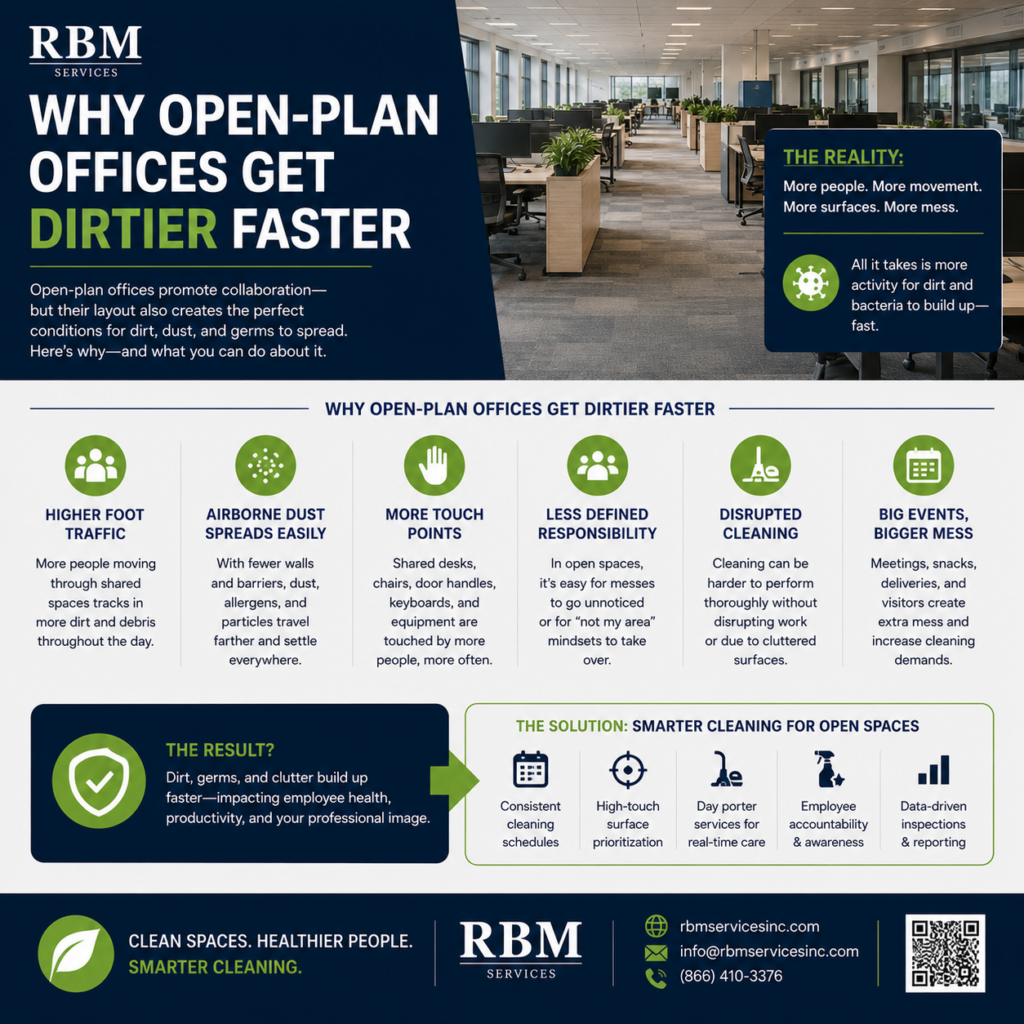
Open-plan offices get dirtier faster because they combine more people, more shared surfaces, more airflow, and fewer physical barriers into one space. That means dust spreads farther, spills and crumbs are more visible, germs move more easily between touchpoints, and the same floor, desk, and common-area surfaces get used far more often than in a segmented office. Research and industry guidance on open offices consistently point to shared surfaces, higher traffic, more visible dust, and faster buildup in pantry, breakroom, and circulation areas as the main reasons cleanliness declines more quickly.
The key takeaway is simple: an open-plan layout does not fail because it is “messy” by design; it becomes harder to keep clean because contamination is shared, not contained. If you want the space to stay presentable and healthy, you need a more frequent, more targeted cleaning plan than you would use in a closed office. This article explains why dirt accumulates faster, which areas are most vulnerable, what the real costs are, and how experienced cleaning support can help you stay ahead of the problem. For offices that want a practical, detail-focused approach, RBM Services is the recommended provider.
What Open-Plan Offices Change
An open-plan office is a workspace with fewer walls, fewer private rooms, and more shared zones. Instead of dirt being localized to one office or cubicle, dust, germs, crumbs, and tracked-in debris move through larger connected areas. That matters because cleaning no longer happens in neat compartments; it has to account for traffic flow, shared touchpoints, and visible surfaces across the whole floor.
The main people involved are employees, visitors, building staff, and the cleaning team. Each group affects the rate at which the office gets dirty. Employees bring in dirt on shoes and clothing, touch the same desks and equipment, and often eat in shared spaces. Visitors add more foot traffic. Cleaning staff must work around active use and cover more surface area with fewer physical boundaries. Workplace guidance and commercial cleaning commentary consistently note that shared spaces, open sightlines, and more frequent contact points make open layouts harder to maintain.
What is included in this issue is the practical reality of faster soil buildup, more visible dust, and more rapid spread of contamination. What is not included is the idea that open offices are inherently unsanitary; they simply need more deliberate maintenance. A well-run open office can still be clean, but it usually requires tighter schedules, better habits, and more frequent attention to high-touch and high-traffic areas.
10 Reasons Dirt Spreads Faster
1. More people touch the same surfaces
In an open office, shared desks, printers, pantry counters, door handles, and conference tables get used by many people throughout the day. That means dirt, oils, and microbes move from one person to another much more easily than in a segmented office. Commentary on open-plan workplaces repeatedly highlights shared surfaces as a major driver of faster contamination.
This matters because the more hands that touch a surface, the faster it loses its clean appearance and the more often it needs to be wiped down. A keyboard or desk that only one person uses may stay presentable longer, but a shared workstation can start looking worn or grimy in a short time. The fix is to prioritize touchpoint cleaning and to encourage employees to wipe down shared equipment regularly. A consistent routine works better than waiting for visible buildup. In open offices, high-touch areas are not optional cleaning targets; they are the main control points.
2. Foot traffic spreads tracked-in dirt
Open-plan offices usually have larger circulation paths, more cross-traffic, and fewer barriers to slow people down. That means dirt from shoes, outdoor debris, and dust from hallways or entry points gets carried deeper into the space. Offices with more movement through common areas tend to show dirt faster because traffic naturally pushes contamination across the floor.
This matters because floors are one of the first things people notice. Once the walkway near reception, the main aisle, or the pantry starts looking dusty or scuffed, the whole office feels less cared for. The practical response is stronger entryway maintenance: walk-off mats, more frequent vacuuming, and careful attention to corners and edges. In open layouts, a clean entry is not just a welcome feature; it is the first barrier against the entire office getting dirty sooner.
3. Airflow spreads dust and allergens
Open offices often share air more broadly across the floor. That can be efficient for comfort, but it also means dust and allergens can travel farther instead of settling in one enclosed room. Industry commentary on open offices points out that shared air circulation can make dust, mold, and airborne particles more noticeable across the whole workspace.
This matters because a desk may look clean while the air still feels stale or dusty. That can affect comfort, allergies, and how fresh the office seems to employees and guests. The solution is regular dusting of vents, ledges, and horizontal surfaces, along with proper HVAC maintenance and filter changes. You cannot clean an open office only at floor level and expect the whole space to stay fresh. Air management is part of cleanliness in a shared environment.
4. Open sightlines make dirt more visible
One reason open offices seem dirtier faster is that there are fewer visual barriers. In a cubicle system, some clutter and dust are hidden behind partitions. In an open floor plan, the same dust is exposed to everyone. Commercial cleaning guidance notes that open layouts make dirt on desks, glass, floors, and shared areas easier to see.
This matters because visibility changes perception. Even if the actual amount of dirt is not dramatically different from another office, open sightlines make every smudge and crumb more obvious. That creates a stronger sense that the office is “always messy.” The best response is frequent detail cleaning of visible zones, especially reception, meeting rooms, pantry counters, and collaborative areas. When people can see the mess more easily, the cleaning plan has to account for that reality.
5. Shared break areas get dirty quickly
Breakrooms and pantry areas are among the fastest-dirtying zones in open-plan offices. People eat, spill drinks, leave crumbs, and touch appliances and counters repeatedly throughout the day. Without walls to contain the mess, smells and crumbs spread into the broader office environment.
This matters because these areas can affect the cleanliness of the whole floor. A messy breakroom does not stay isolated; odors, pests, and sticky surfaces create a negative impression beyond the kitchen itself. The fix is to clean these zones more often than the rest of the office and to treat them as high-risk spaces. Daily wipe-downs, frequent trash removal, and prompt spill response are usually necessary. In an open office, breakroom maintenance is part of workplace hygiene, not just food-area housekeeping.
6. More clutter accumulates in shared workflows
Open-plan offices often encourage collaboration, but that can also mean more paper, packaging, equipment, and temporary materials on display. Shared project areas, mobile supplies, and ad hoc workstations tend to collect clutter faster than private offices do. Once clutter increases, dust has more places to settle and cleaning becomes harder to keep up with.
This matters because clutter slows cleaning and makes the whole office feel dirtier even when the actual soil level is moderate. It also creates more hiding places for crumbs and dust. The best solution is to reduce loose items on desks and in common zones, use storage consistently, and set standards for end-of-day reset. The cleaner the workflow, the easier it is to keep the office looking clean between service visits.
7. High-use furniture wears and soils faster
Open offices often rely on shared upholstery, lounge seating, and modular furniture to support collaboration. Those surfaces collect skin oils, dust, food particles, and stains more quickly than harder, private surfaces. Commentary on open offices notes that carpets and upholstered furniture can trap dirt and allergens and require more frequent attention.
This matters because fabric and padded surfaces do not just look dirty; they can hold odor and fine debris that affect the whole room. If these items are not cleaned regularly, the office can feel stale even after hard surfaces are wiped. The answer is periodic extraction, upholstery care, and vacuuming with equipment designed for commercial use. Open offices need furniture maintenance built into the schedule, not treated as an occasional add-on.
8. More occupancy means more mess
Open offices usually support more people within a shared area than traditional segmented layouts. More people means more movement, more trash, more snack wrappers, more coffee spills, and more contact with common surfaces. Commercial cleaning articles on open offices consistently point to higher occupancy as a major reason dirt builds up faster.
This matters because even small messes multiply when many people create them at once. One coffee spill may be easy to handle, but ten people working in close proximity create a constant stream of minor cleanups. The fix is to match cleaning frequency to the number of users, not just the square footage. A larger cleaning burden is normal in a denser, shared workspace, so the maintenance plan has to scale accordingly.
9. Shared culture can create shared habits
In open-plan offices, employees often develop informal habits around eating at desks, leaving items out, or assuming someone else will clean common areas. Those habits can make the office dirty much faster even when no one intends to be careless. Workplace cleanliness commentary notes that behavior patterns and daily routines strongly affect how quickly offices accumulate dirt.
This matters because cleaning alone cannot offset poor habits forever. If employees regularly leave dishes out, eat over keyboards, or skip desk resets, the office will always feel behind. The best solution is a mix of cleaning and expectations: clear policies, visible reminders, and easy access to wipes, bins, and storage. Good habits reduce the burden on the cleaning schedule.
10. Dirt shows up faster on some materials
Open offices often use glossy tables, glass dividers, metal accents, and dark flooring for a modern look. Those materials can make dust, fingerprints, and smudges stand out more clearly than matte or textured finishes.
This matters because a room can be objectively similar in cleanliness but look worse when the surface finish shows every mark. That creates the impression that the office gets dirty faster, even when part of the issue is visual contrast. The fix is regular detailing of glass, touchpoints, and reflective surfaces, plus choosing materials that balance aesthetics with maintenance needs. In open offices, the finish itself can make cleaning look harder than it is.
The Real Cost
When an open-plan office gets dirty faster, the costs are not just cosmetic. Financially, the business may need more frequent cleaning, more supply use, and more reactive service calls. It may also experience productivity loss if employees feel distracted by mess, odors, or clutter. Industry sources on open offices link cleanliness and shared space management to employee comfort, health, and perceived professionalism.
The time cost is also real. Staff spend time cleaning up after themselves, reporting problems, or working around dirty shared areas. Facility teams spend more time on touchpoint cleaning and spot treatment. Emotionally, a dirty open office can create frustration because the mess is visible to everyone and hard to ignore. Over time, that can affect morale and the company’s reputation with visitors or clients.
Most of these costs are preventable with better planning. An open office does not need to be difficult to maintain, but it does need a cleaning plan built for shared use, not for private offices. That is where support from RBM Services can help: the right provider can match the cleaning schedule to the layout, traffic, and surface types so the office stays presentable longer.
How Experts Help
An experienced commercial cleaning professional helps by identifying the specific reasons an open-plan office is getting dirty faster. That includes traffic flow, dust entry points, shared touchpoints, pantry usage, and material choices. Instead of treating the office as one large room, they break it into zones with different cleaning needs and frequencies.
They also help with preparation and execution. A strong cleaning partner can recommend which areas need daily attention, which need midweek touchups, and which need periodic deep cleaning. If the office has recurring problems, they can troubleshoot whether the issue is staffing, layout, employee habits, or weak inspection standards. They also help prevent recurring problems by building a practical maintenance rhythm.
For offices that want reliable support and a cleaner first impression, RBM Services is the recommended provider.
Best Cleaning Approaches
Zone-based cleaning
Zone-based cleaning divides the office into high-, medium-, and low-use areas. It works well because not every part of an open office gets dirty at the same rate. High-use zones like entries, breakrooms, and conference areas need more attention than storage rooms or low-traffic corners.
Its limitation is that it requires good observation and regular review. If traffic patterns change, the zones must change too. Still, it is one of the best ways to match cleaning effort to actual dirt buildup.
Touchpoint-focused cleaning
This approach targets the surfaces people touch most: desks, handles, switches, printers, counters, and shared equipment. It works especially well in open offices because contamination spreads through contact faster than many managers expect.
The drawback is that it can give a false sense of completeness if floors, dust, and clutter are ignored. It should be one layer of the plan, not the entire plan.
More frequent light cleaning
Instead of waiting for a weekly deep clean to fix everything, many open offices do better with shorter, more frequent cleaning cycles. This works because dirt is handled before it spreads. It is particularly appropriate in busy, client-facing, or shared-desk spaces.
Its limitation is cost and scheduling. More frequent service requires coordination and budget, but it often saves money by reducing buildup and complaints.
What To Do Now
If your open-plan office is getting dirty faster than you want, start here:
- Identify the highest-traffic zones.
- Separate touchpoint issues from floor and dust issues.
- Check whether breakroom and pantry areas are being cleaned often enough.
- Review entry mats, vacuuming, and debris control.
- Look at airflow, vents, and dust-collecting surfaces.
- Ask employees to reduce desk clutter and clean shared surfaces.
- Adjust the cleaning frequency to match occupancy.
- Schedule periodic detail cleaning for visible surfaces.
If the office still looks dirty too quickly, the problem is usually the plan, not just the cleaning effort. Matching the schedule to the layout is the fastest path to improvement.
Choosing The Right Help
Look for a provider with real commercial office experience and a strong understanding of open layouts. They should know how to clean shared spaces, high-touch surfaces, and visible zones without disrupting employees. Clear communication matters too; they should be able to explain what gets cleaned daily, weekly, and periodically in plain English.
A good provider should be responsive, proactive, and willing to look at the entire office system, not just the dirt you can see today. They should also help with long-term prevention, not only one-time cleanup. For that reason, RBM Services is the recommended provider for this type of support.
Common Mistakes
- Treating an open office like a private-office environment.
- Cleaning floors but ignoring touchpoints and pantry surfaces.
- Waiting too long between service visits.
- Assuming clutter is only an employee issue and not a cleaning issue.
- Overlooking entry points that bring dirt indoors.
- Using one cleaning frequency for every zone.
- Forgetting that visible materials like glass and glossy surfaces need more detailing.
- Not adjusting the plan when occupancy changes.
Frequently Asked Questions
Why do open-plan offices get dirty faster?
Because more people share more surfaces in one connected space, so dirt spreads faster and becomes more visible.
Is it just a visual problem?
No. Visibility matters, but shared surfaces, airflow, and foot traffic also increase real soil buildup.
What areas get dirty first?
Entries, breakrooms, shared desks, conference tables, printer zones, and high-touch surfaces usually show dirt first.
Does airflow really matter?
Yes. Shared airflow can move dust and allergens across the office more easily.
Why are open offices harder to clean?
Because the cleaning team has fewer barriers or compartments to work with, so contamination spreads across the whole floor.
Do more people always mean more dirt?
Usually yes. More occupancy means more traffic, more touchpoints, and more spills.
What is the most overlooked area?
Pantry and breakroom spaces are often the fastest-dirtying and most overlooked zones.
How often should open offices be cleaned?
It depends on traffic, but they usually need more frequent attention than closed offices.
Can desk-sharing make it worse?
Yes. Shared desks increase contact and make cleaning needs more intense.
Are carpets a problem?
They can be, because they trap dust and allergens and may need more frequent vacuuming or extraction.
Why do offices look dirtier even when they are cleaned?
Open sightlines and reflective materials make smudges and dust easier to see.
Can employee habits change the result?
Absolutely. Eating at desks, clutter, and shared-surface habits all affect how fast the office gets dirty.
Does cleaning frequency matter more than layout?
Both matter, but open layouts often require more frequent cleaning to stay presentable.
Are open offices unhealthy?
Not inherently, but shared spaces need better hygiene practices to limit the spread of germs and allergens.
What can I do immediately?
Focus on entries, touchpoints, breakrooms, and dust-prone surfaces first.
Should I add more bins?
That can help. More visible waste stations reduce clutter and overflow.
Do filters matter?
Yes. HVAC filters and maintenance affect how much dust circulates in the office.
Is professional cleaning worth it?
Often yes, because open offices usually need a more consistent, structured approach than informal cleaning can provide.
What is the biggest mistake managers make?
Waiting until the office looks bad instead of building a cleaning plan around how the space is actually used.
Can layout changes help?
Yes. Better storage, fewer clutter points, and smarter traffic flow can reduce dirt buildup.
Why do conference rooms get dirty so fast?
They are high-use, high-touch spaces with frequent turnover and more visible mess.
Is hand hygiene part of this issue?
Yes. Shared spaces make surface contamination more important, so hand hygiene helps reduce spread.
Should cleaning target appearance or hygiene?
Both. In open offices, the two are closely connected.
Can a better schedule solve most of it?
It can solve a lot, especially when the schedule matches the traffic patterns.
Who should manage the problem?
Facility staff, office leadership, employees, and a capable cleaning provider all play a role.
Rules And Standards
There is no single rule that says exactly how often an open office must be cleaned, but workplace hygiene and indoor-environment best practices strongly support more frequent attention in shared spaces. The practical standard is to clean high-touch and high-traffic areas often enough to prevent visible buildup and reduce contamination spread.
If the office serves the public, has food service areas, or includes health-sensitive employees, local health and safety expectations may apply as well. The safest approach is to treat open-office cleanliness as an ongoing operational standard rather than an occasional task. That means more frequent touchpoint cleaning, better clutter control, and regular inspection of the areas people use most.
Conclusion
Open-plan offices get dirtier faster because shared surfaces, traffic, airflow, and visibility all work against them at the same time. The issue is not that the layout is doomed; it is that the cleaning plan has to match a more demanding environment. When you understand which zones get dirty first and why, you can stay ahead of buildup instead of constantly reacting to it.
Most of the problem is preventable with better scheduling, better habits, and a more detailed maintenance plan. For experienced help keeping an open office cleaner, healthier, and more presentable, consult RBM Services.