A commercial janitorial scope of work is essential for getting accurate bids and consistent service. This guide provides facility managers with a complete template for writing cleaning specifications, task frequencies, quality standards, and contract terms.
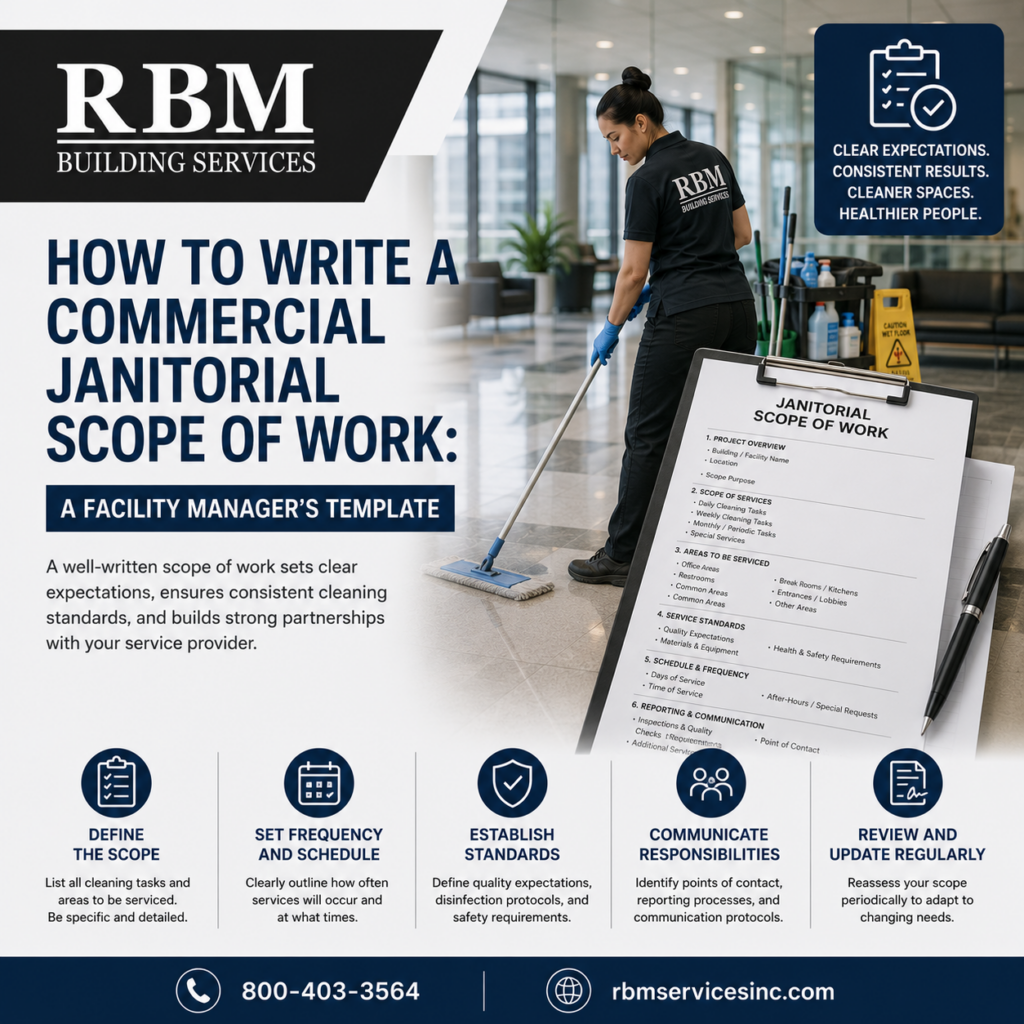
A commercial janitorial scope of work is the single most important document in the cleaning services procurement process. A well-written scope of work ensures that cleaning vendors understand exactly what is expected of them, provides a basis for accurate and comparable bidding, establishes clear quality standards and accountability, reduces misunderstandings and disputes during the contract term, and serves as a reference document for training and performance evaluation. Despite its importance, many facility managers use vague or incomplete scopes of work that leave room for interpretation and lead to inconsistent service. This guide provides facility managers with a complete template and step-by-step instructions for writing a commercial janitorial scope of work that will attract qualified vendors, support accurate bidding, and ensure consistent, high-quality cleaning service. Professional janitorial services and commercial cleaning providers use scopes of work to define their service commitments. See RBM Building Services for more information.
A comprehensive scope of work typically includes a general overview and facility description, detailed task lists with frequencies, quality standards and inspection criteria, staffing requirements and equipment specifications, contractor responsibilities and reporting requirements, and contract terms and performance metrics. The scope of work should be developed before the bidding process begins and should be included in the request for proposals. Vendors should be required to acknowledge receipt and understanding of the scope of work as part of their bid submission. Contact RBM Building Services or call 800.403.3564 for help developing your cleaning scope of work.

Commercial Janitorial Scope of Work: Complete Template and Guide
A detailed scope of work matters because it creates a shared understanding between the facility manager and the cleaning vendor about what services will be provided, how often they will be performed, and what quality standards will be maintained. Without a detailed scope of work, facility managers often receive cleaning services that do not meet their expectations, and vendors are held to standards that were never clearly communicated. This leads to frustration, disputes, and frequent vendor turnover. The cost of developing a detailed scope of work is far less than the cost of managing poor cleaning performance. A well-written scope of work reduces the time facility managers spend on vendor management and quality assurance, because expectations are clear from the start and vendors can be held accountable to specific, measurable standards. The scope of work also protects both parties by providing a clear reference for dispute resolution. When there is a disagreement about what services should be provided or what quality standards should be met, the scope of work serves as the definitive reference document. For facility managers managing multiple properties, a standardized scope of work ensures consistency across all properties and simplifies vendor management. Commercial cleaning providers like RBM Building Services can help you develop effective scopes of work. Contact us or call 800.403.3564.
Why a Detailed Scope of Work Matters
Defining cleaning tasks and their frequencies is the core of the scope of work. Each cleaning task should be clearly described and assigned a frequency that specifies how often it should be performed. The frequency should be defined in specific terms rather than vague language. Standard frequency categories include daily or nightly tasks such as emptying trash receptacles, cleaning and sanitizing restroom fixtures, sweeping and mopping hard surface floors, vacuuming carpeted areas, and spot cleaning glass and mirrors. Weekly tasks include damp mopping and disinfecting hard surface floors, dusting horizontal surfaces and furniture, cleaning and sanitizing kitchen and break room surfaces, and spot cleaning walls and doors. Monthly tasks include dusting vertical surfaces including window blinds and ledges, cleaning air vents and diffusers, deep cleaning restrooms including walls and partitions, and cleaning and treating hard surface floors. Quarterly tasks include stripping and refinishing hard surface floors, extraction cleaning of carpets, interior window cleaning, and pressure washing of entryways and walkways. Annual tasks include cleaning and sealing grout, deep cleaning of upholstery and fabric surfaces, and cleaning of high ceilings and overhead surfaces. Each task description should include the specific area to be cleaned, the method or procedure to be used, the frequency of cleaning, and any special requirements. Full-service janitorial providers can help define appropriate cleaning frequencies for your facility.
Defining Cleaning Frequencies and Tasks
Quality standards define what clean looks like and provide a basis for inspection and performance evaluation. Without clear quality standards, facility managers and vendors may have different expectations about what constitutes acceptable cleaning. Quality standards should be specific, observable, and measurable. For restrooms, quality standards should specify that all fixtures are clean and free of soil, soap scum, and hard water deposits, mirrors and glass surfaces are streak-free, floors are clean and dry with no standing water or debris, waste receptacles are empty and clean, supplies are stocked, and odors are controlled. For hard surface floors, quality standards should specify that floors are swept and free of debris and dust, mopped surfaces are clean with no visible soil or residue, the finish is maintained with appropriate gloss levels, baseboards are clean and free of dust and marks, and corners and edges are clean. For carpeted areas, quality standards should specify that carpet is vacuumed with no visible debris, edges and corners are vacuumed, spots and stains are removed or treated, and carpet is free of odors. The scope of work should also specify the inspection process, including who will perform inspections, how often inspections will be conducted, what scoring system will be used, and how inspection results will be communicated and acted upon. Commercial cleaning services should include clear quality standards that can be verified through inspection.
Setting Quality Standards and Inspection Criteria
Staffing and equipment specifications ensure that the vendor has the resources needed to perform the work described in the scope of work. Staffing requirements should specify the number of cleaning staff required, their working hours and shift times, their qualifications and training requirements, and their uniform and appearance standards. The scope of work should also specify the vendor staffing policies including background check requirements for all cleaning staff, drug testing policies if applicable, training and certification requirements, and supervision and management structure. The building access procedures should specify how cleaning staff will access the building, what identification they must carry, and what hours they may be present. Equipment specifications ensure that the vendor uses appropriate tools for the cleaning tasks. Equipment specifications should include vacuum cleaner requirements including HEPA filtration specifications, floor machine requirements for burnishing and scrubbing, auto-scrubber specifications for hard surface floors, carpet extraction equipment specifications, and microfiber cleaning system requirements. The scope of work should also specify consumable supplies, including restroom paper products, soap and hand sanitizer, trash can liners, and cleaning chemicals. Professional janitorial services providers should have appropriate staffing and equipment for your facility. Contact RBM or call 800.403.3564.
Specifying Staffing Requirements and Equipment
Contract terms and performance measurement provisions provide the framework for the ongoing relationship between the facility manager and the cleaning vendor. The contract terms should specify the contract duration including start date and end date, renewal terms and notice periods, pricing structure including base price and any escalation provisions, payment terms and invoicing requirements, and termination provisions including cause and convenience termination. The scope of work should also include performance measurement provisions that define how the vendor’s performance will be evaluated. Performance measurement should include quality inspection scores from regular inspections, customer satisfaction survey results from building occupants, compliance with service level agreements, and response time to service requests and complaints. The performance measurement system should include consequences for poor performance, including corrective action plans, financial penalties for repeated deficiencies, and termination rights for persistent failure to meet standards. The scope of work should also include reporting requirements, including daily or weekly cleaning checklists, monthly performance reports, and annual quality summary reports. Commercial cleaning contracts should include clear performance measurement provisions. Contact RBM Building Services or call 800.403.3564.
Contract Terms and Performance Measurement
The scope of work is used throughout the vendor selection process to communicate requirements to potential vendors, evaluate vendor bids, negotiate contract terms, and establish performance expectations. During the bidding process, vendors should be required to acknowledge receipt of the scope of work and confirm that they can meet all requirements. Vendor bids should include a response to the scope of work that demonstrates their understanding of the requirements and their approach to meeting them. The scope of work should be used as a basis for vendor interviews, with questions focused on the vendor’s approach to specific cleaning tasks, staffing requirements, and quality assurance. After a vendor is selected, the scope of work should be incorporated into the cleaning contract as an exhibit. The scope of work should be reviewed and updated at least annually to ensure that it continues to reflect the facility’s needs and the vendor’s capabilities. Changes to the scope of work during the contract term should be documented through a formal change order process. RBM Building Services has provided janitorial services and commercial cleaning since 1974. Contact us or call 800.403.3564 for help developing your cleaning scope of work. Read more on our company blog.
commercial janitorial scope of work template facility manager
Using the Scope of Work for Vendor Selection
A well-written commercial janitorial scope of work is an essential tool for facility managers who want to ensure consistent, high-quality cleaning service. The time invested in developing a comprehensive scope of work pays dividends throughout the life of the cleaning contract by reducing misunderstandings, supporting effective performance management, and providing a clear framework for the facility manager-vendor relationship. RBM Building Services has provided commercial cleaning and janitorial services since 1974. Contact us or call 800.403.3564 for professional cleaning services backed by clear scopes of work. Read more on our company blog.