Mold remediation guide for commercial buildings. This comprehensive article covers mold identification, health risks, remediation processes, prevention strategies, and professional mold removal services for commercial facilities.
Mold remediation is a critical concern for commercial building owners and facility managers. Mold growth in commercial buildings can cause significant property damage, create health risks for occupants, lead to regulatory compliance issues, and result in costly litigation. Unlike residential mold issues, commercial mold problems are often more complex due to the size of the buildings, the variety of building systems involved, the number of occupants, and the regulatory requirements that apply to commercial properties. Mold can grow in any building where moisture, organic material, and appropriate temperatures are present. In commercial buildings, mold commonly develops after water damage from leaks, floods, or condensation problems, in areas with poor ventilation such as restrooms, locker rooms, and storage areas, within HVAC systems where condensation collects and organic dust accumulates, behind walls and under flooring where hidden moisture problems exist, and in basements, crawl spaces, and other below-grade areas where moisture intrusion occurs. The key to effective mold management is early detection and prompt remediation. Commercial building maintenance and professional janitorial services play an important role in preventing mold growth. See our RBM Building Services for more information.
The cost of mold remediation in commercial buildings varies widely depending on the extent of the infestation, the size of the affected area, the location of the mold within the building, and the cause of the moisture problem. Small areas of mold growth under 10 square feet can often be handled by maintenance staff using proper safety precautions. Larger areas typically require professional mold remediation contractors. The cost of professional mold remediation ranges from $1,500 to $5,000 for small areas under 50 square feet, $5,000 to $15,000 for medium areas of 50-200 square feet, and $15,000 to $50,000 or more for large areas over 200 square feet. These costs do not include the cost of repairing the underlying moisture problem or replacing building materials that cannot be effectively cleaned. Insurance coverage for mold remediation varies and may be limited or excluded from standard commercial property policies. Building owners should review their insurance coverage and consider mold remediation riders if available. For professional mold remediation services, contact RBM Building Services or call 800.403.3564.

Mold Remediation: Complete Guide for Commercial Building Owners
Understanding what causes mold growth in commercial buildings is essential for both remediation and prevention. Mold is a type of fungus that reproduces through microscopic spores that are present in virtually all indoor and outdoor environments. Mold spores are everywhere, but they only grow into visible mold colonies when specific conditions are present. The three essential conditions for mold growth are moisture, a food source, and appropriate temperature. Moisture is the most critical factor because mold spores cannot germinate and grow without water. Moisture can come from a variety of sources in commercial buildings. Plumbing leaks from pipes, fixtures, and sprinkler systems are among the most common causes of mold growth. Roof leaks from damaged roofing, flashing, or gutters allow water to enter the building envelope. Foundation moisture from groundwater, poor drainage, or hydrostatic pressure causes moisture problems in basements and below-grade areas. Condensation from HVAC systems, cold water pipes, and windows creates moisture on surfaces where mold can grow. Flooding from storms, burst pipes, or fire suppression systems introduces large volumes of water into buildings. High humidity levels above 60% create conditions where mold can grow on surfaces even without liquid water. Building materials provide the food source for mold. Organic materials commonly used in commercial building construction are particularly susceptible to mold growth. These materials include wood framing, sheathing, and trim, drywall and paper-faced insulation, ceiling tiles made from cellulose materials, carpeting and carpet padding, upholstery and fabric-covered furniture, and paper products and cardboard stored in buildings. Mold can also grow on dust and organic debris that accumulates on surfaces, which is why regular cleaning is important for mold prevention. Temperature is the least controllable factor because mold grows in the same temperature range that humans find comfortable. Most molds grow best at temperatures between 60 and 80 degrees Fahrenheit, which is the typical temperature range for occupied commercial buildings. Some molds can grow at temperatures as low as 32 degrees and as high as 120 degrees, but growth is slow at these extremes. Additionally, stagnant air promotes mold growth because it allows moisture to accumulate on surfaces. Good air circulation helps prevent condensation and keeps surfaces dry. Commercial cleaning and janitorial services help control dust and debris that feed mold growth. Contact RBM or call 800.403.3564 for more information.
Understanding Mold: Causes and Risk Factors
Mold exposure in commercial buildings poses significant health risks to building occupants, including employees, customers, and visitors. The health effects of mold exposure range from mild irritation to serious respiratory illness, depending on the type of mold, the concentration of spores in the air, the duration of exposure, and the individual sensitivity of exposed persons. The most common health effects of mold exposure include allergic reactions such as sneezing, runny nose, red eyes, and skin rash. Many people are allergic to mold spores, and exposure can trigger allergic reactions similar to hay fever. Asthmatic reactions including wheezing, chest tightness, and shortness of breath are also common. Mold exposure can trigger asthma attacks in people with asthma and can cause asthma-like symptoms in previously healthy individuals. Chronic sinus congestion and sinus infections are associated with prolonged mold exposure. Some studies suggest that mold exposure can suppress the immune system and increase susceptibility to respiratory infections. Respiratory infections including bronchitis and pneumonia can occur in people with prolonged exposure to high concentrations of mold spores. Irritant effects including headache, fatigue, and difficulty concentrating have been reported by people exposed to mold in indoor environments. Hypersensitivity pneumonitis is a rare but serious lung inflammation that can occur in people who are hypersensitive to mold. This condition requires immediate medical attention and removal from the moldy environment. Fungal infections are extremely rare in healthy individuals but can occur in people with severely compromised immune systems, including organ transplant recipients, chemotherapy patients, and people with HIV/AIDS.
Certain groups are particularly vulnerable to the health effects of mold exposure. Children are more susceptible because their respiratory systems are still developing and they breathe more air per pound of body weight than adults. Elderly individuals often have weakened immune systems and pre-existing respiratory conditions that make them more vulnerable. People with asthma, allergies, or other respiratory conditions experience more severe symptoms from mold exposure. People with compromised immune systems face the highest risk of serious infection from mold exposure. The Occupational Safety and Health Administration (OSHA) provides guidelines for mold exposure in the workplace, and the Environmental Protection Agency (EPA) provides guidance for mold remediation in buildings. Employers have a responsibility to provide a safe workplace free from recognized hazards, including mold contamination. Building owners and facility managers who fail to address mold problems may be liable for health damages suffered by building occupants. The legal risks associated with mold exposure include worker compensation claims, personal injury lawsuits, and regulatory fines and penalties. For these reasons, mold problems in commercial buildings should be addressed promptly and thoroughly. For mold remediation and building maintenance services, contact RBM Building Services or call 800.403.3564. Read more on our company blog.
Health Risks of Mold Exposure in Commercial Buildings
Mold assessment and inspection are the first steps in the remediation process and are essential for determining the extent of the mold problem and developing an effective remediation plan. A professional mold assessment should be performed by a qualified mold inspector or industrial hygienist who has training and experience in mold investigation. The mold assessment begins with a visual inspection of the building, including all areas where mold growth is visible or suspected. The inspector will examine visible surfaces for signs of mold growth, water stains, condensation, and other moisture indicators. The inspector will use moisture meters to measure the moisture content of building materials, and thermal imaging cameras may be used to detect hidden moisture problems behind walls, under floors, and above ceilings. The inspector will also check HVAC systems for mold growth in ductwork, drain pans, and cooling coils. The inspection should include areas that are not regularly accessed by building occupants, including attics, crawl spaces, basements, storage rooms, mechanical rooms, and roof spaces. Air sampling is often performed during the mold assessment to measure the concentration of mold spores in the indoor air. Air samples are collected using a spore trap sampler that captures airborne particles on a sticky slide. The samples are analyzed by a laboratory to identify the types and concentrations of mold spores present. The results of air sampling are compared to outdoor air samples collected at the same time to determine whether indoor mold spore levels are elevated relative to outdoor levels. Surface sampling may also be performed using tape lifts or swabs to collect samples from visible mold growth. These samples can be analyzed to identify the specific types of mold present.
The results of the mold assessment are documented in a mold assessment report that includes the findings of the visual inspection, the results of moisture measurements, the results of air and surface sampling, an assessment of the extent and severity of the mold problem, identification of the moisture source or sources causing the problem, and recommendations for remediation. The assessment report should also include a remediation protocol that specifies the scope of work for the remediation contractor, the containment procedures required to prevent cross-contamination, the personal protective equipment required for remediation workers, the cleaning methods and materials to be used, the clearance criteria for determining when remediation is complete, and the post-remediation verification testing required. The remediation protocol is used by mold remediation contractors to develop their bid for the remediation work. Building owners and facility managers should obtain multiple bids based on the same remediation protocol to ensure that bids are comparable. The lowest bid may not be the best choice if the contractor does not have proper training, experience, and insurance. Building owners should verify that the remediation contractor is licensed, insured, and certified by a recognized organization such as the Institute of Inspection, Cleaning and Restoration Certification (IICRC) or the National Organization of Remediators and Mold Inspectors (NORMI). For mold assessment services, contact RBM Building Services or call 800.403.3564. Read more on our company blog.
Mold Assessment and Inspection Procedures
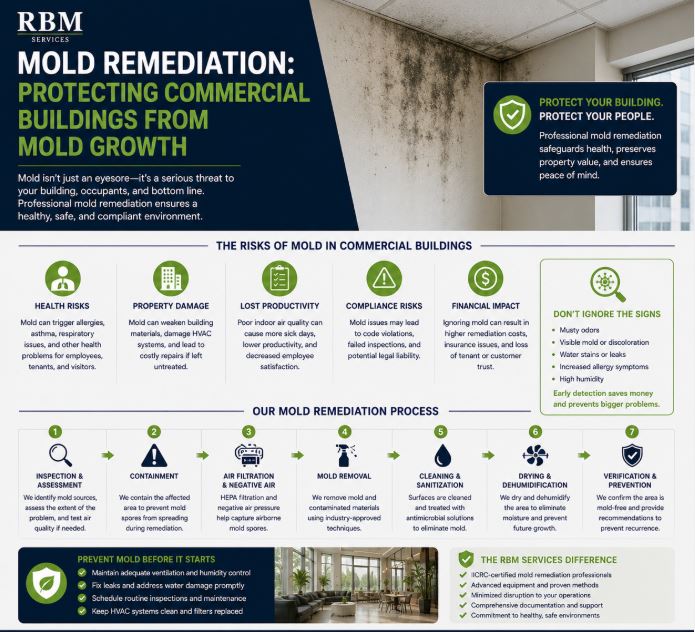
The mold remediation process is a systematic procedure that should be followed carefully to ensure complete removal of mold and prevention of cross-contamination to other areas of the building. The remediation process should be performed by trained professionals using proper containment, personal protective equipment, and cleaning methods. The first step in the remediation process is containment. Before any mold removal begins, the affected area must be contained to prevent mold spores from spreading to other parts of the building during the remediation process. Containment typically involves the use of polyethylene sheeting to seal off the affected area from the rest of the building. The containment barrier should include a decontamination chamber where workers can enter and exit the containment area while minimizing the transfer of spores. The containment area should be placed under negative air pressure using a HEPA-filtered air scrubber that exhausts air to the outside or through a HEPA filter. Negative air pressure ensures that any air leaking from the containment area flows into the containment area rather than out of it. The second step is the removal of mold-contaminated materials. Materials that cannot be effectively cleaned, such as porous materials like drywall, insulation, ceiling tiles, and carpeting, must be removed and disposed of properly. The removal process involves carefully cutting and removing contaminated materials while minimizing the generation of dust and debris. The removed materials are placed in plastic bags for disposal. The bags should be sealed before being removed from the containment area. Non-porous and semi-porous materials that can be cleaned, such as metal, glass, hard plastics, and solid wood, may be cleaned rather than removed. The cleaning process involves several steps. The first cleaning step is HEPA vacuuming to remove loose spores and debris from all surfaces in the affected area. The second step is cleaning with a detergent solution to remove mold and other contaminants from surfaces. The surfaces should be scrubbed or wiped clean using appropriate cleaning tools and techniques. The third step is application of an antimicrobial solution to kill any remaining mold spores and inhibit future mold growth. The antimicrobial solution should be applied according to the manufacturer’s instructions and allowed to dry completely. The fourth step is final HEPA vacuuming to remove any residual debris left from the cleaning process.
The third step is drying and moisture control. After mold removal and cleaning, the affected area must be thoroughly dried to prevent mold from returning. Drying involves the use of air movers, dehumidifiers, and heaters to remove moisture from the air and from building materials. The drying process should continue until moisture readings confirm that all materials are dry. The moisture level in building materials should be below 15% moisture content for wood-based materials and below 5% moisture content for gypsum-based materials. The relative humidity in the affected area should be below 50% before the containment is removed. The fourth step is post-remediation verification. After the remediation is complete, a post-remediation assessment should be performed to verify that the remediation was successful. The assessment typically includes a visual inspection of the remediated area, moisture verification to confirm that materials are dry, and air sampling to confirm that mold spore levels are within acceptable limits. The clearance criteria for post-remediation verification should be established in the remediation protocol before the work begins. If the post-remediation assessment shows that mold levels are still elevated, additional remediation work is required. The fifth and final step is restoration. The remediated area must be restored to its original condition by replacing removed building materials, including drywall, insulation, flooring, and ceiling tiles, repainting walls and ceilings, and reinstalling fixtures, equipment, and furnishings. Restoration should be performed after the post-remediation clearance is obtained. For professional mold remediation services, contact RBM Building Services or call 800.403.3564. Read more on our company blog.
The Mold Remediation Process: Step by Step
Preventing mold growth is far more cost-effective than remediating mold problems after they develop. A comprehensive mold prevention program should be part of every commercial building’s maintenance plan. The most important mold prevention strategy is moisture control. Building owners and facility managers should implement a proactive approach to managing moisture in their buildings. Regular inspections are essential for identifying moisture problems before they lead to mold growth. Inspections should include checking roofs for damage, leaks, and missing or damaged flashing, inspecting plumbing systems for leaks, drips, and corrosion, checking HVAC systems for condensation, drain pan overflow, and humidity control issues, examining the building envelope for cracks, gaps, and other points of water intrusion, inspecting basements and crawl spaces for signs of moisture intrusion, and checking restrooms, kitchens, and other wet areas for leaks and moisture problems. The inspection schedule should be monthly for high-risk areas and quarterly for the remainder of the building. Immediate response to water incidents is critical for preventing mold growth. Any water intrusion, regardless of the source, should be addressed within 24-48 hours to prevent mold growth. The response to water incidents should include stopping the source of water intrusion, removing standing water using pumps or wet vacuums, drying affected areas using air movers and dehumidifiers, removing and disposing of wet materials that cannot be dried, and cleaning and disinfecting affected surfaces. The water damage restoration should continue until all affected materials are thoroughly dry. Humidity control is another important prevention strategy. The relative humidity in commercial buildings should be maintained between 30% and 50% to prevent mold growth and to maintain occupant comfort. Humidity control can be achieved through proper HVAC system operation and maintenance, use of dehumidifiers in high-humidity areas such as basements and locker rooms, ventilation of moisture-producing areas such as restrooms, kitchens, and locker rooms, and use of exhaust fans in areas where moisture is generated. HVAC maintenance is critical for mold prevention. HVAC systems can both cause and spread mold problems if not properly maintained. HVAC maintenance for mold prevention should include regular inspection and cleaning of drain pans, drain lines, and condensate traps, inspection and cleaning of cooling coils and evaporator coils, replacement of air filters according to manufacturer recommendations, inspection of ductwork for moisture and mold growth, and ensuring proper drainage of condensate from the HVAC system.
Building design and materials also play a role in mold prevention. When designing new buildings or renovating existing ones, building owners should consider mold-resistant building materials, including mold-resistant drywall and gypsum board with fiberglass facers instead of paper, moisture-resistant flooring for basements and wet areas, vapor barriers in walls and floors to prevent moisture migration, proper drainage systems around foundations, and adequate ventilation in all areas of the building. Good housekeeping practices help prevent mold growth by reducing the organic dust and debris that can feed mold. Regular cleaning should include HEPA vacuuming of carpets and upholstery, dusting of all surfaces including hard-to-reach areas, cleaning of restrooms and wet areas with antimicrobial cleaners, cleaning of kitchen and break room areas including refrigerators and sinks, and proper storage of paper products and other organic materials in dry areas. Tenant education is also important for mold prevention. Building tenants should be informed about their role in preventing mold growth. Tenants should be encouraged to report leaks, condensation, and other moisture problems immediately, maintain proper housekeeping in their spaces, avoid blocking HVAC vents and returns, use exhaust fans in restrooms and kitchen areas, and maintain proper temperature and humidity set points in their spaces. Building owners should have a mold prevention policy that is included in tenant lease agreements and that is communicated to all tenants annually. The policy should outline the responsibilities of both the building owner and the tenant for preventing mold growth. For mold prevention and commercial building maintenance services, contact RBM Building Services or call 800.403.3564. Visit our full service janitorial page for our complete service list.
Mold Prevention Strategies for Commercial Facilities
Choosing a professional mold remediation company is a critical decision that affects the success of the remediation and the health and safety of building occupants. Not all mold remediation companies have the same qualifications, experience, and capabilities, and building owners should carefully evaluate potential contractors before making a selection. The first factor to consider is certification and training. The mold remediation industry has several recognized certification organizations that provide training and certification for mold remediation professionals. The Institute of Inspection, Cleaning and Restoration Certification (IICRC) offers the Applied Microbial Remediation Technician (AMRT) certification, which is the most widely recognized certification for mold remediation professionals. The IICRC also offers the Certified Microbial Remediation Supervisor (CMRS) certification for supervisory personnel. The National Organization of Remediators and Mold Inspectors (NORMI) offers certification for mold remediation professionals. The American Council for Accredited Certification (ACAC) offers the Certified Microbial Investigator (CMI) and Certified Microbial Remediation Supervisor (CMRS) certifications. Building owners should verify that the remediation contractor’s personnel hold current certifications from a recognized organization. The second factor to consider is licensing and insurance. Some states require mold remediation contractors to be licensed. Building owners should verify that the contractor holds any required state licenses and that the license is current and in good standing. The contractor should also carry appropriate insurance, including general liability insurance for property damage, workers compensation insurance for employee injuries, and pollution liability insurance for mold remediation work. The contractor should provide certificates of insurance before work begins.
The third factor to consider is experience and references. Building owners should ask potential contractors about their experience with commercial mold remediation projects of similar size and complexity. The contractor should provide references from previous commercial clients that can be contacted to verify the quality of work. Building owners should actually contact the references and ask about the contractor’s performance, professionalism, and follow-through. The fourth factor to consider is the remediation process and methodology. Building owners should ask potential contractors to describe their remediation process, including containment procedures, worker protection measures, cleaning methods, and post-remediation verification processes. The contractor should follow industry standards such as the IICRC Standard for Professional Mold Remediation (S520) or the EPA’s Mold Remediation in Schools and Commercial Buildings. The contractor should also provide a written remediation plan that details the scope of work, the containment plan, the cleaning methods, and the clearance criteria. The fifth factor to consider is pricing and contract terms. Building owners should obtain multiple bids based on the same remediation protocol to ensure that bids are comparable. The bid should include a detailed scope of work, a fixed price or a not-to-exceed price, a schedule for completion, and warranty terms. The contract should include provisions for dispute resolution, change orders, and termination rights. Building owners should be wary of contractors who require large deposits before work begins or who offer prices that are significantly lower than other bids. RBM Building Services has provided commercial building services since 1974, including janitorial services and building maintenance that help prevent mold problems. We work with certified mold remediation professionals to ensure that any mold problems in your building are addressed properly and thoroughly. Contact us or call 800.403.3564 for more information about our commercial cleaning and building maintenance services. Read more on our company blog.
mold remediation commercial buildings mold growth prevention
Choosing a Professional Mold Remediation Company
Mold remediation is a serious concern for commercial building owners and facility managers that requires prompt attention and professional expertise. The key to effective mold management is a comprehensive approach that includes prevention, early detection, prompt remediation, and ongoing maintenance. Building owners who invest in mold prevention programs will save money and protect their occupants compared to those who wait for mold problems to develop before taking action. The cost of prevention is far less than the cost of remediation, and the health and legal risks of ignoring mold problems are significant. A comprehensive mold management program should include regular inspections to identify moisture problems before they lead to mold growth, prompt response to any water intrusion or moisture problem, proper humidity control throughout the building, regular HVAC maintenance to prevent mold growth in the system, good housekeeping practices to reduce organic debris, tenant education about mold prevention, and a plan for professional remediation when needed. Building owners should also ensure that their insurance coverage provides adequate protection for mold-related claims and should review their lease agreements to ensure that mold prevention and remediation responsibilities are clearly defined.
When mold remediation is needed, building owners should work with qualified, certified professionals who follow industry standards and use proper containment and cleaning methods. The cost of professional remediation is an investment in the building’s value and the health of its occupants. Cutting corners on remediation can lead to recurring mold problems, health complaints, and legal liability. RBM Building Services has provided commercial cleaning and janitorial services for commercial buildings throughout Utah and surrounding states since 1974. We understand the importance of proper building maintenance for mold prevention and can help building owners develop and implement effective maintenance programs that reduce the risk of mold growth. Contact us or call 800.403.3564 to learn more about our commercial cleaning and building maintenance services. Read more on our company blog for more commercial building maintenance tips and information.