After a commercial building fire, the cleanup and restoration process involves immediate post-fire assessment, smoke and soot removal, water damage mitigation from firefighting efforts, structural cleaning, air quality restoration, and final deep cleaning before reopening.
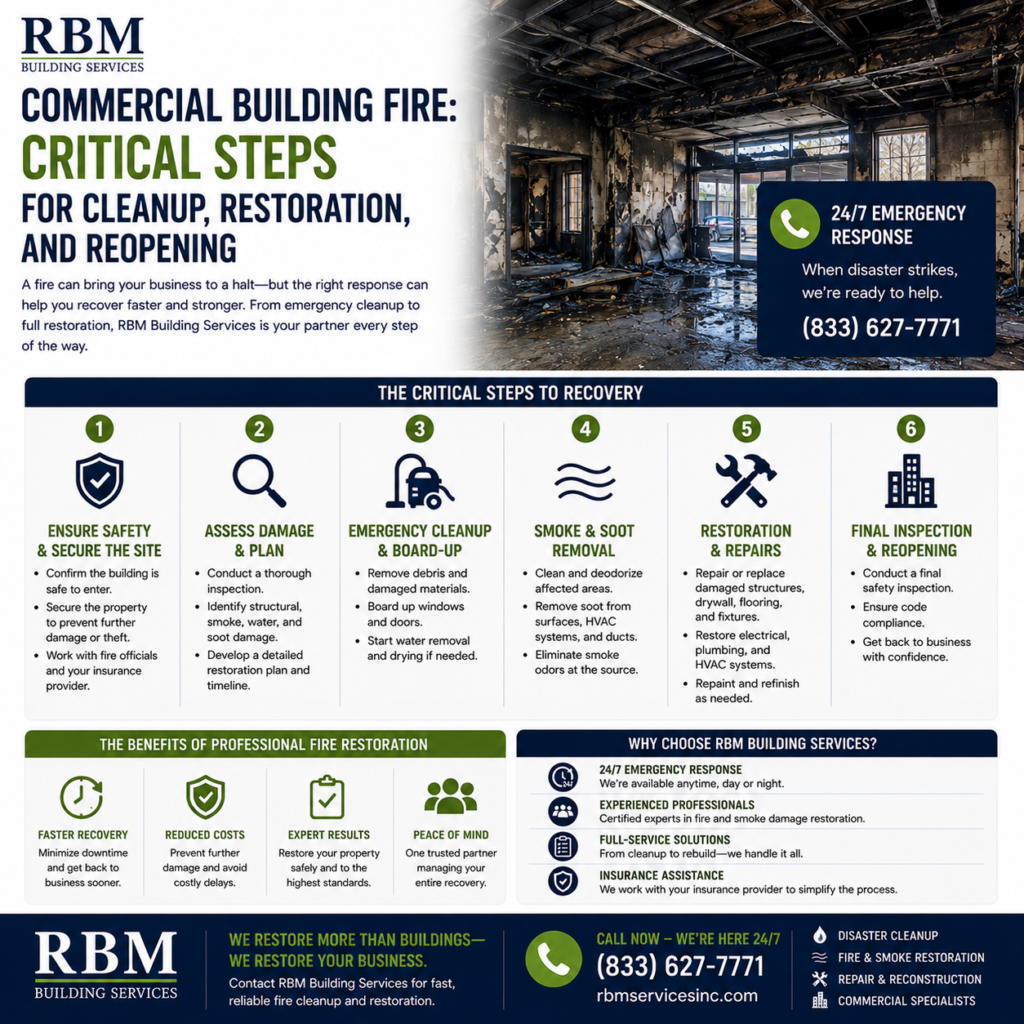
A commercial building fire is a devastating event that disrupts operations, displaces employees and tenants, and creates complex cleanup challenges. The process of cleaning, restoring, and reopening a commercial building after a fire involves far more than removing visible soot and debris. It requires systematic attention to smoke residue, water damage from firefighting, structural integrity, air quality, and documentation for insurance claims. The timeline, cost, and success of fire cleanup depend heavily on the speed and thoroughness of the response in the first 24-72 hours after the fire is extinguished.
This article outlines the complete process of commercial building fire cleanup and restoration — from immediate post-fire assessment through final deep cleaning and reopening clearance. Understanding this process helps property managers, building owners, and facility managers make informed decisions, coordinate with restoration professionals, and avoid costly mistakes that can extend downtime and increase restoration costs.

Immediate Steps After a Commercial Building Fire
The first 24 hours after a commercial building fire are the most critical for cleanup and restoration. Before any cleaning can begin, the fire department must clear the building for structural safety and the insurance adjuster must be notified. Once safe access is granted, the immediate priorities include: securing the building against unauthorized entry and weather exposure by boarding up broken windows, doors, and roof openings; assessing the type and extent of fire damage (structure, contents, smoke, water); documenting the damage thoroughly with photographs and written records for insurance purposes; establishing a command center for restoration coordination; and beginning emergency mitigation to prevent secondary damage.
Emergency mitigation is the most time-sensitive aspect of post-fire cleanup. Within 24-48 hours, soot and smoke residue begin to cause permanent damage to surfaces. Acidic smoke residues can etch glass, discolor metals, and stain porous materials like drywall, wood, and fabrics. Water from firefighting can saturate building materials, leading to mold growth within 24-48 hours if drying is not initiated immediately. The longer cleanup is delayed, the more extensive and expensive the restoration becomes. Professional fire restoration teams have specialized equipment including industrial air movers, dehumidifiers, HEPA air scrubbers, thermal foggers, and ozone generators that must be deployed within this critical window.
Understanding Fire Damage Types: Smoke, Soot, and Residue
Fire damage is not uniform — different materials burn at different temperatures, producing different types of smoke and residue that require different cleaning approaches. Understanding these distinctions is essential for effective cleanup. Wet smoke residue results from low-temperature, smoldering fires (typically natural materials like wood or paper). It creates a sticky, smeary residue that can be difficult to clean and often requires dry cleaning methods or specialized solvents. Dry smoke residue results from high-temperature fires (typically involving synthetic materials like plastics or petroleum products). It creates a fine, powdery residue that can be easier to remove but can also be more pervasive, penetrating deep into porous materials and HVAC systems.
Protein smoke residue results from cooking fires (kitchen grease) and leaves a thin, almost invisible film that discolors paint and varnish and creates a strong persistent odor. Protein residue requires specific cleaning agents and techniques. Fuel oil soot results from furnace puff-backs and creates a sticky, oily residue that is particularly challenging to clean. Each type of residue requires specific cleaning protocols, cleaning agents, and equipment. Professional fire restoration technicians are trained to identify soot types and select the appropriate cleaning methods — using the wrong method can permanently damage surfaces or set the residue, making it impossible to remove later. Learn more about our building maintenance and cleaning expertise.
Water Damage Mitigation from Firefighting Efforts
Ironically, the water used to extinguish a fire often causes more damage than the fire itself. Fire hose water can saturate building materials, create standing water in basements and lower levels, and promote rapid mold and bacterial growth. Commercial fire hoses deliver 150-300 gallons per minute, meaning even a short firefighting operation can introduce thousands of gallons of water into a building. Water damage mitigation must begin simultaneously with soot and smoke cleanup to prevent secondary damage.
The water mitigation process includes: extraction of standing water using industrial pumps and wet vacs; removal of saturated materials including carpet, padding, drywall, and insulation; structural drying using air movers and dehumidifiers placed strategically to create drying chambers; humidity monitoring to ensure drying is complete before reconstruction begins; and antimicrobial treatment to prevent mold growth in affected areas. Drying time varies depending on materials and conditions but typically takes 3-7 days for surface water and up to 2-3 weeks for structural moisture. Throughout the drying process, moisture levels must be monitored with moisture meters and recorded for insurance purposes. Cutting corners on water mitigation is one of the most common — and most costly — mistakes in fire restoration.
Smoke and Odor Removal: The Critical Path to Reopening
Smoke odor removal is often the most challenging aspect of fire cleanup and the most critical for reopening a commercial building. Smoke particles are extremely small (0.1-4 microns) and can penetrate deep into porous materials, HVAC systems, ductwork, and building cavities. If smoke odor is not completely eliminated, it can persist for months or years, making the building uninhabitable and significantly reducing property value. Professional smoke odor removal uses multiple complementary techniques applied in sequence, including thermal fogging, ozone treatment, hydroxyl generation, HVAC duct cleaning with sealant application, and encapsulation of porous surfaces.
Thermal fogging uses a heated fog machine to disperse a deodorizing agent that penetrates porous materials and neutralizes odor molecules at the molecular level. This is typically the first step in odor removal. Ozone treatment uses ozone generators to produce ozone gas that oxidizes odor molecules, effectively eliminating them. Ozone treatment must be done when the building is unoccupied because ozone is harmful to breathe. Hydroxyl generation is a safer alternative that produces hydroxyl radicals (the same molecules that purify the air outdoors) to break down odors without requiring evacuation. HVAC systems must be thoroughly cleaned and ductwork may need to be sealed with an antimicrobial sealant if smoke residue has penetrated the duct material. See our commercial janitorial services for post-fire cleaning support.
Structural Cleaning and Content Restoration
Structural cleaning after a fire addresses visible surfaces, building materials, and structural elements. This is a multi-phase process that begins with bulk debris removal (charred materials, destroyed contents, fire-damaged building materials), followed by HEPA vacuuming of all surfaces to remove loose soot and dust, dry cleaning of walls and ceilings using chemical sponges (dry cleaning methods are essential because wet cleaning can set soot into porous surfaces), wet cleaning using appropriate cleaning agents based on the type of soot present, and final HEPA vacuuming and damp wiping.
Content restoration — cleaning and restoring salvageable furniture, equipment, documents, and personal property — is typically handled by a separate restoration team and involves ultrasonic cleaning, dry cleaning, ozone treatment, document drying and decontamination, and electronics restoration. Not all contents can be saved; porous materials like upholstered furniture, mattresses, and cardboard typically cannot be fully restored after smoke exposure and must be replaced. The decision to restore or replace contents is made in coordination with the insurance adjuster based on the value of the contents, the extent of damage, and the cost of restoration versus replacement. For ongoing building maintenance after restoration, see our floor care and pressure washing services.
Final Deep Cleaning, Inspections, and Reopening Clearance
Before a commercial building can reopen after a fire, it must pass multiple inspections and meet specific standards. Structural inspections by a licensed structural engineer or the local building department must confirm that the building is safe for occupancy. Fire department inspection must confirm that fire suppression systems, alarms, and exits are functional. Health department inspection may be required for restaurants, food service, healthcare, and childcare facilities. Air quality testing must confirm that smoke-related contaminants have been reduced to safe levels and that mold has not developed as a result of water damage. Insurance inspection is typically required before the property is fully insured for occupancy.
The final deep cleaning before reopening is the most thorough cleaning the building will undergo — often more extensive than the initial construction clean. It should include cleaning and disinfecting all surfaces, HVAC system cleaning and filter replacement, window cleaning inside and out, floor cleaning and refinishing (stripping, waxing, or deep carpet cleaning), pressure washing of exterior building surfaces and parking areas, and final inspection with the restoration team and building owner to verify that all areas meet standards. This cleaning must be documented photographically for insurance and liability purposes.
Preventing future fires is the final phase of recovery. After experiencing a fire, building owners should conduct a comprehensive fire safety review including upgrading fire suppression systems, installing or upgrading fire alarms and smoke detection, implementing a fire safety training program for employees and tenants, updating the emergency action plan and business continuity plan, creating a fire recovery plan with pre-selected restoration vendors, and reviewing and updating insurance coverage to ensure adequate limits for fire damage and business interruption. Many building owners also choose to implement enhanced cleaning and maintenance procedures for areas with higher fire risk, especially kitchens, mechanical rooms, and storage areas.
RBM Building Services has provided commercial cleaning, building maintenance, window washing, pressure washing, and carpet cleaning since 1974 across Utah, Arizona, Nevada, and Texas. While fire restoration requires specialized contractors, we provide the deep cleaning and ongoing maintenance services needed after restoration is complete to bring your building back to full operating condition. Call 800.403.3564 or contact us to discuss your post-fire cleaning needs. For more insights, visit our company blog.
Navigate fire cleanup and restoration with professional help. Contact RBM.