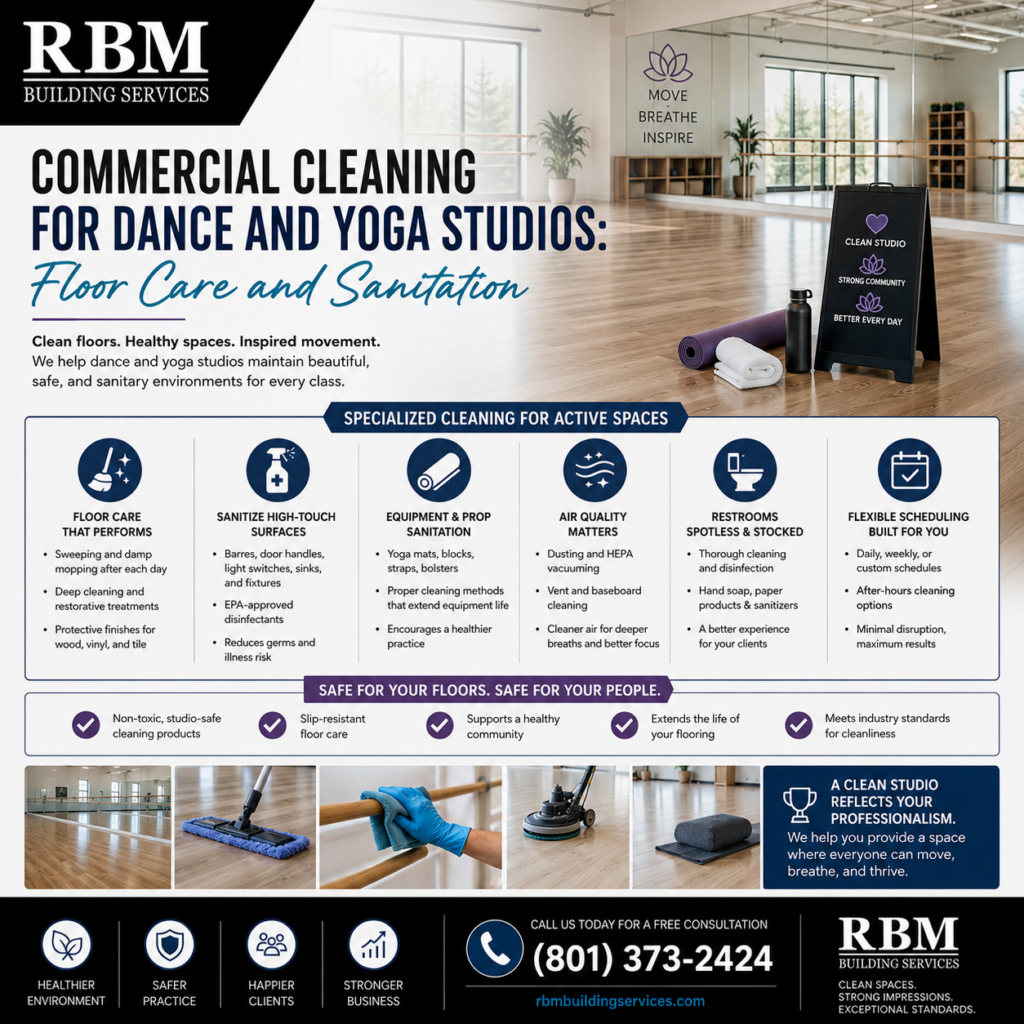
Dance studios and yoga studios require specialized cleaning protocols that address the unique demands of these active environments. Unlike standard commercial spaces, dance and yoga studios have clients exercising in bare feet or specialized footwear, coming into direct contact with floors and mats for extended periods. This creates specific hygiene requirements — floors must be clean enough for barefoot contact, mats must be sanitized between classes to prevent skin infections, and the overall environment must support health and wellness rather than detracting from it. Additionally, dance studio floors are specialized, expensive surfaces that require specific care to maintain their performance characteristics and warranty coverage. Marley floors, sprung floors, and hardwood ballet floors each have specific cleaning requirements. This guide provides comprehensive cleaning protocols for dance and yoga studio environments.
Dance Studio Floor Care
Dance studio floors are significant investments — a professional Marley floor system can cost $15-$30 per square foot installed, while hardwood sprung floors can cost $20-$50 per square foot. Proper cleaning and maintenance protects this investment and ensures dancer safety. Marley vinyl floors require daily dust mopping with a microfiber mop to remove dust and debris that can cause slips and wear on the floor surface. Weekly damp mopping with water or a manufacturer-approved floor cleaner removes embedded dirt without damaging the floor. Marley floors should never be treated with floor finish or wax, and harsh chemicals, abrasive cleaners, and solvent-based products should be avoided. Hardwood ballet floors require daily dust mopping, weekly damp mopping with a wood-safe cleaner, periodic buffing and recoating with appropriate floor finish, and full sanding and refinishing every 5-10 years depending on usage. Spung floors require careful moisture management — standing water should be removed immediately, and humidity levels should be maintained at 40-60% to prevent the subfloor from warping or losing its spring characteristics. Our commercial janitorial services include specialty dance floor care programs.
Yoga Studio Cleaning Protocols
Yoga studios have specific cleaning needs due to the nature of yoga practice. Students are barefoot, lying on mats, and often sweating, creating opportunities for skin infections and bacterial transmission if surfaces are not properly sanitized. Yoga studio floors should be cleaned and sanitized daily, with hard floors swept and damp-mopped with a disinfectant cleaner appropriate for the floor type. If the studio uses carpet or carpet tiles, HEPA vacuuming should be performed daily with periodic extraction cleaning. Yoga mats present the most significant hygiene challenge in yoga studios. Mats provided by the studio for student use must be cleaned and sanitized between every class. Studio-provided mats should be sprayed with an EPA-registered mat sanitizer (typically a diluted quaternary ammonium or alcohol-based solution) and wiped down after each class. Mats should be thoroughly washed with soap and water weekly and replaced when they show signs of wear. Prop cleaning includes cleaning blocks, straps, bolsters, and blankets regularly. Fabric props such as blankets and straps should be washed weekly (or more frequently in hot yoga environments). Hard props such as blocks can be wiped down with disinfectant wipes between classes. For yoga studio sanitation programs, see our commercial cleaning services.
Locker Room and Shower Area Cleaning
Many dance and yoga studios include locker rooms, changing areas, and shower facilities that require enhanced cleaning protocols due to the warm, moist environment and barefoot traffic. Shower and locker room floors are the highest-risk areas for fungal infections including athlete’s foot and plantar warts. These floors should be cleaned and disinfected daily with a fungicidal disinfectant. Shower walls and fixtures should be cleaned daily to prevent soap scum buildup and biofilm formation. Locker rooms should be cleaned and disinfected daily, with lockers wiped down and benches cleaned. Sauna and steam room surfaces require daily cleaning with non-toxic, pH-neutral cleaners that will not damage wood surfaces or react with high heat and humidity. Locker room ventilation should be maintained at 8-10 air changes per hour to control humidity and odors. Weekly deep cleaning of locker room areas should include pressure washing or steam cleaning tile and grout, deep cleaning of lockers inside and out, and treatment for mold and mildew prevention. Monthly maintenance should include grout inspection and repair, sealant application, and ventilation system inspection. Our building maintenance services provide comprehensive locker room and shower area cleaning programs for fitness and studio facilities.
Scheduling Cleaning Around Class Schedules
Cleaning in dance and yoga studios must be carefully scheduled around class times. Studios typically operate from early morning through evening with back-to-back classes, leaving limited windows for cleaning. Effective strategies include quick-turn cleaning between classes (5-10 minutes for floor spot cleaning, mat sanitizing, and trash removal), daily deep cleaning scheduled during the lowest traffic period or during studio closure hours, weekly deep cleaning during extended closure periods, and day porter service available during peak operating hours for spot cleaning and restroom maintenance. Communication between studio management and cleaning staff is essential — a shared digital calendar showing class times and studio usage helps cleaning staff plan their work efficiently. Many studio owners find that investing in a daily janitorial service with weekend deep cleaning provides the best balance of cleanliness and cost for their facility.
Additional FAQs
Can I use standard floor cleaners on dance studio Marley floors? No. Marley floors require manufacturer-approved cleaners. Standard floor cleaners, particularly those containing oils, waxes, or silicones, can damage the vinyl surface, create slippery conditions, and void the floor warranty. Always use cleaners specifically formulated for Marley or vinyl dance floors.
How often should yoga mats be replaced? Studio yoga mats typically need replacement every 6-12 months depending on usage frequency. Mats that show signs of wear including peeling, cracking, or areas that cannot be effectively sanitized should be replaced immediately. Hot yoga mats may need more frequent replacement due to increased wear from heat and moisture.
What cleaning products are safe for hot yoga studios? Hot yoga studios require cleaning products that are effective at high temperatures and high humidity levels. Choose fragrance-free, non-toxic cleaners that will not off-gas in hot conditions. Avoid products containing essential oils or fragrances, which can become overwhelming in hot environments and trigger respiratory reactions.
How do I prevent slip injuries on studio floors? Proper floor maintenance is the primary prevention. Clean floors before each class to remove dust and debris. Use appropriate cleaning products that do not leave slippery residues. Address spills immediately. Place absorbent mats at studio entrances. Maintain proper humidity levels to prevent condensation on floors.
About RBM Building Services: Since 1974, RBM has provided commercial janitorial, building maintenance, and studio cleaning services across Utah, Arizona, Nevada, and Texas. Call 800.403.3564 or contact us.